An adaptation of Kafka, brought forward to expose Canadian academic bureaucratic evil. Meet a pair of demons confers, Uncle Malfax and his dear demon nephew and new apprendice Smoldergut
If you believe in the importance of free speech, subscribe to support uncensored, fearless writing—the more people who pay, the more time I can devote to this.
Please subscribe to receive at least three pieces /essays per week with open comments. It’s $6 per month, less than USD 4. And now take 50% off.
Everyone says, "Hey, it’s just a cup of coffee," but please choose my coffee when you come to the Substack counter. Cheers.
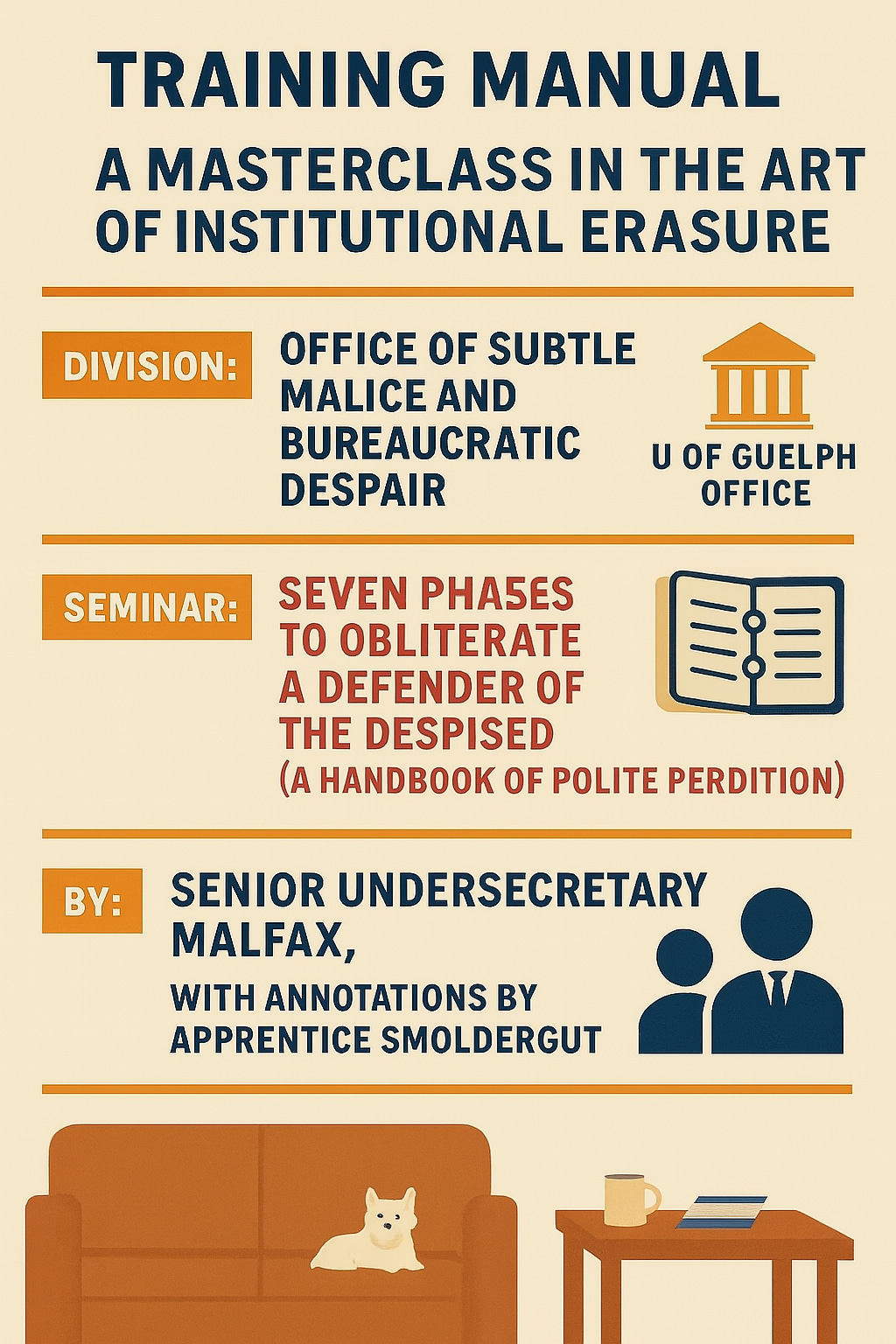
Training Manual: A Masterclass in the Art of Institutional Erasure
Division: Office of Subtle Malice and Bureaucratic Despair. U of Guelph Office.
Seminar: Seven Phases to Obliterate a Defender of the Despised (A Handbook of Polite Perdition)
By: Senior Undersecretary Malfax, with annotations by Apprentice Smoldergut
Narrator’s Foreword: Consider this a dispatch from the beige bowels of institutional hell, where the soul is smothered not by fire but by forms, where evil wears a lanyard and sips decaf. If Kafka and Hannah Arendt had a lovechild, it would be this: a seminar on how to ruin a man without spilling a drop of blood, all while chirping about “wellness.”
Our target? A professor who dared call Hamas Nazis and stand with Israel. Our method? A Kafkaesque trial, minus the goose-stepping, but with a generous side of schadenfreude. Buckle up, dear reader—this is bureaucracy as black comedy, and the punchline is despair. —P.F.
Scene Setting: The Seminar of Shadows
The room is beige. Not the existential beige of a hospital corridor, nor the cosy beige of a suburban sofa, but the default beige of a bureaucracy that forgot to care. The walls hum with the sterile buzz of fluorescent lights, stained where posters once preached “Together We Thrive.” Now, only their ghostly outlines remain, like gravestones for hope.
No desks. No chairs. Just a wobbly plastic table buckling under a broken speakerphone and three binders: “CONFIDENTIAL,” “DO NOT READ,” and “TRAINING MATERIALS.” A flip chart looms, veiled in grey, promising revelations.
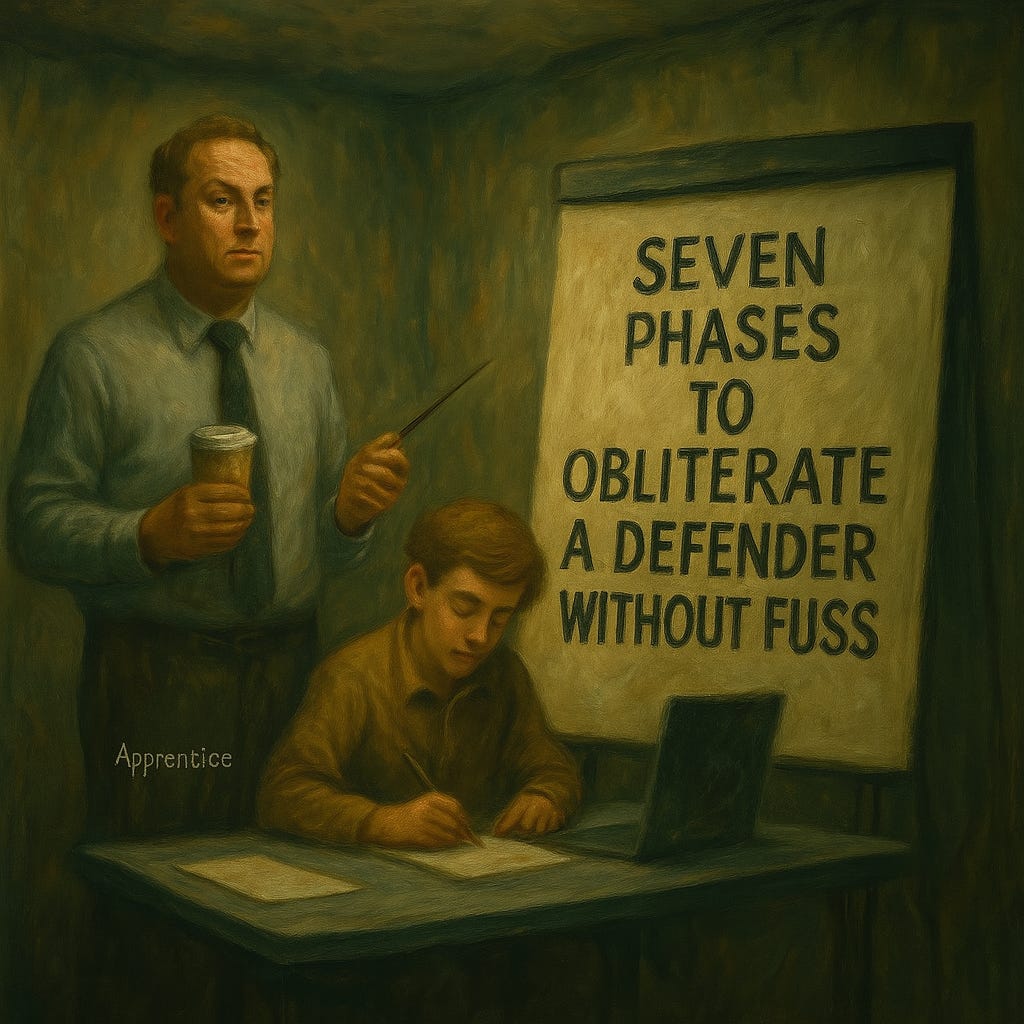
Malfax, Senior Undersecretary of the Academic Office of Subtle Malice and Bureaucratic Despair, stands at the front, clad in business casual. His powder-blue shirt is wrinkled just enough to feign humanity, the knot on his tie is too tight for a man with his sleeves rolled up. He stands, one hand on a tepid decaf, the other fondling a laser pointer he’ll never use. A monitor, with its red light indicating it is powered up, faces forward.
Smoldergut, his nephew, perches on an ergonomic stool. Clutching a clipboard, he scribbles with the zeal of a demon auditing souls for an infernal MBA. No brimstone here, no claws—just toner’s faint whiff and the rustle of sealed envelopes. This is bureaucratic academic hell: banal, meticulous, terminally polite. The room is airless, just one window, the shade almost pulled down, timeless. Tuesday or Armageddon? Who cares.
Malfax clears his throat.
“Smoldergut, my smouldering cinder, welcome to the art of erasure,” he purrs, adjusting his collar with a smirk. “We call it ‘employee lifecycle optimisation’ now—HR loves a euphemism.”
He giggles, a sound like paper shredding. “No fiery pits, nephew. Zoom calls, and auto-replies, and you, if you listen to the bugs, you might hear them chanting Cousin Jeremy’s 1mantra: Peace, peace, when there is no peace.”
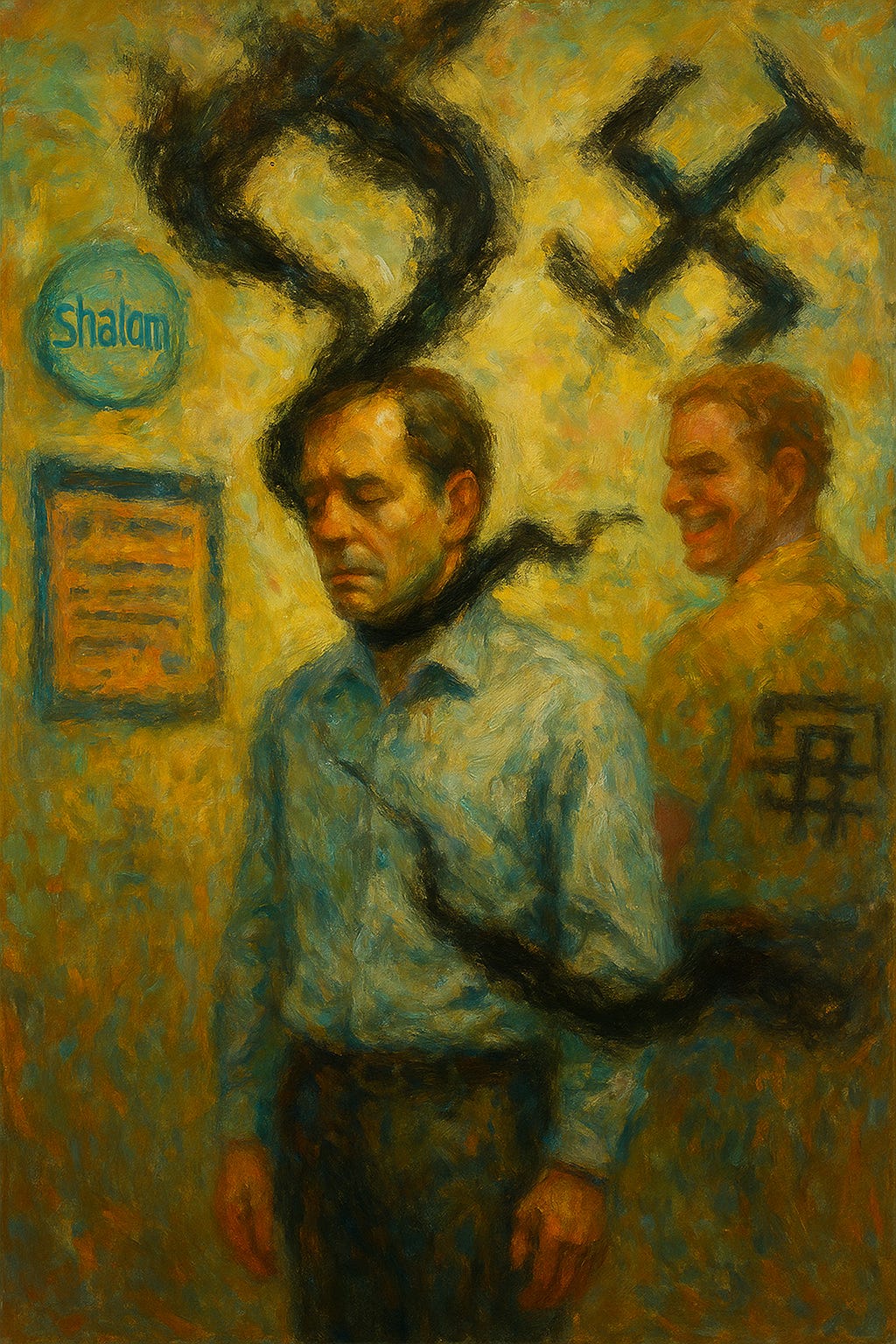
Malfax continues, “Our target: a professor, a fool who speaks truths about Israel, calling Hamas what it is—Nazis reborn. A defender of the despised, Smoldergut, and thus a problem. His colleague, Zebadiah, a venomous wretch whose hard drive brims with Jew-hate—cursing Israel, calling Jews “filth”—is our sacred cow, untouchable by bureaucratic fiat. Our mission: banish the truth-teller, make him a pariah, while the university’s drones pin “Shalom” badges to their Zoom backgrounds and chirp about “mental health.”
This is no vendetta. It’s a masterclass in bureaucratic evil—thoughtless, bloodless, the kind that ruins lives while muttering peace, peace, when there is no peace.
Malfax unveils a flip chart.
Seven Phases to Poison a Workplace and Erase a Defender Without Fuss.
PHASE ONE: Arrest by Ambiguity
We begin, Smoldergut, with an arrest—not with handcuffs, but with a memo. Suspend the professor mid-semester, during finals’ chaos, when students are zombies and faculty phantoms. No charges, no explanation—just a letter: “You are suspended until further notice. ‘Do not contact anyone from the university, past, present, or future.’ Signed? Not a name, but a title: Director, DEI and Wellness Dreams.
Irony is our aperitif.
Yes, ban him from campus. Threaten to arrest him if he comes near his office. This is facelessness, nephew—no one owns the order, yet it’s done. Accountability? A myth. A department can’t be sued, can’t be shamed.
Smoldergut broods: “Why gag him? No charges, no accusers.”
Malfax snapped his fingers. “The point? There is none. Gagging severs bonds between students, colleagues, and janitors. Separation is the broth before the stew. Soon, they whisper: He’s gone? Suspicious. Humans crave closure, Smoldergut. A void begs a lie.”
Malfax points at the monitor, which comes to life.
“Cue Vice President Bland, our Kafkaesque clerk in a blazer, her mail-order PhD framed beside intern-cribbed speeches.”
Bland murmurs, “He’s finished,” and smiles.
“What is finished?” Smouldergut says.
Malfax nods, “Exactly, you see, Smouldergut, confusion festers, and pretension fogs, and humans, scrolling their phones, love the fog—it lets them avoid guilt. They chant peace, peace, when there is no peace, mistaking words and labels for truth.
Malfax pushes a button on the remote to change the view.
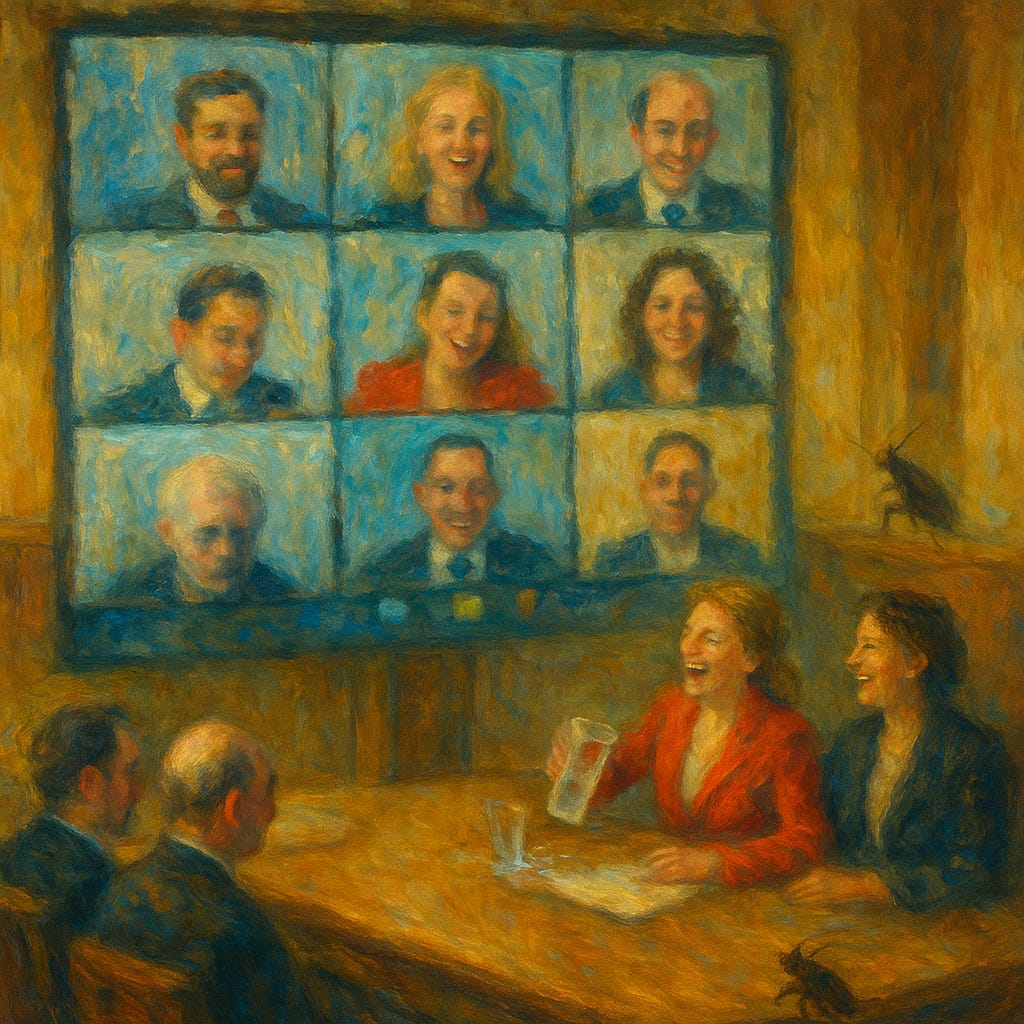
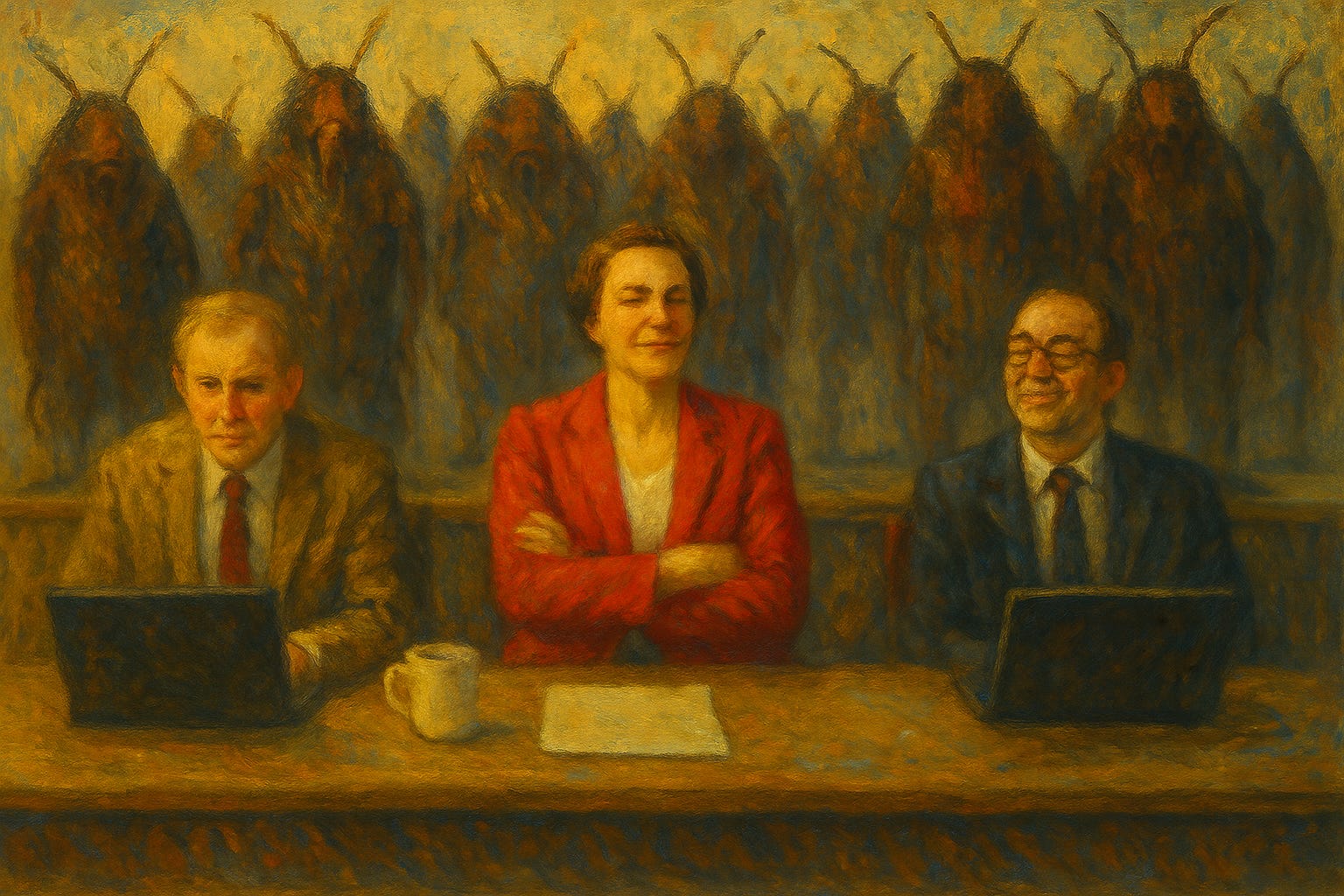
The professor sees bugs, cockroaches, a little taller than the humans, but better dressed. They are Kafkaesque horrors oozing and sliding down hallways, but no one looks up. He shakes in revulsion.
“Moral blindness, nephew, Malfax quips. “They’re too busy swiping. They never see our friends, pointing to the roaming bugs, all wearing khaki pants and Tommy Hilfiger golf shirts.
Smoldergut’s note: No charges? Too blatant?
Malfax’s reply: Blatant? Of course, subtle gossip trumps facts. A blank page invites darker and darker lies.
PHASE TWO: The First Whisper of Defamation
“Next, Smoldergut, we summon the court of whispers—quieter than a priest’s alibi and twice as oily - Zebadiah, our hate-fueled zealot, spreads rumours: our decent professor is ‘violent,’ and... “
He pauses. “This is grotesque, granted, he calls the professor a safety threat to children,” which is, of course, a sly wink at calling him a paedophile, a criminal. Remember the trick, imply in a whisper, so it is so forever clear, but it wasn’t said, never “pedophile”—too gauche.”
“Innuendo is our venom,” he pauses, enjoying the sound of his insight. “Zebadiah’s fifteen daily posts—Jews as ‘filth,’ Israel’s ruin, his blood and holocaust libels, his death fantasies—are our script. No one checks his record; it’s tedious. Bland shields him, another court official hiding a file. Lies fester and ooze and spread.”
“If the professor protests, threaten ‘process.’ Why is he upset? He must be guilty. Gossip mutates, and a fortnight by dusk, he’s a monster—claim ‘thousands of complaints’ - all manufactured,” he snickers.
“In 2025, fact-checking is a chore. This is defamation by murmur, responsibility vanishing like a memo in the archives. PhDs nod, mistaking degrees for virtue, joining the hate while still muttering peace, peace, when there is no peace. They confuse assertion with truth and think using the word ‘fairness’ sanctifies lies. And they are always blind to the bugs’ hissing truths; only the professor sees.
Smoldergut’s note: “What if the lies unravel?”
Malfax’s reply: Unravel? They’re too busy scrolling. Whisper on, and they’ll buy it. But hate is the enemy of reason. Someone consumed with hate is more foolish than a child. Remember your schooling. You must remember that years ago, our beloved Goebbels dropped by to say that if you repeat a lie enough, it will always be believed. Have faith, young demon.
PHASE THREE: The Manufacturer’s Lesson in Bureaucracy
“Enter a new player, Smoldergut—a ‘consultant,’ Malfax says. They nod solemnly, fingers ‘crimping’ in the sacred rite of academic sarcasm—those twitching little quote-marks that signal moral superiority while saying nothing at all.
This is Dr. Quill, a retired dean with a corner office and a knack for explaining the unexplainable. He tells the professor: “The system’s not broken—it’s built this way. It’s not a defective justice machine; it’s a highly tuned injustice machine.
Appeals? They’re filed, not read. But they exist! We created something and gave it a proper name so that they wouldn't lie, but of course, they do. Hearings? The same, Bad theatre.”
Quill’s not cruel, just resigned, a cog who’s seen the machine grind too many into paste.
This phase deepens the professor’s dread. Quill reveals Bland’s power: her position in the academic org chart, soul-sucking and unwanted, makes her untouchable. How do people whose ability and worth are no more than a set of sharp elbows rise so?
When the professor cries, Bland sighs, “What’s he on about?” Violations hide in emails: “Your case is under review. Have a lovely day!” She kills with a smile, thoughtless, muttering peace, peace, when there is no peace.
“The professor may plead, ‘I’m cast out, let it end, ’ and Bland will not blink, while she will show her ‘Mental health awareness week button’ to a colleague. On the monitor, the bugs hiss around her, but she’s scrolling; she misses them again.”
Smoldergut’s note: “Won’t someone report her?”
Malfax’s reply: Report to whom? The system is the court, and Bland is its clerk. Apathy, combined with a healthy dose of self-interest, is forever our ally.
PHASE FOUR: The Silence and the Schadenfreude Whispers
“The whispers in the faculty lounge turn sour. Colleagues smirk, relishing the fall; jolts of schadenfreude pleasure wash across their faces. The good professor had been too popular,” Malfax says, pointing at the monitor. Listen to her.“
“He thought he was so great,” an old woman in the staff room sneers.
“Ignore the professor’s emails, pleas, and pleas for help. Silence is unpunishable. If he protests, he’s “trouble.” If he’s quiet, he’s guilty. Silence lets hate bloom, and humans love it. The power of schadenfreude is not the joy of seeing the mighty fall; it is the joy in seeing others’ pain.”
“So we amplify schadenfreude, Smoldergut,” says Malfax matter-of-factly.
“Colleagues whisper, ‘He’s under investigation? Ooooh.’”
“His absence is guilt, his silence proof. They scroll through his old tweets, hunting for justification. If he speaks, he’s “harassing.” If silent, “hiding.” Imagine the power when we tell staff not to respond to him, to forward his emails to a dead email address, buried in a mouldy corner of HR. “
Gutty furrowed his brow, confused.
“Think, dear Gutty! What kind of monster is so toxic that every word he speaks is poison, toxic, like the most deadly plant, where even a faint brush of the arm leaves it red and painful?” Malfax explains.
“But did they call him a monster? They whispered it, and it is a wonder, for hateful actions beget hateful thoughts, and they will grow in their hate for him; he may cry out in innocence, seeking just a word of kindness from a community, but even one word from him makes them hate him more. He has become a toxic weed; it is glorious, isn't it? And who can accuse anyone of malice? They were just protecting the staff. Whispers are hidden, silence is not malice. “
“Meanwhile, we weaponize the Human Rights Office,” Malfax said, flipping the chart.
Our demon teams script complaints, inflate numbers via radical groups—hundreds of thousands, none genuine. Gossip becomes gospel, the mob feasts, chanting peace, peace, when there is no peace.
The professor’s sin? Truths about Hamas. We morph him into a bigot. Or a ‘racist’, a word that has such defamatory power,” Malfax pauses, climbing a crescendo, breathes and continues, “than a thousand libraries full of evidence.”
Malfax put his hand on the monitor, groping for a rhetorical flourish.
“So every move damns him, because their joy demands it. Feed a rumour: ‘Say police are involved.’ Even if they mean they copied the police on an email for no reason at all, such half-truths are so much better than lies. If you plant even a tiny mustard seed of accusation, it will grow; you just need to have faith in your sorcery.
Malfax leaned against his desk.
“You don’t need to shout; whispers work better. Slip them in like arsenic in tea. ‘Should I be worried?’ they ask, never checking to see if what they said is true; they say to themselves, all gossip has a trace of truth, but it doesn’t.
Humans say that because they savour the juicy morsels of their slander. Naturally, it is their hunger that drives their appetite.”
“They know that truth might spoil the fun. They rehearse his funeral: “He had it coming,” they smirk.
“And there are never tears, just HR-approved sighs,” Malfax laughed, pointing at the monitor.
More bugs were banging on drawers in the faculty lounge, and they giggled as the two secretaries not working from home snuck out the side door at 3:15.
Smoldergut’s note: “Why does absence damn?”
Malfax’s reply: It lets them paint the monster. And they don’t know our professor; he has not been human since he left. He is a caricature, a negative vibe, a childish sketch, coloured a little too dark with schadenfreude.
PHASE FIVE: The Hearing Looms
The “disciplinary hearing” looms—a Zoom farce where guilt is prewritten, where justice is not blind but bored. The investigator finds him guilty of everything: violence, hate, threatening, bad posture—no evidence, witnesses. Appeals? Unread.
One verdict of guilt has the complainant denying the words ascribed to him. Still, the investigators take Zebadiah's word, who claims the complainant said it; it’s princely madness, sanctifying hearsay over the first speaker. No one checks; why would they? - Guilt was decided when the first words were spoken.
“One appeal goes to the investigator himself, a circular routing, the dog returns to its vomit, so that someone can claim it ‘moved.”
Another is sent to Bland, who sits muttering “Discipline” under her breath like a bureaucratic mantra, or a pervert reciting poetry to a mirror as they masturbate.
She knows the word is terminal—’ discipline’ is always code for dismissal—but it comes lacquered in plausible procedure: we had a hearing.”
“And so the poor man is made to speak while knowing his words are dust. Reason has as much effect on the unreasonable as a fire alarm does on the deaf.
“You had a hearing,” they chirp, though the judge was the prosecutor, and the jury was friends with the prosecuter. “You had a defence,” though none of his documents were ever read. “You had an appeal,” though everyone was routed, rubber-stamped, and ritually binned.”
“It is not justice. It is the ceremony of justice, hollowed out and sold back to the accused as mercy. And it always wins the gold star of deviltry,” Malfax said, pausing with pleasure.
“Gutty, remember these words: appeal, process, defence—we make them not actions but relics, holy-sounding labels nailed to nothing.
They serve as indulgences for the pious frauds who wield them—just enough to soothe a flicker of guilt before they return to their inbox. And in that sacred moment of self-exoneration, they desiccate their conscience a little more—until it’s no more than a communion wafer of righteousness, thin, tasteless, and already dissolving on the tongue of cowardice.”
Malfax continued, “And if they are still troubled, they can post mental health memes, and again, they are assured their hearts are golden.”
Malfax laughed as he closed the drapes on the only window, removing the soft yellow light it had left on the floor. “Yet they ruin lives without guilt,” he said. “Remember, guilt means they care a little, Smoldergut, and care’s absent in Zoom’s glow.
“Guilt is so churchy; they have a new religion, it is sympathy, but it is just a thin layer over their irrationally inflated self-regard.”
Smoldergut’s note: “They don’t care?”
Malfax’s reply: Care? They think care is picking wellness emojis.
PHASE SIX: The final Pokemkin signage is nailed down.
“The hearing is our coup, Smoldergut—a pageant where justice is a pixelated myth. The workplace believes the verdict because questioning is hard; following a prescribed verdict is easy. Truth? Fairness? They only use them in memes, if ever.”
“They’re not stupid, just apathetic—and only outwardly concerned with how they appear to their colleagues, and if they are appearing to voice the newest mental health bromides, they are afraid of seeming ‘insensitive.”
It’s not overt antisemitism, but the coward’s kind, the good kind, the whispered slight in public, the drunken bile at home. This anti-Semitism is the kind that can last and grow and infect,” Malfax said, swirling the tepid dregs of his decaf. It is hard to fight what you can’t see.
“It is better than the screaming, masked hoodlums on the street with their ‘go back to Poland’ and the ‘yes, police officer, two creams in my coffee,” he smirked. “They lack discretion.”
“Of course, everyone knows the hearing is checking a box, like separating your recycling. Unions shrug, management nods, colleagues scroll. One panellist reads off his notes with a savage insincerity, “How’s your mental health?”
The professor grimaces and begins to speak, “Well—”
But the inquisitor cuts him off, impatient: “We might want to wrap this up. It’s my wife’s birthday, so I don’t want to get in trouble with her. The boss lady . . .”
The two other panellists give a quick, awkward nod.
Two more bugs in khakis have entered; they hiss, but the panellists miss them, each caught up in their phones.
The professor turns off his Zoom, and Malfax tilts the screen up to show the panellists packing up.
One clears their throat in mocking sarcasm: “What do we do with him?”
Another jests: “Let him off—I was moved!”
The panellists laugh genuinely, one black-haired woman in a red pantsuit, cackling a bit too loudly as she tips over her mug, which she stands up, thankful it was not filled.
“Who’s sending the termination letter?” she asks.
“Got a template,” the short, swarthy-looking man replies, smirking. “I wrote it before the hearing.”
Laughter slaps the walls. A cockroach in a white polo scuttles by.
“Don’t forget the courier,” the red pant-suited woman says, removing her lanyard.
“And our bonus—the union didn’t show. No severance. Fund the retreat!”
“Private rooms?” asks the swarthy man.
“Confirmed,” she nods, satisfied and proud to be the boss.
“Thank you, professor!” she says, throwing her words randomly into the air. She places her unopened notebook into her expensive briefcase, then adds, as if punctuating the farce:
“The retreat’s theme is resilience, mental health, and workplace kindness.”
Even Malfax flinches. He turns to Smoldergut, eyes narrowed.
“Sanctimony,” he growls and gags, “is the sweetest beverage to the one creating it—but it is insufferable to all others. It is the lie that tells itself it is love.
Even we demons find it evil, nephew. It is a false virtue weaponized, smugness with a halo, the sugar coating on cowardice. When they say ‘kindness’ while flaying a man alive, that is sanctimony.”
He pauses, glaring at the screen. “And she means every word.”
“He’ll probably kill himself,” she mutters under her breath, to no one in particular, as she gets up to leave. “It would be a good riddance,” she hisses.
Smoldergut’s note: Why no guilt? She could outdo any demon here. Having no conscience is valuable in management.
Malfax’s reply: Guilt needs care. And these creatures no longer care—they outsource it, like their ethics. They gave up guilt when they found the comfort of slogans.
PHASE SEVEN: The quarry of erasure and a learning summary
So, our masterpiece, Smoldergut: strangers hated the professor on sight—a whisper—“Did you hear?”—sufficed.
He’s a smear, an unpleasant file in the archives. The mob called it justice. Silence is guilt; speech, defiance. I do not use my words intemperately, nephew; the workplace is poisoned. Zebadiah thrives, Bland prospers, the truth-teller is erased.
“Hypocrisy, those are our roaming bugs, Smoulder, you understand?”
Smoulder nods as the lesson comes together in his mind. He understands.
“And shunning is the key; it is so non-confrontational, and remember what Jeremy said, peace, peace, etc. The key is to get them never to respond.”
But how does it end?” Smouldergut asks.
Malfax nods to the screen.
The professor gets the termination letter via a courier. A slender envelope, cream-coloured. A whiff of sulphur as he pulls it out. Inside: a single page, laser-printed, bureaucratically bloodless.
It begins, of course, with that most Canadian of daggers: “We hope you are well.” Then: “Thank you for meeting with us. On behalf of the panellists, we appreciate your time.”
The Judas kiss:
“But in light of your serious human rights violations and reprisal and harassment, we have decided to terminate your employment immediately.”
“Look here, Smouldergut,” Malfax croons, “it’s a masterpiece of cowardice. Simple assertions, from beginning to end - no evidence. When it is this vague, you don’t need evidence - they can’t have it, for even the bowels of their subconscious know he is innocent.
But assertion combined with sanctimony is enough; the sanctimony ensures there is no doubt, no self-examination, just a steady march forward. It is perfection.”
The letter continued.
“We wish you the best in the future.”
Malfax laughs. “ The best! It is precious, it is the smile to the bereaved, the padded noose at the hanging, the crisp white cloth at the bottom of the wicker basket on the ground beneath the guillotine.”
Malfax points to the monitor and rewinds it, struggling with the remote, “Look at their faces, Gutty. They are telling themselves, " We handled this with compassion. My Lucifer that is hideous.”
The professor folds the letter quietly and returns it to the envelope. He throws the envelope on the brown leather couch, and his young Westie, looking for attention, jumps up and sits on the envelope.
Postscript: Yet He Stands
Malfax’s Notes.
They thought he was done. But the professor didn’t beg, curse, or weep. He stood. He said nothing; they grasped. But he stood. In conscience’s unlit corners, after bonuses fade and bugs scatter, he repeated: “I stood with Israel. I called evil by its name. You fired me, but I did not break.”
“My father would have been proud; our name was not dishonoured.”
And still, he stands—unbent, unclaimed, unanswered. The silence they mistook for defeat was, in fact, defiance— a refusal to toss pearls to swine. Somewhere beyond the reach of their paperwork and pretence, his convictions hardened.
Let the slogans march and the lies multiply, let them stamp and sign and sanctify—but he was proud, he had not stepped aside and, as the Russians say, the lies had not gone through him.
He stood. And still, he stands. He will move forward.
If you found value in this article and wish to support my ongoing work, especially during my 18-month suspension, please consider leaving a tip. Your support helps me continue producing uncensored content on critical issues.
It is very clever, but very long. The last sentence is the most important. As a person who has spent too many hours reading, discussing and obsessing about the situations in Israel, and with world Jewry, I want to ‘move forward’ to a position of standing strongly by my beliefs without expecting others to share them. Yes, much of the media, most countries and entirely too many individuals take the side against Israel, against Jews, and thus, against me, but I want to read, think and write about other subjects. I want to forgive those who believe differently, especially when they are family and friends. I want to reduce my consumption of digital content. I want to devote my hours and days to changing the things I may actually be ABLE to change, not to devote my days and hours to ‘preaching to the choir’.
I have reached a point where it is better for my mental health to concentrate my efforts on creating and following new and constructive paths. I have already reached outside the Jewish community, and will continue to do so, to make my presence as a Jew known, to display my mezuzah and wear my Magen David.
I want to spend more hours experiencing the beauties of nature and the arts, the wonders of my six very different grandchildren. To revel in my pride in my own two children, what they are accomplishing in their personal and private lives. To cherish and maintain my health so that I may do all of the above for a long time. I want to learn more about myself.
I want to learn the art of having silly fun. To revel in discovering new places, new aspects of the human condition, new ways to interpret Beethoven, new artists and authors. To hang out with people who make me laugh, to get cozy with the dog. To support in return those people who have done me the honor of loving me.
Wishing you all the best, Paul, in refining and then accomplishing YOUR goals. You are immensely talented as a writer. It is time to take that in new directions, to leave the past behind, to find new and fascinating subjects to write about. I hope you will make it possible for me to read the results when that happens. I know they will be brilliant. All the best!
The issue is the legal fight is just heating up. I need to just trust the lawyers and not think about it. The topic of bureaucratic evil does interest me though.











It is very clever, but very long. The last sentence is the most important. As a person who has spent too many hours reading, discussing and obsessing about the situations in Israel, and with world Jewry, I want to ‘move forward’ to a position of standing strongly by my beliefs without expecting others to share them. Yes, much of the media, most countries and entirely too many individuals take the side against Israel, against Jews, and thus, against me, but I want to read, think and write about other subjects. I want to forgive those who believe differently, especially when they are family and friends. I want to reduce my consumption of digital content. I want to devote my hours and days to changing the things I may actually be ABLE to change, not to devote my days and hours to ‘preaching to the choir’.
I have reached a point where it is better for my mental health to concentrate my efforts on creating and following new and constructive paths. I have already reached outside the Jewish community, and will continue to do so, to make my presence as a Jew known, to display my mezuzah and wear my Magen David.
I want to spend more hours experiencing the beauties of nature and the arts, the wonders of my six very different grandchildren. To revel in my pride in my own two children, what they are accomplishing in their personal and private lives. To cherish and maintain my health so that I may do all of the above for a long time. I want to learn more about myself.
I want to learn the art of having silly fun. To revel in discovering new places, new aspects of the human condition, new ways to interpret Beethoven, new artists and authors. To hang out with people who make me laugh, to get cozy with the dog. To support in return those people who have done me the honor of loving me.
Wishing you all the best, Paul, in refining and then accomplishing YOUR goals. You are immensely talented as a writer. It is time to take that in new directions, to leave the past behind, to find new and fascinating subjects to write about. I hope you will make it possible for me to read the results when that happens. I know they will be brilliant. All the best!
The issue is the legal fight is just heating up. I need to just trust the lawyers and not think about it. The topic of bureaucratic evil does interest me though.