



- No paywall -
When someone dies by suicide, the tragedy does not end with them. What remains is a lifetime of questions carried by the people who stay.
This essay will not help my ranking as a humorist. Some subjects simply refuse the company of humour, and suicide is one of them.
The subject is not entirely abstract to me. I was adopted away as a baby, and only later learned that I had a half-brother in my biological family who had taken his own life. I never met him. By the time I discovered he existed, he was already gone. The knowledge sits somewhere in the background of my thoughts—an unfinished story I only learned about after its final chapter had already been written.
When someone ends their own life, the tragedy does not end with them.
Something else begins—a quiet aftermath that spreads through the lives of the people who remain. It arrives not with spectacle but with silence, and that silence stays.
Families live with questions that never receive answers.
Did I miss something?
Could I have said something differently?
Was there a moment—small, ordinary—that mattered more than I knew?
I often think of a friend who remained in my life well into adulthood, Greg—now gone these eleven years. He once told me about a night that never really ended for him. His father gathered the family, and they went out together, searching—driving, walking, calling—for his brother, who they feared had taken his own life. At that moment, he had not. There was still, perhaps, the fragile illusion of time.
But time, as it does, closed in. And later, they found him. He had gone to the Winnipeg floodway, put a dryer hose over the exhaust pipe and killed himself with carbon monoxide poisoning.
Greg carried that story with him always—not loudly, not in a way that asked for sympathy, but like something embedded beneath the surface. It did not heal cleanly. It did not resolve.
It was a ragged sorrow, unfinished and unfinishable, sitting just behind the ordinary movements of life, returning at odd moments without warning.
Greg lived fully. He laughed, worked, showed up and moved forward as people do. But that absence—what had happened, and what could never be undone—remained with him. Not as a constant presence, but as something that never truly left.
This is what lingers.
Not only grief, but a permanent uncertainty. A quiet, enduring question that does not yield to time or reason.
It doesn’t disappear. It settles into the background of a life and waits there—surfacing in quiet moments, in memories, in conversations that never quite reach the thing itself.
And so the question remains, not as accusation, but as something closer to a reflex of the human mind when faced with the irreversible:
Did I miss something?
Should I have called that night?
Was there a moment when the story might have turned in a different direction?
Grief in these circumstances can never be simple. It becomes tangled with guilt, confusion, and the persistent suspicion that somewhere in the ordinary traffic of life, there was a fork in the road where events might have changed.
The cruel irony is that many people who take their own lives believe, at that moment, that nobody would care if they were gone. They believe they are a burden. They believe their absence might even make things easier for others.
It does not make anything easier. It fractures things.
An empty chair appears at a dinner table, and no one quite knows whether to mention it. Old messages are reread with the faint hope that some warning sign might reveal itself in hindsight. Parents grow older with the quiet and terrible suspicion that perhaps there was something they should have done differently.
The silence that suicide leaves behind is not peaceful. It is heavy.
None of this should be understood as a condemnation of the person who was suffering. Those who reach that point are often in profound pain. They may feel unloved. They may feel humiliated, abandoned, or treated cruelly by people who should have shown them kindness. They may feel that the world has simply closed its doors.
That suffering is real.
But suicide does not end pain. It redistributes it.
The suffering that one person can no longer bear is passed, quietly but permanently, to the people who remain. And for them, it often becomes a different kind of torment: the lifelong psychological torture of unanswered questions.
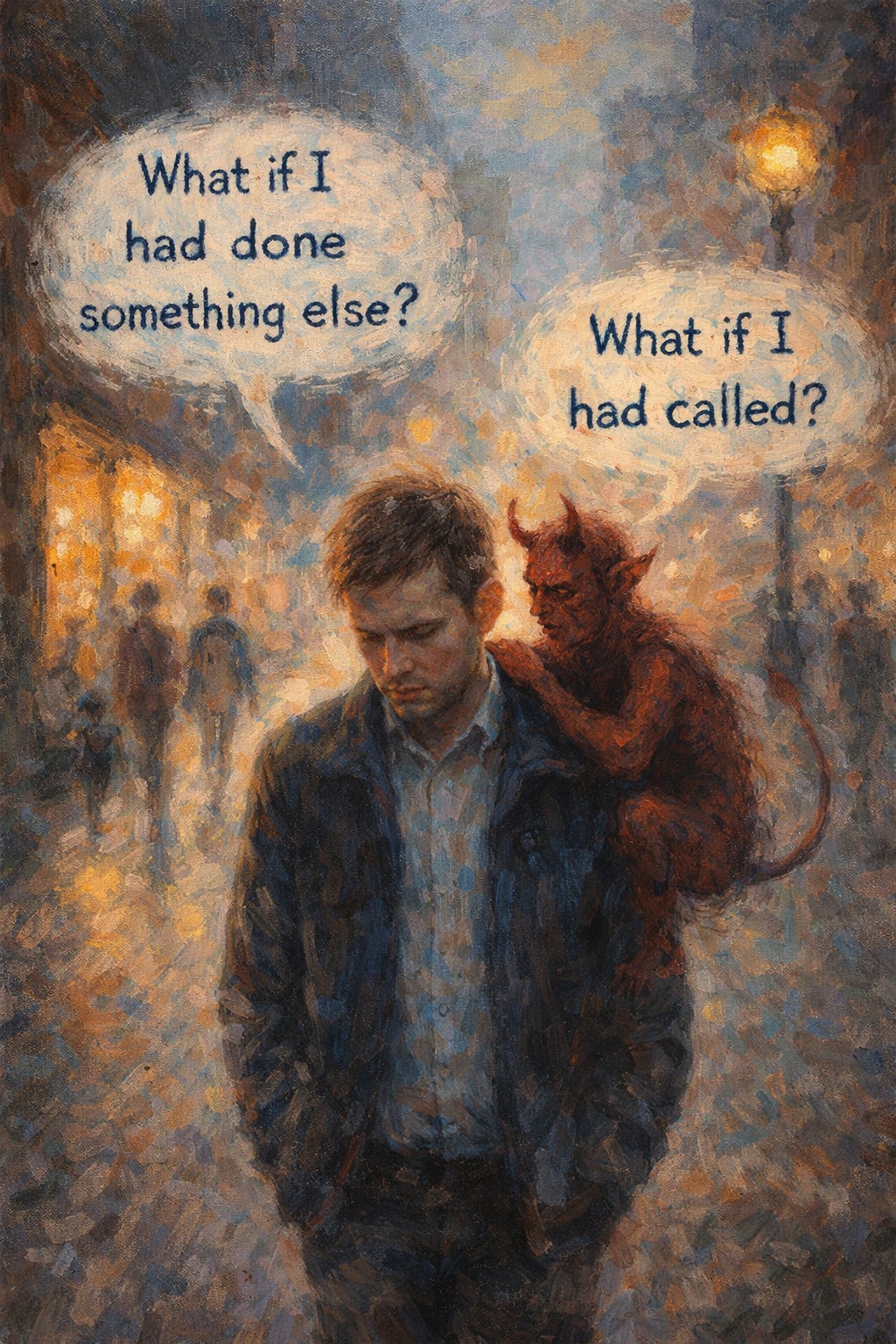
Could I have stopped this?
Did they know that I loved them?
Was there a moment when the future might have been rescued?
These questions echo for years.
And yet there is another truth that deserves to be said plainly: the belief that nobody cares is very often wrong.
There are people who would answer the phone. People who would sit beside you in uncomfortable silence. People who would listen without judgment.
But reaching them sometimes requires a sentence that can feel almost impossible to say.
“I’m not okay.”
If you are reading this and standing close to that edge, please pause for a moment and consider something that despair often hides: the cost that suicide leaves behind. The pain does not disappear when a life ends. It spreads outward into the lives of those who remain—parents, siblings, friends, children—who may carry the unanswered questions for the rest of their lives.
If you can, speak to someone before that moment becomes irreversible.
In Canada, help is available right now. You can call or text 988 to reach Talk Suicide Canada, where trained counsellors are available 24 hours a day. Their only purpose is to listen and help you through the moment.
You do not have to face that darkness alone.
For everyone else, the lesson may be quieter but no less important. Look more carefully at the people around you. Ask the extra question. Send the extra message. Sit a little longer when someone seems troubled.
Because the tragedy of suicide is not only the loss of a life that ends.
It is the lifetime of echoes that remain.
And if you are standing on that edge tonight, please remember this: the people who stay would rather carry your pain with you than spend the rest of their lives carrying your absence.
If this essay resonates with you, please consider sharing it. Someone you know may need to read it.
May I add that I used the Suicide Hotline 50 years ago in a moment of desperation. Being able to share my predicament and desperation did not solve my problems but was a pressure valve release that gave me the strength to carry me forward until I could escape my predicament. Fast forward 45 years and I became a volunteer on the Suicide Helpline.
A good 40 years ago I had to visit the family of a friend who committed suicide to tell them what I knew. The mother was in so much pain she cried that she could ‘kill’ her daughter. The suicide came as a complete shock to almost everyone except me. My friend was suffering from Bipolar Disorder and at times couldn’t get out of bed and could barely speak. She begged me not to tell anyone because she feared the stigma would affect her career. Long story short, she chose to end her life at a time when I was out of the country, after reassuring me she had exciting plans with her boyfriend and as a result of my urging had sought psychiatric help. My job, as I saw it, was to explain to the family that she was suffering terribly, wasn’t in her right mind and in no way intended to hurt them or make them suffer. I shared that she feared becoming like her uncle, who suffered with bipolar disease and saw knowing nods. Yes, the pain suffered by the survivors of a loved one’s suicide is terrible. But in the majority of cases I suspect the act is NOT done to harm loved ones but as a desperate belief that it is the only way to end their unbearable suffering.