


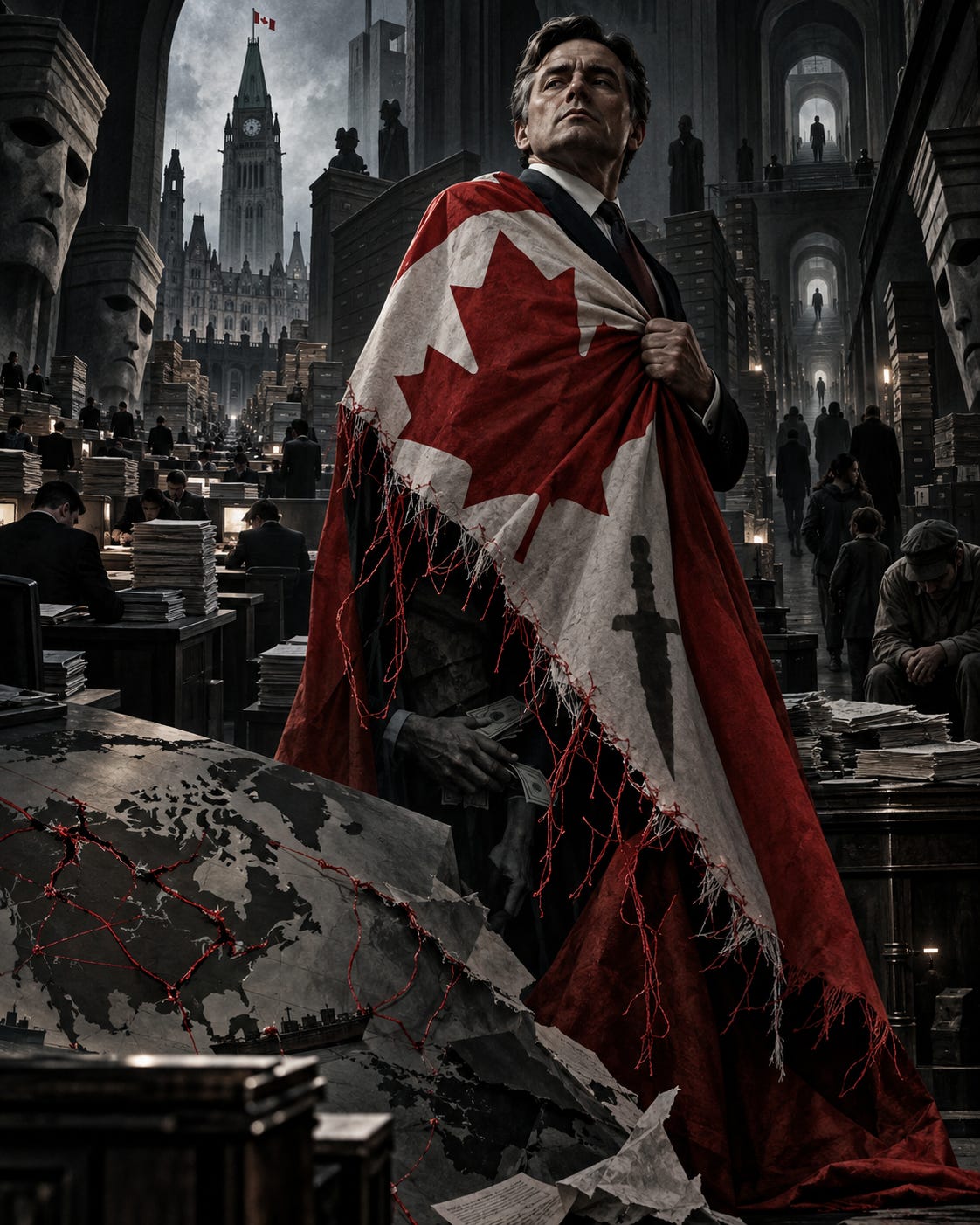
Mark Carney is on a roll.
Canadians are hearing that he is the adult in the room, the sophisticated fellow who arrives triumphantly to protect the country from Donald Trump. The Liberal Party is in full-time gloat mode, and X is full of polls crowing about the electorate’s infatuation with Carney, and how Carney is bravely standing for all of us and confronting the orange southern bear.
Much of the Canadian press appears taken in. But hold on - before we conclude that public enthusiasm equals Carney being wise or right, we need to look at history.
When we do, it ought to make us significantly more humble.
Neville Chamberlain returned from Munich in 1938 proclaiming “peace for our time” and was greeted by a rapturous public. Britain desperately wanted peace, and Chamberlain was popular because the alternative was terrifying. It did not make his policies wise. Within a year, Britain was at war, and the errors of the 1930s would sadly be paid for in Russian, British, Canadian, and American blood.
This is not to compare Donald Trump with Adolf Hitler or Mark Carney with Chamberlain. It is to make the much simpler observation that any current public approval of Carney is not proof of sound judgment.
Iran offers another warning. Ayatollah Khomeini returned in 1979 to immense popular enthusiasm. People assumed his revolutionary promises would bring purification, justice and national renewal. Intellectuals outside Iran fell in love with the old bearded man and millions inside Iran initially supported this revolution.
The result was not the liberal emancipation many dreamed of; what came was an authoritarian theocracy whose repression continues nearly half a century later.
Mao offers an even darker lesson. When millions were mobilized around his political vision, policies associated with the Great Leap Forward and Maoist rule left 70 million dead.
Again, Carney is no Mao, no Khomeini and no Hitler. That is emphatically not the comparison. The lesson is about us. Human beings are very capable of embracing ideas whose costs have not yet arrived. The applause comes first. The bill comes later.
Churchill is said to have said, “The best argument against democracy is a five-minute conversation with the average voter.”
My prediction is that Canada is living through one of these false dawns. I believe that within a few years Mark Carney will be regarded much differently from today - indeed, I think there is a real possibility that history will judge him as one of Canada’s most damaging prime ministers: a man who persuaded Canadians that he was defending their sovereignty while leading them into an economic and geopolitical experiment they scarcely understood.
That is why I increasingly think of him, provocatively but deliberately, as the Canadian Benedict Arnold. He is betraying the average Canadian for his own hubris and ambition.
I am not accusing Carney of treason in any legal sense. I use Benedict Arnold as the metaphor he has become: the symbol of betrayal. My contention is that Carney is betraying Canadian interests while successfully branding himself as their defender.
The Demagogue in a Banker’s Suit
Carney’s demagoguery - a condition where leaders appeal to the people’s emotions and resentments and not reason - is unusual because it is technocratic rather than theatrical.
Carney does not scream into microphones. He does not pound podiums. He does not present himself as an angry populist. He presents himself as precisely the opposite: the sober expert, the adult among children, the former central banker armed with credentials, graphs and a superior grasp of the world.
Canadians have seen this show before, just in another country.
When Mark Carney arrived at the Bank of England, the response to his appointment was rapturous, bordering on parody. Britain bought the brand: the sober, intellectual technocrat, the rock-star banker.
The infatuation did not last. He hinted that rates might rise sooner than markets expected, then quickly backed off, and a British MP dubbed him an "unreliable boyfriend." His interventions on Scottish independence, Brexit and climate led critics to argue he had distorted the Bank's cherished independence, and even a sympathetic biographer concluded his legacy was more conventional than his advocates believe. He was accused of being “startlingly dishonest.”
The pattern his critics kept seeing was a gap between polished words and delivered results. Canada is now repeating the mistake. We have fallen in love with the packaging and still haven't opened the box, like a child thrilled by the wrapping who never looks at what's inside.
We should not confuse style with substance.
The traditional demagogue is an alchemist: he identifies an enemy, stokes resentment, turns disagreement with the leader into disloyalty to the nation, proposes emotionally satisfying remedies, minimizes their costs and wraps himself in patriotic symbolism.
Carney is doing essentially the same thing. He dresses well, loves to get his photographer and put on a hockey jersey, and shows up frequently on my X feed with vapid inanities like “Canada Strong” and “Canada is worth fighting for.”
From Friendship to Hostility
What makes this particularly disturbing is what it puts at risk.
Canada and the United States did not merely have a trading arrangement. We have developed one of the most extraordinary relationships between neighbouring countries in modern history. Indeed, we share the world’s longest peaceful international border. We jointly defend this continent through NORAD. We are NATO allies. Canadians and Americans fought together in two world wars.
Our businesses, families, universities, energy systems and manufacturing industries are intertwined.
When the United States closed its airspace after September 11, 2001, Canadians opened airports and homes to thousands of stranded passengers at Gander, NL.
Generations of Canadians have wintered in Florida and Arizona. Americans vacation here and enjoy our lakes and mountains. Families straddle the border. Goods cross it millions of times every year. Electricity, oil, gas, automobiles and components move through economic systems that were built on the assumption that this relationship would endure.
Donald Trump did not create that relationship, and Donald Trump does not own it. Donald Trump is a blip in our long history.
Yet increasingly Canadians are being encouraged to behave as though Trump and America are the same thing.
I saw a sad but revealing example recently while reading a Winnipeg Jets discussion about goalie Connor Hellebuyck and possible trades for him, as he has decided he is done with Winnipeg. It was hockey. It should have had virtually nothing to do with international politics.
Yet comment after comment descended into anti-American vitriol and howling Trump hate.
We have seen Americans booed at sporting events and American symbols treated with contempt. Whatever one thinks of Trump, directing anger at ordinary Americans is classless, strategically stupid and profoundly un-Canadian.
Two wrongs have never made a right.
Leadership ought to cool that impulse. But Carney benefits politically from inflaming it, and so he does so.
He mocks Trump's "accordion hands," then jokes that he hopes Trump won't bomb us over it, and his popularity rises even as the economic risk to Canada rises with it.
Only in Canada does a leader gain support by doing things that hurt the country's economy. Rallying around the flag delivers a brief dopamine rush, but a public that can't separate rhetoric from action, that cheers the swagger and never checks the trade numbers, ends up applauding its own economic self-harm.
Trump Is Not America
Trump can post absurd AI pictures at three in the morning after his 13th Diet Coke. He can make insulting statements. He can indulge the foolish 51st-state rhetoric. He can adopt protectionist policies that are economically destructive.
None of this changes history or geography.
Donald Trump will eventually leave office, but the United States will still be there.
Even after the deterioration in bilateral trade, 71.7% of Canadian merchandise exports went to the United States in 2025. That was down from 75.9% in 2024, but it remains an extraordinary concentration.
Again - administrations change, but geography does not.
That ought to be engraved above the desk of every Canadian prime minister.
The Relationship We Cannot Replace
There is an enormous difference between diversifying Canadian trade and replacing the United States.
Canada should diversify. Of course it should. We should sell everything we can to Europeans, Asians, Latin Americans, Africans and the Gulf states. But we have been working on achieving that for years; it is not a new idea.
But diversification supplements geography. It does not repeal it.
The United States offers Canada advantages we have forgotten, advantages that China and Europe cannot reproduce: immediate proximity, inexpensive land transportation, pipelines, integrated electrical grids, broadly compatible legal and commercial systems, common language, cross-border labour, huge capital markets and manufacturing supply chains constructed over generations.
A truck leaving Ontario can reach an American customer the same day. Rotterdam requires an ocean and a container-filled carrier.
The latest exercise in political salesmanship is the new $500-billion foreign direct investment headline from Carney’s investment summit.
Foreign direct investment includes the purchase of our debt; it includes American companies buying ours; the number is more dishonest political spin, more Carney half-truths, more distractions designed to keep our eyes off real numbers that matter.
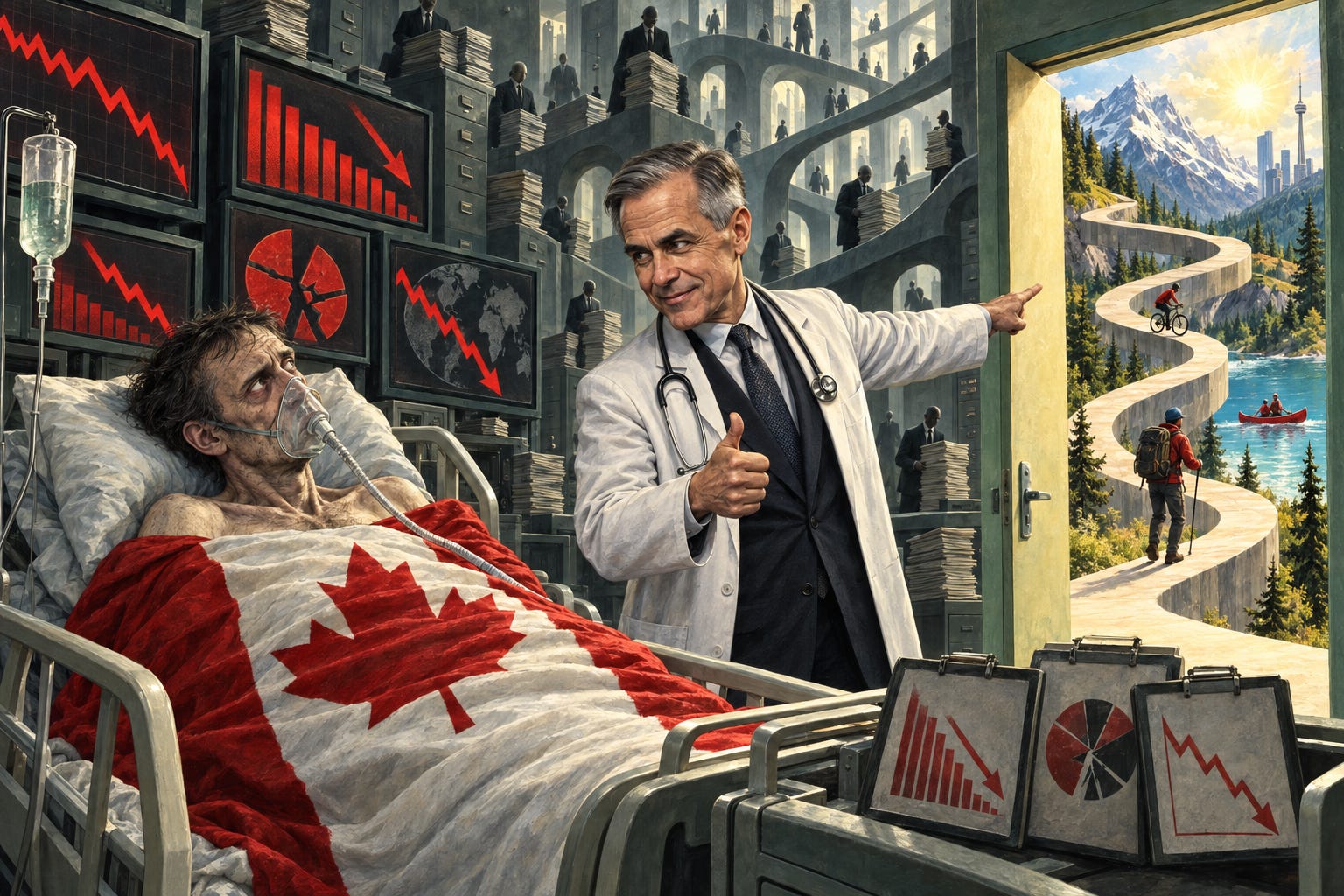
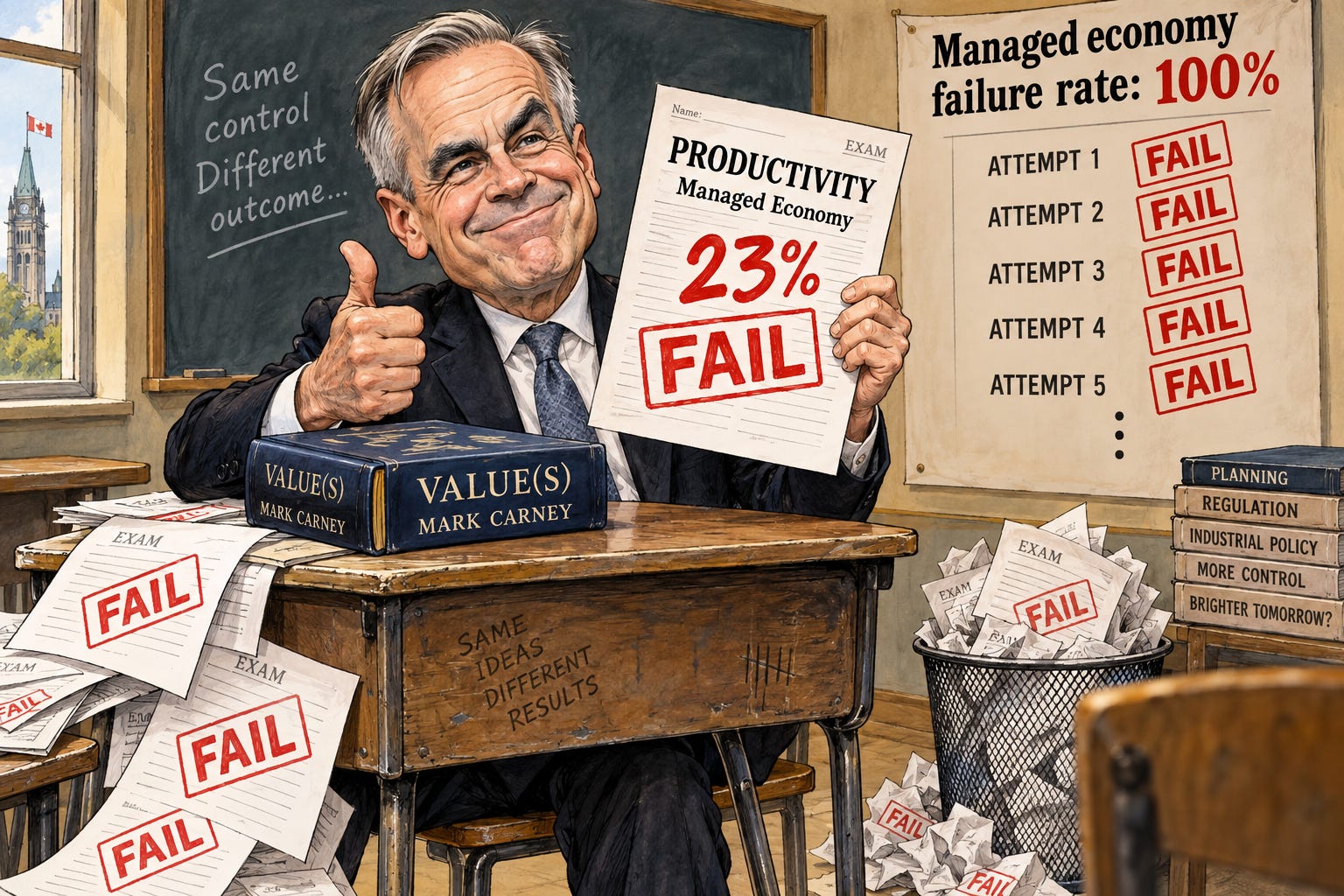
The real numbers are frightening: our per capita GDP is falling, our productivity is in the toilet, and our per capita income has actually declined over the last three years and stagnated since 2019. The gap in per capita GDP between the average American worker and a Canadian has grown from approximately $10,000 in 1999 to over $ 23,000 today.
Canada’s economy is like a sick man who is being told by Dr. Carney that he is well enough to run a marathon, lift hundreds of pounds and work two jobs.
But if you listen to Carney, you’d think that free trade outside the US was invented by the Liberals and that Carney already had single-handedly negotiated billions of dollars of trade between private companies.
Might we keep some sense of scale and reality about how business and trade work?
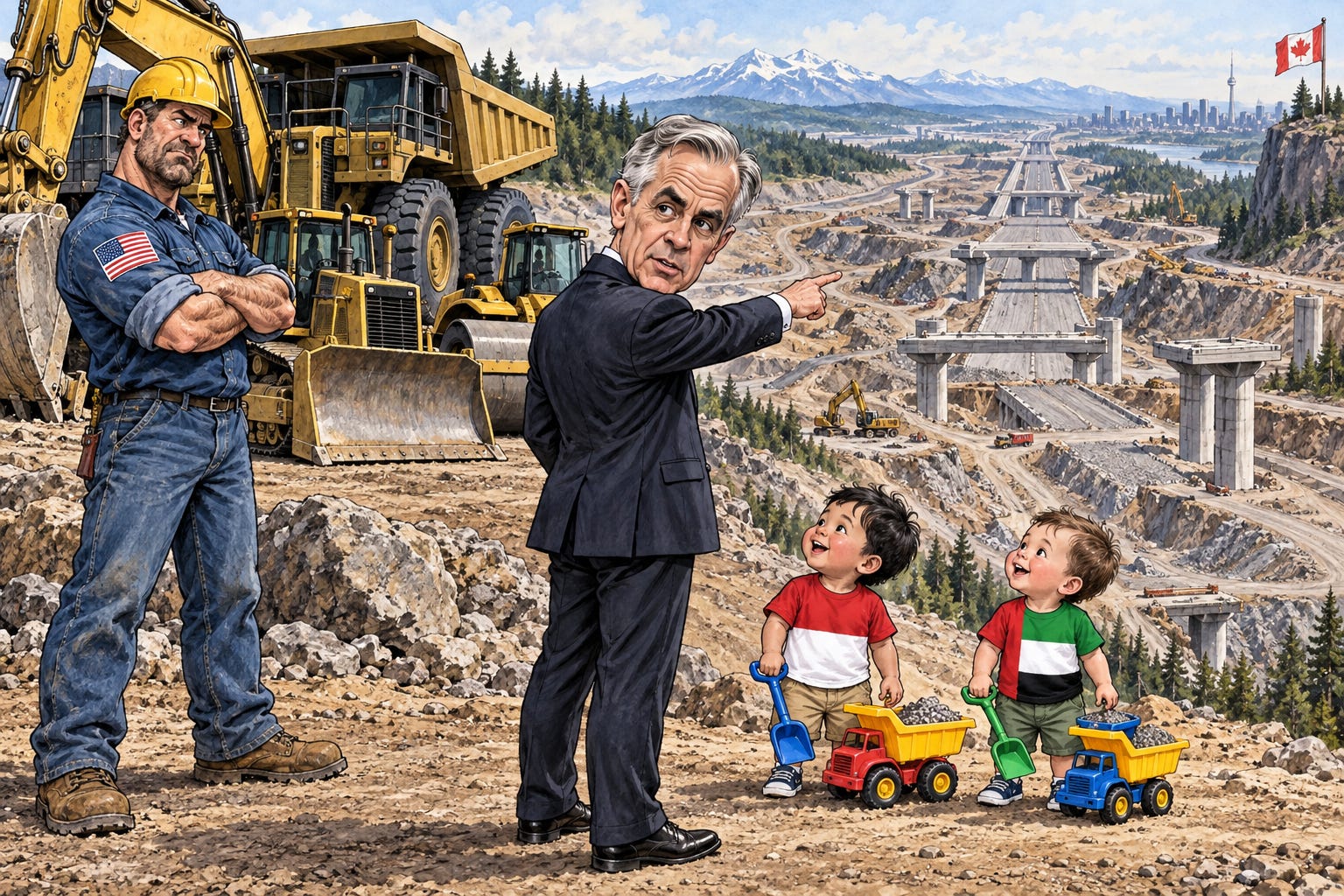
No trade agreement with Indonesia changes where Detroit is.
No agreement with the UAE moves Houston farther away.
We are being encouraged to confuse talking about adding useful markets with replacing an irreplaceable one. We are pretending that trade deals are something other than deals between private companies.
Why Did Carney Walk Away?
On August 21, Carney ended the latest round of U.S. trade negotiations, saying Washington had introduced last-minute demands that were “unfair” and “uneconomic.”
Okay, Mark, but “because Trump is really mean” is not an explanation.
“Trust me, I can’t give you the details, but we needed to take a hard pass on this,” is not an acceptable answer when the economic relationship at stake involves hundreds of billions of dollars.
What precisely were the demands? What had the United States offered? What did Canada counteroffer? Unacceptable provisions?
Which provisions were unacceptable? What did Finance Canada estimate the breakdown would cost in investment, GDP and employment?
Why only silence?
Notice, too, what Carney has not done. He has not recalled Parliament to explain a decision worth hundreds of billions of dollars. He has not tabled a single document, briefing note, or dissenting memo. He offers no accounting, only atmosphere: the Americans were unreasonable, trust me, stand tall, Canada strong.
That is not a policy. It is a hymn. A prime minister confident in his reasons puts them on the record and defends them under questioning; a prime minister who prefers the applause to the audit sends out a slogan and calls it leadership. The refusal to explain is not a detail beside the decision.
Increasingly, it looks like the decision's actual content.
Did Carney walk away because the optics of presenting himself as the brave leader, wrapping himself in the flag, and defending the nation against the Orange Bear's predation were political gold?
Did it have nothing to do with economics and everything to do with political optics and ambition?
“Silence. Trust me. I’m Mark Carney. Trump is bad. I am your leader.”
Is our democracy supposed to operate on the assumption that the prime minister is so intelligent that the rest of us need not see his work?
Retaliation Is Not Free
Another childish, emotional idea is taking hold: that retaliatory tariffs are Canada “fighting back,” as though tariffs were punches delivered exclusively to foreigners.
Tariffs are holding a gun to our own head.
A tariff on an imported product raises its Canadian price directly or encourages substitution toward a more expensive alternative. Domestic competitors can also raise prices. Businesses using tariffed inputs face higher costs.
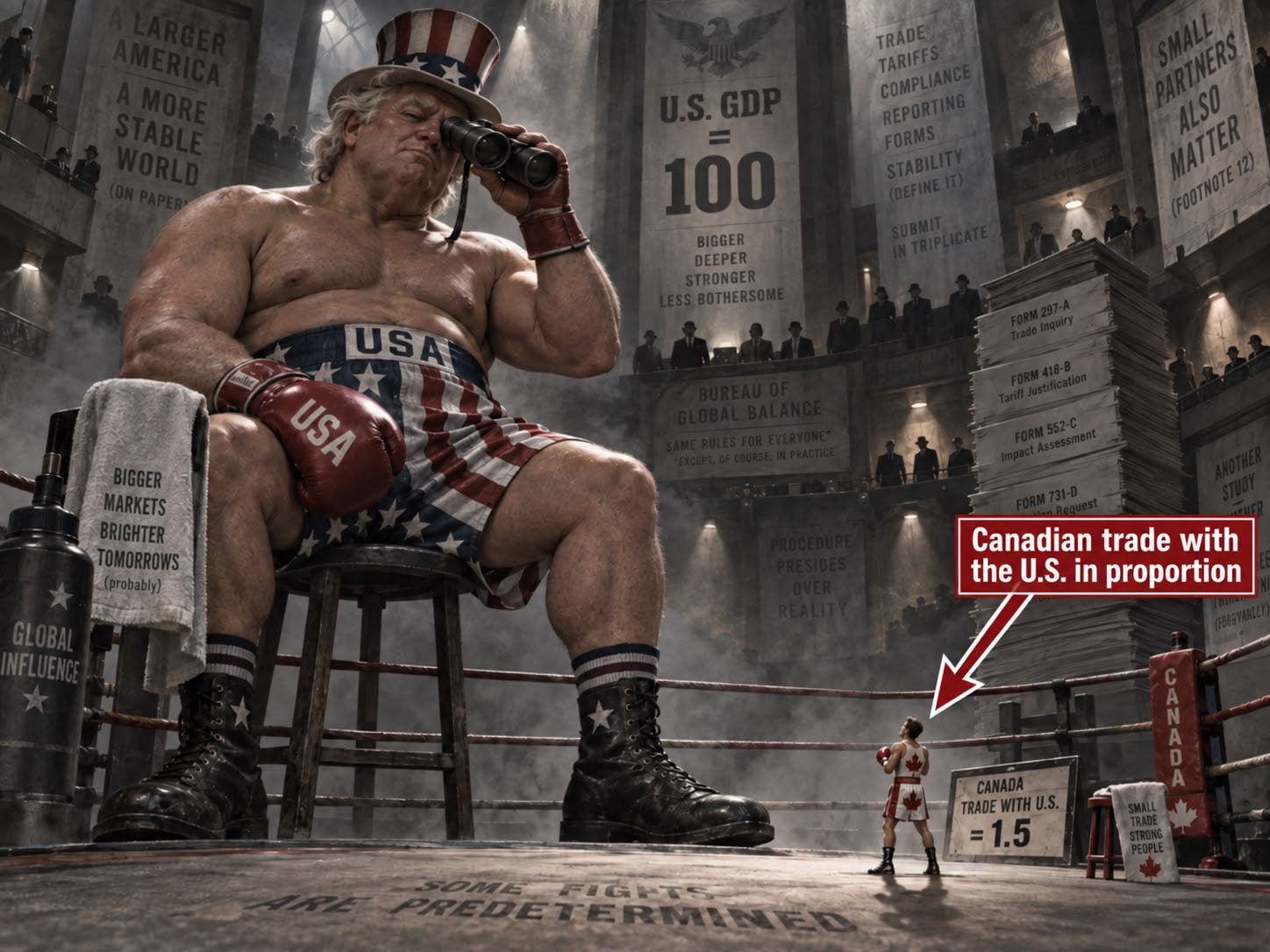
Can retaliatory tariffs create negotiating leverage? Against a trading partner that is 11 times our size? Not likely. But it feels good. Our trade with the US is 1.5% of their GDP. But listen to Carney, and you’d think that he believes we can bring the US to its knees. It’s absurd, unrealistic, destructive but effective; it’s a form of delusional group therapy, and the nation can’t get enough.
Everything Is Trump’s Fault
One of the great conveniences of an external enemy is that he can be blamed for problems he didn’t create. It’s been used by dictators, thugs and authoritarians since the start of recorded history.
Canada’s economic problems long predate the present dispute with Washington. And they have nothing to do with Trump.
Trump did not create Canada’s productivity problem, nor weak Canadian business investment. The housing crisis? Nope. Our insane non-skill-based immigration policy. Our university/college student immigration pathway that someone forgot to cap and monitor. Can’t blame Trump for that. Interprovincial commerce. Did you see Trump putting up his hand blocking a truck at the Saskatchewan border? Did Trump stop a worker from pursuing their trade in a different province because of mindless regulatory impediments?
Nor did Trump set Canadian marginal income tax rates at 53% and make corporate taxes higher than our southern neighbours. An insane regulatory system? No, again and again. It is all on us. Did Trump tell us to make 46% of our industry protected from competition? Did Trump force us to bloat the federal payroll to the point where one in every five workers works for the government? This costs the average non-Canadian in taxes, but of course those federal workers know which side their bread is buttered on and vote overwhelmingly Liberal.
Yet externalizing our failures is a seduction, not an accident. Blame Washington enough, and Ottawa is absolved before it's even accused. Resentment, for the professional politician, is the one resource that replenishes itself with use.
A scapegoat is politically useful precisely because he prevents introspection.

Mark Carney Is Not a Free-Market Liberal
Yet another remarkable achievement of Carney’s branding - and surely Carney is the most skillful marketer that has ever stood (albeit rarely) in the House of Commons - is the notion that because he was a central banker, he must therefore be a conventional free-market liberal.
The secret here isn't a secret; it just reflects a populace that won’t read.
In his book Values, Carney described a “crisis in values” and argued that “radical changes are required” to create an economy serving wider social objectives.
He is not arguing that markets should simply be left to allocate capital according to those overly chatty price signals.
He says that market outcomes must be subordinated, in important areas, to politically established values and objectives. Guess what that means? Carney says he is smarter than the market.
Carney implies that all of us little people in the real economy who buy, sell and make trade-offs shouldn’t be listened to; Mark will tell us what parts of the economy should get taxpayer gifts and what parts should be left alone.
He is wise. Unfortunately, this “I’m smarter than the market” is one of those tests humanity keeps failing, yet keeps saying it will pass next time.
This Is Not About Changing Coffee Shops
There is something almost bourgeois about the symbolic sacrifices being celebrated. Carney’s strongest supporters are rich, retired female boomers. They paid for their homes at 25% of what they go for now; they have indexed pensions, OAS and topped-up RSPs. Of course they are happy with Carney.
They are willing to sacrifice; they will say:
“Don’t go to Starbucks. Buy your coffee from a Canadian shop. Vacation in Canada. Buy Canadian whisky.”
Fine.
But that is not what serious economic restructuring means.
Real economic damage means the plant does not expand. It is the investment that moves south.
It is the raise that never arrives or the pension that is never offered to the new employee. It is the family whose mortgage becomes harder to carry or the young couple that remains renters. It is the worker who discovers that “economic sovereignty” means unemployment.
It is remarkably easy to romanticize sacrifice when the sacrifice is fifty cents more for coffee. It is even easier when the sacrifice is for the mysterious ‘other’ and lies far from your home.
That is not the sacrifice I am worried about as my children graduate from university and enter the workforce.
My children, unlike Carney, cannot just move to the US with his investments.
The Great China Contradiction
And then there is China.
If Carney’s case is that the United States has become unreliable and Canada therefore requires safer partners, one question overwhelms all the others:
Why China?
In January, Carney went to Beijing and announced a new “strategic partnership” with the People’s Republic of China, covering energy, trade, public safety and security, multilateralism, and cultural and people-to-people ties.
Pause on those words - strategic partner.
China.
The Chinese Communist Party presides over an authoritarian one-party state. They have openly said they are in a state of perpetual conflict with the Imperialist running dogs of the West.
Maoist policies the Chinese government still crows about produced catastrophe on an almost unimaginable scale, with 70 million dead. The United Nations has concluded that the arbitrary and discriminatory detention of Uyghurs and other predominantly Muslim groups in Xinjiang constitutes crimes against humanity.
What else?
Beijing has crushed Hong Kong’s political freedoms. It threatens Taiwan militarily.
And Canadians do not need a history textbook to remember Michael Kovrig and Michael Spavor. The Chinese didn’t like the way we treated one of their executives who was violating Iranian export controls, and they tortured two innocents to punish us. Kovrig and Spavor now warn us against becoming close to the Chinese.
But Carney and the Liberals will not listen. Former prime minister Chrétien’s enthusiasm for Beijing might be more persuasive if it appeared less compatible with his commercial interests. At times, the only thing missing from his advocacy is an appointment letter from the Chinese foreign ministry.
Both Trudeaus were famously enthralled by the Chinese, and Trudeau the Younger regaled us with how, without all the messiness of a democracy, those Chinese could really get things done.
Carney continues the tradition.
The Liberals wouldn’t listen when the Chinese destroyed Nortel through espionage. They wouldn’t listen when the RCMP said the Chinese were setting up police stations in Canada; they wouldn’t listen when clear evidence was presented to show Chinese interference in our elections. The Liberals just hired Trudeau’s ex-babysitter to pull a South Park - where Officer Barbrady says, “nothing to see here, move along.”
But the issues, while seldom discussed, have only grown worse.
The European Fantasy
Europe also offers Carney a different fantasy, and Canadians are foolishly buying into it.
Carney now says Canada is seeking a “unique alliance” with the European Union rather than EU membership. Carney panics at Trump’s “51st state” nonsense, which has the quality of a three-in-the-morning message from a sleepless old man still arguing with the grievances of his childhood.
Carney could scarcely ask for more useful material: fear gathers voters beneath the flag, conveniently close to whoever is holding it. Yet his indignation over Canadian sovereignty appears remarkably selective. He recoils at Trump’s fantasies of annexation while seeming far less troubled by the question of how much authority his European ambitions might require Canada to surrender.
Do you think that Brussels would say, “Oh, we won’t ask for any money for this, and you can certainly set all your own rules?”
Would Canadian governments retain complete freedom to regulate Canadian markets differently from Brussels?
Which rules would Canada have to accept in exchange for additional access?
Those are not trivial technicalities.
They are the agreement.
We Already Have CETA
The European bromance becomes even stranger when one remembers that Canada already has an extraordinarily broad trade agreement with Europe. 99% of trade under CETA is tariff-free. We also have visa-free travel.
But again, Canadian sovereignty does not become more valuable when Donald Trump threatens it and less valuable when Brussels requests a portion of it.
But there is a larger philosophical fit here.
Europe’s economic model is far closer to Carney’s instincts than America’s.
Europe generally has more regulation, more aggressive climate policy, greater government coordination of markets and a stronger tradition of industrial planning.
And their productivity is in the toilet, much like Canada’s.
So instead of working on negotiations with the most vibrant economy in the world to the south, Carney wants to turn his nose up at the beautiful pastor’s daughter and tells us that he’d like to shack up and move in with the geriatric meth addict that lives across the pond.
But Europe fits the mould for someone who thinks they are, and will forever be, the smartest guy in the room.
Technocratic management. Industrial strategy. Lots of climate planning. And lots of rich fellows at Davos who think wealth equals wisdom and that they can identify the direction capital should travel much better than the markets.
This is not simply trade diversification. It is part of a much larger Carney vision for remaking the Canadian political economy with him at the centre of it. Read his book.
The Polling Con
And what of polls showing Canadians open to deeper European integration?
Without consequences attached, such questions tell us almost nothing.
Imagine an employer asking workers:
“Would you support a plan that increases productivity by 50 percent and gives everyone a 10 percent raise?”
Of course. But then comes the missing paragraph:
“You will work from eight in the morning until eight at night, and anyone who misses the productivity target will be fired.”
Oops.
A preference measured without its price is not a policy preference.
It is a fantasy.
Ask Canadians whether they want closer European ties, and they respond to the romantic vision of eating a croissant in the shadow of the Eiffel Tower.
It’s like asking me (before getting married, of course) if I’d like to work as a model, surrounded by Guess Fashion House beauties. Sounds good, but what if it meant cleaning out the dumpsters behind Guess headquarters and developing a new model to avoid getting pricked by syringes while emptying said dumpsters?
They Don’t Have the Same Skin in the Game
This is what bothers me most about the entire national conversation. The people romanticizing forced economic rupture have the least to lose.
A prime minister will remain wealthy. Carney will likely die without ever having to cook his own food, pump his own gas, or shovel his own driveway.
MPs seem to retire, even on relatively modest salaries, with enormous net worths that have grown at rates exceeding any stock market index. Strange that.
Senior Ottawa bureaucrats will forever have salaries and plump pensions insulated from the factory cycle.
The internationally mobile professional class can invest globally, educate children internationally and move between Toronto, London and New York.
Carney’s boomer voting base is retired and has shown more interest in keeping their juicy Old Age Security payments than in their grandchildren’s long-term prosperity.
But a factory worker cannot diversify his employer. A small Ontario parts manufacturer cannot move its customer base to Bavaria next Tuesday.
A Vulcan, AB farmer cannot move his farm closer to Rotterdam.
The costs of ideological experimentation are rarely distributed evenly.
The Consequences Arrive Slowly
The wonderful political reality for Carney is that economic consequences always arrive later than political slogans. People can enthusiastically support “sacrifice” while sacrifice remains abstract. They can accept it as it arrives so slowly, especially when the loss is often concentrated on others, or so diffuse that they grow to believe it was always like this.
That is why Carney’s approval ratings today don't persuade me that his strategy is working. They tell me his branding is working.
Those are not the same thing.
The Damage That May Not Be Reversible
Trade disputes can end. Tariffs can be removed.
The cultural damage may prove much harder to repair.
America has historically contained enormous goodwill toward Canada. Canadians were viewed as neighbours, allies, friends and—in many cases—family.
What conceivable Canadian interest is served by turning ordinary Americans into objects of contempt? What conceivable Canadian interest is served by booing Americans at hockey games, having Carney tell us “we are at war with the US,” and having Ontario Premier Doug Ford symbolically pour out bottles of nasty Budweiser that anyone with a working palate should have never bought anyway?
Two wrongs don’t make one right.
Let's stipulate it plainly, so nobody mistakes this for a defence of the man: yes, Trump is vain, impulsive, thin-skinned, given to 3 a.m. proclamations best left unposted, and about as diplomatically subtle as a moose in a china shop. None of that is in serious dispute, and none of it needs Mark Carney's help to be noticed.
Trump will eventually disappear.
If we teach a generation of Canadians that Americans are their enemies and persuade a generation of Americans that Canadians despise them, the scar could remain decades after the tariffs are gone.
One of the grandest acts of strategic stupidity imaginable would be to permanently damage a two-century relationship - all because of one transient presidency.
A statesman understands the difference between an administration and a civilization. Canadians should be so wise.
And we should take a good look to see whether Benedict Carney is betraying Canada for his own vanities, so he can score points with all his Davos pals.
Carney has done tremendously well creating the Mark Carney brand™, but I fear how much we regular folks are paying for the dopamine kick of indulging Carney's foolish statist politics and misguided anti-Americanism.

Thanks for the thorough and thoughtful analysis.
I agree that our relationship with the United States is both crucial and critical to Canada’s prosperity and survival. When Trump began advocating for better trading terms for America and altered the NAFTA framework, what would have been a better Canadian response?
Transparency is needed from Carney.