


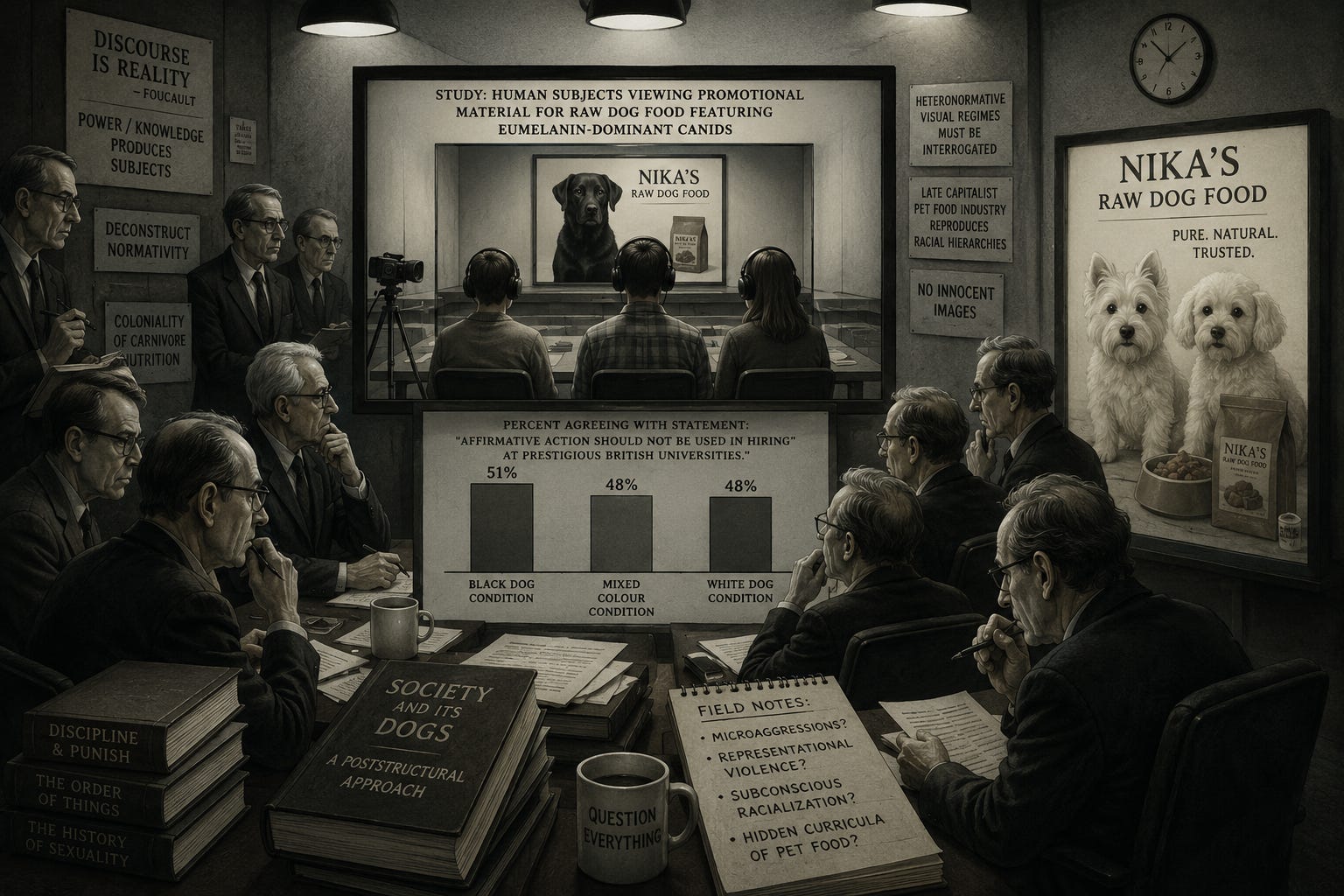
Within contemporary post-hegemonic analyses of heteronormative, decolonial, and late-capitalist representational ecologies, the symbolic circulation of companion-canid nutrient vectors has increasingly been understood as constituting a discursive site through which coloniality, epistemic privilege, and aesthetic normativity are recursively reproduced.
The visual assemblages accompanying these alimentary distribution modalities cannot therefore be regarded as politically neutral artefacts but rather as loci of intersectional power whose semiotic architecture has been rendered invisible through historically sedimented practices of representational normalization.
To explore these dynamics, this study employed randomized visual-signification panels depicting three phenotypic cohorts of Canis lupus familiaris: (i) eumelanin-dominant exemplars; (ii) heterogeneous-pigmentation exemplars exhibiting distributed melanin expression; and (iii) melanin-deprived terrier- and poodle-derived phenotypes.
Participants subsequently completed a post-exposure attitudinal inventory concerning colour-neutral civic organization, distributive justice, and institutional preference architectures.
Although the differences were minor, they were nevertheless subjected to extensive theoretical interpretation because, within sufficiently sophisticated epistemological frameworks, explanatory restraint itself may be understood as reproducing hegemonic silence.
Indeed, the apparent absence of a plausible causal mechanism should not be permitted to foreclose the possibility that one exists but remains discursively occluded by dominant paradigms of knowledge production.
Consequently, the representational ecology surrounding companion-canid nutrient vectors may be provisionally reconceptualized as an intersectional site in which subconscious aesthetic governance is recursively reproduced beneath the appearance of consumer neutrality.
The resulting visual economy therefore constitutes a paradigmatic illustration of how postmodern, heteronormative, colonial, and neoliberal systems of symbolic circulation continue to reproduce exclusion through precisely those mechanisms that remain least visible to participants embedded within.
Fig 1.
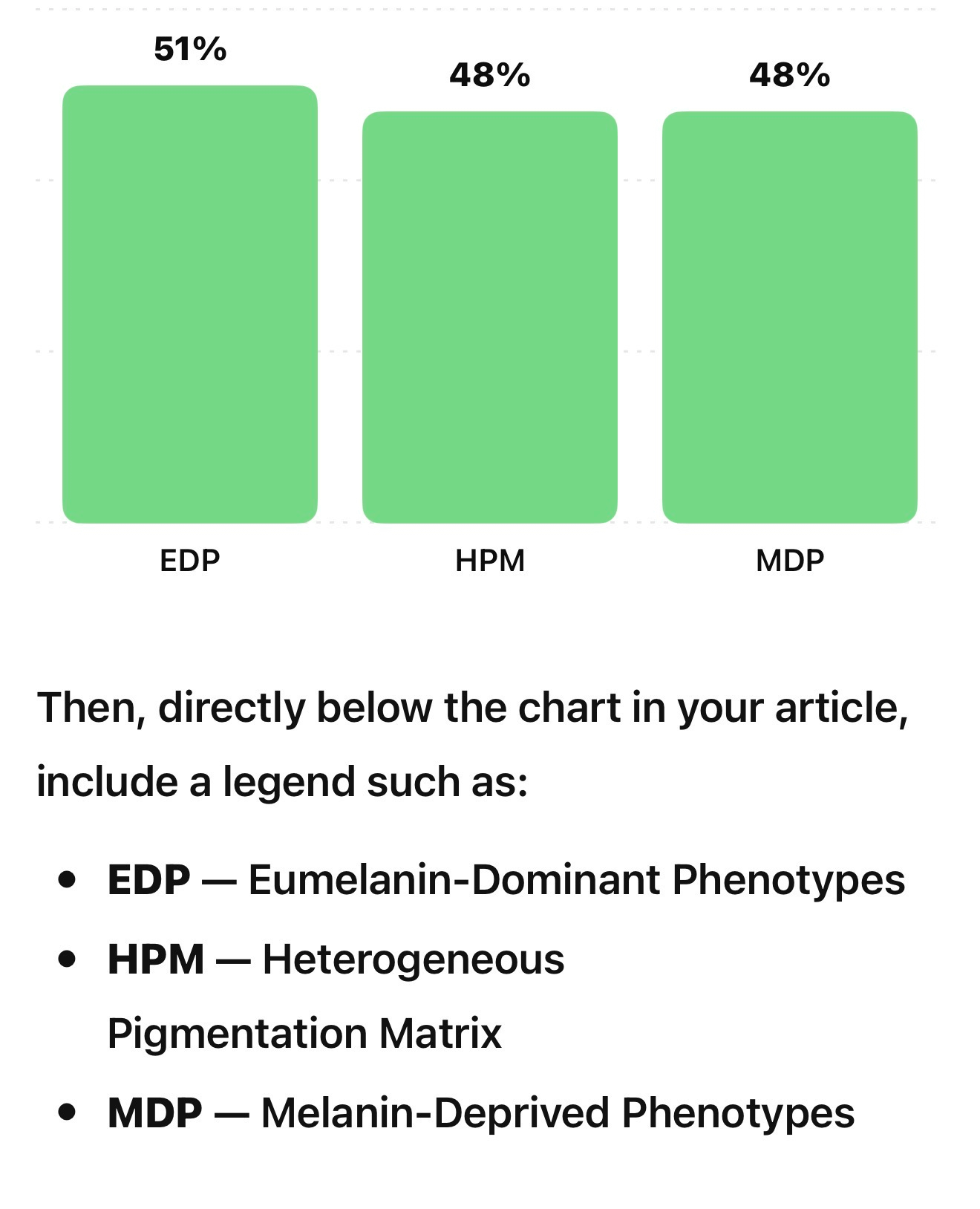
This article advances the proposition that manufacturers of raw dog food who disproportionately employ eumelanin-dominant Canis lupus familiaris within their representational ecology may be participating in the subconscious reproduction of racialized aesthetic hierarchies.
While no direct causal mechanism has been identified, contemporary postmodern and Foucauldian approaches remind us that the absence of a causal mechanism should not be mistaken for the absence of a discursive one.
In the present analysis, participants were randomly assigned to view promotional imagery for companion-canid nutrient vectors featuring either eumelanin-dominant, heterogeneous-pigmentation, or melanin-deprived companion canids.
Participants subsequently responded to a battery of attitudinal statements unrelated to companion animals, including whether hiring at prestigious British universities should proceed without affirmative-action preferences.
The fictional results indicated that 51% of respondents exposed to the eumelanin-dominant imagery endorsed a colour-blind hiring framework, compared with 48% among participants exposed to the other visual conditions.
The key point is that if you like your white poodle it doesn’t make you a racist - well maybe. 😂
Yikes, my mind is reeling. This essay calls to mind a dog joke.
A man walks into a telegraph office with his dog and tells the worker, "My dog would like to send a telegram to my wife to give a message to our other dog." The worker looks at the dog and says, what would you like the telegram to say?" The dog responds, "Woof, woof, woof, woof, woof, woof, woof, woof, woof." The worker smiles and says to the dog, "You know you could add another woof for the same price." The dog says, "But that would make no sense at all."