


Jason Arday is dead. He leaves behind a wife and children who must now bear an immeasurable loss. Whatever one thinks of his conduct, scholarship or public claims, there is nothing here to celebrate. A death is not a debating point, and grief should not be conscripted into anyone’s political campaign.
Compassion, however, does not require amnesia.
Before his death, substantial questions had been raised about Arday’s academic work, qualifications and autobiographical claims. Cambridge had begun an investigation. Students had also alleged inadequate teaching or supervision, and there were reports that student complaints were met with accusations of racism or white privilege.
Arday had apparently imbibed the poison that any criticism of a black man is always made in bad faith.
It remains important to establish who made those accusations and in what circumstances. Those are the facts to be examined. But Arday himself is no longer available to answer them.
The greater responsibility now belongs to the people who remain: the academics, administrators and institutions that constructed his ascent.
Arday did not award himself his doctorate. He did not appoint himself to successive university positions. He did not make himself a professor at Cambridge or produce the publicity that turned his appointment into an international morality tale.
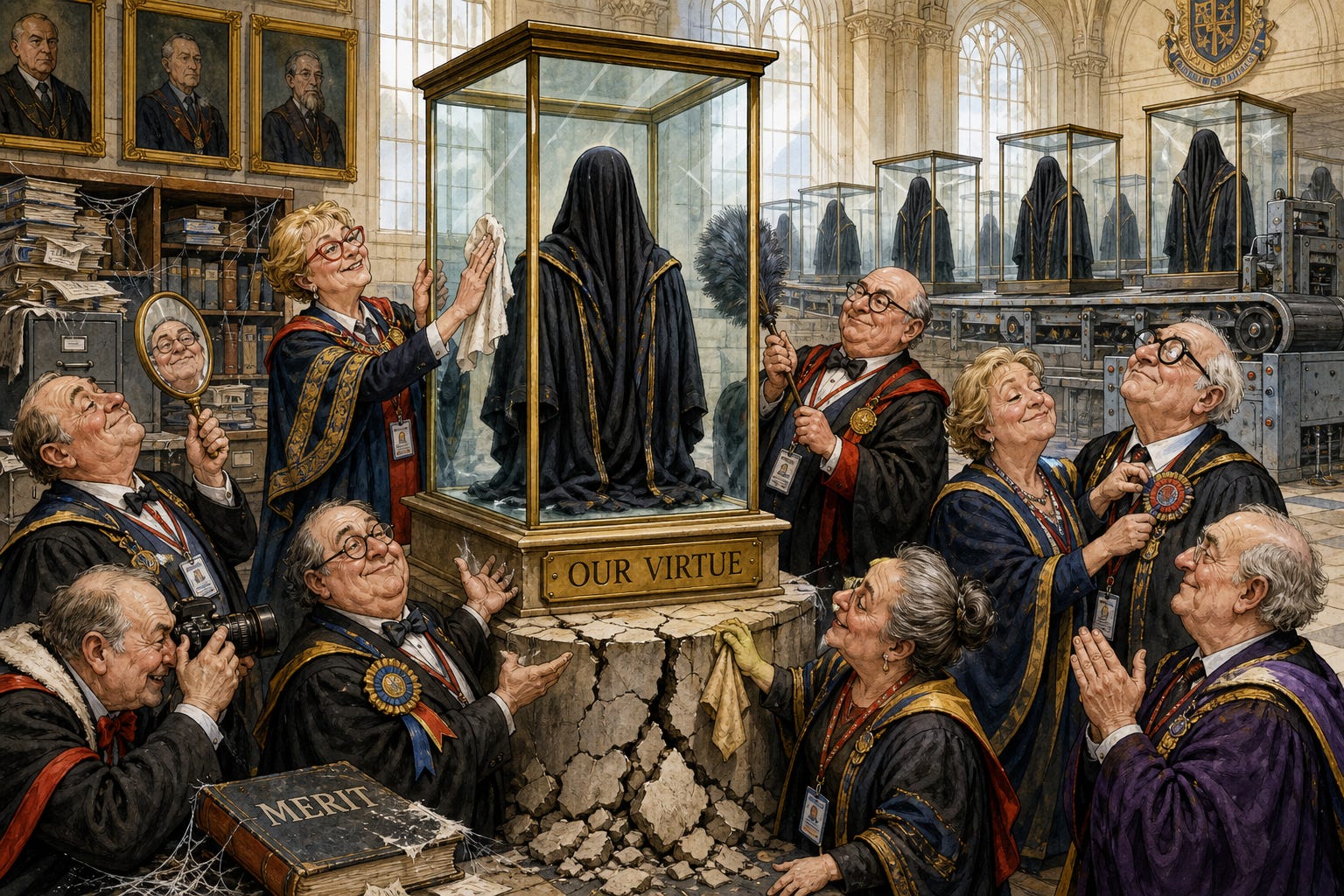
Committees approved him. Senior academics endorsed him. Administrators promoted him. Communications departments converted him into an emblem of institutional virtue.
They accepted the applause. They must now accept the scrutiny.
That scrutiny cannot begin with Arday’s arrival at Cambridge. It must follow the entire chain from his undergraduate education and doctoral supervision through every appointment, promotion, reference, publication and honour that carried him there.
Each institution should disclose what it verified, what concerns it received and how it responded. Appointment records and internal correspondence should be preserved and independently reviewed. Students and faculty members must be able to give evidence without professional retaliation.
The questions are elementary. Who read his work? Who checked his qualifications? Who examined the more improbable parts of his public biography? Who dismissed earlier warnings? Who decided that further inquiry was unnecessary—or ideologically inconvenient?
The most serious possibility is not merely that these people failed to detect problems. It is that some of them had little interest in detecting them.
Arday was institutionally useful. His biography supplied an irresistible story of adversity overcome. His appointment advertised the moral enlightenment of those who made it.
Senior figures could point to him and proclaim, without quite saying the words: Look whom we have appointed. Look how virtuous we are.
This was not colourblindness. They saw his colour perfectly well. That was part of his value to them.
If they promoted him because his identity and biography served their own reputational purposes, they did not honour him. They used him. They placed him in the institutional shop window, enjoyed the admiration his presence attracted and left him exposed when the story could no longer withstand examination.
The language of inclusion cannot make exploitation benevolent.
This is why the investigation cannot be one of those ceremonial exercises designed to survive a news cycle. There must be no polished report announcing that “lessons have been learned” before everyone returns quietly to the same offices and hiring committees.
Due process is essential. No one should lose a career because of speculation, association or political disagreement. But due process is a means of determining responsibility, not a promise that nobody will be held responsible.
If an independent investigation finds that officials knowingly ignored disqualifying evidence, suppressed complaints, retaliated against students, misrepresented Arday’s record or applied standards they would not have applied to another candidate, resignations and dismissals should follow.
It would be grotesque for the institutions that profited from his ascent to treat his collapse as an unfortunate natural event for which nobody was responsible.
It also requires asking the question universities would prefer to avoid: How many more Jason Ardays are there?
This is not an invitation to suspect every Black academic. It demands that universities stop behaving in ways that cast suspicion on accomplished Black scholars who earned their positions without favour, embellishment or theatrical sponsorship.
When institutions relax standards—or create the reasonable appearance that they have—they impose a burden on innocent people. Every distinguished minority scholar may be forced to wonder whether colleagues regard that distinction as earned. Every appointment becomes vulnerable to the poisonous suggestion that merit was secondary. The people most injured by tokenism are often those whose excellence requires no tokenism at all.
The problem is not limited to race. It arises whenever an institution prefers an identity, biography or politically useful narrative to demonstrated ability. Qualified candidates of every background lose opportunities when committees select the person who offers administrators the most flattering story.
Meritocracy has never been perfect. It can be corrupted by patronage, inherited privilege and prejudice. The answer is to make standards fairer and more exacting—not to replace standards with ideological pageantry.
Martin Luther King Jr. dreamed that his children would “not be judged by the colour of their skin but by the content of their character.” Character is a demanding standard because it recognizes the complete person: virtues and failings, achievements and responsibilities, dignity and agency.
Some contemporary anti-racists have moved so far from King’s aspiration that colourblindness itself is denounced as racist. Would Arday’s white enablers call MLK an Uncle Tom?
Indeed, what to make of it when criticism of a Black person is treated as presumptively racist? An accusation about the complainant's motives does not answer a complaint about poor teaching. A question about plagiarism is not resolved by examining the politics of the person who noticed it. Scholarship requires answering evidence with evidence.
To presume that Black scholars require protection from ordinary professional scrutiny is not respect. It is condescension.
It is also destructive. If every setback is persecution and every critic acts in bad faith, self-examination becomes impossible. Encouraging someone to attribute every failure to outside hostility teaches an external locus of control. Success remains his achievement, but error is always someone else’s fault.
This may feel protective. In reality, it destroys agency.
A person who believes that nothing is his responsibility must eventually believe that nothing is within his power to change. He cannot learn from criticism because he has defined criticism as aggression. He cannot correct a mistake because acknowledging it would validate an enemy. He is left with the consoling but paralyzing identity of permanent victim.
That is not liberation. It is a refined form of contempt.
No young person should be taught to react to adversity by asking only which prejudice caused it. Young Black men will sometimes encounter genuine racism, and they should be prepared to identify and resist it. But they must also retain the capacity to distinguish an injustice imposed from outside from a failure they possess the power to correct. Resilience depends upon both capacities.
The danger now is that Arday’s entire story will be reduced to a simple narrative in which a racist society hounded an innocent man to death. Such a narrative would be emotionally convenient and intellectually dishonest.
Nor would that narrative serve his family, Black scholarship or racial equality. It would serve those who crave the sugar rush of public righteousness: the open letter, the denunciation, the performance of solidarity and the applause of people already in agreement. These gestures cost their authors very little. Arday paid a far greater price for the institutional story constructed around him.
Jason Arday’s death is a tragedy. It neither vindicates his critics nor absolves his defenders. It is tragic because a human being is dead, children have lost their father, and a wife has lost her husband.
It may also represent the final failure of a system that made a man into a symbol, rewarded the symbol lavishly and neglected the human being carrying its weight.
We should mourn him and show mercy to those who loved him. But mercy does not require falsehood, and mourning does not require silence.
Jason Arday is dead. His enablers are alive. They hold titles, occupy offices, sit on committees and continue to exercise power over students and scholars. Now some are feeding off his carcass, proclaiming that all criticism of him was driven by systemic racism.
I eagerly await Al Sharpton and other such racialized confidence men to join the feeding frenzy.
But before that the institutions that pushed Arday forward must answer for their actions.
Sensitive and enlightening diagnosis. You placed the responsibility for this tragedy exactly where it belongs. Will the enablers own up to their roles? Will they acknowledge that DEI ultimately and inevitably leads to DIE?
I think his narrative will be reduced to someone who undeservedly was promoted by the DEI system on a falsified history and when uncovered he could not bear the subsequent fallout. It also says something about kids coming out of today's educational systems. They are pushed through regardless of ability and eventually it all catches up to them.