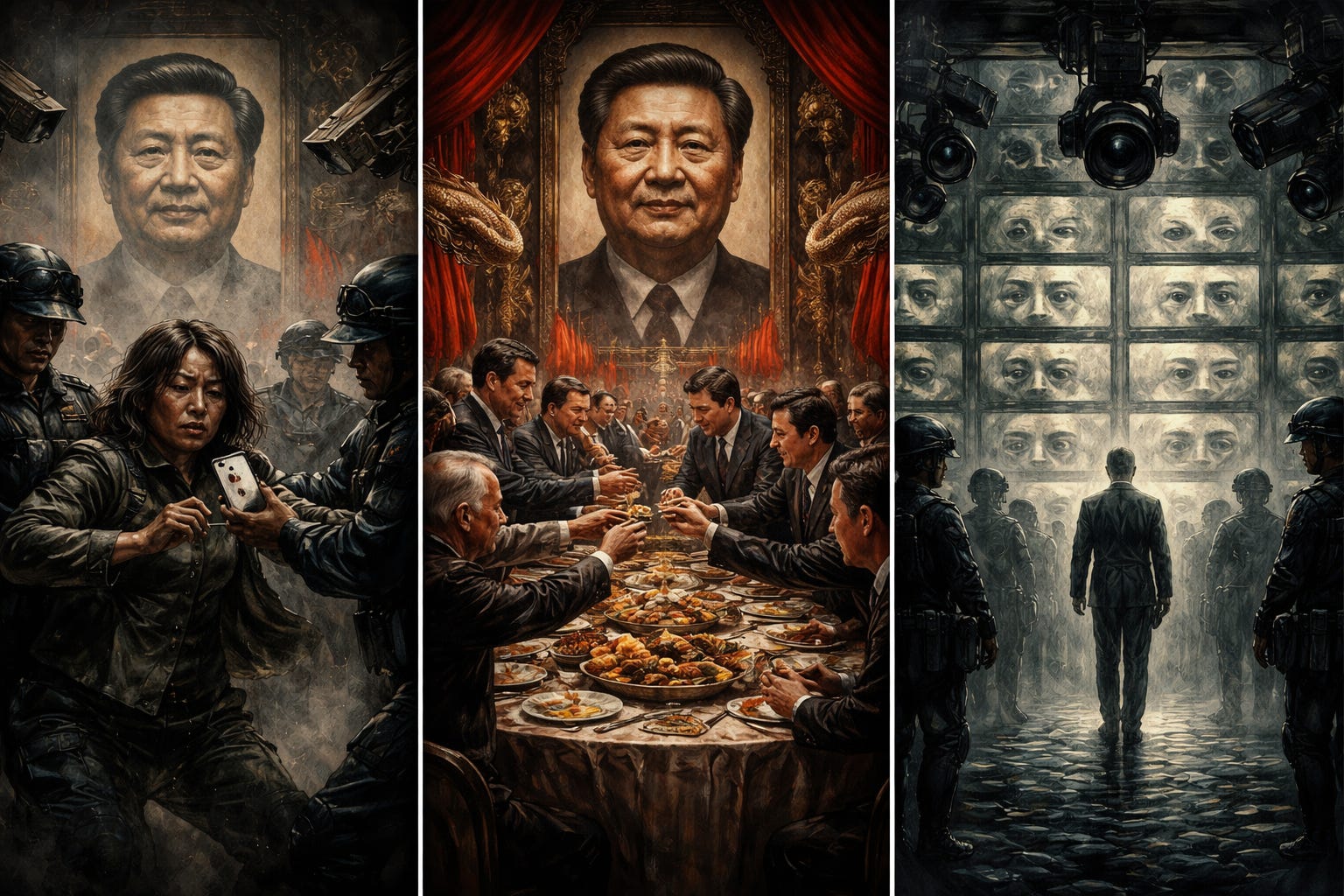
In early 2020, Zhang Zhan, a former lawyer turned citizen journalist, travelled to Wuhan to document what the Chinese state preferred not to see recorded: sealed apartment doors, grieving families, silenced doctors, and the quiet panic of a population locked down by decree. For this act of reporting—nothing more—she was detained, charged with the catch-all crime of “picking quarrels and provoking trouble,” and sentenced to prison.
When she protested through a hunger strike, she was force-fed through a tube. After serving her term, she was promptly re-detained and sentenced again. Zhang did not organise a rebellion. She did not incite violence. She filmed, spoke, and refused to recant. That was enough. This is the lived reality of the Chinese state: a system where surveillance replaces law, silence is mandatory, and truth itself is treated as subversion.
Let’s take a little stroll through the Chinese influence on Canada.
The Chinese are the primary source for fentanyl coming into Canada — a fact that, astonishingly, nobody in polite company will say out loud — even though each day their poison causes twenty Canadian deaths.
And did we forget that this Chinese government interfered in our last election, sending Chinese students to be coerced into voting for the party-approved candidate, with the threat that their student visas would be cancelled if they did not comply?
The historical record is not ambiguous. The Chinese Communist Party presides over one of the most lethal governments of the modern era. Conservative estimates place the death toll of Maoist rule — through famine, forced collectivisation, political terror, and engineered catastrophe — at 60 to 70 million people. Add the catastrophe of the Cultural Revolution, the massacre at Tiananmen Square, the ongoing destruction of Tibetan culture, and the mass incarceration of Uyghurs in the 21st century, and the picture sharpens further.
This is a regime built on coercion, sustained by surveillance, one that threatens the sovereign nation of Taiwan and is unapologetic in its hostility to individual liberty, judicial independence, and political pluralism.
It should be the simplest of truths: a government that crushes its own people ought not to be entrusted with the well-being of ours; a regime that exports death abroad — whether through chemical precursors or political meddling — ought not to be excused with diplomatic euphemism.
Yet, in Canada and much of the West, we have become so habituated to the language of convenience that we will speak of “engagement” and “partnership” while our neighbours’ children die and our democratic processes are bent to foreign will.
One need not be an ideologue to recognise this for what it is: an abdication of moral responsibility dressed up as realpolitik. The refusal to confront these realities — to name the source of the poison and to defend the sanctity of our civic processes — is not prudence. It is cowardice.
Given all this, an obvious question demands an answer. Why are so many Western democratic leaders so persistently smitten with Chinese tyranny?
Why do figures as varied as Keir Starmer, Donald Trump, Justin Trudeau, and Mark Carney speak of Beijing with a reverence they reserve for no democratic ally? Why the flattery, the “strategic partnerships,” the indulgent talk of engagement—why the bromance?
The answer is neither ignorance nor geopolitical sophistication. It is a far older and more ignoble weakness: the attraction of democratic leaders to power that enjoys the luxury of never having to explain, defend, or justify itself.
So one finds the familiar romance between Western political poobahs and the iron-fisted seducers of the East. China, that veteran dragon of despotism, continues to exert a peculiar erotic pull over leaders who, once elected, appear to resent the very voters who put them there.
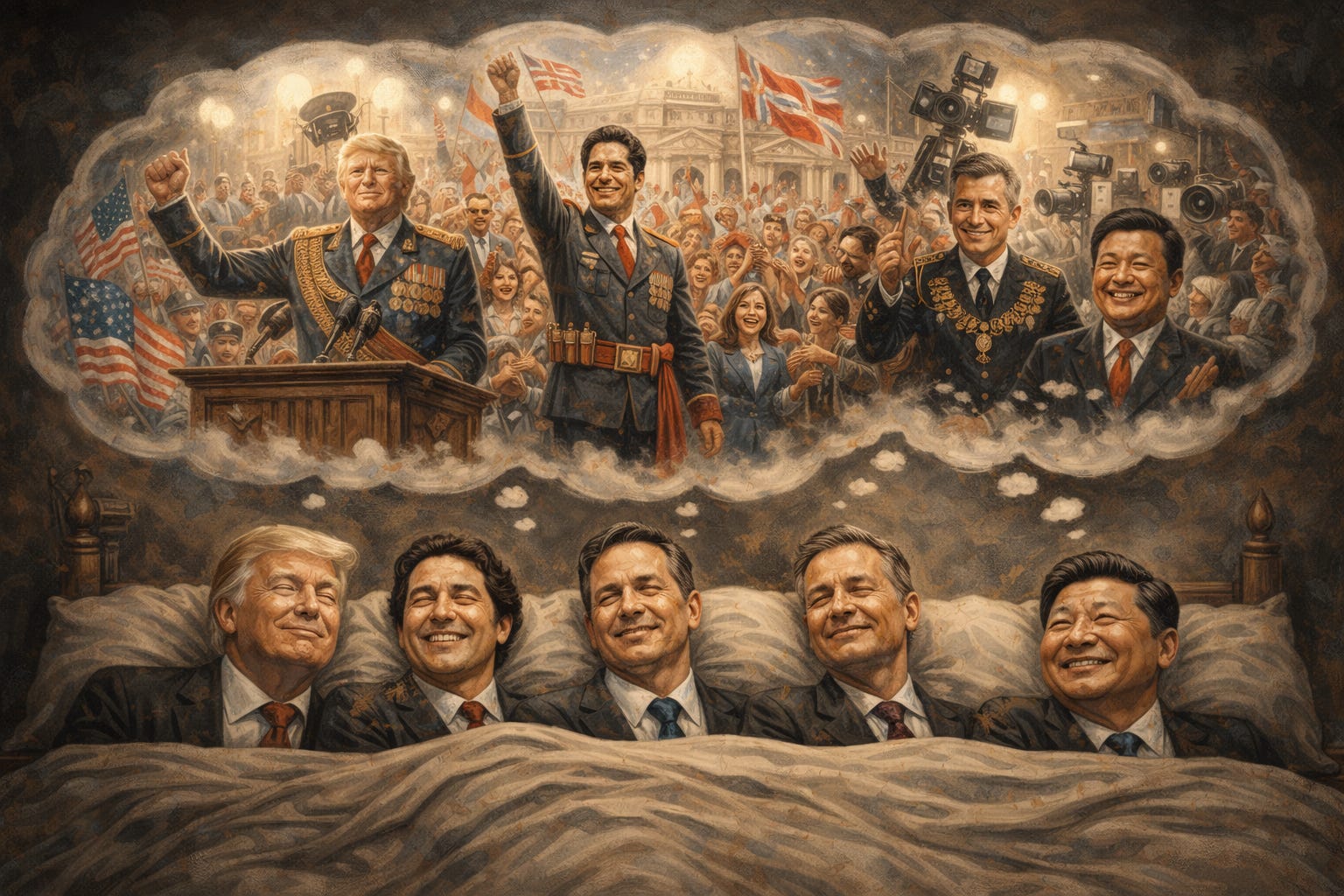
Observe the cast: Donald Trump, gushing over Xi Jinping as a “brilliant” ruler who governs 1.4 billion people “with an iron fist”; Mark Carney, freshly installed in Ottawa, murmuring darkly at Davos about a coming “rupture” in the world order while floating new “strategic partnerships” with Beijing; Keir Starmer, returning from Shanghai beaming about lifting sanctions and extending polite invitations to Xi for a spot of G20 statesmanship; and Justin Trudeau, who once confessed his “admiration” for China’s “basic dictatorship” because it allows the state to “turn the economy around on a dime”—a flexibility, he mused, that democratic leaders can only dream of.
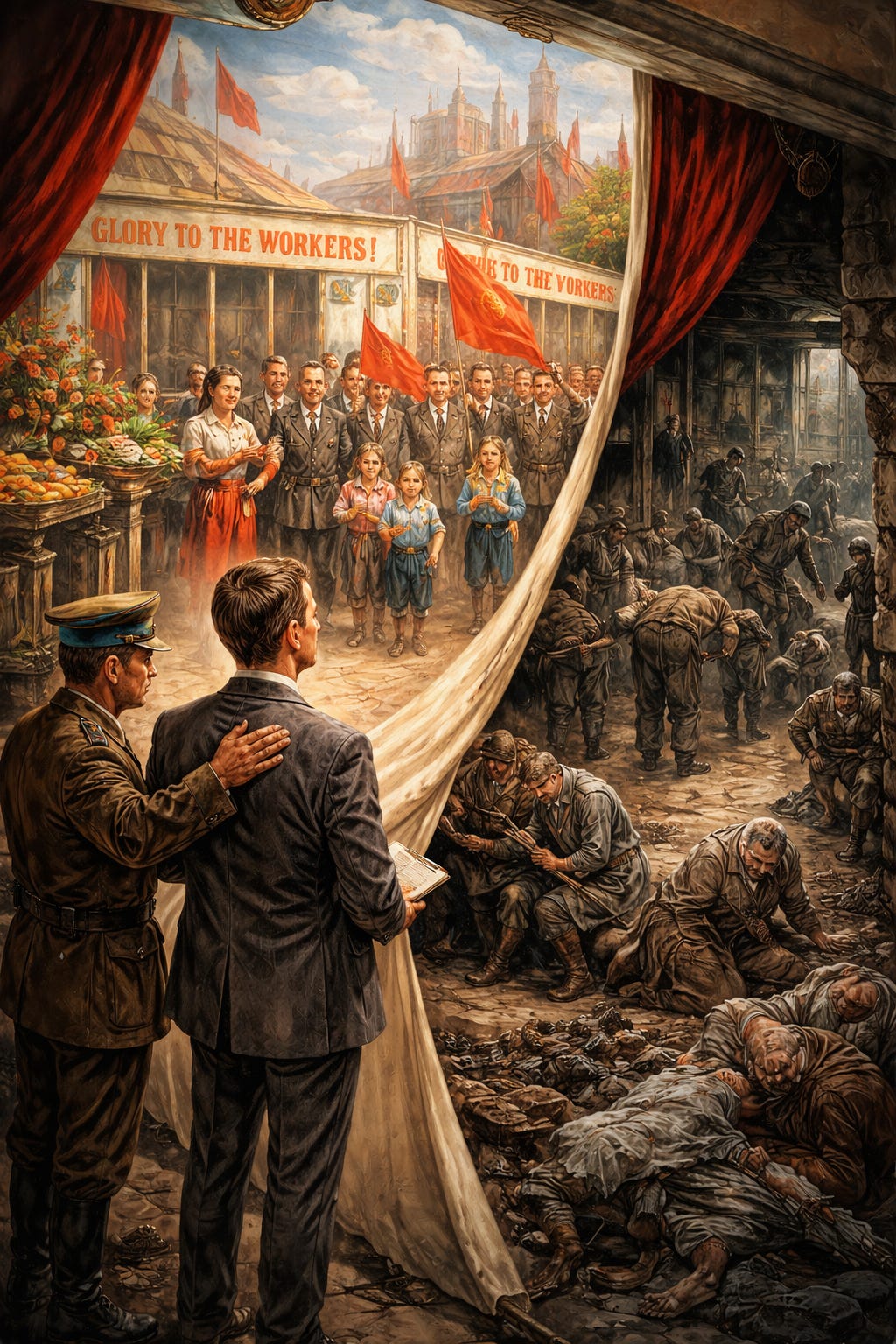
This is not a novelty. It is a rerun. One has seen it before, in black-and-white photographs of Western intellectuals queuing to genuflect before Stalin, Mao, or any other butcher who promised efficiency without dissent.
Beatrice and Sidney Webb toured the Soviet Union and returned starry-eyed about a “new civilisation,” airbrushing out the gulags and the famines. Edgar Snow portrayed Mao as a benevolent agrarian reformer rather than the architect of a catastrophe that killed tens of millions through famine, terror, and social annihilation.
The Great Leap Forward alone left perhaps forty-five million corpses in its wake. The Cultural Revolution followed—a decade of sanctioned lunacy in which children denounced parents and mobs pulverised culture itself. Then came Tiananmen, the tanks, the blood washed from the square. Today, we have the Uyghur camps—“re-education,” in the same sense that a firing squad is a finishing school.
None of this is hidden. It is announced. The Chinese Communist Party does not disguise its ambition to supplant the liberal, post-Enlightenment order. It practices hostage diplomacy—the Two Michaels—militarises the South China Sea, props up Putin’s war machine, and underwrites the Iranian theocracy. Yet Western leaders persist in cooing about “engagement,” as though moral anaesthesia were a form of realism. Engagement, in this context, means willful blindness lubricated by trade delegations.
The historical record is not ambiguous. The Chinese Communist Party presides over one of the most lethal governments of the modern era. Conservative estimates place the death toll of Maoist rule—through famine, forced collectivisation, political terror, and engineered catastrophe—at 60 to 70 million people. Add the Cultural Revolution, Tiananmen Square, the ongoing destruction of Tibetan culture, and the mass incarceration of Uyghurs, and the picture sharpens further. This is a regime built on coercion, sustained by surveillance, and unapologetic in its hostility to individual liberty, judicial independence, and political pluralism.