


Most universities and colleges claim to support free speech. “Silence,” or the modern administrative equivalent—“watch what you say or else”—is rarely engraved in Latin on their coat of arms.
The interesting question is not why institutions proclaim their devotion to liberty. The interesting question is why so many of them panic the moment someone actually exercises it.
Freedom of speech that cannot offend anyone is not freedom of speech at all. It is merely permission to agree.
Polite speech needs no protection. The agreeable, the fashionable, the safely conventional survive quite comfortably without charters, courts, or policies. They flourish in polite company and require no legal defence. The speech that requires protection is the speech that irritates people, unsettles orthodoxies, and punctures the moral vanity of the age.
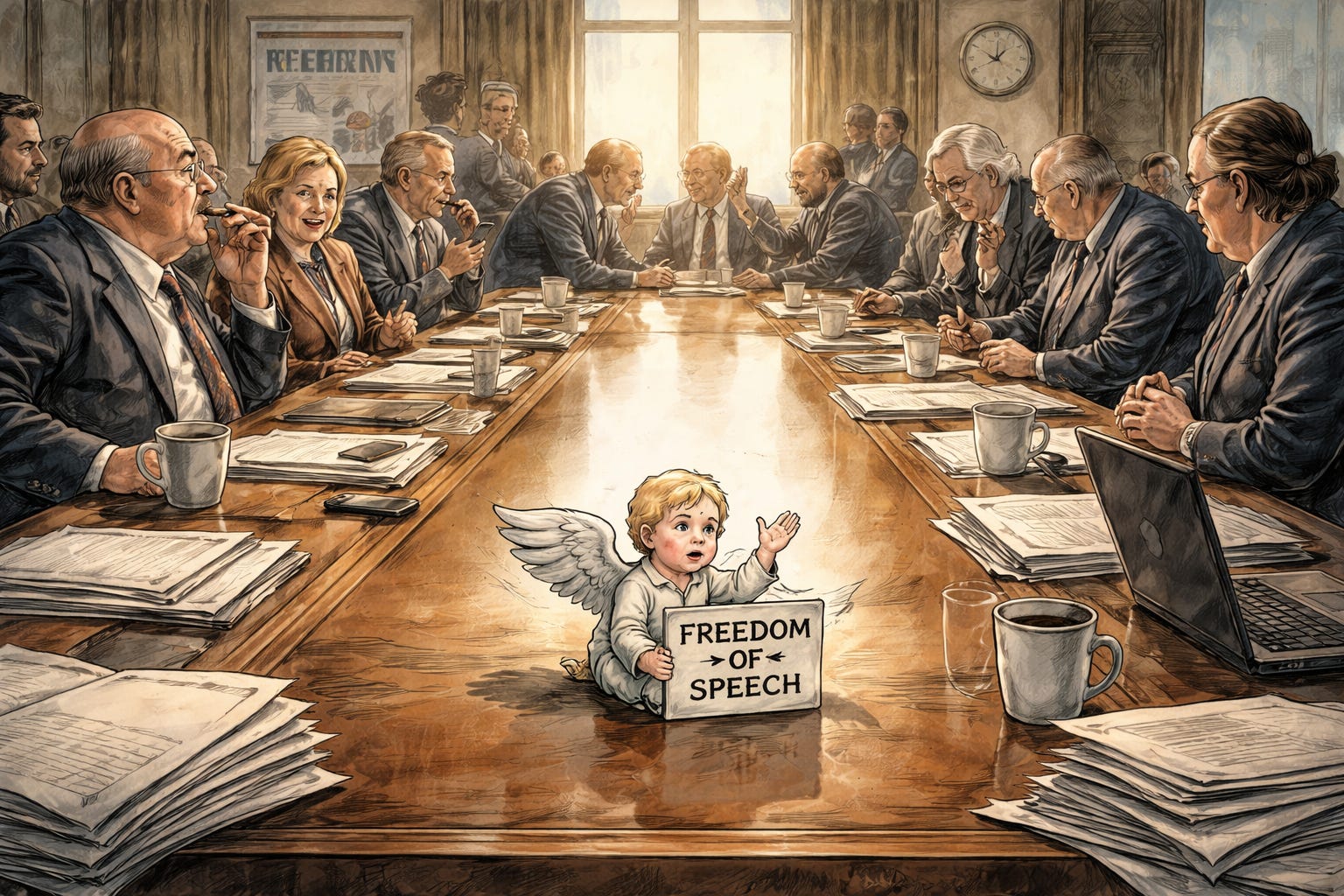
That is why this Substack is called Freedom to Offend.
Freedom of expression exists precisely to protect speech that people would rather not hear. In Canada, that principle is embedded in Section 2(b) of the Canadian Charter of Rights and Freedoms, which guarantees freedom of thought, belief, opinion, and expression.
Which brings us to the instructive case of Humber (now “Polytechnic!”—yesterday college) and its curious partner institution, the University of Guelph-Humber, where the principle of free expression appears to be admired largely as a decorative abstraction.
At Humber, the rule seems fairly simple: you are perfectly free to agree with management or the shrillest faculty member, the one best connected with the President / VP or the one who uses the words “emotional safety” the most in a paragraph.

(On top, it says, “You better watch what you say.” On the bottom, it says, “We aren’t really into freedom of speech here.”
Things look so much more impressive when they are in Latin.)
If you disagree with management—particularly on political matters—you may discover that your freedom has a surprisingly short shelf life. And they may, as with me, start drafting your termination papers before they tell you their charges.
On paper, Humber’s policy on free expression is magnificent. It promises “open discussion and free inquiry.” It assures the community that controversial ideas should be debated “without fear of reprisal.” It even states that colleges must not shield members of the community from ideas they may find disagreeable or offensive.
Splendid language. One could hardly draft it better. Unfortunately, it does not mean very much.
Institutional policies of this sort often possess a curious architecture. They begin with a hymn to liberty and end with a series of trapdoors.
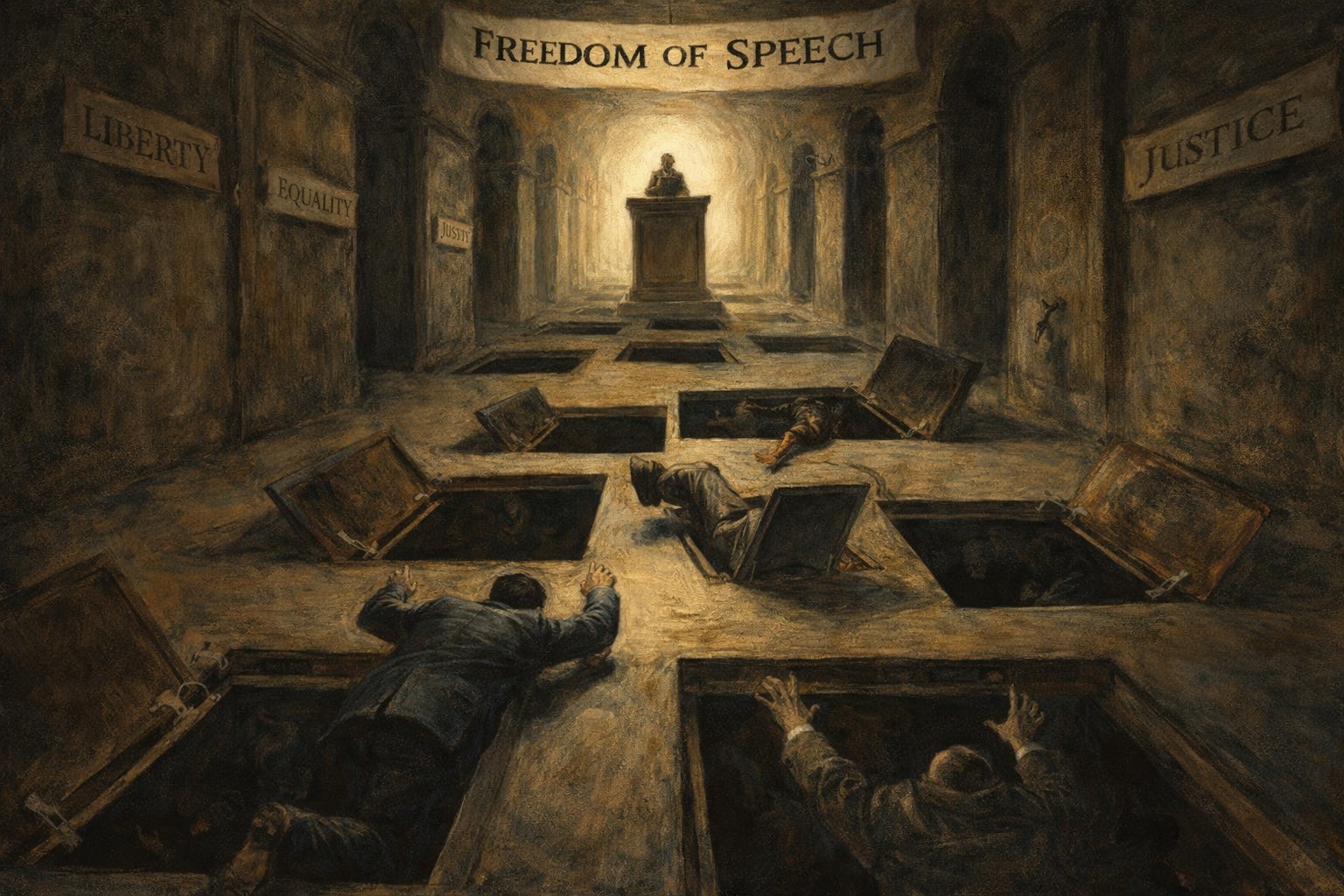
After affirming that people should not be shielded from offensive ideas, Humber’s policy quietly adds that speech violating the Ontario Human Rights Code is prohibited, that harassment is prohibited, and that additional “context-specific boundaries” may apply through employment rules and internal procedures.
A free speech policy that says speech is permitted except where it violates the Human Rights Code is, in practice, not a free speech policy at all.
The Ontario Human Rights Code defines harassment broadly as “engaging in a course of vexatious comment or conduct that is known or ought reasonably to be known to be unwelcome.”
Pause for a moment and consider what that means.
Speech may become prohibited if it is judged “unwelcome.” If someone claims it was annoying, vexatious, or something a speaker “ought reasonably to have known” would not be appreciated.
This introduces a remarkable degree of subjectivity. What counts as vexatious, what someone ought to have known, and whether speech is unwelcome are judgments made after the fact by administrators and investigators.
Once one pauses to think about it, the possibilities are almost limitless.
Imagine a student asking a professor, “How did I do on my accounting exam?”
The professor replies honestly: “You received forty-six percent. You failed.”
The student might reasonably say: “That comment was unwelcome. I did not want to hear that. It caused me distress.”
By the logic of such elastic definitions, the professor has now engaged in speech that was unwelcome, upsetting, and entirely foreseeable as such. One could even argue that telling a student he is performing poorly is “vexatious conduct” because the professor ought reasonably to know that students dislike hearing bad news.
Under a sufficiently imaginative interpretation, the student now has standing.
Or consider the entirely mundane statement: “This paper is poorly written.” Unwelcome.
Or the devastating remark heard in universities since the Middle Ages: “You are mistaken.” Clearly unwelcome.
One could go further. Suppose a professor says, “Your argument makes no sense,” or “You should have read the assigned material before coming to class.” These are statements that students are historically known not to appreciate.
Unwelcome again.
Under such a framework, the basic act of teaching becomes hazardous. A professor cannot tell a student he is wrong, cannot say his work is weak, cannot say he failed an exam, because all of these statements may be unwelcome and therefore vexatious.
Ironically, something very much like this occurred in my own case.
When I made the LinkedIn comment referring to Hamas as Nazis in response to a man in Pakistan—someone entirely unconnected with the university—the algorithm, or perhaps a direct connection between the two, delivered the remark to a single student.
This particular student had already developed a reputation for treating anything less than an A as a grave injustice. Any mark below perfection was promptly escalated to the department head as though it were a violation of the Geneva Conventions. She belonged to that increasingly familiar category of undergraduate: the permanently aggrieved self-confessed A-student, convinced that academic evaluation exists solely to confirm her brilliance.
When she discovered that I had called Hamas Nazis, she evidently saw her opportunity.
My earlier remarks to her about poor work, weak reasoning, and the fact that entitlement is not a substitute for aptitude had been—one might say—unwelcome.
Under the elastic logic now fashionable in institutional policy, such remarks might even qualify as vexatious. One could easily imagine them being interpreted as a violation of her emotional safety.
And so vengeance arrived.
The LinkedIn comment became the spark. She circulated it, amended it, escalated it, and helped assemble the chorus of outrage that soon followed. A remark directed at a stranger halfway across the world was transformed into an alleged campus emergency.
Under the modern administrative theology of “unwelcome speech,” the sequence almost writes itself.
First, the criticism is unwelcome. Then the professor is unsafe. Then the machinery of accusation begins.
The result, in my case, was predictable enough: reputations destroyed, allegations multiplied, and an institutional drama in which the original offence—an opinion about a terrorist organisation—was quietly buried beneath a mountain of procedural theatre.
And yet universities exist precisely to say such things.
Truth is frequently unwelcome. Correction is unwelcome. Criticism is unwelcome. Education itself is, in large measure, the systematic process of telling people that something they believe is incorrect.
Once the definition of harassment expands to include speech someone finds unwelcome, the entire enterprise collapses into absurdity.
At that point, the rule does not merely chill speech. It swallows it whole.
If speech can be prohibited simply because someone claims it was unwelcome, then the boundary of permissible expression is no longer defined by principle.
It is defined by the sensitivity of whoever chooses to complain. At that point, the exception begins to swallow the rule.
Almost any controversial opinion about religion, politics, ideology, identity, or history can be interpreted as creating an “unwelcome environment.” Under such a framework, speech is permitted only so long as it does not offend anyone who can plausibly frame the speech as discriminatory or harassing.
But free speech exists precisely to protect speech that others find offensive.
That is not a flaw in the concept. It is the entire point of the concept.
Once the standard becomes subjective—once “unwelcome” becomes the test—the result is not a narrow restriction on harassment. In practice, it becomes a universal gag order. Speech regulations so elastic that they depend entirely on interpretation are indistinguishable from censorship, because no one can know in advance what will later be judged impermissible.
The chilling effect is immediate. Faculty learn which opinions are safe. Students learn which questions should remain unasked. Everyone becomes careful. Self-censorship becomes the operating system.
At that point, free speech has not merely been limited.
It has effectively disappeared.
One might think this is merely theoretical.
Unfortunately, I am living proof that it is not.
My supposed offence was to describe Hamas as Nazis. The remark was made on LinkedIn in response to a man in Pakistan who has no connection whatsoever to the University of Guelph-Humber. It did not mention Islam. It referred to Hamas, a designated terrorist organisation whose charter openly calls for the destruction of Israel and the murder of Jews.
Historically speaking, the comparison is not exactly implausible.
Yet within days, the machinery of institutional alarm began whirring into action.
The Vice-Provost, Melanie Spence-Ariemma, and an allied professor—an individual who has publicly proclaimed that he hopes the world will one day be remade in the glorious image of a seventh-century Islamic caliphate—set about assembling what can only be described as a purpose-built complaint.
The remarkable thing about the document is not merely its accusations but its language.
One quickly notices the repeated incantations: harm, safety, safety concerns, unsafe environment.
‘Safety’ becomes the word of the day. Safety appears again and again, as though repetition itself might transform a political disagreement into a public emergency.
Students, we are told, felt unsafe.
Some allegedly feared coming to campus.
Others reportedly feared being in a classroom with me.
All because a professor had compared Hamas to Nazis in a LinkedIn exchange with a stranger in Pakistan.
The entire exercise has a curious, backwards-engineered feel.
It is as though the participants had discovered the relevant phrases in the Human Rights Code and then constructed a narrative designed to activate them. Words like harm, safety risk, and unsafe environment appear not as descriptions of reality but as administrative trigger phrases.
One is tempted to conclude that while the architects of this complaint may never have read a single line about freedom of expression, they had certainly become fluent in the fashionable dialect of bureaucratic grievance.
The irony is particularly striking.
Here we have an individual who has openly celebrated the idea of the world being reorganised into a seventh-century Islamic caliphate—yet when the time came to launch an accusation, he reached instinctively for the most modern vocabulary of Western progressive bureaucracy: the language of emotional safety, psychological harm, and feelings-based grievance.
One might almost admire the adaptability.
Meanwhile, the supposed victims of my remark remain conveniently anonymous.
The complaint refers to frightened students and concerned individuals. Their names are withheld. Their statements appear through intermediaries. We are assured they exist and that they were afraid.
But there is no evidence of their existence whatsoever.
It is therefore impossible to know whether these complainants exist at all, whether they were accurately represented, or whether they were simply recruited to supply the necessary expressions of alarm.
Such mysteries tend to arise when institutions operate in bad faith.
The Human Rights office involved in this affair did little to inspire confidence. The department appeared strikingly unfamiliar with the very Human Rights Code it was supposed to enforce. Yet when the Vice-Provost decided a complaint should exist, the machinery obligingly produced one. I am sure that the fact that the Human Rights Manager’s superior was the Vice Provost did not influence the situation.
The process appears to have been admirably efficient.
A form was located somewhere on the internet. Passages were assembled. The Vice-Provost signed herself as the claimant, despite having no standing to bring a human rights claim. The paperwork was assembled, and a human rights complaint materialised.
Thus, the administrative theatre was complete.
Anonymous complainants.
Safety concerns.
A human rights complaint produced on demand.
Meanwhile, another story began circulating among staff and faculty.
According to this narrative, I had not been suspended for political speech at all. I had been arrested. Handcuffed. Led away by the police.
This story was entirely fabricated.
No arrest occurred. No police were involved. No charges existed.
Yet the lie spread methodically—students being stopped in hallways, faculty repeating the story, colleagues whispering that the real reason for my suspension was criminal conduct.
The purpose was obvious. Poison the well first, and the rest becomes easy.
Once the dissenter has been recast as a criminal rather than a heretic, the surrounding community will do the rest of the work. The work environment becomes hostile, reputations collapse quietly, and by the time termination arrives, the outcome already appears justified.
In other words, the heretic must first be discredited before he can be safely removed.
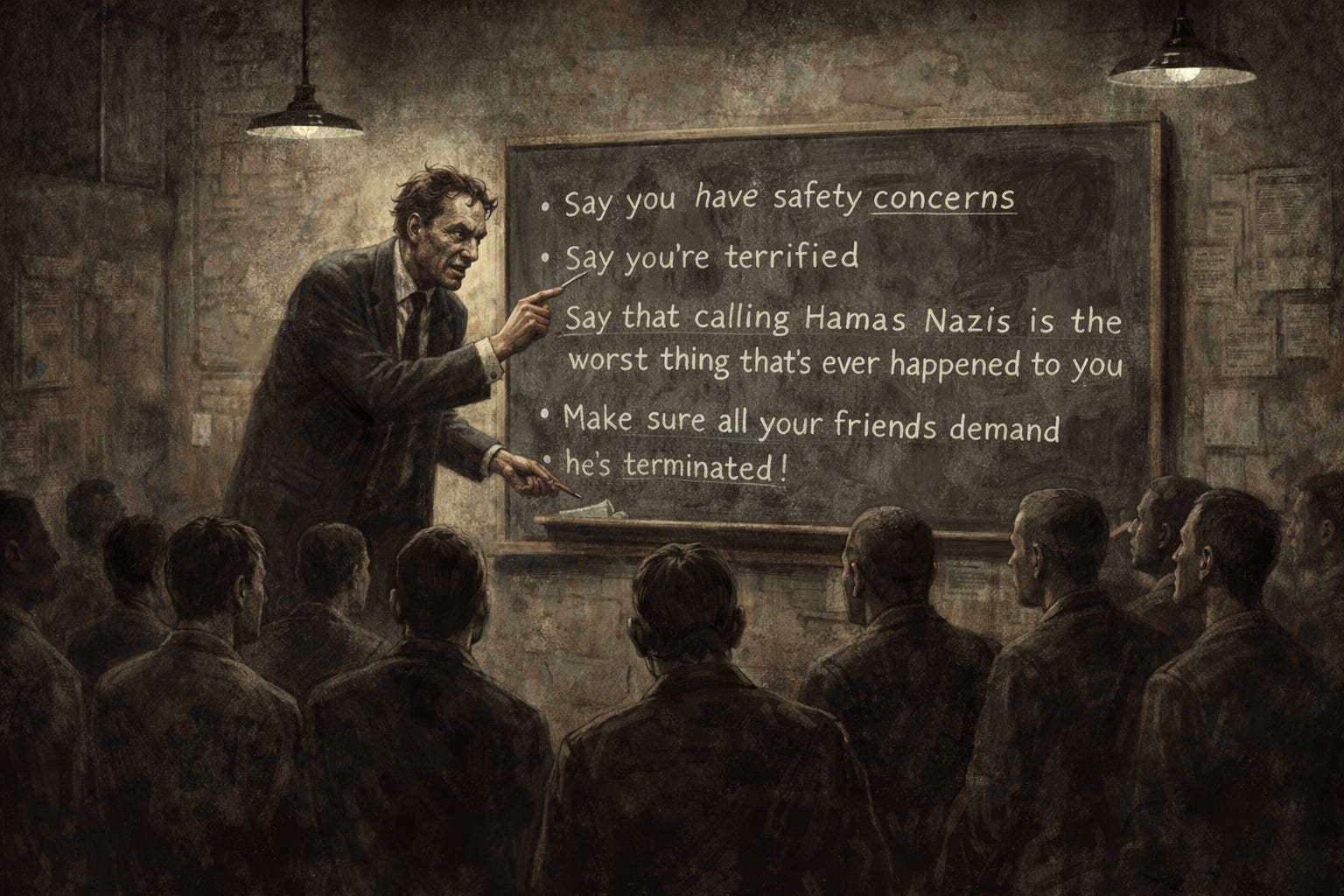
When I attempted to stop this slander and defend myself publicly, the response from Humber’s Manager of Public Safety was to send a letter advising me to “watch what I say” on social media and threatening me with police arrest.
Pause again to appreciate the irony.
A publicly funded university and college—institutions supposedly devoted to inquiry and intellectual courage—responding to a faculty member defending himself not by correcting falsehoods but by warning him to be careful about what he says.
This is not merely hypocrisy. It is institutional contempt for free speech.
And it reveals something important.
The administrators involved in this affair do not appear to have wrestled seriously with the concept of freedom of expression at all. To them, speech is not a right to be protected but a problem to be managed.
And when speech becomes a problem, the easiest solution is silence.
This is how erosion happens in a free society.
Not with a dramatic decree banning speech outright, but through slow administrative suffocation. No one says openly that you are forbidden to speak. Instead, the warning arrives in softer language: be careful, watch what you say, someone might feel unsafe.
One exception is added, then another, until the principle itself quietly evaporates.
The policy remains. Freedom disappears.
Once speech must first pass the test of being welcome, it is no longer free speech.
It is approved speech.
And once approval becomes the standard, academic freedom has already been quietly surrendered.
If the principle of free expression matters to you—if you believe universities should be places where ideas are debated rather than suppressed—please consider supporting this work.
Freedom to Offend is reader-supported. A paid subscription is $8 a month and helps keep essays like this coming.
And unlike certain administrative policies, the terms are refreshingly simple: no committees, no investigations, and no warnings to “watch what you say.”
If you value this work, consider leaving a tip. It’s cheaper than therapy, less pious than public broadcasting, and the only censorship here is my bad taste. On second thought, it’s bad therapy.
As your experience, plus countless disruptions of speaking appearances by Israelis or pro-Israelis by the keffiyeh crowd have shown, their motto is "Free speech for me, not for thee!" Their side has no interest in truth, just doctrine. In fact, truth is to them like sunlight is to a vampire.
Never ever play by supposed rules in battles such as what you experienced, especially when it comes to social media.
Today, as you note it's very easy for students to hold a knife to the throat of profs, not literally of course. Administrators, many faculty and senior leaders in universities have devolved into....so much so that few respect them or their expertise if they ever had any. Solution: in Canada change will not happen easily and not going to happen till the taxpayer voter acts to rid Canada of the current Liberal mindset and the woke policies.