


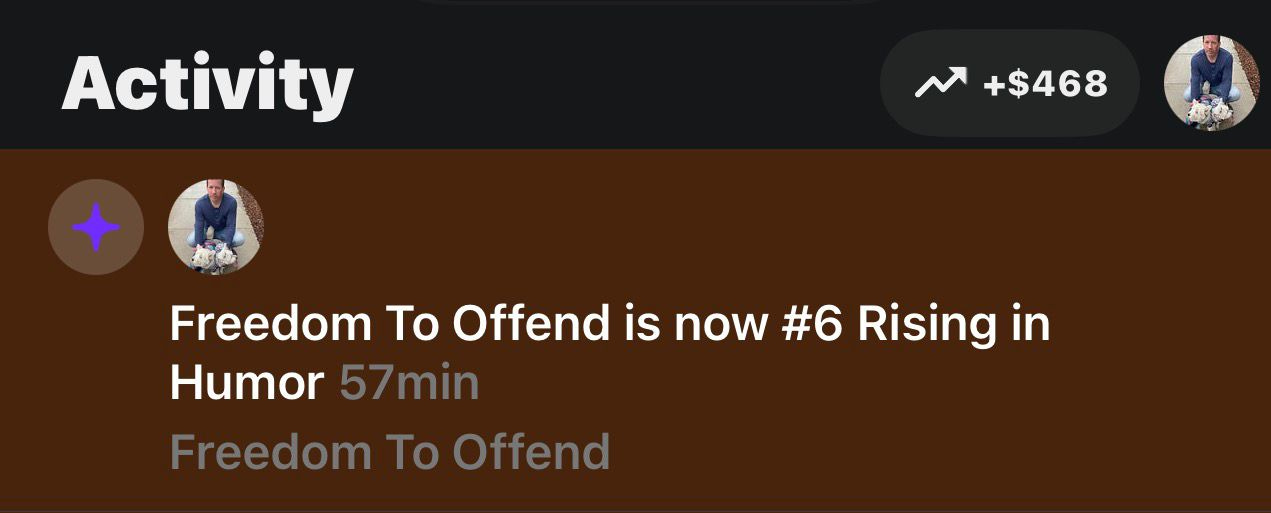
I find that one of the least funny things anyone can voice is the desperate “look at me, I’m funny.”
So naturally, that is exactly what I am doing.
I write on such crowd-pleasing comedic staples as euthanasia, Palestinian fraud, gaming addiction, pet grief, coerced ideology, and cheating AI girlfriends. It is, I admit, an odd way to climb the comedy charts.
But what I mean by “humour” is not stand-up rhythm or the verbal equivalent of slipping on a banana peel. I am not in the business of pratfalls, though I bear no ill will toward the noble fart joke. Laughter has its hierarchies. There is the laugh of release, the laugh of embarrassment, the laugh of cruelty, and then there is the laugh that exposes something rotten.
I aim, on my better days, for the last of these.
What I write is closer to satire than comedy — and satire is not giggling for its own sake. Satire has a moral spine. It sharpens exaggeration to reveal absurdity. It stretches a premise just far enough that you can see its bones. If it resembles anything, it is the Hitchens habit of taking a sacred cow by the horns and asking whether it might, in fact, be a goat in costume. The tone may sparkle; the intent does not. Satire is a scalpel, not a whoopee cushion.
I rather hope one admires the sheer perversity of taking Roald Dahl’s Charlie and the Chocolate Factory and refashioning it into an indictment of the modern bureaucratic state — Oompa-Loompas recast as compliance officers, golden tickets as regulatory permits, and Willy Wonka as the last eccentric capitalist hunted by committees. It took some work.
I suspect perhaps five people read it all the way to the end, but that is beside the point. Three said it needed to be shorter. I added another short chapter where people get high on their own hubris.
Satire is not a popularity contest; it is an autopsy. If the patient is institutionalised, one does not expect applause from the waiting room. One expects discomfort — and, if one is lucky, recognition.
Christopher Hitchens understood that mockery, properly deployed, is not juvenile — it is clarifying. It is the refusal to grant unearned solemnity. When institutions demand reverence for nonsense, satire becomes a civic duty. It is the raised eyebrow that says, “Explain yourself.” It is the polite but lethal question posed in a drawing room full of people who have agreed not to notice the elephant in the upholstery.
So when I call my Substack “humour,” I do not mean that I am auditioning for late-night television. I mean that I am trying to illuminate absurdities that have grown so normalised that they pass for wisdom. There is something inherently comic about a bureaucracy explaining why a four-year-old possesses metaphysical insight into gender but a university professor may not utter an unfashionable political opinion. There is something comic about a culture that can engineer rockets yet cannot define a woman. The laughter, when it comes, is not delight; it is recognition.
Satire is not opposed to seriousness. It is born of it. The reason euthanasia policy, ideological extremism, or technological loneliness can be written about with edge is precisely that they matter. The sharper the subject, the more carefully the blade must be handled. The point is not to belittle suffering; it is to expose the moral evasions surrounding it.
And yes, occasionally, amid the moral surgery, there is room for a crude joke. We are, after all, embodied creatures. But the purpose is never merely to be seen performing wit. The purpose is to unsettle complacency. If someone laughs and then winces — good. That means the satire did its work.
If that strikes some as abrasive, so be it. Satire has never been a spa treatment. It is a cold plunge. It wakes you up.
I was fired for calling out Hamas, but I must admit that was not satire; that was staring evil in the face.
Strive to be the man who dares to point at the king and proclaim he has no clothes. However people are awoken to the truth, itis always a noble cause. If it can be done by creating mild discomfort for some, and a smile on the inside for others, so much the better!
Keep on pointing and making us smile.
Always sharp. And we do indeed read to the end.