


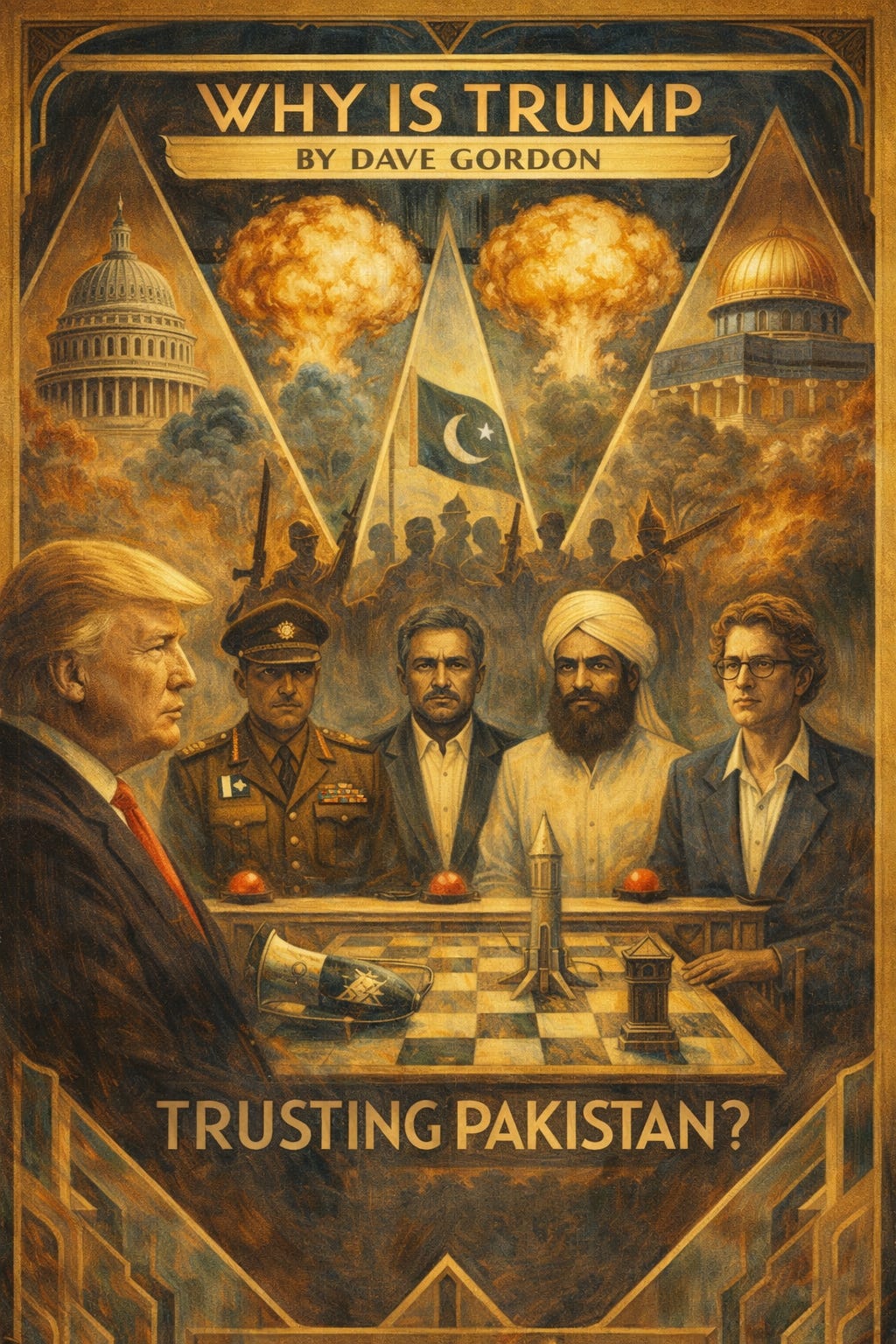
President Trump is making a big new bet on a dangerous partner: Pakistan. His administration is relying on Islamabad as a behind-the-scenes player in Iran and Gaza diplomacy, even though Pakistan helped build Iran’s nuclear program and long backed jihadist groups that killed Americans.
In January 2026, Pakistan’s foreign ministry announced that the country would join Trump’s “Board of Peace,” originally launched to work on Gaza. Pakistani officials have confirmed they are relaying a U.S. 15-point ceasefire and peace proposal from Washington to Tehran, and they have publicly offered to host direct U.S.–Iran talks in Islamabad.
On the surface, Trump’s move fits a familiar pattern of post-9/11 U.S. realpolitik: lean on “problem allies” such as Saudi Arabia, Qatar, and Pakistan as intermediaries -- with the very Islamist currents they helped to fund, arm, or shelter. But Pakistan is not just another unsavoury partner. It is the state whose proliferation network quietly accelerated Iran’s bomb quest, and whose security services incubated the Taliban–Al Qaeda nexus that drew the United States into its longest war.
How, then, did Pakistan end up as a broker in Trump’s Tehran and Gaza diplomacy? And what does it mean that Washington is again outsourcing high-stakes diplomacy bets to a country that’s shown no signs of reforming?
Any honest accounting has to start with A.Q. Khan, the Pakistani metallurgist who built a clandestine proliferation network that supplied Iran and others with nuclear materials, designs, and expertise. Open-source investigations, U.S. and European analyses, and think-tank reporting have long detailed the Pakistan–Iran connection, from centrifuge designs to sensitive components.
Islamabad insists Khan acted alone. Yet U.S. and European assessments, as well as work by the Washington Institute and the Institute for Science and International Security, strongly suggest that elements of Pakistan’s military and nuclear establishment almost certainly knew of, and in some cases facilitated, his activities. The problem was not just a rogue scientist; it was a state ecosystem that tolerated and exploited his proliferation side hustle.
Washington never forced real responsibility.
The United States accepted a finagled “confession,” allowed Pakistan to keep tight control over access to Khan, and effectively shut the case.
The nuclear file is only half the story. Pakistan also spent decades incubating jihadist actors such as the Taliban and the Haqqani Network inside a broader Al Qaeda–Taliban nexus, that took root in Pakistani tribal areas after 2001.
As analysts at the Foundation for Defense of Democracies and others have documented, Islamabad’s long-standing ties to these groups, and its use of militant proxies in Afghanistan and Kashmir, did not evaporate after 9/11.
A 2002 Cato Institute analysis argued that the Bush administration effectively traded Pakistan’s selective cooperation in the “War on Terror” for a “see-no-evil” approach to Islamabad’s dealings with extremists. The United States received some targeting and intelligence against selected groups, while Pakistan preserved its jihadist infrastructure.
A decade later, a U.S. Senate Foreign Relations Committee report in May 2011 was still flagging live connections between Islamist networks and Pakistani military and intelligence services. Three weeks earlier, U.S. Navy SEALs had killed Osama bin Laden in his walled compound in Abbottabad, Pakistan—an operation that humiliated Pakistan’s generals but never triggered a deep public house-cleaning over how the world’s most-wanted terrorist lived for years under their noses.
The pattern persisted well into the 2010s and 2020s. Cato and Brookings analysts in 2018 described Pakistan’s “double game,” noting its persistent acquiescence to safe havens for the Afghan Taliban and its Haqqani branch. The Council on Foreign Relations’ Global Conflict Tracker has likewise highlighted ongoing Pakistani military support for the Haqqani network, Lashkar-e-Taiba, and other militant proxies.
UN Security Council monitoring reports and UN-linked field analysis suggest these jihadist and insurgent networks were not dismantled after the U.S. withdrawal from Afghanistan, but instead shifted across the Afghanistan–Pakistan frontier, re-establishing sanctuaries under Taliban rule.
In February 2026, however, Pakistan suddenly declared “open war” on the Taliban regime, after lethal cross-border attacks, launching airstrikes on Kabul and other provinces. That escalation was less proof of a cleansed security environment than evidence of blowback from years of double-dealing. It certainly, though, could have been sold to U.S. policy-makers as “progress” or a “good step forward,” at least optically.
All of this intersects with the nuclear file. The joint U.S.–Israeli strikes that “decapitated” Iran’s nuclear facilities in June 2025 disrupted infrastructure and timelines. They did not, however, erase in its totality Iranian nuclear expertise, documents, or potential covert stocks of material.
Here Pakistan matters again. A state that once helped midwife Iran’s bomb program, and whose own strategic community has learned how to exploit proliferation grey zones, now sits at the centre of Trump’s informal diplomatic architecture for dealing with Tehran. The obvious question is what happens if any surviving Iranian know-how, designs, or material is resuscitated—with quiet Pakistani assistance—under the cover of a “peace process” that Washington is too invested in to scrutinize hard.
Given this record, why has Trump decided to trust Pakistan with such a sensitive role? Some possibilities might be:
1. Guilt-shaming.
The U.S. could have couched it as “you helped make the problem, now you help fix the problem.”
2. Transactional realpolitik.
Pakistan has channels into Tehran and Islamist networks that Washington either lacks or has allowed to atrophy. There’s also the idea that Pakistan, Gaza and Iran are, in essence, fellow Islamist travellers, and if you can “speak” the language of the negotiating partner – through a proxy – you’re in better shape.
On this reading, Pakistan’s past as the Ayatollah’s nuclear enabler and incubator of jihadist proxies is not forgotten, so much as conveniently put aside. It is the same logic that in the early days of the “War on Terror” drove Washington to rely on Pakistan for access to Afghanistan, while quietly shrugging at the Islamism festering in their backyard.
3. The “reformed Pakistan” illusion
A more optimistic possibility is what might be called the “reformed Pakistan” facade. Islamabad’s oh-so-recent declaration of “open war” on the Taliban, its desire to be seen as a responsible stakeholder, and its participation in Trump’s “Board of Peace” are read in Washington as signs that it wants to be taken seriously as a global mover and shaker.
The problem is their still-existent jihadist networks in their midst. It is politically convenient to pretend that a serial offender has turned over a new leaf, but wishful thinking dressed up as strategy is not a sound basis for nuclear and counter-terrorism policy.
4. Domestic optics and burden-shifting
Putting Pakistan on a diplomatic pedestal creates the image of muscular burden-sharing and international goodwill. Trump could tell the public and the press: “Hey, look, we’re bringing in all kinds of allies here, even people and places that I wouldn’t really agree with politically. They said they wanted to help, so let’s let them help. They might have something special to offer...”
It’s also pure optics: “we’re not anti-Muslim – we’re anti-Islamic Republic.”
5. A risky “4-D chess” gambit
A more cynical kind of long game. Washington may be consciously testing whether Pakistan can demonstrate “proof of concept” as a diplomatic broker. It’s to preserve a “working relationship” ahead of the next crisis... whether inside Pakistan, in a fractured Iran, in Afghanistan or perhaps elsewhere.
In other words: Flatter Pakistan in public – then hopefully reap a future defensive lineman.
In the end, the effect is the same. Washington is once again staking global security on the assurances of a state with no banked trust. President Trump has taken a lot of foreign policy gambles, some unpopular – and this one is a mystery that has yet to unfold.
— Dave Gordon
If you value this work, consider leaving a tip. It’s cheaper than therapy, less pious than public broadcasting, and the only censorship here is my bad taste. On second thought, it’s bad therapy.
Trump certainly thinks outside the box and acts in novel and unpredictable ways. Attempting to curry favor and turn Muslim nations such as Qatar and Pakistan into allies would work to achieve America's objectives, so long as Trump sticks to objectives beneficial to America and staunch allies such as Israel, who supported America despite knowing they would bear the worst of Iran's retaliation. It worked with Qatar as they influenced hamas to free the remaining living and most of the dead hostages. Remains to be seen long term how it works, especially given the dynamics of American politics and Trump hate hysteria by the Democrats, and on the Right and Left.
Really interesting analysis commentary. I doubt anyone in Trump's admin or Trump himself would actually trust Pakistan. Heck I doubt you'll find an informed person on the streets that would ever say - trust Pakistan. I'd say use them and watch.