


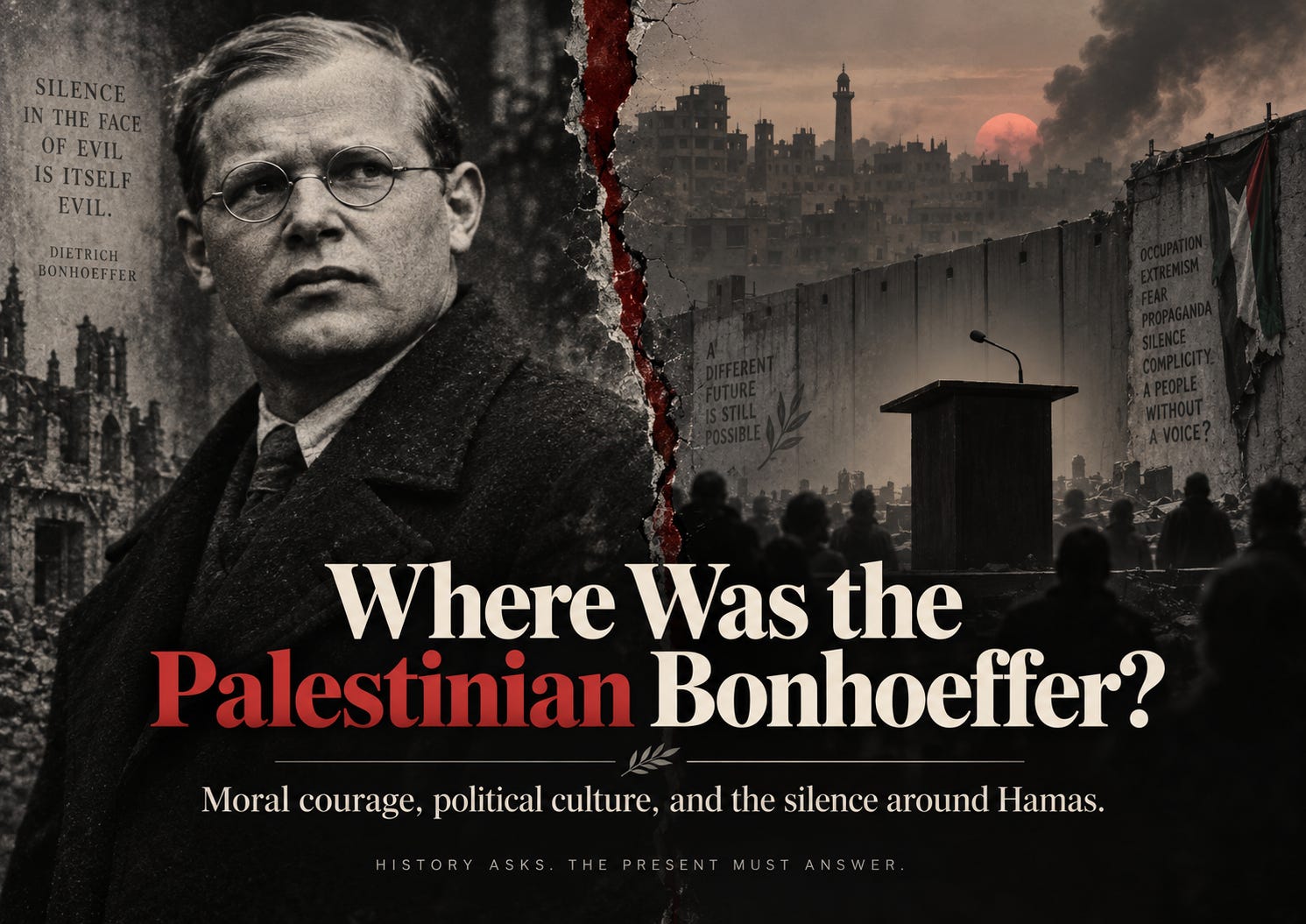
Dietrich Bonhoeffer was a German pastor and theologian who opposed Adolf Hitler, even when opposition was dangerous, isolating and eventually fatal. He had opportunities to remain abroad.
In the mid and late 1930s, with the danger of Nazism no longer a distant shape on the horizon but an approaching catastrophe, Bonhoeffer travelled to the United States and London. He could have stayed there. Instead, he returned to Germany, knowing perfectly well what sort of country Germany was becoming and what returning might eventually cost him. He refused the luxury of condemning evil from a safe distance while leaving others to endure it.
From the beginning, one of the central reasons for Bonhoeffer’s opposition to Hitler was the Nazi persecution of the Jews. He rejected the German churches’ capitulation to antisemitism. He defended Jews when the regime sought to exclude them. He opposed the removal of Jews from German public life. Most importantly, he insisted that the church’s obligation was not merely to bind the wounds of those crushed beneath the machinery of injustice, but, when necessary, to thrust a spoke into the wheel itself.
Bonhoeffer helped build the Confessing Church, became involved in the German resistance and was executed by the Nazis in April 1945, only weeks before the war in Europe ended.
Bonhoeffer matters because his life destroys one of the easiest excuses available to anyone living inside a corrupted political culture: Everyone around me believed it, so what was I supposed to do?
Not everyone believed it.
Not everyone submitted.
Some refused. Some spoke. Some resisted. Some paid for that refusal with their lives.
All of which leads to a question about Palestinian society that is treated in much of polite Western conversation as somehow indecent even to ask:
Where was — and where is — the Palestinian Bonhoeffer?
I do not mean the Palestinian who privately dislikes Hamas. I do not mean someone who mutters his misgivings to his wife or friend, but fears the men with guns, or whispers anonymously to a Western journalist that things have gone too far. Those people unquestionably exist, and some have shown considerable courage.
I mean the religious leader, intellectual, professor, political figure or popular movement willing to stand before Palestinian society and say plainly that hatred of Jews was corrupting it; that murdering Jewish civilians was evil; that kidnapping children was evil; that teaching children to romanticize martyrdom was evil; that Israelis had a right to live beside them; that Jews were not intruders upon Arab soil; that peace required accepting the permanent existence of a Jewish state; and that, if their own people refused to hear these things, then their own people were wrong.
Such Palestinians do exist individually. Some have paid heavily for dissent. Hamas is brutal toward opponents. Accusations of collaboration can be lethal. Palestinian political culture is authoritarian. It is infinitely easier to demand courage from a comfortable room in Toronto or London than from a street in Gaza City.
But courage under threat is precisely what made Bonhoeffer Bonhoeffer.
Fear does not make the moral question meaningless. It makes those who resist the fear more important.
The same confusion infects the use of the word civilian. A strange phenomenon surrounds that word whenever Gaza is discussed. It begins with an entirely correct proposition and ends with an absurd one.
Civilians are not combatants. They may not lawfully be attacked merely because of their political opinions, because they voted badly or because they live under a terrorist government. A civilian does not lose protection because he believes something stupid, hateful or monstrous.
But from that legal truth another proposition has somehow been manufactured: that Palestinian civilians can be politically unrelated to Hamas, untouched by its ideology and irrelevant to any discussion of the society from which Hamas emerged.
That does not follow.
A civilian may be innocent of any crime and still believe terrible things. A society may contain children, dissidents, terrified opponents and genuine peacemakers while also sustaining a political culture in which violence has acquired enormous legitimacy.
“Not every Palestinian is Hamas” is obviously true.
“Hamas tells us nothing about Palestinian society” is obviously false.
We should have the courage to hold both ideas in our heads at once.
We understand this distinction perfectly well almost everywhere else. Only a minority (about 10%) of Germans formally belonged to the Nazi Party, although membership eventually numbered in the millions. Nobody serious concludes from that fact that National Socialism was merely an eccentric club that happened somehow to seize control of uninformed society. Nor does any serious historian say that every German was equally guilty. There were fanatics, conformists, opportunists, beneficiaries, frightened bystanders, opponents and rescuers.
There were Bonhoeffers.
Gaza is not Nazi Germany, and Hamas is not the Third Reich. Historical analogies become foolish when they are stretched until everything resembles Hitler. But Hamas did not descend upon Gaza from another planet.
Hamas grew directly from the Palestinian branch of the Muslim Brotherhood. Sheikh Ahmed Yassin and other Brotherhood figures founded Hamas during the First Intifada in 1987, and Hamas’s original charter explicitly identified the movement with the Brotherhood.
That lineage has its own ugly history. The Palestinian nationalist leader Haj Amin al-Husseini, the Grand Mufti of Jerusalem, became an enthusiastic collaborator with Nazi Germany. He met Hitler. He broadcast antisemitic propaganda from Berlin. He cooperated with the Nazi propaganda apparatus and supported recruitment efforts involving Muslim formations serving the Axis, including Waffen-SS units in the Balkans.
There was contact. There was ideological traffic. There was virulent antisemitism. European conspiracy theories about Jews migrated into parts of Middle Eastern political culture and interacted with older religious prejudices, colonial resentment, nationalism and the conflict over Palestine. Hamas inherited elements of that ideological world and fused them with Palestinian nationalism, Islamist theology, historical grievance and a commitment to armed struggle.
In the 2006 Palestinian legislative election, Hamas’s Change and Reform list received just under 45 percent of the vote and won 74 of 132 seats. Democracy rarely provides us with voters who have read and endorsed every paragraph of a party manifesto. But 45 percent is not a rounding error. Governments in Canada and Britain have governed with smaller shares of the vote.
And the alternatives do not rescue the comforting storyline.
The political party Fatah itself emerged from a tradition of armed struggle. The Popular Front for the Liberation of Palestine (PFLP) has a long history of terrorism and hijacking. Palestinian Islamic Jihad explicitly rejects accommodation with Israel. Together, movements with long records of violence or rejectionism accounted for much of Palestinian political life.
Mahmoud Abbas, routinely presented in Western diplomacy as the moderate president of the Palestinian Authority, wrote a doctoral dissertation that was based on holocaust denial and has repeatedly made remarks condemned internationally as antisemitic.
So one may say that “only” 45 percent voted for Hamas, but then one must examine what substantial numbers of the remaining voters supported.
Rejectionism and armed struggle are not angry fringe doctrines imported into an otherwise peaceful Palestinian political culture. To pretend otherwise is simply to misrepresent reality.
Pre-October 7 polling makes the point hard to evade. In September 2023, before the present war, the Palestinian Center for Policy and Survey Research asked Palestinians what was the most effective means of ending the occupation and establishing a Palestinian state, and armed struggle enjoyed support far greater than Hamas’ vote count
Then came October 7.
Hamas and allied armed groups broke through the Israeli border and carried out mass killings, kidnappings and atrocities. They murdered people in their homes and at the Nova music festival. Families were burned. Elderly people were abducted. Children were kidnapped. Attackers filmed parts of the assault themselves on the person’s phone, as they were committing the murders. They made fathers watch their children be killed. There is extensive evidence of sexual violence associated with the attack and the captivity that followed.
Civilians from Gaza also crossed through the breached border after the attack proceeded. The exact number, and the degree to which every person crossing participated in violence, remain disputed, but estimates of violent non-Hamas terrorists joining in were over 500.
Then came the crowds.
A crowd is not a census. Several hundred or several thousand people cannot pronounce a moral verdict on two million.
But the fashionable response goes much further. It requires us to pretend that the crowds signify nothing whatsoever.
Of course they signify something.
Israeli hostages were dragged through Gaza amid cheering, abuse and public celebration. Later hostage releases were repeatedly turned into choreographed pieces of political theatre, captives marched through crowds surrounded by armed and masked men. Even the return of bodies became a spectacle.
The Bibas family became perhaps the most unbearable example. Kfir Bibas was nine months old when kidnapped. His brother Ariel was four. Their mother, Shiri, was taken with them. Hamas falsely claimed they had died in an Israeli airstrike; Israeli forensic authorities later disputed that account and said the children had been strangled to death by their captors. What is beyond dispute is that the bodies of kidnapped children became props inside Hamas’s political theatre.
And when bodies and hostages can be displayed before cheering crowds, when people surge toward coffins and cameras, when suffering itself becomes a perverted theatre, it is intellectually cowardly to say that this tells us absolutely nothing about the surrounding political culture.
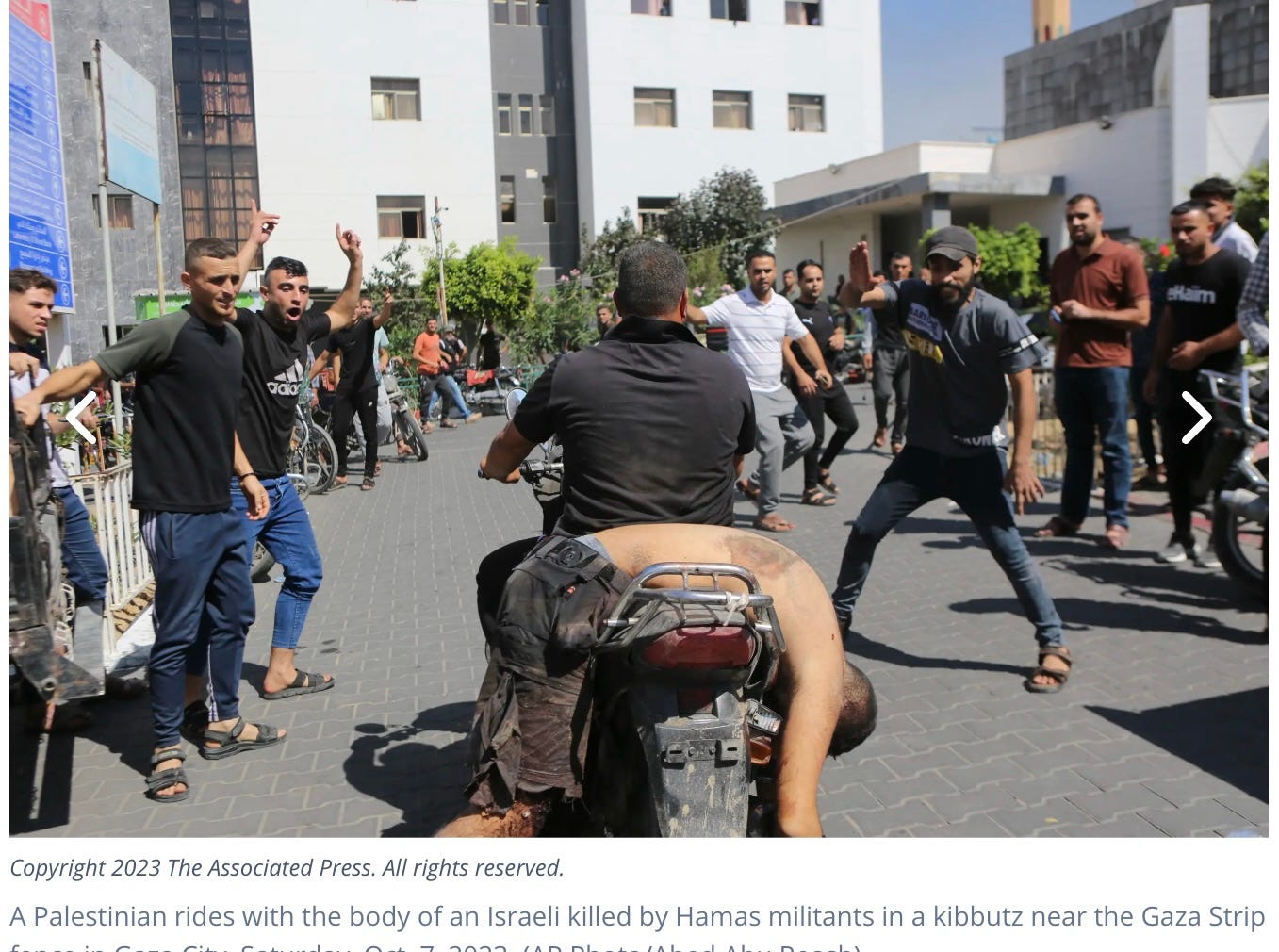
‘It does not describe every Palestinian.
It does describe something.
What kind of political culture makes such scenes socially possible?
Or is Palestinian society the one society on earth for which commentators demand 100 percent participation before permitting anyone to observe a social phenomenon?
Of course not.
The identity of some of the victims makes the point even more painful.
Some of the kibbutzim devastated on October 7 contained precisely the kind of Israelis Hamas propaganda — and a great deal of Western rhetoric — pretends scarcely exist: left-leaning peace activists, advocates of coexistence, supporters of a two-state settlement and Israelis who had personally helped Palestinians from Gaza obtain medical treatment inside Israel.
Vivian Silver of Kibbutz Be’eri spent years advocating coexistence and assisting Palestinians. She was murdered on October 7.
Yocheved and Oded Lifshitz of Nir Oz were peace activists who helped transport sick Palestinians from Gaza to Israeli hospitals. Both were kidnapped. Yocheved was eventually released. Oded died in captivity.
These were not caricatures of Jewish conquest.
They were not settlers advancing with rifles into a Palestinian village.
They were Israelis who had built part of their moral lives around the conviction that Palestinians should be treated as neighbours rather than enemies.
In the end, this meant nothing.
The attackers did not stop to ask whether an Israeli had marched for peace, supported two states or driven a Palestinian child to a hospital. The ideological category was sufficient:
Israeli.
Jew.
Zionist.
Enemy.
Gazans also worked in Israeli communities before October 7, where they had developed deep personal relationships. After the massacres, survivors described the terrible suspicion that information about kibbutz layouts, security arrangements and access points had been supplied to Hamas through people familiar with the communities. The very possibility of such betrayal was devastating precisely because Israelis in those communities had often supported employment, medical assistance and coexistence.
The schools matter as well.
One need not rely on Israeli advocacy organizations to find troubling evidence. European-funded and independent examinations of Palestinian educational material have repeatedly identified examples of antisemitic imagery or narratives, glorification of violence, celebration of martyrdom and maps or historical presentations that erase or delegitimize Israel. There is argument over the extent, interpretation and prevalence of this material. Palestinian textbooks are not one uninterrupted antisemitic screed.
But troubling material exists, and pretending otherwise insults the intelligence.
Children do not invent political cultures. Adults transmit them.
Adults inculcate the youth through textbooks, television, mosques, songs, posters, martyr commemorations, maps, heroes, family stories and the language used around the dinner table.
Of course not every Palestinian parent consciously requests such material. But societies are revealed not only by what everyone believes. They are also revealed by what becomes ordinary and by what fails to produce sustained internal resistance.
Where was the Palestinian mass movement demanding that children not be taught to romanticize martyrdom?
Where were the teachers insisting that Jewish children possess exactly the same moral value as Palestinian children?
If this is true, where were the Islamic theologians publicly and repeatedly teaching that murdering Jews dishonours Islam?
Where were the parents demanding that hatred be stripped from the curriculum?
The hostage question presses the same nerve.
Hundreds of captives were brought into one of the most densely populated territories on earth.
They had to be transported. Hidden.Guarded. Fed. Moved.
Some remained in captivity for many months.
Israel publicly appealed for information and offered rewards.
How could such an enormous hostage enterprise function for so long inside a civilian environment without implicit civilian consent?
Fear must explain some silence. Ignorance must explain some. Ideological sympathy must explain some. Coercion undoubtedly explains some.
But simply uttering the word civilian and closing the file explains nothing.
A society in which hostages can be concealed, transported and publicly displayed over long periods deserves analysis of the social environment in which that could occur, even while the legal and moral distinction between fighters and civilians remains absolute.
None of this erases Palestinian suffering.
A Palestinian child killed in war does not become guilty because of a poll taken among adults.
A Palestinian mother remains a civilian regardless of what her neighbour believes.
Few deny collective guilt is wrong.
But the doctrine of collective innocence — the increasingly fashionable idea that Palestinian society itself cannot be morally or politically examined at all — is nonsense.
Palestinians are human beings.
We infantilize them when we pretend they possess no agency.
They can be victims.
They can be perpetrators.
They can be peacemakers.
They can be propagandists.
They can be dissidents.
They can be enthusiasts.
They can be courageous.
They can be cowardly.
To deny them this moral complexity is not compassion.
Hamas is not every Palestinian.
But Hamas grew from Palestinian society. Palestinian society was the rich loam in which the organization recruited, governed, propagandized and entrenched itself. It received substantial political support, influenced institutions and spent years preparing for a war that any remotely intelligent observer must have known would bring suffering upon Gazans.
The proper question, therefore, is not whether every Palestinian supported Hamas.
Of course they did not.
The question is why a movement committed to permanent struggle could become so deeply rooted without producing an equally powerful indigenous movement committed to coexistence.
Germany had Bonhoeffer. It had the White Rose. It had Germans who hid Jews. It had clergy who resisted. It had conspirators who tried to kill Hitler.
They were minorities — often tiny minorities — but history remembers their names precisely because they stood against the moral current of their own society.
The Palestinian people deserve such figures too.
Where are they?
Perhaps some exist now, hidden by fear and drowned out by gunfire. If so, they, rather than Hamas, should become the heroes of Palestinian national life.
Their names should be taught in schools.
Their faces should appear on posters.
Their courage should be celebrated in mosques, universities and homes.
A future Palestinian national story capable of coexistence will require heroes whose greatness comes not from killing Israelis but from refusing to hate them.
It will require a political culture in which the murder of a Jewish child produces the same instinctive horror as the murder of a Palestinian child.
It will require a society in which mothers do not dream that their sons will become martyrs by strapping explosives to themselves and killing Jews.
It will require coexistence with Jews no longer to be treated as surrender.
It will require an Israeli to be capable of becoming a neighbour without first ceasing to be a Zionist.
It will require a man who drives your sick child to a hospital not to become deserving of death because he sleeps beneath an Israeli flag.
Bonhoeffer understood something more important than opposition politics.
He understood that the first obligation of a moral person living inside a corrupted political culture is not merely to explain how his own people became corrupted.
It is to refuse the corruption.
No peace worth having can be constructed on the fiction that only one side possesses moral agency while the other exists permanently as a victim, acted upon by history but never responsible for shaping it.
Until the Palestinian voice of refusal becomes louder than the men with guns, the barrier between Gaza and Israel will remain more than concrete.
It will remain an elusive idea.
Note to readers: Please consider a paid subscription. I won’t patronize you with the usual “it costs the same as two cups of overpriced coffee a month” routine. Keep the coffee. Enjoy the coffee. For the love of all that is holy, however, please don’t put Coffee-Mate in it. Life is difficult enough without voluntarily introducing that substance into your bloodstream.
If a paid subscription isn’t possible, please repost this. You’re unlikely to read much like it in the CBC, Toronto Star or Globe and Mail. Between federal support and Google money, much of Canadian media has become remarkably domesticated. I prefer to remain housebroken only in the most technical sense.
Consider leaving a tip if you want to support Freedom To Offend

Islam has had its apostates for centuries; they were all murdered. There have been attempts at an Islamic Reformation several times. All were killed, so most of the names are unknown to us. Muslims killed their reformers and apostates, their Martin Luthers and Dietrich Bonhoeffers. Islam is by far the most violent religion in world history, with over 50,085 deadly terror attacks since 9/11 (see https://www.cspii.org/trop).
Hamas is an Islamic terror group, the sole purpose of which is to destroy Israel and kill Jews as a religious duty. It's not about the welfare of Palestinian people or even creating a nation-state for themselves. They have one purpose: to genocide Jew as they did on Oct 7th. It is an end in itself, a religious ritual they desire with all their hearts, being conditioned to give their lives to it from an early age, as seen in their war training of toddlers. The desire to murder Jews is part of the Islamic faith now. Robert Spencer and others argue it always has been, for 1400 years. They accept only Jews who are subordinate and pay the dhimmi tax. A powerful Jew, like a Zionist, is seen as a threat to their very identity. It's an irrational religious ideology.
Their group identity was manufactured in the 1960s for that single purpose. Yes, there were anti-Zionist Arabs before that, but Palestinianism was created for that purpose, co-opting the name from an old name for the religion that previously never applied only to one small group of Arabs Muslims. Jews had Palestinian passports as well between the wars. The PLO took the name, added Marxist ideology, and got the USSR's backing to destroy Israel -- now supported by Communist China. The Communists had their own agenda: destroy the USA. If Palestinians wanted their own state, they had the chance in 1947, and many times since, but it was never really about that.
Of course, deep down there is also a human being that periodically surfaces in the form of an apostate, one who rejects the violence and the genocidal agenda and just wants to live. When this happens, such individuals are murdered. Maybe a few escape to the West and live normal lives, but they know better than to challenge Hamas, even abroad. Once in a while, an exceptional individual will speak out against Hamas and live to tell about it, from a safe distance, in another country, like Mosab Hassan Yousef. That's quite rare.
There was a public protest against Hamas in Gaza in March 2025. I saw it on the news and knew the people in it had sealed their fates and would be murdered. It was an act of extreme courage and desperation after losing everything in the war that Hamas started. Odai Nasser Al Rabay (Sadi) was the fearless 22-year-old leader. He was captured by the Al-Qassam Brigades, Hamas's armed wing, and beaten with clubs and metal rods for four hours, tortured to death, and his body was left on his family's doorstep as a warning to other dissenters. Following that protest, Hamas publicly executed at least six other individuals accused of leading protests or collaborating with external entities.
Someone named Yasser Abu Shabab, leader of an armed anti-Hamas Bedouin tribal militia based in Rafah, was shot in Dec. 2025. His group got backing from Israel to challenge Hamas's post-war governance. Who shot him is not certain, but Hamas had called for his head.
When Hamas came into power, they executed members of the rival party at the time. They also, of course, killed thousands of their own people by forcing them to be human shields,s martyrs for Islam in conflicts with the IDF.
If there are Bonheoffers, we never hear of them because they're killed. Also, with very few exceptions, Arabs tend not to be great thinkers or philosophers like Bonhoeffer. And there is no moral core to their religion that they can easily appeal to for universal peace or human decency, unlike Christianity. Islam is a religion based on hate and tribalism, not love. Their leader was a warlord, in stark contrast to Jesus' ethical teachings.