


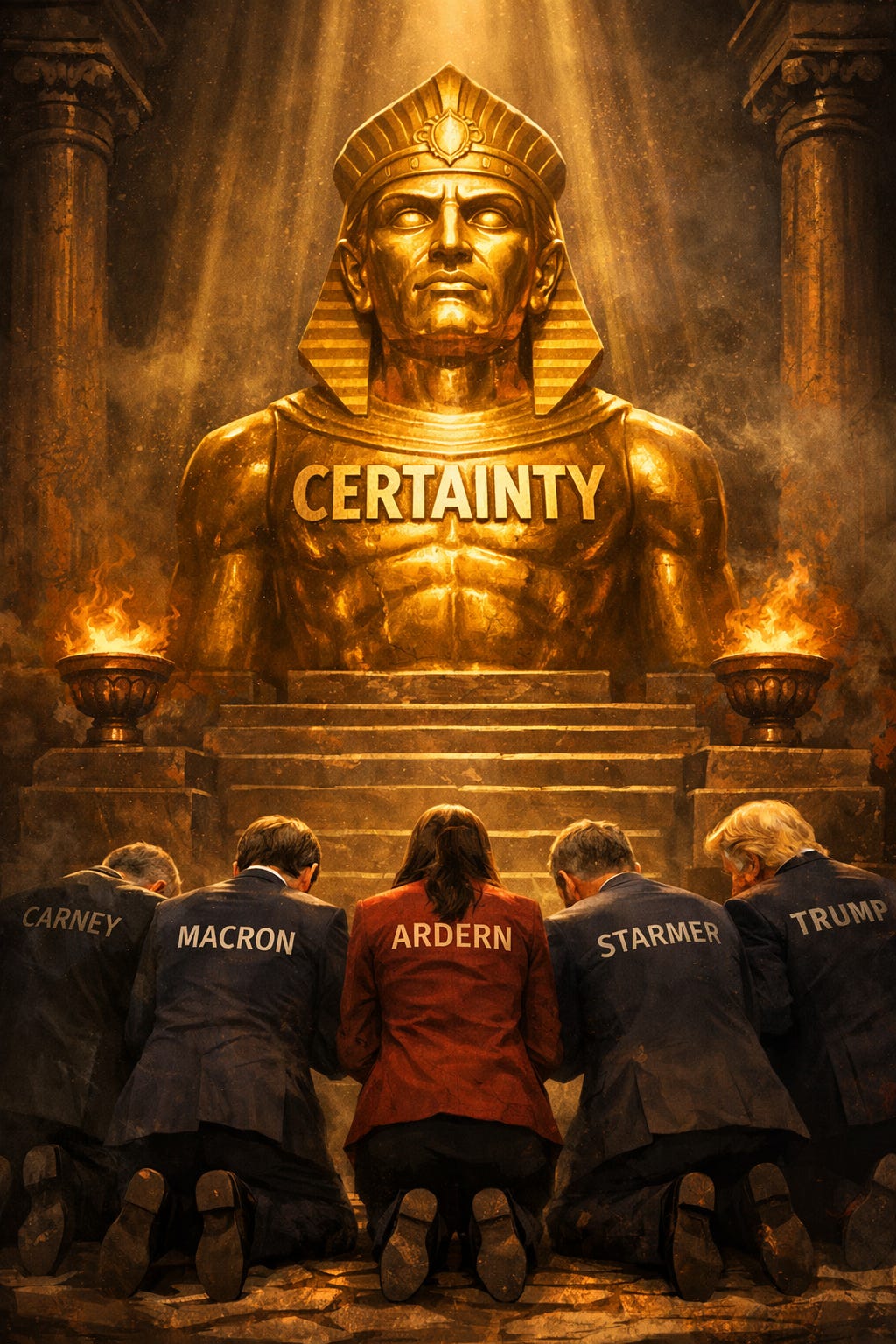
When Jacinda Ardern — former Prime Minister of New Zealand, Davos luminary, and global emblem of empathetic governance — described free speech as a potential “weapon of war,” she did not stumble.
She revealed something. A window opened to her soul.
In that phrase, we glimpsed the instinct beneath it: the belief that speech is not a liberty to be defended but a force to be managed. That citizens are not sovereign thinkers but variables in need of calibration. That stability requires supervision.
For that clarity, we should be almost grateful.
Because moments like this illuminate more than policy; they illuminate temperament. They show us how today’s political class — not just in Wellington, but in Ottawa, Paris, London, Washington — increasingly thinks.
They believe they are stewards of order. They believe they are curators of truth. They believe society is safer when filtered through their judgment.
It is revealing. It is instructive.
Thank you, Jacinda.
She warned that online speech can shape reality. That misinformation may persuade citizens that a war is “legal and noble.” That climate change might be denied. That “hateful and dangerous rhetoric” may erode human rights. Such forces, she argued, “cause chaos” and weaken the collective strength of nations.
The tone is calm. The vocabulary is responsible.
But the framing is radical.
The threat she describes is not violence. It is a belief.
If citizens conclude that a war is just when leaders insist it is not, that becomes “destabilising.” If they question the urgency or framing of climate policy, that too is branded as destabilising. If they scrutinise prevailing human rights doctrines, destabilising once more.
And yet the deeper instability does not arise from disagreement. It arises from the certainty that disagreement itself is intolerable.
The “weapon” is persuasion that contradicts leadership.
And once speech is framed as weaponry, regulation becomes defence.
She admits she cannot yet define the precise solution — but speaks with “complete certainty” that the problem cannot be ignored.
Complete certainty.
That is what should alarm us. Certainty is a dangerous register for a politician. It implies finality. It implies authority over truth. It implies that dissent is not merely disagreement but a defect.
Let us assume sincerity. Let us grant that she believes misinformation corrodes democracy. That she believes social cohesion is fragile. That she believes she is acting in good faith.
That is precisely the problem.
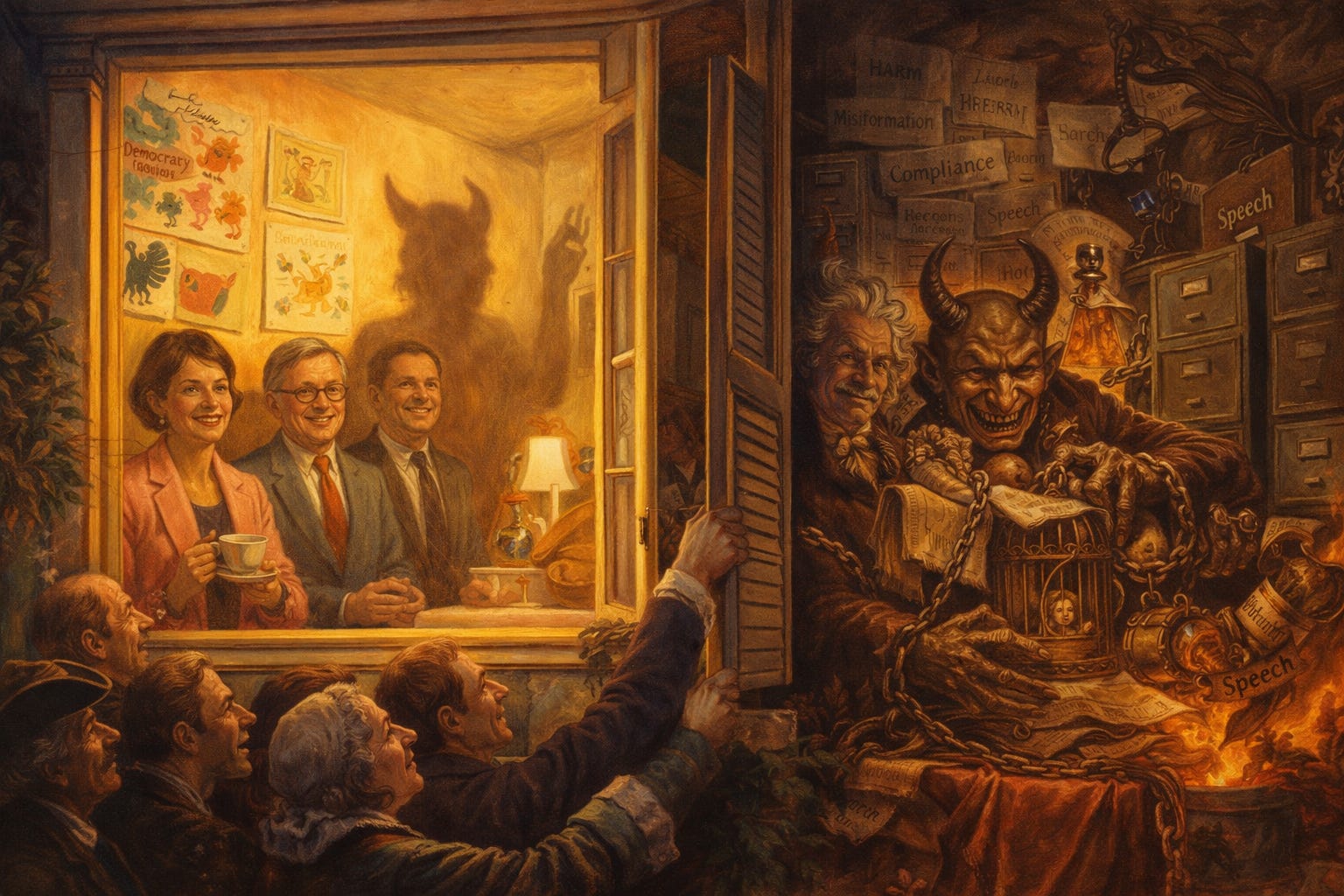
Because once a leader concludes that dissent weakens society's collective strength, free speech ceases to be foundational. It becomes conditional. It becomes subordinate to policy.
In a free society, error is corrected by argument. Falsehood is defeated by evidence. Citizens persuade one another. The public square is turbulent because liberty is turbulent.
The managerial instinct distrusts turbulence.
If citizens can be persuaded of the “wrong” interpretation of a war, perhaps such persuasion must be limited. If citizens can be persuaded that climate policy is misguided, perhaps such narratives require filtering. If citizens question emerging social doctrines, perhaps that rhetoric requires supervision.
She speaks of research. Of tools. Understanding how information is curated. Of defending collective strength.
The premise is clear: society is safer when information flows are managed by people like her — people who believe they possess a clearer, more responsible understanding than the general public.
And that is not a new idea. It echoes an older, more dangerous claim: that a morally enlightened class has access to truths the ordinary citizen cannot grasp. The revolutionary vanguard once called it class consciousness — a higher awareness that justified directing, correcting, and, when necessary, silencing the masses for their own good.
The language today is softer. It speaks of “curation,” “harm reduction,” and “collective strength.” But the structure is familiar. An elite defines reality. The public is deemed susceptible. Dissent becomes destabilisation.
The difference is rhetorical, not structural.
Then it was the Party that knew best.
Now it is the managerial class.
In both cases, the assumption is the same: that society is safer when filtered through those who consider themselves more enlightened than the people they govern.
This instinct is not hers alone. Leaders across the ideological spectrum share it. They differ in tone, not in impulse. Each believes certain narratives are too destabilising to circulate freely. Each believes stability requires guardrails.
They are not villains.
They are certain.
“Misinformation.”
“Disinformation.”
“Harmful rhetoric.”
These words sound clinical. They are elastic. They depend entirely on authority.
Who decides what is false?
Who decides what is harmful?
Who decides when scepticism becomes sabotage?
The bridge from certainty to policing speech is short. The bridge from policing speech to eroding other freedoms is shorter still. Once speech is conditional, every other liberty rests on administrative discretion.
Free speech is not one value among many.
It is foundational. It sits at the bottom of the structure. It protects the right to criticise climate policy, to defend a war, to question human rights doctrine, and to challenge leadership itself.
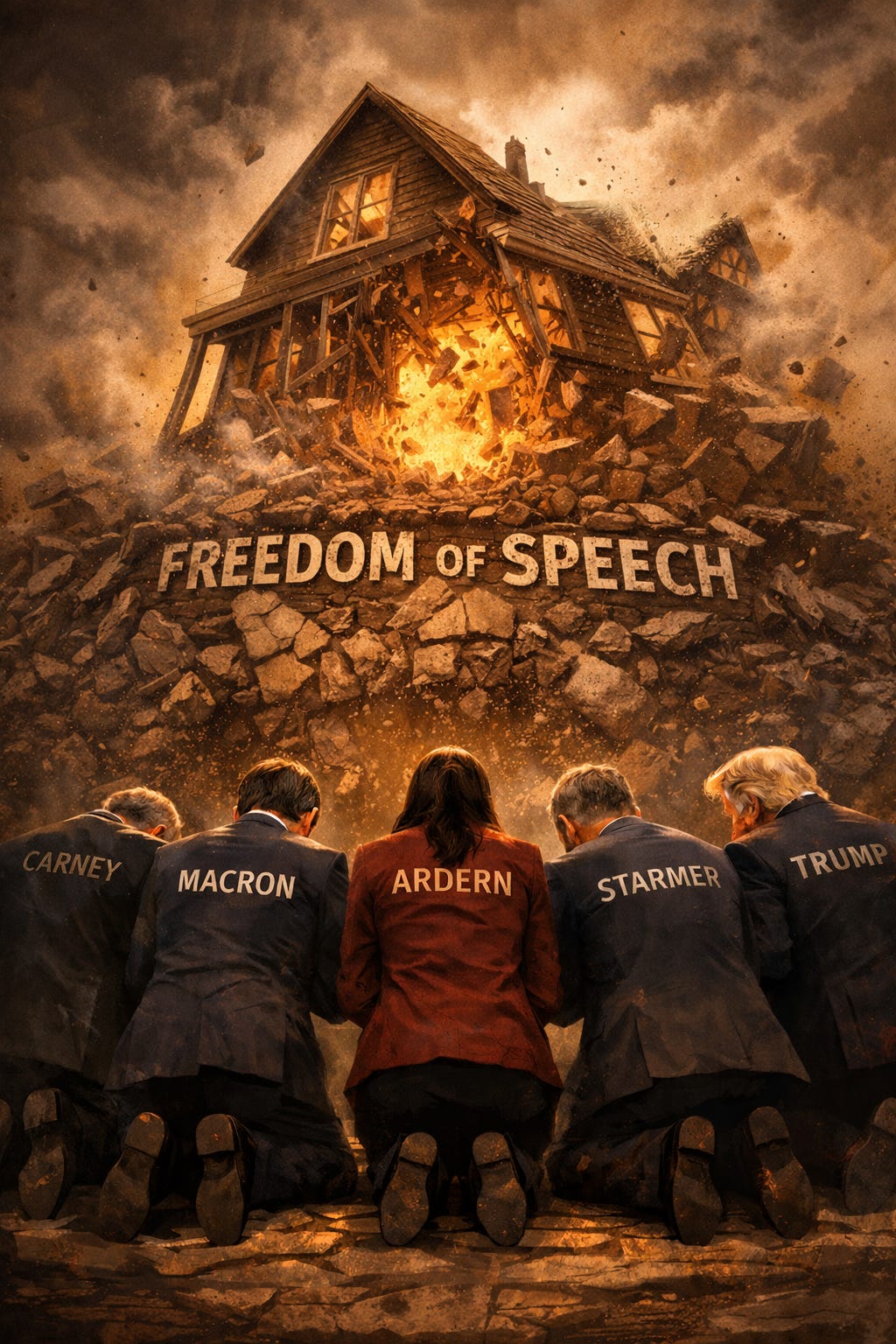
If you weaken the foundation because you distrust the occupants, the house does not stand stronger. It collapses.
Politicians will always believe they are acting for the common good. They will always believe they see dangers more clearly than the crowd. They will always be tempted to substitute their judgment for public contestation.
What should alarm us is not conspiracy. It is language that carries the confidence of the final truth. It is the inappropriate certainty of those who wield power.
When Jacinda Ardern called free speech a “weapon of war,” she did not announce a policy of censorship.
She exposed a governing instinct: that liberty is admirable until it interferes with consensus.
And that instinct is not theoretical to me.
I have watched a senior academic administrator — the Vice Provost of the University of Guelph-Humber, Melanie Spencer-Ariemma — suspend me, shut down my communication with staff, faculty, and students, and imply that my words were too dangerous to be heard.
I had condemned a terrorist group that she was obviously quite fond of.
The saddest thing is that senior executives at the University of Guelph, Humber College and the University of Guelph-Humber do not fundamentally understand free speech. They are fully on board with Jacinda. At universities!
No debate. No cross-examination. No awkward moment in which competing arguments are forced to stand under fluorescent light and fend for themselves. Just the serene, bureaucratic presumption: this speech is harmful — therefore it must be isolated. Not answered. Not rebutted. Not tested.
Contained.
And if containment proves insufficient, then escalation is required. Terminate — their word, not mine — the speaker. Remove the inconvenience. Eliminate the dissonance. Restore the atmosphere.
And so it was done.
The modern censor does not argue; he diagnoses. He does not persuade; he classifies. The verdict precedes the inquiry. The charge manufactures the guilt. Once the word harm is uttered with sufficient solemnity, the discussion is declared over, and the disciplinary machinery begins to hum.
And let us dispense with the fairy tale that such policing will ever be neutral.
The regulation of speech will always have an agenda because it is born of one. It will always be selective because selectivity is the point. The slogans of power will circulate freely; the slogans of dissent will be scrutinised for “impact.” Approved heresies are granted panels and funding; disapproved ones are escorted to investigation.
We are told this is unfortunate but necessary — the regrettable trimming of excess liberty in the interest of stability. But the trimming is never symmetrical. It does not fall randomly. It falls where authority feels threatened.
Selectivity, as the cliché goes, is not a bug in the system. It is the operating system.
For in my experience, at the same time, a man who publicly described Jews as filth, subhuman, satanic, devil worshippers — thousands of posts — was treated as a credible moral authority in the process that ended my career.
He was a longtime acquaintance of the noted VP; the human rights complaint notes that he had her personal number.
When I described Hamas as Nazis, referencing their historical ties to the Muslim Brotherhood and documented ideological sympathies with National Socialism, it was labelled misinformation.
Not investigated. Not debated. Simply declared false.
That is what certainty does when it is fused with institutional power. It does not argue. It asserts. It does not test claims. It presumes bad faith.
And the larger danger is not personal.
I am, at most, a canary in a coal mine.1
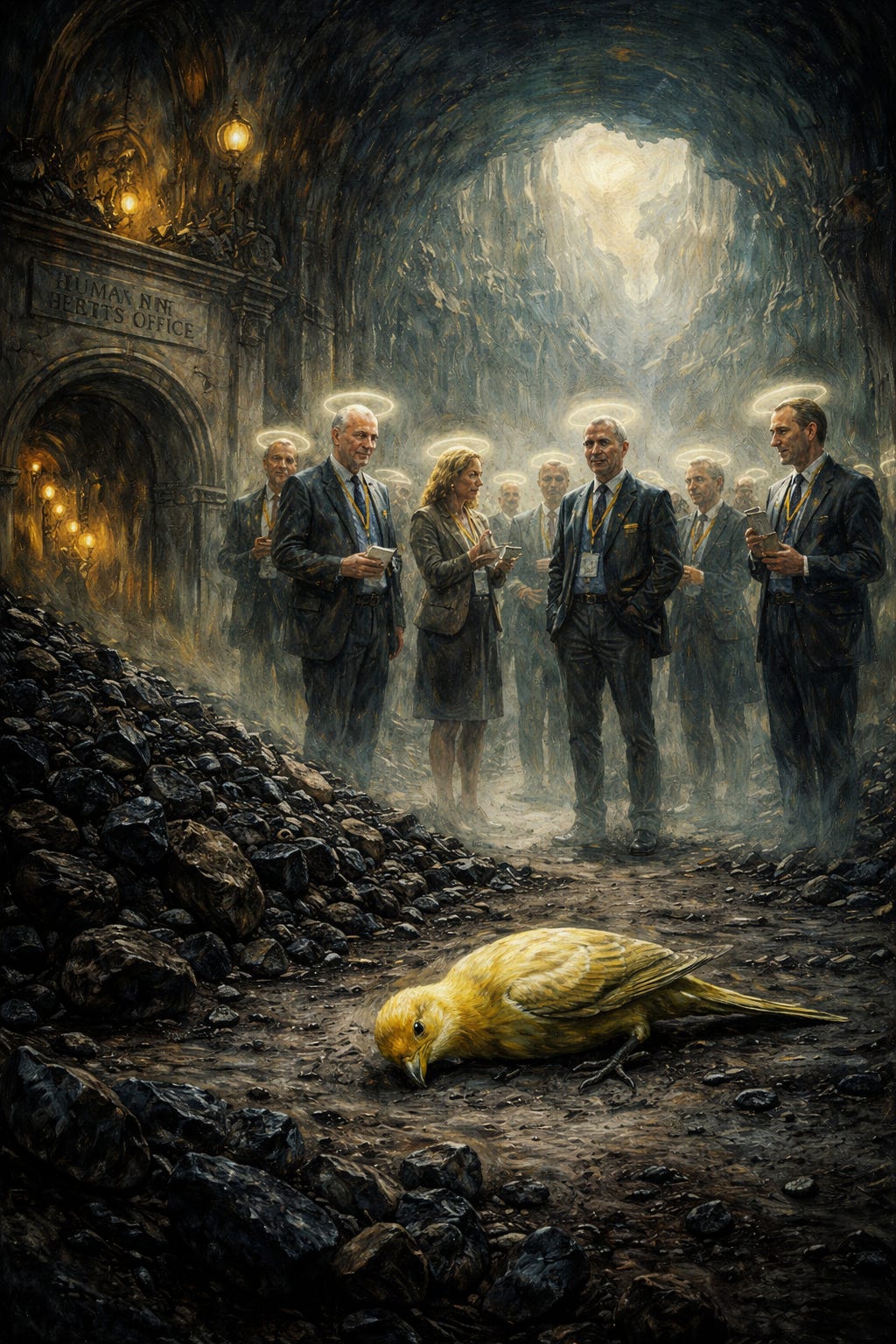
What happened to me affects very few people. But the logic behind it — the conviction that certain speech is too destabilising to permit — scales easily.
Universities are granted wide discretion. Governments defer. Legislatures consider expanding categories of prohibited expression. Each step is justified as protection.
The bridge from certainty to policing speech is short. The bridge from policing speech to weakening every other foundational liberty is shorter still.
Free speech is not protected because it produces tidy outcomes. It is protected precisely because leaders are fallible. However compassionate, however intelligent, however certain — no one is entitled to curate reality for everyone else.
That is why it is called foundational.
You can debate policy. You can criticise governments. You can defend or oppose wars. But if the foundation is pulled out because those in power distrust the conclusions citizens might reach, the structure above it does not become safer.
It collapses.
And when it does, it will not be because of chaos from below.
It will be because of certainty from above.
The mistake is to go hunting for villains.
There are none in capes.
The people who do this do not consider themselves tyrants. They think of themselves as custodians. In their own minds, they are not dismantling liberty; they are refining it. They are not silencing dissent; they are protecting the vulnerable. They are not narrowing the permissible; they are civilising it.
And frankly, their self-perception is irrelevant.
It does not matter whether someone believes they are doing good. What matters is whether good is done. History is littered with catastrophes engineered by people who were certain they were on the side of virtue.
Pull out the foundation, and the house falls — no matter how benevolent the architect.
And when liberties are thinned, they will not be stripped away by snarling monsters. They will be eased out of existence by polished professionals. By women in immaculate Prada and perfect nails. By men in Savile Row who quote Havel at dinner and sit on the boards of tasteful charities. By people with excellent manners and impeccable résumés who speak softly about safety, cohesion, and responsible governance.
The danger will not announce itself with fangs.
It will smile.
If you found value in this article and wish to support my ongoing work, please consider leaving a tip. Your support helps me continue producing uncensored content on critical issues.
A small point of interest.
The same social-media platforms that hosted — without interruption — thousands of grotesque, Jew-denigrating posts from my accuser suddenly discovered their moral scruples when I reposted those exact same images to expose him.
I did not fabricate them. I did not embellish them. I did not alter a pixel.
I took them directly from his publicly available accounts — accounts that remained live, tolerated, and algorithmically distributed.
When he posted them, they were a permissible expression.
When I reposted them as evidence, they were flagged as “violations.”
That is not safe.
That is selectivity.
Hatred is allowed when it flows in a direction the system finds politically convenient. Exposure of that hatred is disallowed when it embarrasses the wrong people.
The content did not change. The pixels did not change. The language did not change.
The only thing that changed was the target of scrutiny.
And that is the quiet architecture of managed speech. Not the elimination of extremism — but the management of optics. Not the removal of harm — but the removal of discomfort for institutions aligned with prevailing sensibilities.
Selectivity, as the cliché goes, is not a bug.
It is the design.
Bravo