



(Play simple, top right, Substack mobile app only)
When people announce that they are anti-Zionists—usually with the reflexive appendage, “but not anti-Semitic”—they tend to do so with the confidence of someone stating an obvious fact. The phrase is delivered as if it were self-evident, like gravity or the existence of Tuesdays. One is expected to nod solemnly, murmur assent, and move along.
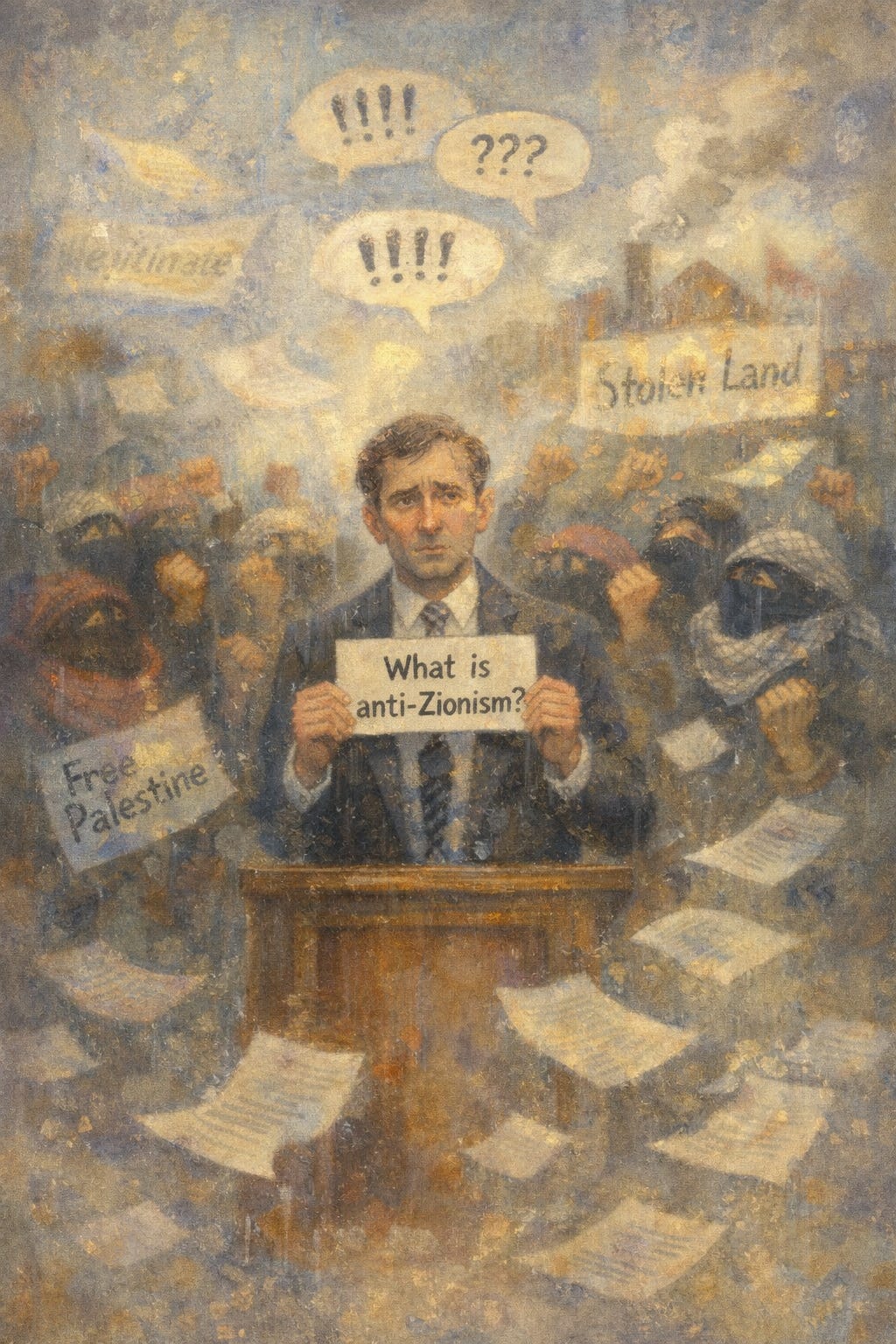
And yet, when one asks the most elementary follow-up—what exactly does that mean? What is anti-Zionism?—the answer never arrives in the form of a definition.
What arrives instead is a cloud of accusations, slogans, and moral gestures, loosely bound together by indignation. It is the intellectual equivalent of someone pulling a fire alarm to avoid writing the exam.

The responses are, by now, almost ritualistic in their predictability. Israel is declared historically illegitimate. Land was “stolen.” Civilian deaths are invoked—usually without context, always with theatrical certainty. Nationalism is denounced in the abstract. Religion, suddenly, is deemed an unacceptable basis for statehood.
Zionism itself is then collapsed into whatever policy, government, or military action happens to offend this week’s sensibility. The charges are presented as cumulative, devastating, and beyond dispute.
But none of them—not one—answers the question that was actually asked.
And one is entitled to press further. What, precisely, is the proposed outcome? Do anti-Zionists imagine that Israel is to rent a convoy of U-Hauls, fold up seventy-five years of sovereignty, and politely vacate the premises because they disapprove of its origin story—an origin story they themselves refuse to examine with any consistency or intellectual honesty?
For there is an unspoken fantasy at work here: that nations, in general, were formed in some pastoral calm—birds obligingly chirping, the sun casting a benevolent glow, and a gathering of wise and courteous statesmen sketching borders with mutual satisfaction. Israel, in this telling, is the lone barbarism intruding upon an otherwise civilized pattern.
The truth is rather less sentimental. Borders are not composed; they are fought over. States emerge from the wreckage of empires, from war, partition, displacement, and the steady accumulation of grievances no one agrees upon and no one forgets. Refugees are created, populations move—sometimes by choice, often not—and no settlement satisfies all parties. That is not an aberration. It is the rule.
And against that background, Israel’s creation—however imperfect, however contested—was not some rogue improvisation but one of the more legally structured and internationally mediated formations of the modern era. That fact is not denied. It is ignored.
And once the mythology of immaculate nation-building is set aside—once we admit that states are born in friction, not in fable—the evasions become harder to sustain. The question cannot be postponed by sentiment or obscured by selective outrage.
This is not confusion. It is evasion, practised with confidence and rewarded with applause.
So let us slow things down and insist—rudely, if necessary—on definition before denunciation. Zionism is not a secret doctrine, nor a coded insult, nor a mystical toxin that infects policy. It is the belief that Jews, like other peoples, are entitled to national self-determination in their ancestral homeland.
And here we encounter the first sleight of hand: the insistence that “Jew” is merely a religious category, as though it were interchangeable with denominational preference. It is not.
Jewish identity is older, thicker, and far more inconvenient than that—a fusion of peoplehood, history, culture, and ancestry, traditionally traced through the maternal line, alongside a spectrum of belief. One may be devout, secular, or somewhere in between, and still unmistakably part of the same people.
It is, in fact, a rather remarkable continuity. The Jews have outlasted the Philistines, the Hittites, and a long procession of empires that once mistook themselves for eternal and are now reduced to footnotes and glass cases.
They persist—still numbering only around fifteen million worldwide, not the imagined hordes of conspiracy or casual ignorance (Joe Rogan, among others, once managed to overshoot that figure by almost two orders of magnitude).
To reduce all of this—to compress a civilization that has survived millennia of exile, expulsion, and attempted annihilation—into “just a religion” is not analysis.
It is evasion dressed up as sophistication.
And before the predictable objection arrives—that a nation tied to a particular identity is somehow illegitimate—one might briefly consult reality. Dozens of countries were formed with Islam as a central organizing identity, and today roughly fifty states either designate Islam as their official religion or embed it deeply within their legal and constitutional frameworks.
This fact rarely occasions moral panic or demands for consistency. Yet when the same principle—self-determination of a people in a homeland—is applied to Jews, it is treated as uniquely suspect. That is not a universal standard. It is a selective one, and it rests either on anti-Semitism or on a deliberate refusal to think clearly when the subject turns to Jews.
That is the entire proposition. It does not dictate borders, mandate observance, or prescribe policy. It asserts only that Jews are a people—and not a scattering of individuals indefinitely dependent on the goodwill of others.
Or, as Theodor Herzl put it with admirable bluntness: “If you will it, it is no dream.” Not a dream of conquest, but of normalcy—the modest ambition of being allowed to exist like everyone else.
Modern Zionism arose in the nineteenth century not from religious intoxication but from realism bordering on pessimism. Jews in Europe were not fleeing theology; they were fleeing patterns—pogroms in the east, exclusion in the west, and the recurring lesson that assimilation was always conditional and easily revoked.
Zionism was not born of triumphalism but of recognition: that tolerance is not the same thing as security. Jewish memory, prayer, and orientation toward Jerusalem long predated nationalism as a theory. The movement did not arise because Jews felt powerful, but because repeated experience taught them that being tolerated as a minority did not protect them from expulsion, massacre, or betrayal.
It is therefore simply false to claim that Israel was conjured into existence as an emotional afterthought to the Holocaust. Zionism did not begin in 1945. It was already decades old. The Holocaust did not create Zionism—it vindicated its bleakest assumptions.
And yet, even setting that aside, the moral contortions that follow are difficult to take seriously. After the worst genocide in modern history, in which roughly two-thirds of European Jewry were systematically exterminated, the re-establishment of a Jewish state is singled out—not as understandable, not even as regrettable—but as uniquely illegitimate. Of all the nation-states on earth, it is this one that is told it should not exist.
At that point, we are no longer dealing with criticism or argument. One may call it bad faith—but at this level, such bad faith becomes indistinguishable from anti-Semitism.
We then arrive at the next refrain: that Israel is historically illegitimate. This claim is delivered with immense confidence and almost no history. Israel did not arise from a midnight land grab or a legal conjuring trick. It emerged from the collapse of an empire, through an internationally recognized mandate system, after decades of commissions, negotiations, and rejected compromises.
It is also worth stating what did not happen. Jewish land in Mandatory Palestine was, in large part, acquired through legal purchase. Contemporary objections were not framed as disputes over deeds; they were objections to Jewish presence itself. When partition was proposed and endorsed internationally, it was accepted by Jewish leadership and rejected by their opponents, who chose war.
That decision matters.
When Arab states declared war in 1948, the consequences were not one-directional. The movement of Palestinian Arabs—real and often tragic—was matched, and ultimately exceeded, by a largely forgotten expulsion in the opposite direction.
Between 1948 and the early 1970s, roughly 850,000 to 900,000 Jews were driven out of Arab and Muslim-majority countries. These were not adjustments. They were expulsions.
No UN agency was created for them. No permanent refugee status was enshrined. They were absorbed—largely by Israel—often penniless and stateless.
Israel did not warehouse them. It integrated them.
This fact alone detonates the carefully constructed moral asymmetry on which so much rhetoric depends.
Meanwhile, in the areas where Arab residents departed, those departures occurred in the context of a declared war. Some fled in fear, some under instruction, some amid chaos. War does this. But this was not a premeditated campaign of dispossession preceding the conflict. It was a population movement inseparable from a war launched to prevent Jewish sovereignty altogether.
No serious historian claims a blanket expulsion plan prior to that war. What occurred was flight during conflict—with the expectation of return that never came.
History, alas, is not a grievance counsellor.
Wars have consequences. Populations move. Expectations collapse. None of this is unique—except in the accounting afterwards, where one side’s rejection is rewritten as the other’s original sin.
The suffering of Palestinian Arabs was real. But it did not arise from theft masquerading as law. It arose from a refusal to accept Jewish presence—and from the gamble that war would erase it.
Tragedy does not invalidate legality. And losing a war you chose does not entitle you to rewrite its cause.
To initiate a war, lose it, and then declare the victor’s existence unlawful is not jurisprudence. It is grievance dressed up in borrowed robes.
At this point, the discussion almost always veers. Zionism disappears, replaced by a recital of civilian deaths. Context evaporates. History collapses into an eternal present in which Israel alone is frozen in permanent guilt, while the erasure of nearly a million Middle Eastern Jews is treated as an administrative footnote.
This is not historical reckoning. It is selective moral accounting with the arithmetic quietly fixed in advance.
And it works only if one side’s suffering is remembered forever—while the other’s is required to vanish without remark.
But back to the question that began this exercise. What is anti-Zionism?
You may condemn a military campaign. You may criticise a government. You may argue about proportionality, strategy, or competence. None of this answers whether a Jewish state has the right to exist. The pivot from definition to casualty figures is not an argument.
It is a diversion.
And when pressed, anti-Zionism retreats again—this time into abstraction. Nationalism itself is declared immoral. This would be interesting if applied consistently. It never is.
The modern world is composed almost entirely of nation-states born through war, partition, and imperial collapse. Their origins are messy, frequently violent, and always imperfect. Welcome to history. Yet only one state is told that its origin alone disqualifies it from continued existence.
Failing to notice this exclusivity is not moral sophistication. It is intellectual laziness with a dented conscience.
When this inconsistency is exposed, the labels multiply. Zionism is uniquely racist, uniquely colonial, uniquely immoral—contradictory accusations applied without concern for coherence. Their purpose is not analysis but atmosphere. They are not arguments; they are noise.
Eventually, the discussion ceases to resemble a discussion at all. Conversation gives way to chant. “Free Palestine” is repeated with increasing volume and decreasing content. Questions are not answered; they are drowned out.
This is not persuasion. It is theatre.
And this is the tell. The chanting is not a response; it is an admission. Faced with a request for clarity, the anti-Zionist does not reflect. He declares himself righteous and turns up the volume to eleven, as though amplification were a substitute for thought.
One final manoeuvre appears: the display of Jews who oppose Zionism. A handful of dissenters are elevated into moral witnesses, as though their existence resolves the question. Unscrupulous politicians like New York Mayor Mandami love creating photo ops with him hugging anti Zionist Orthodox Jews. But it is merely a parlour trick.
Every people produces dissenters. No nation is required to justify its existence by citing its most alienated members. This is not evidence. It is tokenism.
Using Jews as props to sanitize hostility toward Jewish self-determination is not solidarity. It is exploitation.
And so we arrive, inevitably, at the claim: “I am not anti-Semitic, only anti-Zionist.”
Let us assume, generously, that this is said in good faith. Even then, the result is the same. If one’s principles apply only to Jews, if one denies only them the right afforded to all others, if one substitutes slogans for definitions and outrage for reasoning, then the position functions as anti-Semitism regardless of intent.
Prejudice does not require malice. It requires only the steady refusal to look at what one is doing.
So we return, once again, to the unanswered question.
What exactly is an anti-Zionist?
In practice, it is someone who believes that Jews are the one people on earth who may not exercise collective self-determination. That they may live anywhere—provided they never possess sovereignty of their own. Jewish vulnerability is tolerated. Jewish agency is condemned.
This idea has a very long history. It has merely learned to speak in the language of progress.
Anti-Zionism offers no workable alternative. The one-state fantasy collapses on contact with reality. The binational dream has no mechanism to prevent immediate conflict. There is no plan, because the point is not peace but negation.
Anti-Zionism is anti-Semitism for those who cannot, or will not, bring themselves to say so plainly. It is prejudice dressed in abstraction, hostility with better manners.
And given how often we are assured that this position is self-evident, one might imagine it could be articulated without the need for chanting.
It never is.
“Free Palestine” has become less an argument than a kind of verbal incense—wafted endlessly, meant to sanctify, never to explain. It is noise pretending to be thought.
But the noise is only the symptom. It is what this argument sounds like when it can no longer sustain itself. To understand what it is, one must look not at the volume, but at the structure.
Anti-Zionism, in practice, is anti-Semitism—less because of some hidden essence than because no coherent definition of it can be sustained without collapsing into arbitrariness. Press its advocates for a principle, and one does not encounter a doctrine but a reflex: condemnation that sharpens only when Israel is the subject, and evaporates the moment comparison is required.
And that is where the mask begins to slip. For this is not even “selective morality,” which would at least imply the existence of a moral standard, however unevenly applied.
No—what we are dealing with is something thinner, more evasive, and far less defensible: selective criticism, entirely unmoored from principle. The moral half of this supposed pairing is stillborn—never formed, never tested, never brought to life. Its twin, however—the selective impulse—arrives with indecent vitality, rushing down the rhetorical birth canal eager to accuse, condemn, and conclude. One is dead on arrival; the other will not stop talking.
Thus, Israel is singled out, scrutinized, and condemned—while the standard by which it is judged remains conveniently undefined, untested, and, above all, unapplied elsewhere. One would expect criticism of this intensity to rest upon a sharpened and consistent moral code. Instead, the code is perpetually deferred, forever gestured toward and never produced. Only the criticism is real; the morality it pretends to rest upon is a ghost.
As Christopher Hitchens understood, moral seriousness requires consistency—the willingness to apply one’s standards universally, or not at all. Here, we are offered neither. What passes for principle dissolves into a sequence of improvised exceptions, invoked with theatrical passion and no intellectual discipline, and applied with remarkable precision to one state alone.
We are invited to pretend otherwise in the same spirit that bureaucrats rename spending as “investment”: a linguistic laundering exercise, fooling no one except those determined to be fooled. Anti-Zionism, so defined—or rather, so conspicuously undefined—does not describe a political position. It describes a habit of judgment untethered from reason, dressed up just well enough to pass, for those willing, as something else.
And yet, observe the predictable recoil: no one wishes to be called an anti-Semite. The objection is immediate, indignant, and almost always beside the point. Because anti-Semitism is not a matter of inner self-certification, as though one might consult one’s feelings, find no trace of conscious hatred, and emerge acquitted. It resides instead in what one says, what one does, and—most revealingly—in the standards one quietly abandons when Jews are the subject.
What is called selective morality is not morality at all. It is prejudice—tidied up for public display.
We do not excuse the thief because he feels misunderstood, nor the fraud because he insists upon his essential decency. The world is full of people who imagine themselves innocent while doing guilty things. One’s character is not determined by one’s intentions, still less by one’s self-image, but by the pattern of one’s judgments and the company they keep.
And so the refrain—“I am not an anti-Semite, for I harbour no such feeling”—collapses on contact with reality. It asks to be judged not by evidence, but by introspection; not by conduct, but by sentiment. And that is not an argument.
It is an alibi.
And as the Overton window drifts ever leftward in its tolerance for what was once unsayable, there may be one unintended virtue: the collapse of euphemism. The polite fiction may soon give way.
No more coy invocations of “Zionists.”Just the word that was meant all along.
“Jews.”
God bless Israel.
ברוך ה’ את ישראל
If you value this work, consider leaving a tip. It’s cheaper than therapy, less pious than public broadcasting, and the only censorship here is my bad taste. On second thought, it’s bad therapy. Subscribe for $ 8 Canadian/month, cancel anytime.
Great summary of the anti Zionist anti semite trope. People espousing an anti Israel position while claiming no anti semitic feelings often think they are being smart and circumventing being labelled but in reality they've made it quite clear exactly what they are.
Nothing new under the sun.
In the late 19th century, it had become socially unacceptable to hate people for their religion. Thus, Wilhelm Marr declared that he didn’t hate Jews for their religion, but rather for their “race,” popularizing the idea that he was only anti-Semitic. That was acceptable at the time, but never manifested in hatred for, say, Arabs.
Antisemitism is now disdained by many, so they need a new excuse.