


The Jason Arday affair is not primarily the story of Jason Arday. He has already been subjected to an immense and increasingly personal public examination. There is no particular valour in joining a mob after it has identified the safest available man upon whom to pile.
But to be safe, if it comes out that Arday claims to have been raised by racist wolves, please note that this did not happen.
But the more important story concerns the institutions surrounding him.
Arday did not award himself an undergraduate degree, two master’s degrees or a doctorate. He did not supervise and examine his own dissertation. He did not appoint himself at Roehampton, Durham, Glasgow or Cambridge. He did not peer-review his own articles, issue his own honorary degrees, compose every admiring university biography or declare himself an exceptional scholar. He did not force publishers and journalists to repeat his athletic, charitable and professional achievements until repetition acquired the appearance of proof.
Other people did all of that.
Professors did it. Supervisors did it. External examiners did it. Appointment panels did it. Journal editors, publishers, public-relations departments, honorary-degree committees and senior university administrators did it. These were not bewildered strangers approached at a bus stop. They were credentialled professionals whose authority rests upon their supposed ability to examine evidence, test claims and distinguish scholarship from assertion.
The villain of this story is therefore not Jason Arday. The villain is the academic culture that enabled him, elevated him and found his story so irresistibly flattering to its own moral vanity that truth became an administrative inconvenience.
Perhaps Arday is a fantasist. The accumulating pattern makes the question legitimate. But a fantasist can fantasize alone. It takes a university system to award the fantasy a doctorate, a professorship, a book contract, a ceremonial robe and a press release.
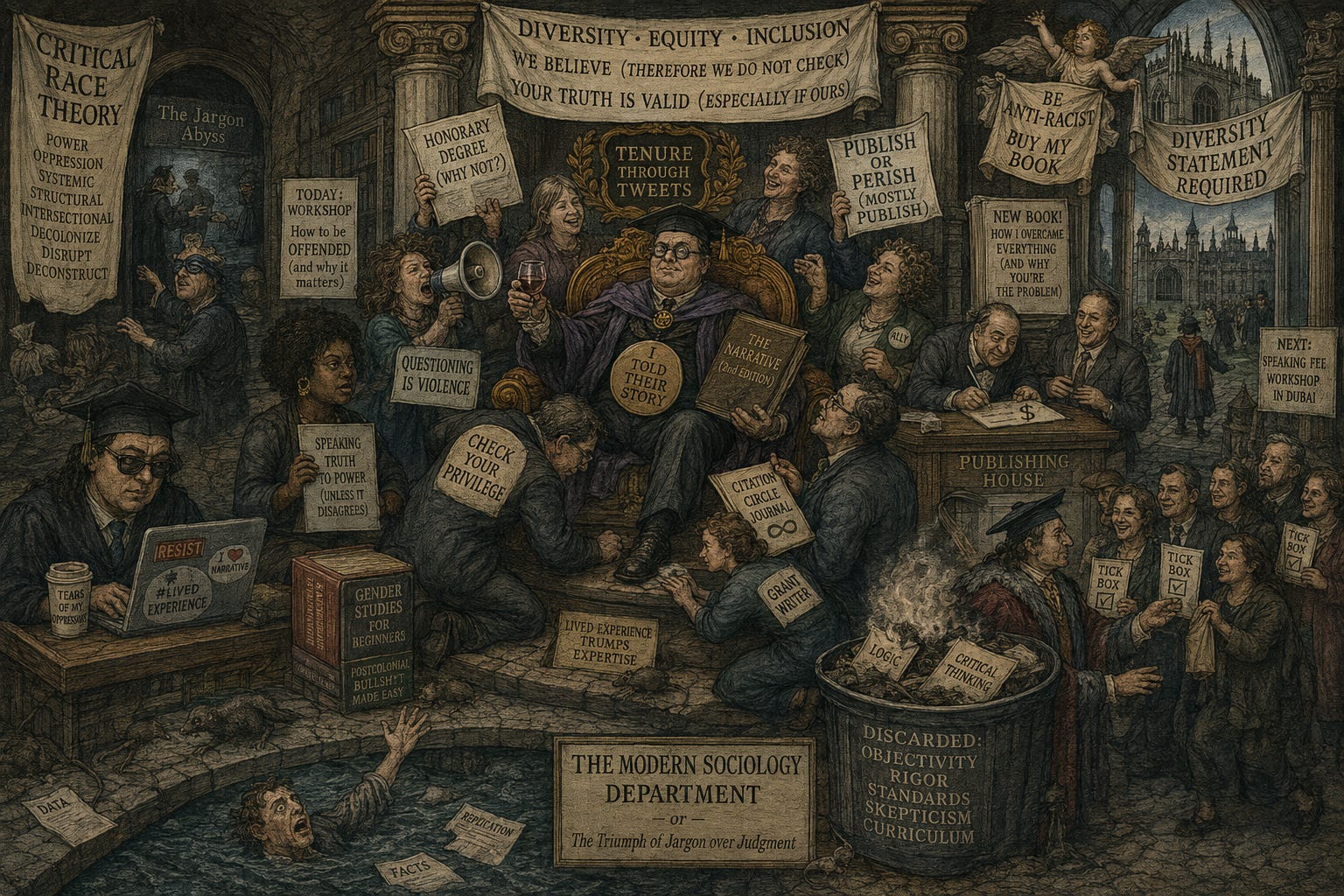
It takes a university system to create this Hogarthian picture of madness. The only thing we are missing is the abundant gin.
A Biography Too Magnificent to Examine
Arday’s original story was already remarkable. He has said that he was diagnosed with autism and developmental delay as a child, did not speak until 11 and learned to read and write at 18. He subsequently completed university degrees and rose to become Cambridge’s youngest black professor.
That story required no additional ornament. Yet the ornaments arrived in battalions.
He was reported to have run 30 marathons in 35 days, continuing after a seizure and an apparent leg fracture. He said he ran 300 miles in three days on a treadmill. He was credited with running 600 miles in six days, an achievement that would place him among the most formidable multiday endurance athletes in recorded history. He claimed to be a professional footballer and snooker player.
Arday reported charitable fundraising increased from £1 million to more than £3 million and eventually to approximately £5 million or £5.5 million.
Biographical accounts associated him with Seven Up!, the famous documentary series that began more than 20 years before he was born.
Then there are Arday’s accounts of racist persecution.
He described a masked intruder confronting him inside a Cambridge faculty building and later threatening him with a knife. After an earlier alleged intrusion, enhanced CCTV was reportedly installed and a panic alarm placed in his office. Yet the supposed armed intruder was not captured by the cameras, no one else appears to have seen him, and the alarm reportedly brought no security response. Arday nevertheless maintained that the encounter occurred.
He also described a severed pig’s head being delivered to his parents’ home and said police questioned local butchers. Reporters later found no photograph of the object, while police reportedly disputed the account of the investigation. Arday has stood by his broader description of racist threats and harassment.
Walter Mitty Finds an Appointments Committee
James Thurber’s Walter Mitty escapes an ordinary and rather disappointing life through heroic fantasies. In his imagination he is an ace pilot, a brilliant surgeon, a fearless military commander and the master of every emergency. Mitty is not evil. There is something almost tender about him. Fantasy supplies the courage and grandeur that reality has withheld.
The crucial point is that Mitty’s adventures remain inside his head.
No medical school appoints him professor of surgery because he imagined performing a miraculous operation. No defence ministry commissions him because he daydreamed about commanding a bomber. No university issues an announcement celebrating his distinguished service in several wars that occurred only while his wife was shopping.
The comedy in the Arday affair lies not in the possibility of fantasy but in its institutional certification.
Mitty may imagine himself a great man. The university supplies the title, the robes, the photographer, the office and the citation.
That changes the target of the satire. The central object of ridicule is no longer the dreamer. It is the solemn committee awarding academic credit for the dream.
Arday may have exaggerated achievements. Only universities could transform those achievements into credentials. He may have supplied questionable scholarship and plagiarized horrible material, committing a double sin. Only supervisors, examiners and editors could certify it as knowledge.
A man can embroider his biography. It takes an institution to upholster a professorial chair with it.
Liverpool John Moores and the Doctorate
Cambridge was the final and most prestigious stop, but it was not the beginning.
Arday completed his doctorate at Liverpool John Moores University. A doctorate is not a decorative certificate awarded in recognition of adversity overcome, nor should it ever become a DEI participation trophy. It is supposed to certify that its holder has demonstrated mastery of a field and the capacity to conduct rigorous, original scholarship.
The ironies here now overlap almost beyond parody. Arday rose to extraordinary prominence as a sociologist despite apparently never having taken a sociology course. Perhaps that would not have mattered anyway, since he has also claimed that, shortly before defending his doctoral dissertation, he suffered memory loss so severe that his knowledge had effectively been wiped clean.
Thus we arrive at the remarkable spectacle of a man obtaining a doctorate after claiming to have lost the knowledge required to defend it, subsequently becoming a professor in a discipline he apparently never formally studied, and eventually being celebrated by one of the world’s most prestigious universities as a leading authority in that very field. At some point, the interesting question ceases to be how Jason Arday managed this. The far more interesting question is what, precisely, the institutions examining, credentialling, hiring and promoting him thought they were doing.
A PhD is supposed to certify that the holder can conduct original research, handle evidence honestly, understand relevant scholarship and produce work capable of surviving expert scrutiny.
That process requires supervisors, internal oversight and external examination. The candidate presents the work, but the university certifies it.
Liverpool John Moore University investigated allegations concerning Arday’s doctorate and did not uphold findings of plagiarism or academic misconduct. It characterized the problems it identified as honest or reasonable errors.
Arday shows no evidence of competence; his students complained he was hopeless, frequently AWOL and, when students would press Arday for meaningful feedback, he would retreat to the safe harbour of DEI advocates - he would impugn the accusers’ motives; they were obviously racist.
But an institutional investigation does not answer every intellectual question merely by announcing that the institution has investigated itself. Who supervised the work? Who examined it? How were the extensive textual similarities evaluated? What standard distinguished an honest mistake from a failure of attribution? Were the alleged parallels examined individually or as a cumulative pattern?
How did a doctorate containing so many disputed passages, self-enforcing loops of Critical Race Theory (CRT) gibberish, not to mention spelling mistakes, become the foundation of an accelerated academic career?
The Academic Relay Race
After Liverpool John Moores came a succession of institutions.
Arday held academic positions at Roehampton and Durham before becoming a professor at Glasgow and then moving to Cambridge. Each institution inherited a record already authenticated by the institutions before it. Each new appointment gave the earlier ones additional credibility.
Roehampton could assume Liverpool John Moores had examined the doctorate. Durham could assume Roehampton had evaluated the scholar. Glasgow could assume Durham had performed due diligence.
Cambridge could look upon Glasgow’s professorship as evidence that somebody, somewhere, must have read the work.
This is how institutional reputation becomes a relay race in which nobody examines the baton. Each university simply passed along the same greasy lump of DEI gristle, congratulating itself on its moral refinement while never asking whether there was any intellectual meat attached to it.
Each university trusts the prestige conferred by the previous university. The candidate rises higher, and the increasing height becomes evidence that the ascent must have been deserved. By the time he reaches Cambridge, questioning the original foundation appears almost eccentric.
