



The West is not reducible to a map, a people, or some flattering myth of blood and soil. It is a system—a particular way of arranging human affairs around a set of hard-won and, in their time, deeply subversive ideas: that the individual possesses rights that precede the state; that power must be shackled by law; that truth is to be pursued through argument and evidence rather than proclamation; and that authority must answer to those it governs.
This is what we mean, however imperfectly, by liberal democracy.
In plainer language, it is the system in which one may criticize the government without imprisonment, publish dissent without disappearance, and replace leaders without the ritual spilling of blood. It is not perfection. It is something far rarer: a structure that restrains power while permitting correction.
And it is not confined to geography. Where these principles have been adopted—Japan, South Korea, Taiwan—the results have converged. Different cultures, different histories, yet broadly similar outcomes. This is not an accident of ancestry. It is the consequence of institutions.
But here is the uncomfortable fact, seldom acknowledged by those who treat liberal democracy as a kind of moral climate system: it is, historically speaking, an anomaly. A blip. A brief and improbable interruption in the long human habit of organizing life around hierarchy, coercion, superstition, and force.
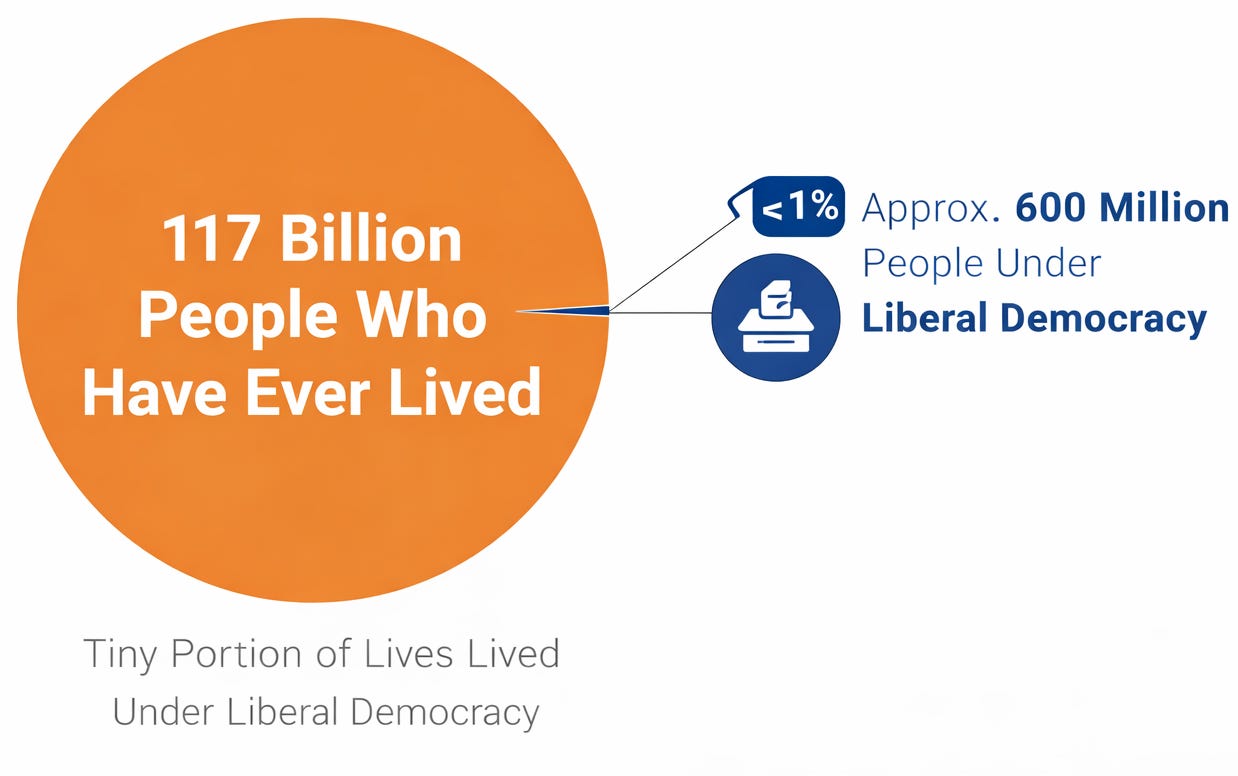
For most of our species’ existence, the default setting has not been liberty under law but rule by decree—empires, monarchies, tribal loyalties, priestly authority, and the occasional enthusiastic tyrant. Even today, the arrangement we flatter ourselves into believing is universal remains decidedly provincial. According to the Varieties of Democracy project, roughly 7 percent of the world’s population lives under what can meaningfully be called a liberal democracy, while the overwhelming majority lives under various forms of autocracy. The supposed endpoint of political evolution is, in practice, a minority taste.
Widen the lens further, and the picture becomes almost comical. Of the roughly 117 billion human beings who have ever lived, only a tiny fraction—statistically negligible—have experienced anything resembling modern liberal democracy. Even if one generously includes the post-Enlightenment populations of Western Europe and North America, one is still left with a rounding error. The idea that this system is humanity’s natural resting state begins to look less like confidence and more like parochial vanity.
Which is another way of saying that the West—properly understood—is not the culmination of history, but a disciplined rebellion against it.
And rebellions, as history also teaches, are fragile things.
Remove the habits that sustain it—free inquiry, tolerance of dissent, the slow and often tedious respect for procedure—and the system does not gently persist. It collapses, usually with enthusiasm, back into the older and more familiar arrangements: the strongman who promises order, the mob that demands conformity, the censor who offers protection from offence, the ideologue who explains that liberty was always a bourgeois illusion anyway.
Human beings do not, left to their own devices, drift toward constitutionalism. They drift toward power—unaccountable, intoxicating, and, in the end, destructive.
That is the point most often missed by those who inherit liberal democracy as if it were a birthright rather than an achievement. They treat it as self-sustaining, like weather, rather than what it actually is: a precarious system that survives only so long as enough people understand why it must.
The West, then, is not inevitable. It is unlikely.
And the proper response to something unlikely is not complacency, but vigilance.
Or, to put it more bluntly: if you think this is how the world naturally works, you haven’t been paying attention—for about 117 billion reasons.
A Civilization Forged, Not Found
This model was not discovered; it was forged. It emerged from the Reformation’s defiance of absolute authority, the Enlightenment’s insistence on reason, and centuries of contest over rights, sovereignty, and truth. It was shaped by dissenters, philosophers, reformers—often at great personal cost.
What we have inherited is not static. It is a living system that improved precisely because it permitted its own criticism. Its greatest strength has never been purity, but adaptability—its capacity to recognize error and amend itself without collapsing into it.

The Empirical Record
When one sets aside rhetoric and consults the record, the results are not ambiguous. Societies organized around liberal democratic institutions consistently produce superior outcomes across the most meaningful measures of human well-being.
People live longer. Fewer children die. Education expands. Wealth is generated. Innovation accelerates. Freedoms—speech, belief, association—are practiced rather than proclaimed.
These outcomes appear wherever the institutional model is adopted. This is not a cultural claim. It is a structural one.
Serious scholarship has made this point with precision. In Why Nations Fail, Daron Acemoglu and James A. Robinson demonstrate that prosperity is determined not by geography or culture, but by institutions. Inclusive institutions—those that constrain power, protect property, and enable participation—produce flourishing societies. Extractive institutions—those that centralize authority and suppress dissent—produce stagnation.
The contrast between North and South Korea, identical in culture yet radically different in outcome, is not a curiosity. It is a demonstration.
What we call “the West” is simply the most successful expression of inclusive institutions yet devised.
The Turn Toward Self-Negation
Given this record, one might expect confidence. Instead, one finds hesitation, even embarrassment. The capacity for self-critique—once the engine of reform—has drifted into something more corrosive: self-negation.
There is a difference between examining one’s history and dissolving into it. The former clarifies; the latter exhausts. The former strengthens institutions; the latter undermines them.
We have, in many quarters, abandoned proportion. Failures are treated not as part of a broader story, but as the story itself. The conclusion is no longer that we must improve, but that we are irredeemable.
This is not serious. It is fatigue masquerading as virtue.

The Quiet Erosion of First Principles
The consequences are no longer merely rhetorical. They are institutional.
Speech is increasingly treated as something to be managed rather than answered. Dissent is reframed as disruption. The language of rights is used not to protect liberty, but to enforce orthodoxy. The impulse to regulate expression, once associated with less free systems, has begun to appear—tentatively, but unmistakably—within our own.
This is not the confident exercise of a stable civilization. It is the behaviour of one who has lost clarity about their own foundations.
