


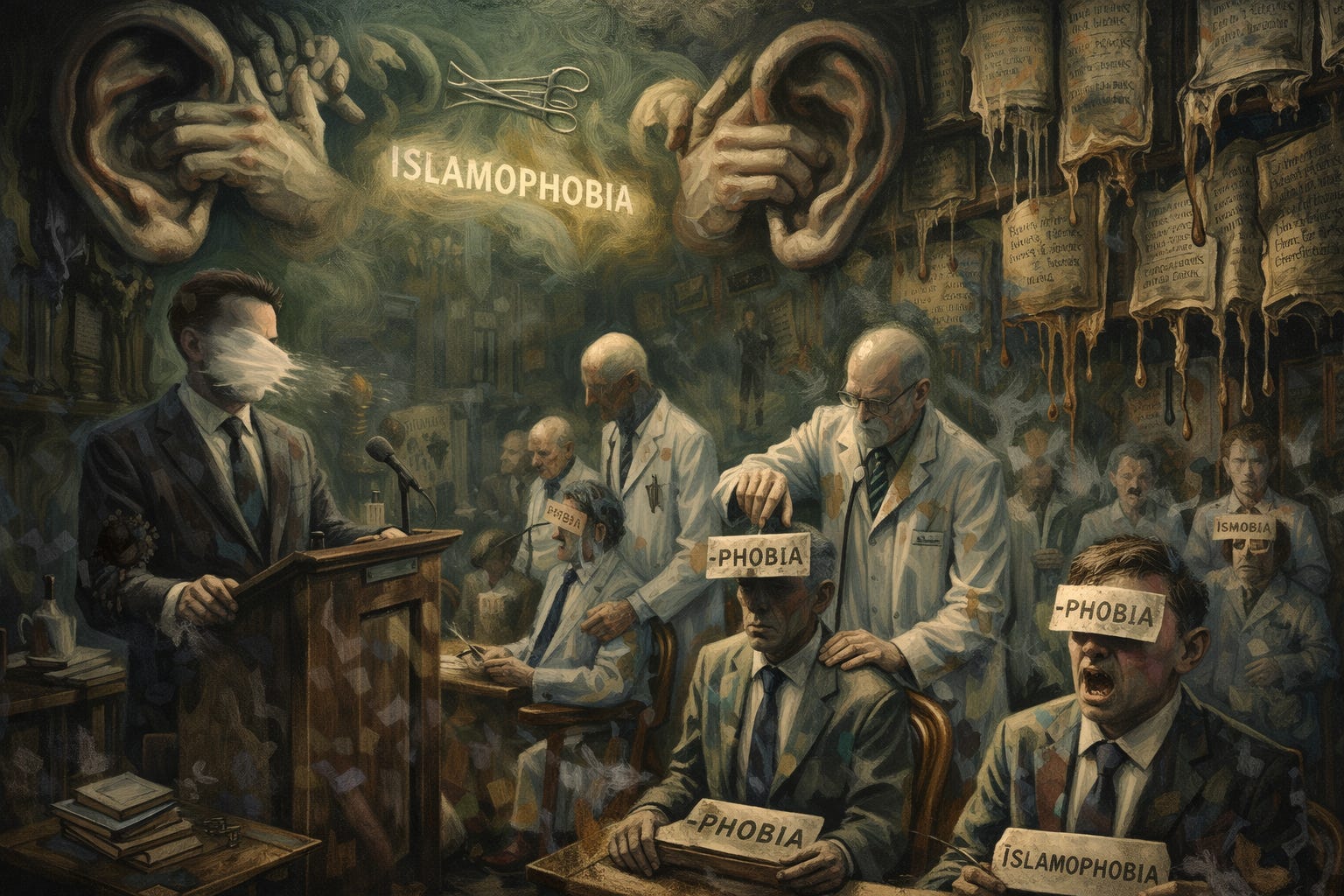
There was a time—one scarcely dares to remember it—when language existed to clarify thought. Increasingly, it exists to evade it. Few developments better capture this decline than the rise of the rhetorical “-phobia,” a suffix that has escaped the confines of clinical psychology and now operates as a kind of intellectual kill switch.
“Islamophobia” is among its most effective applications.
The procedure is elegantly simple. Once the word is uttered, the argument disappears. The speaker is no longer mistaken but morally defective, perhaps even psychologically unwell. The discussion is no longer difficult but dangerous. The shutters slam down. The accuser, diagnosing rather than engaging in argument, may retire in the quiet satisfaction of having “won.”
It is the debating equivalent of clapping one’s hands over one’s ears and declaring victory—a performance so juvenile it would be comic were it not so thoroughly institutionalized. One might be tempted to laugh, were it not for the dreary fact that this particular species of anti-intellectualism has been not merely tolerated but cultivated—greenhoused, even—by the very academic culture that once prided itself on the discipline of thought.
The irony begins with the word itself. In ordinary English, a phobia is an irrational fear of spiders, heights or confined spaces. The term derives from the Greek phobos, meaning terror or panic, and properly belongs in the vocabulary of medicine. Yet in recent decades, it has been repurposed with considerable cunning. Attach “-phobia” to any disagreement and the opponent need not be answered; he need only be pathologized.
Why argue with a man when you can diagnose him?
This maneuver did not originate with Islam, but it has found there one of its most reliable uses. The linguistic trick proved irresistible. Once opposition could be reframed as pathology, the burden of argument vanished entirely. The suffix spread with bureaucratic enthusiasm—transphobia, fatphobia, Islamophobia—like mould in a damp institutional bathroom. The pattern never varies: the argument evaporates, the diagnosis remains.
George Orwell saw this trick coming long before we perfected it. Political language, he observed, is not merely used to express ideas but to prevent them—to render certain thoughts unsayable, and therefore unthinkable.
Words cease to clarify and instead begin to sedate. They function not as instruments of reason but as a kind of intellectual chloroform, dulling distinctions, numbing judgment, and recasting disagreement as a species of moral or psychological defect.
Add to this the anti-intellectual tribalism of social media—where argument has been replaced by signalling, debate by denunciation, and listening by the Pavlovian twitch of outrage—, and you have the perfect breeding ground. In such an environment, words like “Islamophobia” do not merely survive; they flourish. They are not descriptive terms but strategic ones—deployed not to illuminate but to accuse, not to engage but to end the conversation before it has begun.
“Islamophobia” entered mainstream discourse via the 1997 Runnymede Trust report, which began with the modest aim of identifying prejudice against Muslims as individuals. Fair enough. But like so many bureaucratic inventions, it did not remain modest for long. It expanded—enthusiastically—into a shield not merely for people, but for ideas.
And here is where the category error becomes useful.
Religions are not ethnic groups. They are systems of belief—claims about morality, history, law, and power. Those claims may be profound or preposterous, humane or brutal, true or absurd. But they are ideas.
And in any society that still pretends to value freedom, ideas must be open to criticism, satire, and, when necessary, demolition.
Christopher Hitchens understood this with gleeful ruthlessness. In God Is Not Great, he subjected Christianity, Judaism, Islam, and every other creed to the same merciless scrutiny. No one accused him of “Catholicophobia” or “Sikhophobia.”
No headlines warned of “Protestantophobia.” Religious ideas were treated as what they are: arguments about reality, not sacred artifacts to be handled with ceremonial gloves.
Yet Islam has, in certain quarters, been granted precisely the exemption that no other system of ideas enjoys. Doctrines and political expressions associated with it have produced, in practice, a familiar and wearying pattern: hypersensitivity elevated into principle, outrage deployed as a tactic, and intimidation offered as a substitute for argument.
What, in any other setting, would be recognized as a failure of emotional discipline is here indulged as cultural authenticity.
The results are not subtle. Behaviours that would once have been considered presumptuous—or simply unacceptable—are now advanced with increasing confidence. Public spaces are appropriated, ordinary life is interrupted, and displays of performative piety are staged not merely as acts of devotion but as assertions of presence and power. Ten years ago, such spectacles would have been remarkable.
Today, they are defended.
And the irony is almost too perfect. The very text invoked to justify such displays contains its own rebuke. In Surah Al-Ma’un (Qur’an 107:4–6), we find a warning not against insufficient zeal, but against ostentation itself:
“So woe to those who pray,
but are heedless of their prayer—
those who make a show of their deeds.”
One might think this would settle the matter. But then, consistency has never been the strong suit of those who prefer performance to principle.
And here is the truly astonishing part: instead of saying plainly that such behaviour must be confronted rather than indulged, our society has chosen to submit to it.
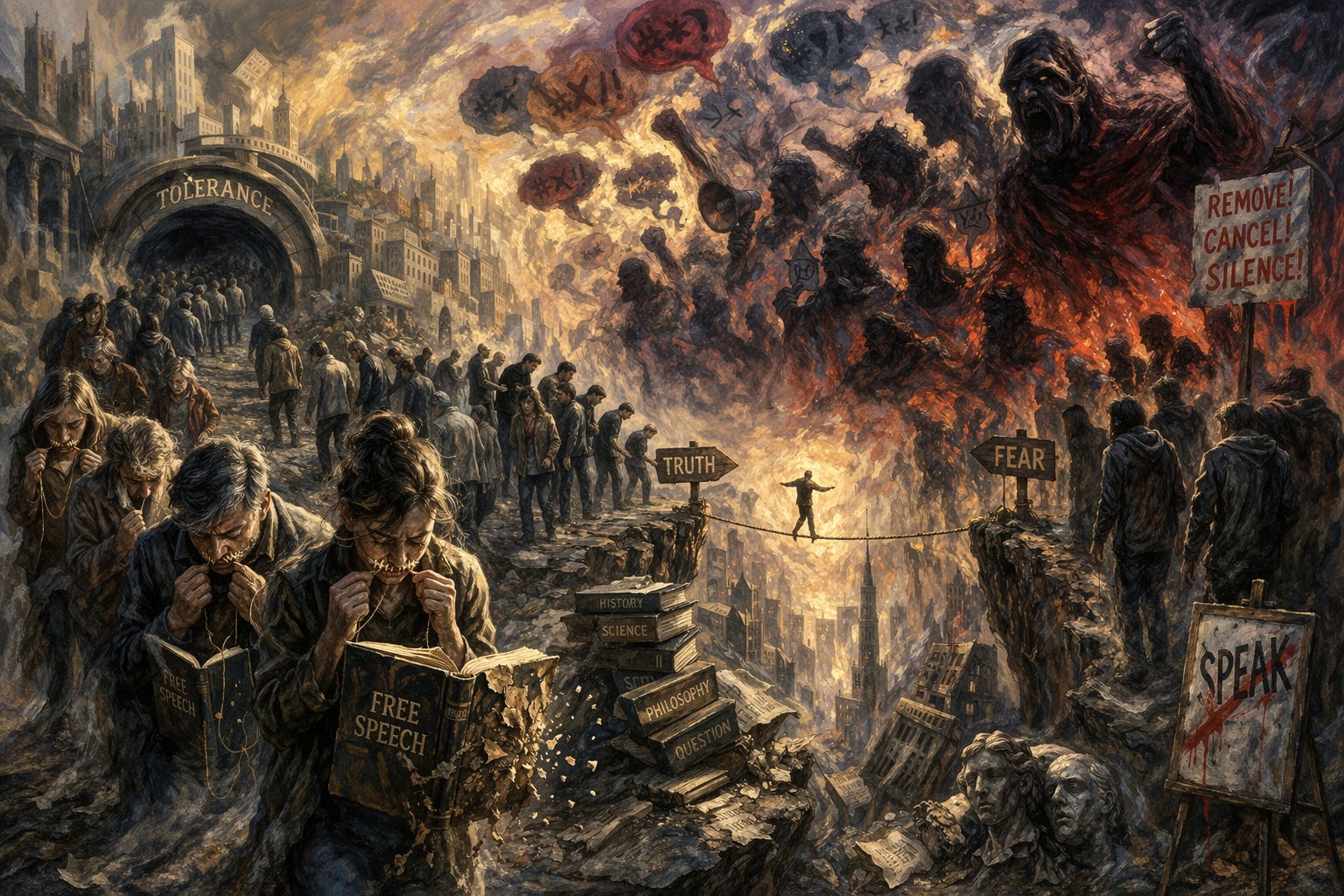
After centuries spent building Western liberal values—values forged in argument, defended in law, and paid for in blood—we now behave as though they are provisional. We hear the accusation—“Islamophobia”—and instead of testing it, we internalize it. Perhaps we have gone too far. Perhaps we should say less. Perhaps silence is the wiser course.
So we oblige.
We soften language.
We avoid subjects.
We retreat before we are even challenged.
This is not tolerance. It is intellectual cowardice masquerading as virtue.
Cowardice, when institutionalized, does not merely fail—it instructs. It teaches precisely the wrong lesson: that outrage is not a lapse of control but a method of control. That volume substitutes for arguments. That the quickest way to silence dissent is not to refute it, but to howl it down. And once that lesson is absorbed, the incentives become brutally clear: escalate, accuse, dominate.
And so, predictably, the escalation continues—not as an accident, but as a system that rewards itself.
The tragedy is compounded by a collapse of moral clarity. One need not indulge the lazy fiction that all Muslims are adversaries to recognize that there exist ideological currents—sometimes explicit, sometimes carefully veiled—that are plainly at odds with liberal norms and would, if given the chance, supplant them with theocratic authority. To refuse to acknowledge this is not tolerance. It is evasion dressed up as virtue.
And spare us the anecdotal consolations. “I know a Muslim family across the street—they’re lovely.” No doubt they are. But serious judgments are not constructed from self-selected samples of one. Sentiment is not analysis, and a pleasant neighbour is not a rebuttal.
Yet the immediate casualties of this arrangement are not the loud or the radical, but the very people who might sustain a sane middle ground. Moderate Muslims—those navigating the difficult terrain between liberal society and more rigid interpretations—find themselves cornered. On one side stands the intimidation of the zealot; on the other, the timidity of institutions that would rather appease than confront.
The result is not coexistence but distortion. The shrill are mistaken for the representative. The reasonable are rendered invisible. And a conversation that might have been conducted in good faith is instead abandoned to those least capable of it.
The facts are clear; do a quick search of the most destructive terrorist attacks of the last ten years, and it is a clean sweep for Islam. Whether or not it represents all Muslims is a stupid question; the fact is, the religion (truthfully, it is a religion mixed with a political imperialism bent) has an anger management problem.
Even facts do not survive this environment intact. Data does not disappear because it is inconvenient, but it can be made unspeakable. Surveys such as those conducted by Pew Research have shown that in some regions, a significant minority of Muslims express support for some form of Sharia law. In its traditional formulations, Sharia stands in direct tension with core Western principles such as equality before the law and freedom of expression.
To state this is not bigotry. It is an observation.
But once the word “Islamophobia” is invoked, observation itself becomes suspect. The argument is no longer answered—it is anesthetized.
The conversation ceases to be about evidence and becomes an inquiry into alleged prejudice instead.
This is achieved through a neat conceptual trick: collapsing two distinct things into one. Hostility toward people is conflated with criticism of ideas.
The first is rightly condemned. The second is indispensable to intellectual life. Confuse them, and entire domains of discussion can be quietly sealed off without anyone having to admit that censorship has occurred.
The result is a strange inversion of liberal values. Instead of defending open inquiry, institutions now reward rhetorical alarmism. The accusation of “-phobia” performs the work that reasoning no longer attempts. Disagreement becomes moral failure. Argument becomes diagnosis.
None of this is to deny that prejudice against Muslims exists. Of course it does, and it should be opposed without hesitation. Muslim citizens are entitled to the full protection of the law and the full dignity of equal citizenship.
But those rights do not include immunity from criticism.
A confident society does not fear scrutiny of ideas, including religious ones. It understands that criticism is not a threat but a necessity. Once certain doctrines are placed beyond question, the entire structure of open discourse begins to collapse.
The modern “-phobia” vocabulary, for all its therapeutic pretensions, accelerates that collapse. It discourages analysis, rewards outrage, and converts complex questions into moral accusations. The result is not greater tolerance but a steadily narrowing intellectual field.
Hitchens once remarked that a mature civilization is one capable of questioning its own sacred things. What we are witnessing now is something closer to regression: a civilization increasingly unwilling to argue, increasingly eager to diagnose, and increasingly afraid of its own voice.
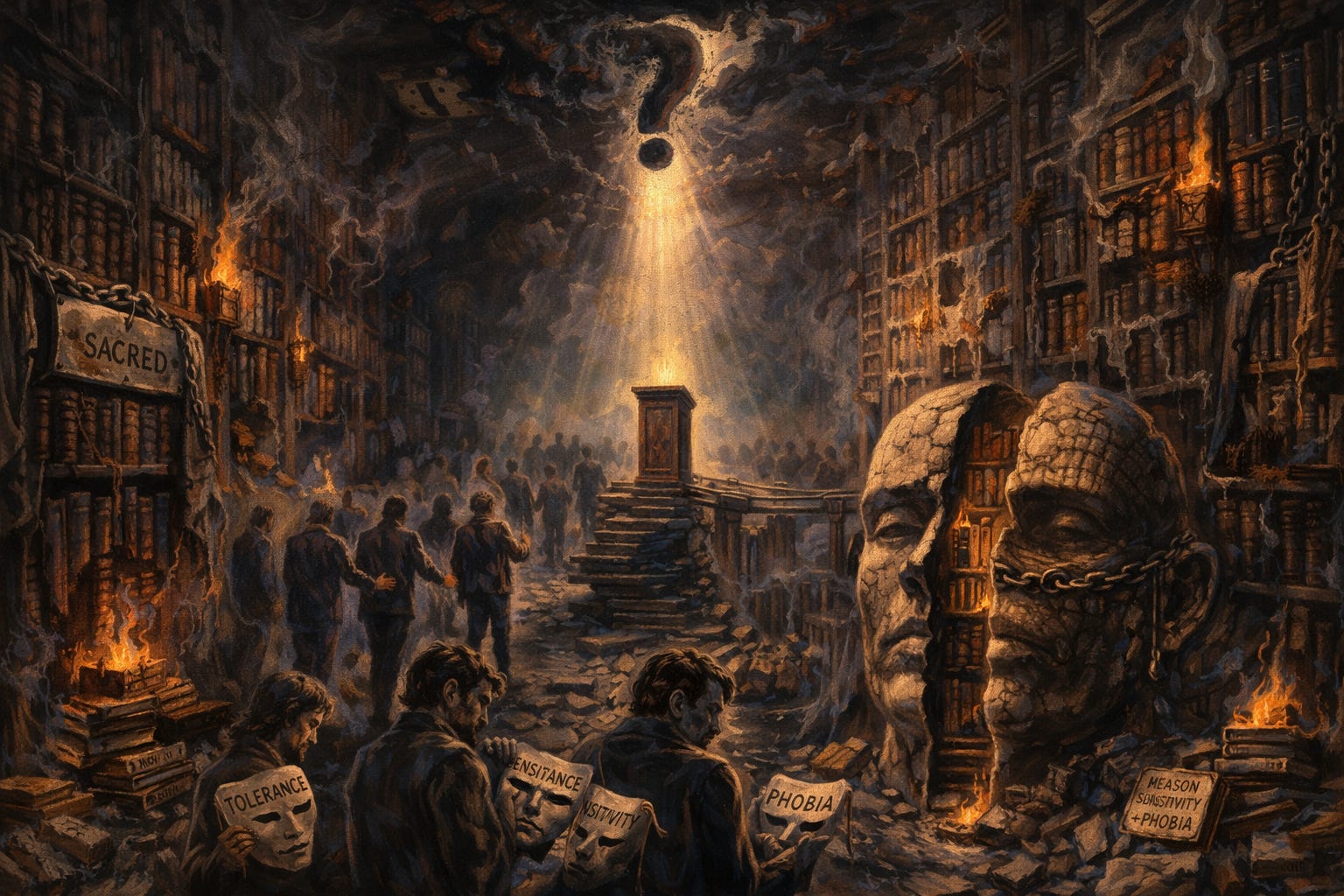
If “Islamophobia” were confined to describing genuine hatred of Muslims, it would be uncontroversial. But as it is commonly deployed, it serves a different purpose: not to illuminate difficult conversations, but to prevent them.
And a society that cannot discuss difficult things without resorting to therapeutic insults is not demonstrating moral progress.
It is demonstrating fear.
And fear, however politely expressed, has never been the foundation of a free civilization.
If you found value in this article and wish to support my ongoing work, please consider leaving a tip. Your support helps me continue producing uncensored content on critical issues.
There is nothing irrational about fearing radical Islam when its proponents are responsible for the overwhelming majority of terrorist attacks.
Really excellent take-down of the Islamophobia racket. Those who shout Islamophobia are just trying to prevent criticism of Islam. To which my usual response and sample flyer is: "All Religions can be criticized, Christianity, Judaism, and Islam. There is no Islam exception".