


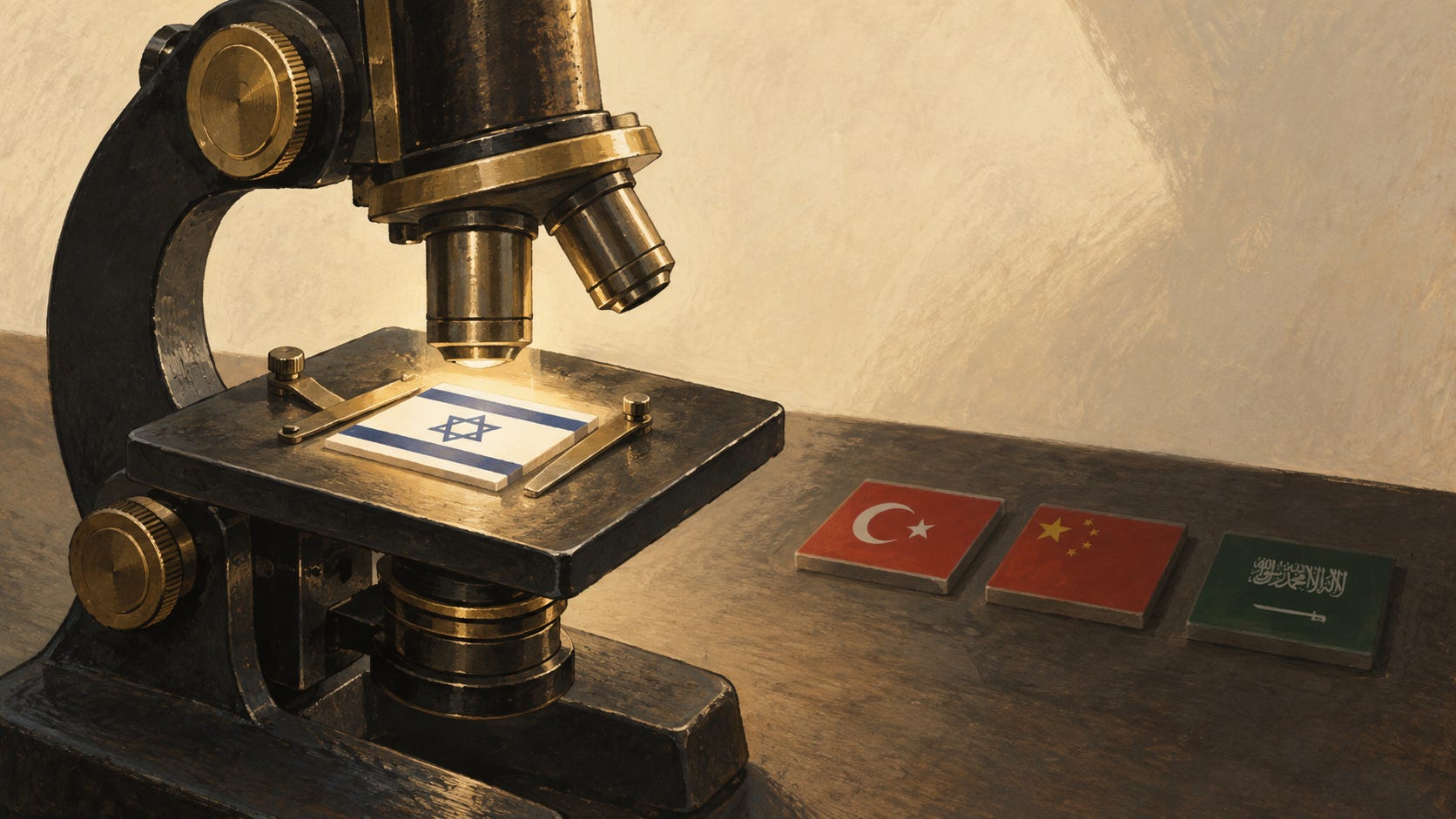
Nuance is an unfashionable commodity in the argument over Israel, perhaps because it interferes with the pleasurable business of choosing saints and villains.
Today, Canada, France and Britain joined a coordinated move toward restrictions on trade with Israeli settlements in the West Bank; Britain went further, announcing an import ban and a broader sanctions regime. Mark Carney, Emmanuel Macron and Ed Miliband would like this understood as the application of international law and moral principle.
Perhaps some of it is.
The more interesting question is whether the policy survives four less flattering tests: Is the law really as uncontested as they imply? Is the Israeli public accurately represented by the conduct of its most extreme settlers? Is the extraordinary language of “ethnic cleansing” justified by what has actually been established? And would this same moral microscope be taken out of its velvet case if the country under examination were Turkey, China or Saudi Arabia rather than Israel?
That is the argument here. Not that Israel is blameless. Not that the settlements are beyond criticism. Not that Palestinians have imaginary grievances. And certainly not that the present Israeli government has behaved wisely. It is possible—although modern politics increasingly treats this as a neurological disorder—to hold two thoughts simultaneously: Israel can deserve criticism, and its critics can still be selective, legally imprecise, politically opportunistic and wrong.
Let us therefore concede what ought to be conceded.
There are extremist settlers in the West Bank. There has been serious violence against Palestinians. Israeli enforcement has often been inadequate. The current Israeli coalition includes ministers whose politics on settlement expansion are hard to defend and whose rhetoric has sometimes been worse. Britain’s government cites homes demolished, infrastructure destroyed, Palestinian families displaced and a dramatic rise in settlement activity. These are not fantasies invented in Whitehall. They deserve investigation, prosecution and, where Israeli law has been violated, punishment.
But notice what disappears almost immediately from the Western telling of the story: Israelis.
They become scenery.
The actions of violent settlers, the ambitions of Defence Minister Smotrich and the decisions of Netanyahu’s coalition dissolve conveniently into “Israel,” as though nine or ten million people had convened in a national gymnasium and voted unanimously for every caravan dragged onto a Judean hilltop.
They have not.
An INSS national-security survey in January found that 55 percent of Israelis believed the security establishment was being too lenient toward Jewish nationalist crime in Judea and Samaria.
Among Jewish Israelis the figure was 48 percent. Even among voters for the governing coalition, one third said enforcement was too lenient. That is not a population united behind settler violence. It is a country arguing bitterly with itself about it—which, inconveniently, is what democracies do.
One can condemn the Israeli government without pretending that its most objectionable coalition partners are a representative sample of Israeli moral opinion.
Then we arrive at the magical word: illegal.
Today’s joint statement by Canada, France, Britain and their partners describes the settlements straightforwardly as “illegal under international law.”
Miliband went further and announced that Britain now officially considers the Israeli occupation itself unlawful. The foundation for that position is formidable. The International Court of Justice concluded in its 2024 advisory opinion that Israel’s continued presence in the occupied Palestinian territory is unlawful, and the prevailing international interpretation regards settlement activity as violating the Fourth Geneva Convention.
That is the dominant legal view.
That is not, however, the same as saying there is no legal argument on the other side.
This is where Natasha Hausdorff becomes interesting.
Hausdorff, a British barrister specializing in international law, recently put the dissenting argument directly before Parliament’s Foreign Affairs Committee. Her starting point is a doctrine with the magnificently unmemorable name uti possidetis juris. Strip away the Latin and the proposition is straightforward: when a new sovereign state emerges from a previous administrative territory, the default rule of international law is generally that it inherits the boundaries of the territorial unit that preceded it unless those borders are subsequently altered by binding agreement.
Hausdorff therefore asks a question that almost disappears from ordinary discussion of the West Bank:
What were Israel’s legal borders when the British Mandate ended?
The familiar story jumps quickly from the UN partition proposal of 1947 to the Green Line and then to 1967. Hausdorff says international law does not permit such casual jumps.
The 1947 UN partition resolution was a General Assembly recommendation. It proposed a Jewish and an Arab state, but it was rejected by the Arab side, war followed, and the proposed boundaries never became a mutually implemented sovereign border settlement. Hausdorff therefore argues that Resolution 181 cannot simply displace the ordinary default rule governing the territorial boundaries inherited when the Mandate ended.
Then came the 1949 armistice lines—the famous Green Line.
But an armistice line is not necessarily a sovereign border. Indeed, the agreements deliberately avoided finally adjudicating territorial sovereignty.
Jordan subsequently controlled the West Bank and annexed it in 1950. That annexation received almost no international recognition.
So Hausdorff asks: if Jordan did not possess generally recognized sovereignty over the territory, exactly whose sovereign territory did Israel invade when it took the West Bank from Jordan in 1967?
Her argument is more radical than the usual Israeli talking point that “the territory is disputed.”
She says the proper legal starting point is the boundary of the former British Mandate west of the Jordan, because uti possidetis juris ordinarily supplies the territorial baseline when a state emerges.
In parliamentary testimony, she compared the principle with Ukraine: Ukraine inherited its Soviet administrative boundaries at independence, which is one reason Crimea remains Ukrainian sovereign territory despite Russian control. If Ukraine retakes Crimea, we would not ordinarily call Ukraine an occupier of Russian territory. Hausdorff says international law requires an explanation for why the same border principle should simply vanish when Israel is the state involved.
If respectable international lawyers and dissenting judges can articulate a contrary argument based upon a recognized doctrine of customary international law, then politicians should have the modesty to acknowledge that there is a legal argument rather than presenting three words—“illegal under international law”—as though they had been found engraved on a tablet beneath Mount Sinai and God Himself had pronounced it on Tuesday morning.
And Oslo complicates the morality play even further.
The Oslo agreements divided the West Bank into Areas A, B and C. Palestinian authorities acquired extensive governing authority in Areas A and B; Israel retained control in Area C pending negotiations over final status. The arrangement was supposed to be temporary.
Thirty years later, “temporary” has become one of the Middle East’s more ambitious euphemisms.
But the important legal-historical point remains: final sovereignty and borders were left to negotiation.
Hausdorff emphasized this distinction precisely before Parliament. An eventual agreement can change the territorial position. Her point is that no final negotiated agreement has done so.
That does not give Israel carte blanche.
It does mean that the phrase “Israel is simply building houses on another sovereign country’s settled territory” contains inside it the conclusion that the negotiations were supposed to determine.
Then comes Miliband’s most explosive accusation.
Today, standing in the House of Commons, the British Foreign Secretary declared that there is “ethnic cleansing of Palestinians in areas of the West Bank—perpetrated by settler terrorists.”
Those words deserve to be read carefully because their gravity is immense.
Miliband cited 65 Palestinian communities he says have been completely displaced since 2023, affecting more than 4,000 people. He cited settler attacks, destruction and intimidation. He quoted former Israeli prime minister Ehud Olmert and former minister and IDF brigadier general Ephraim Sneh, both of whom have themselves used the terminology of ethnic cleansing. He then adopted that allegation as the British government's position.
That is considerably more serious than saying that settler violence exists.
The UN formulation Miliband himself quoted describes ethnic cleansing as a purposeful policy by one ethnic or religious group to remove another civilian population from particular territory through violence or terror.
There are therefore at least two separate propositions here.
The first is well evidenced: violent settlers have attacked Palestinians, and some Palestinian communities have fled or been displaced.
The second is much larger: that these episodes collectively establish the purposeful policy required to characterize what is occurring as ethnic cleansing.
Miliband simply crosses the bridge.
The evidence he gives may support investigating that charge. It does not make the characterization self-proving.
And this distinction matters enormously. Criminal extremists intimidating Palestinians from particular villages should be prosecuted relentlessly. Israeli officials who knowingly facilitate such displacement should be held accountable. But moving from those propositions to the morally radioactive phrase ethnic cleansing requires evidence of purpose, scope and policy commensurate with the accusation.
Otherwise the term stops describing evidence and begins organizing it.
There is an additional absurdity in allowing the extremists to stand in for the country itself. Again, while Miliband tells Parliament about “ethnic cleansing,” nearly half of Jewish Israelis tell pollsters their own authorities are not being tough enough on Jewish nationalist crime.
Those facts can coexist.
Indeed, that is precisely the point.
Nuance permits them to.
Propaganda does not.
Now consider the sanctions themselves.
If the governing principle is that states whose citizens or governments facilitate violent displacement in disputed or occupied territory should face targeted economic consequences, then that may be an excellent principle.
Apply it.
Consistently.
Turkey has occupied northern Cyprus for more than half a century. Its history with Kurdish populations includes forced evacuations, destroyed villages and grave human-rights abuses. China has constructed an enormous apparatus of coercion in Xinjiang, with credible evidence concerning arbitrary detention and forced labour. Saudi Arabia is not generally regarded as Scandinavia with better weather.
Western governments certainly criticize and sometimes sanction these countries.
But what Israel appears uniquely capable of inspiring is something more exquisitely tailored.
Special rules for settlement goods. Special prohibitions on services. Special restrictions on financing. Special prohibitions involving real estate and construction. Special treatment of advertisements. Special parliamentary declarations about the legality of territory.
And now an official British pronouncement of ethnic cleansing.
One begins to wonder whether the international rules-based order has acquired a Jewish appendix.
Hausdorff has made precisely this broader complaint: customary international law cannot be universal except when its application becomes politically inconvenient. If uti possidetis helps establish the boundaries of states emerging from colonial and federal administrative units elsewhere, then one must explain—not merely assert—why Israel is different.
And then there is politics.
This is the section in which certainty should diminish rather than increase.
Nobody can climb inside Mark Carney’s, Emmanuel Macron’s or Ed Miliband’s skull to establish whether principle or polling occupies the larger chamber. But uncertainty about the contents need not oblige us to furnish the place with virtues.
In Carney’s case, the presumption of principle seems especially generous. Here is a man whose appearances in Parliament have the air of guest engagements, whose contribution to political philosophy includes the stirring injunction “Canada Strong,” and whose political appeal appears heavily dependent on that most economical substitute for Canadian self-confidence: resentment of the United States.
To discover statesmanship in this requires an interpretive charity he has yet to earn.
Miliband deserves a more discriminating judgment. But granting him sincerity does not deny the Labour Party's political reality. Gaza has become an important electoral issue on the British left. Labour faces pressure from Greens and independents in constituencies where anger over Gaza matters significantly; even today’s reporting on the Holborn and St Pancras contest identifies Gaza as one of the issues helping the Greens challenge Labour.
Governments know where their political vulnerabilities lie.
There is strong evidence that Gaza has become an unusually important electoral issue for Muslim voters in Britain and Canada—and that its influence is magnified because Muslim voters are geographically concentrated rather than evenly scattered.
In Britain, YouGov found that 41% of Pakistani and Bangladeshi Britons named Gaza/Israel among the top issues determining their 2024 vote, compared with just 5% of voters overall; in heavily Muslim constituencies Labour’s vote fell dramatically, and explicitly pro-Gaza independents won several seats. The Greens have benefited from that shift even though their domestic social platform includes policies such as legal gender self-identification for trans and non-binary people, an agenda that cannot simply be assumed to reflect the views of socially conservative Muslim voters.
The more plausible conclusion is not that Muslim voters suddenly embraced the entire Green manifesto, but that for a significant bloc Gaza is salient enough to outweigh disagreement on other issues.
Canada shows the same basic electoral logic, though the polling is thinner. A 2025 survey by the Canadian Muslim Public Affairs Council found 75% of respondents saying Palestine and foreign policy were the most important issues determining their vote, and 86% judging Ottawa’s response to Gaza completely inadequate.
The political importance is greater than the raw national Muslim population share suggests because Muslim Canadians are concentrated in parts of the GTA and other urban battlegrounds. A vote moved in a safe Alberta Conservative seat or a safe downtown-Toronto Liberal seat changes little; a similarly sized bloc in a marginal Mississauga or suburban Toronto riding can change who forms government. So parties need not believe Muslim voters endorse their entire progressive program.
They need only recognize that Israel–Gaza can be a sufficiently powerful issue to move a concentrated constituency in exactly the seats where a few thousand votes matter most.
Indeed, politics very often consists of finding principles whose application happens not to injure you.
And this returns us to the curious restoration of Western eyesight whenever Israel appears.
Toward Turkey, complexity intrudes.
Toward China, commercial realities appear.
Toward Saudi Arabia, strategic necessity enters the room.
Governments begin explaining that diplomacy requires engagement, that change occurs slowly, that geopolitical relationships are complicated and that screaming denunciations from the dispatch box are not always productive.
All perfectly reasonable.
Then Israel appears. Suddenly everyone has tenure in international law. Every border is obvious. Every legal dispute is settled. Every settler represents the state. Every Palestinian displacement acquires the vocabulary of ethnic cleansing. Every dunam1 can be inspected from Ottawa, Paris or Westminster with astonishing optical precision.
And this is why the objection to today’s policy should not be caricatured as “Israel can do no wrong.”
Israel can do wrong. Its government can do wrong. Its settlers can commit crimes. Its policies can deserve condemnation.
Those propositions are almost banal.
The interesting questions begin after them.
Is a contested proposition being presented as uncontested law?
Are extremist settlers being permitted to define millions of Israelis who themselves want tougher enforcement against those extremists?
Has evidence of violent localized displacement justified the extraordinary governmental conclusion of ethnic cleansing, or has the conclusion outrun the evidence presented for it?
Are equivalent principles applied with equivalent enthusiasm elsewhere?
And how remarkable is it that this particular outbreak of Western moral courage arrives in a political environment in which condemning Israel is increasingly inexpensive—and, in some constituencies, positively remunerative?
Those questions do not absolve Israel.
They indict something else: the conceit that selectivity becomes principle merely because a foreign minister pronounces it solemnly.
For Israel, Western governments discover law without ambiguity, morality without hesitation and punishment without delay.
Elsewhere they rediscover nuance.
Perhaps Israel does deserve a microscope.
But anyone claiming to act in the name of universal principles has one elementary obligation: occasionally point the microscope somewhere else.

A dunam is a unit of land area used in Israel, the Palestinian territories and parts of the former Ottoman Empire. In modern Israeli and Palestinian usage, it equals 1,000 square metres—roughly a quarter of an acre.
Article 24 of the 1964 Palestinian National Charter states:
“This Organization does not exercise any territorial sovereignty over the West Bank in the Hashemite Kingdom of Jordan, [or] the Gaza Strip…”
Arafat reveals two important realities in his Charter. First, that Palestinians are Arabs. So let us remember that Arabs are indigenous to to Arabia, not to the Levant. Secondly, that as long as Egypt and Jordan occupied disputed territories Arafat renounced any claim for Gaza or Judea/Samaria as sovereign Palestinian territory.
Suddenly in 1967, when Jordan was defeated and Israel took over administering J/S, it was illegally occupied by colonial aggressors.
This reveals the end goal,which was not Palestinian self government. It was pan Islamic domination over non Muslim and indigenous regional Jews. Islam cannot live in equity beside non Muslim dhimmis and infidels.
The sanctions announced today against Israel only show to what extent Carney, Miliband, and Macron are such scurrilous individuals with no moral fibre, bending over to placate their Muslim voters and banking on the millennial anti-Jewish hatred typical of their countries and their foreign policy elites (Canada inherited this being a British colony). I wish these leaders nothing but the worst and am glad Israel is sufficiently strong that it can ignore their meaningless and ignorant positions. That Britain takes the lead on this only reinforces the idea that the country has never gotten over the fact that the Jews and not the Muslims kicked them out of Mandate Palestine. There is no point arguing against the tendentious claims in Miliband's speech. He is the kind of Jew who would have been working the Inquisition against the Jews. This entire piece of foreign policy garbage should alert the Jews that they have no home in the West and to the extent that they stay, they had better mobilize against the people who want to murder them.