


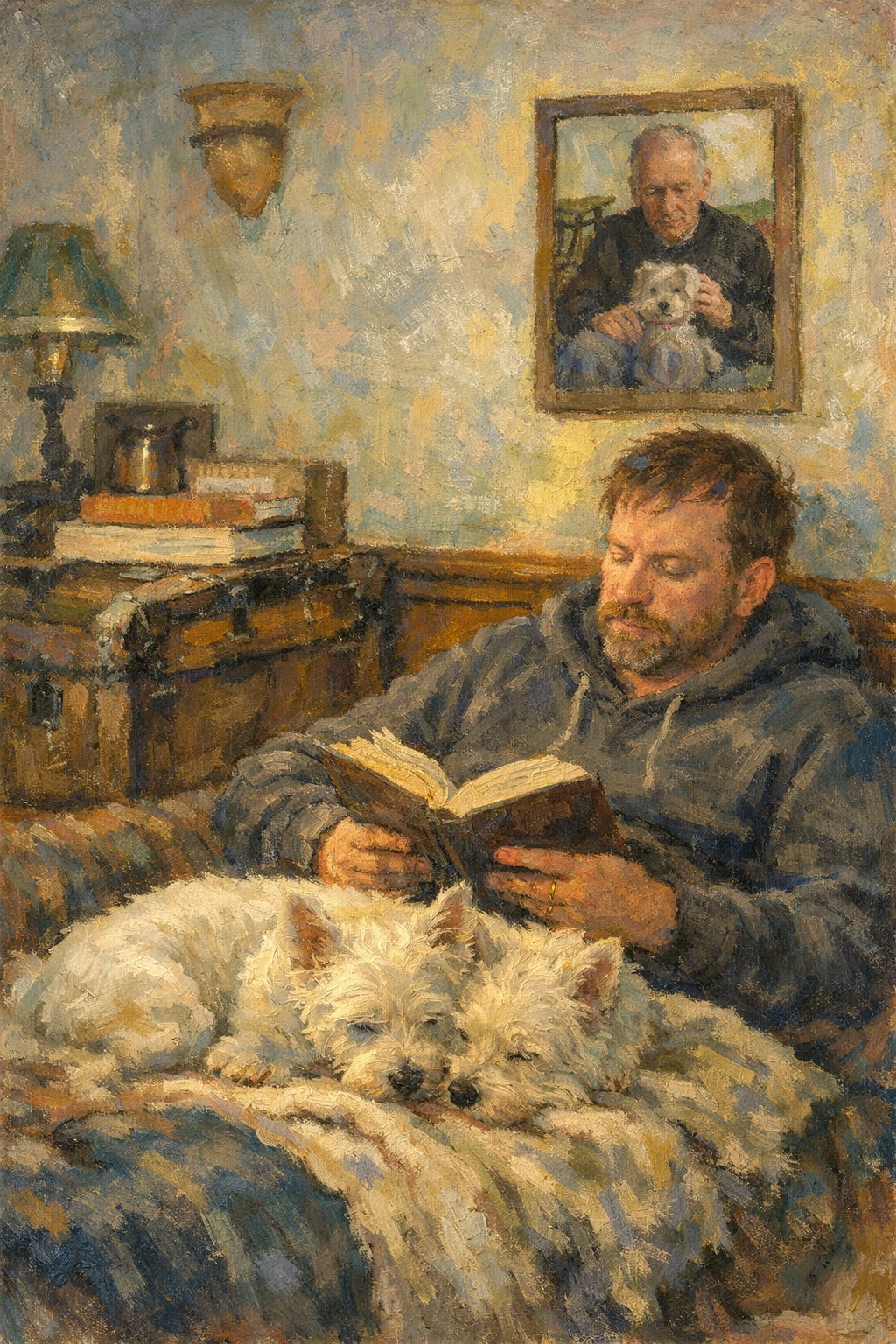
I live now mostly underground, a basement retreat—not in exile but by preference. A cellar of thought.
I find calm alone, among books lining the walls like old friends, iron weights dulled more by time than by use. These things do not console in any grand way. They steady the room. They hold it in place.
It has become a habit, almost without intention: the descent, the settling in, the quiet assumption of place among things that have learned me.
I rest among relics of an Irish crossing long past: a trunk my grandmother carried across the Atlantic in 1904, from Kerrykeel, Ireland, to Ensign, Alberta. It sits quietly now, no longer bearing weight, but not ornamental either. It is proof that my people once fled and endured. It does not speak of courage. It simply remains. That seems enough.
My late father is present as well—captured in a photograph taken with our new Westie puppy, Malibu, on his lap. It was the last photograph taken before Dad died. At the time, I was naive, unaware that I was about to be overtaken by grief’s close companion, mortality, advancing with its usual authority.
That ignorance protected me then. Now there are occasional reminders—sudden, sharp pressures in the gut. Still, it is better than hiding the photograph and dimming his memory. Its presence does not disturb the room. It keeps something from slipping quietly out of view.
In spite of time, my life has remained draped in grief. Not suffocating, not panicked, not futile. It does not ask to be solved. But it has not been folded away either, any more than the throws on my couch are folded away when the day ends. It remains—familiar, sometimes even warming. As C.S Lewis once observed, grief itself does not shrink; life grows around it. Something accumulates, layer by layer, like a pearl formed around an irritation that never disappears.
On the wall, there are Guinness posters—mine, chosen long ago. They provide a small, steady warmth, an unspoken connection to my grandmother, to another era, another life. Nearby is a separate tribute to a long-lost dog, given to me by a kind friend of my daughter. These things do not cure anything. They offer something quieter: continuity.
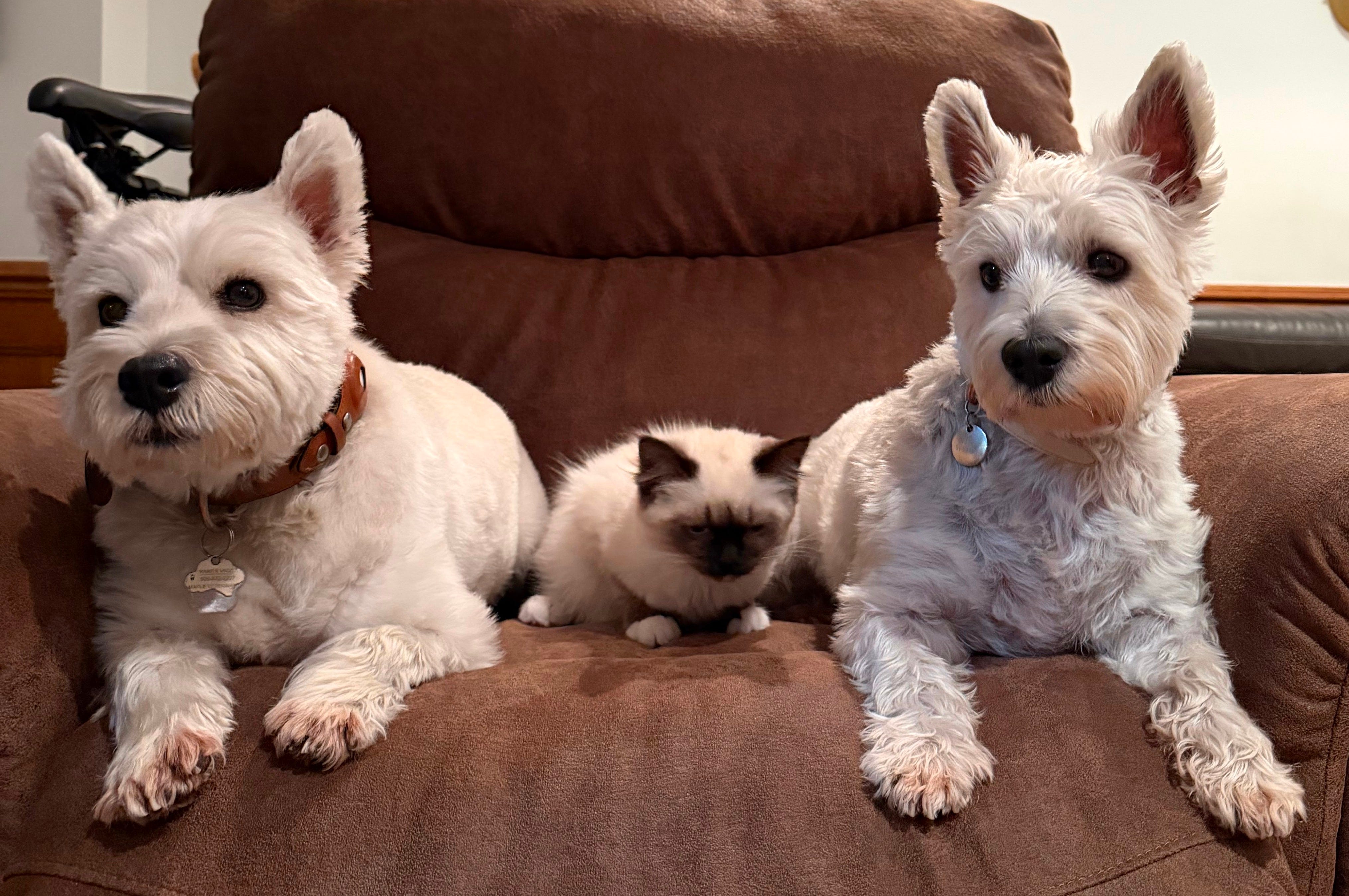
I pass my days quietly, ageing without ceremony, protected by solitude, working at home, and at home with myself. Yet I am never entirely alone. Always there are two white terriers at my side.
Toby and Malibu—West Highland terriers, compact and resolute, creatures of fur, pride, and minor grievances. I call them brother and sister, though they are not so by birth. I was adopted, and the brother and sister I speak of are the ones I was raised with. The word, once earned, is not easily surrendered.
I recline on the couch—a couch, not a chair. Chairs demand posture, and posture is a kind of tyranny, whether in later years or earlier ones. At the edge of the couch, the terriers assemble. Each covets the place nearest me, as though proximity conferred rank.
