


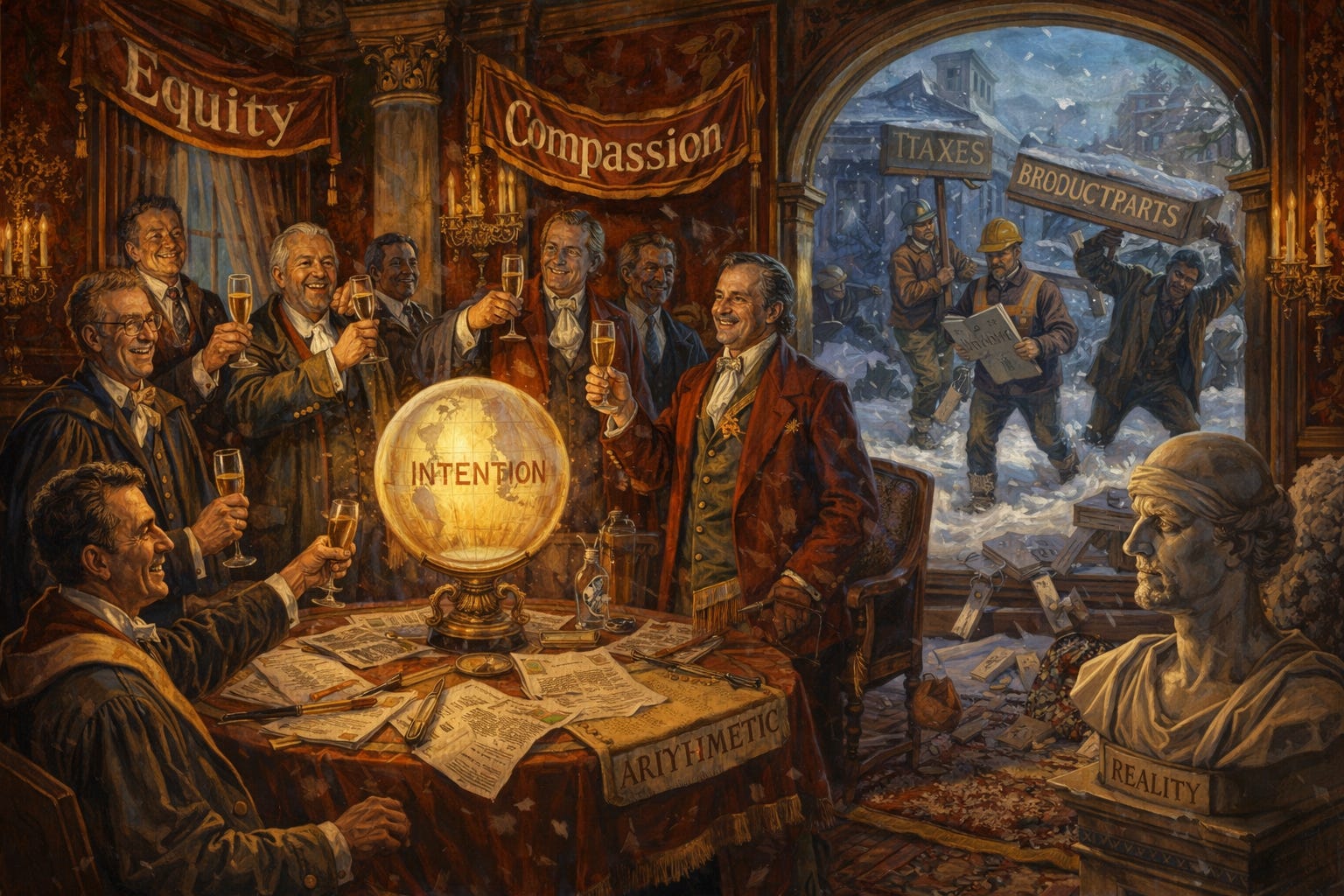
There is a type who recurs in political life with such dreary regularity that one begins to suspect he is not an accident but a feature of democratic decline. He appears in different guises—credentialed technocrat, theatrical insurgent, moral lecturer—but is instantly recognizable.
He speaks fluently of justice or grievance, is impeccably networked or artfully anti-establishment, and always arrives wrapped in the reassuring language of public virtue. What unites him is not ideology but insulation. He does not bear the consequences of his convictions.
He is what I have elsewhere called the ‘Revolutionary Gentleman’.
Serious countries make policy from reality.
Declining countries make policy from intention. Canada, with a tone of moral self-congratulation and a frighteningly weak appetite for scrutiny, has begun to prefer the latter. That is the thesis of our current moment. We are increasingly governed by image rather than results, by branding rather than substance, by a political class that performs seriousness while avoiding its burdens.
And because the media and educational institutions now function less as correctives than as amplifiers, the entire system floats free of consequence. Failure is narrated as sophistication. Decline is marketed as maturity. And the public, having been turned from citizens into consumers of political mood, applauds while the national furniture is quietly removed.
The Revolutionary Gentleman can afford to be wrong.
The contractor cannot. The machinist cannot. The small business owner cannot sign both sides of a payroll cheque and then declare arithmetic a social construct.
Risk concentrates the mind. Insulation permits ideology. This is why so much modern political language has the dreamy unreality of a trust-fund manifesto. Economic error, for the insulated, is theoretical. For everyone else, it is dinner, rent, payroll, medication, and a child’s winter boots. The gentleman radical, the polished planner, the moralizing technocrat—all share the same luxury: they can be mistaken at scale without paying for it personally.
One sees this most clearly in the curious reverence recently afforded to Mark Carney’s Davos oration. We were told it was serious, statesmanlike, even historic. But if one asks the most elementary question—what, precisely, was proposed?—the applause dissolves rather quickly. Strip away the cadence, the flattering summaries, the Davos lighting, and what remains is not strategy but atmosphere.
The speech offered the sensation of substance without its burden. It gestured toward Thucydides, toward middle powers, toward shared sovereignty, and toward the collapse of the rules-based order, but nowhere did it name trade-offs, identify enemies plainly, or submit itself to measurable consequences. It was all packaging, but the wrapping covered an empty box.
One left reassured, even impressed, yet strangely unable to identify a single concrete commitment likely to improve the life of an ordinary Canadian.
That, of course, is not a failure of execution. It is the method.
And so we arrive at the modern Canadian absurdity: a political class insulated from consequence, buoyed not by performance but by presentation. We have, quite plainly, a serious accountability problem.
Our current prime minister is a man who inspires confidence with remarkable ease and demonstrates competence with remarkable scarcity. He presides over an economy that, by every meaningful measure, is worse than under his predecessor. Not rhetorically worse.
Not ideologically worse. Empirically worse. Unemployment has ticked upward—though even that flatters reality, because when discouraged workers stop looking for work altogether, they drop out of the labour force and unemployment can perversely appear to improve. Governments, particularly Liberal ones, have long been fond of treating this statistical illusion as a positive indicator. It is not. A discouraged worker vanishing from the data is not a job created.
The deficit has swollen from roughly $45 billion to something near $70 billion. Food inflation—the statistic no citizen can evade because it follows him into the grocery aisle—has risen from roughly 3.2 percent to over 4.1 percent.
And yet, astonishingly, none of this appears to matter. The brand remains intact. The image holds. The narrative persists. One is reminded, irresistibly, of Lenin, who is often credited with observing that capitalists would sell him the rope with which he would hang them. Whether the quotation is authentic hardly matters; the insight is.
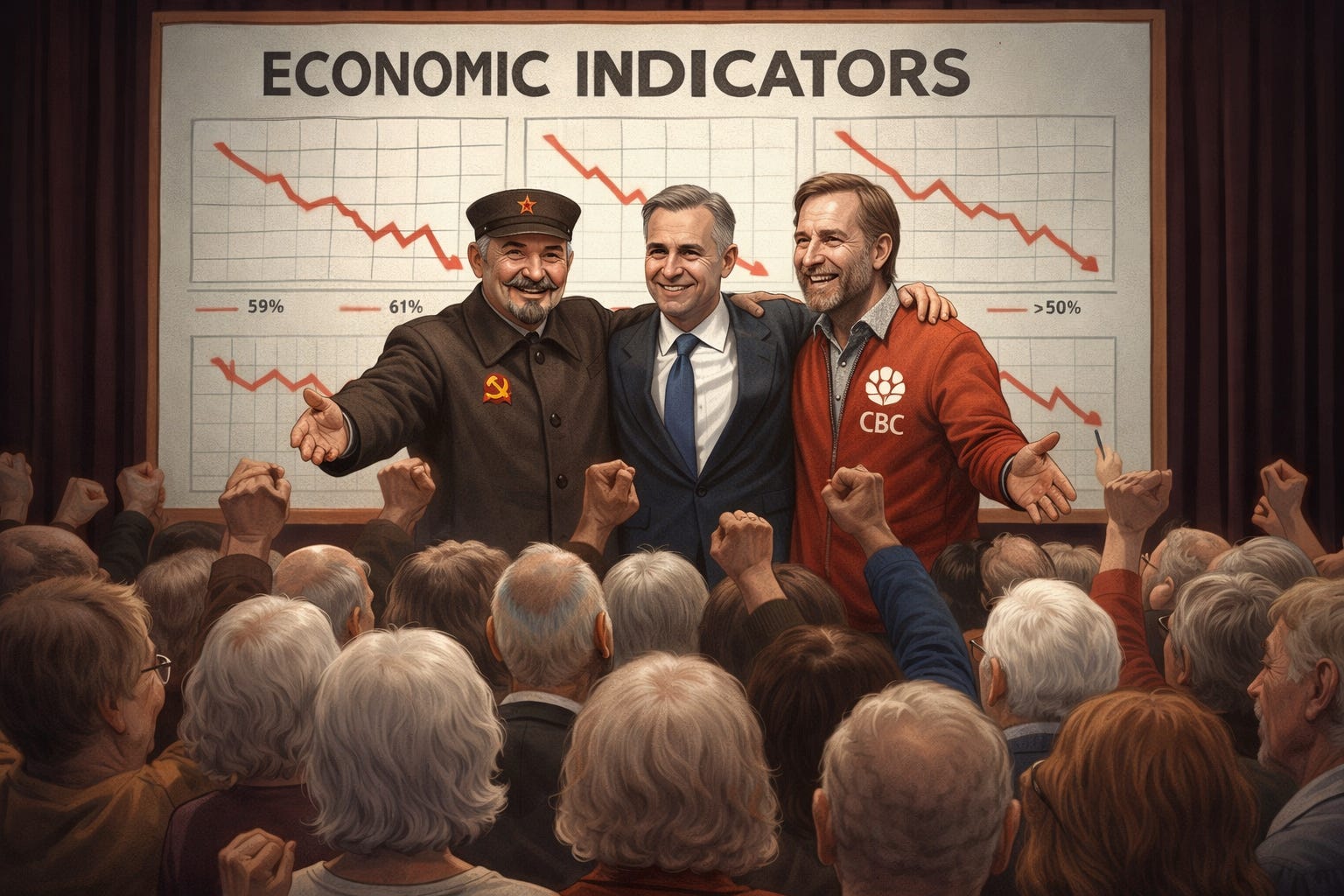
Survey the Canadian scene, and one begins to suspect that the rope is not merely being sold, but gift-wrapped, subsidized, and promoted with earnest enthusiasm.
We have built a political ecosystem in which branding eclipses substance, where a figure like Carney can be presented as a technocratic oracle—polished, credentialed, fluent, and yet curiously hollow when judged by outcomes.
This could not happen without a media class that has largely abandoned the adversarial function on which democratic health depends.
The CBC leads this parade with almost devotional consistency, echoed by the Globe and Mail, the Toronto Star, Global, CTV, and the usual ecosystem of progressive reinforcement. This is not journalism as scrutiny. It is journalism as liturgy.
It does not interrogate power so much as translate it into morally flattering language for public consumption. When Carney treads ground that would, under another name, be denounced as conservative heresy, the metamorphosis is instantaneous. If he counsels restraint, it becomes stewardship. If he nods to private investment, it becomes sustainable. If he dares utter the word productivity, it is rebaptized as morally laundered pragmatism. The substance does not change.
Only the packaging does. What we possess is not a media ecosystem but a pandering pedagogical advocacy machine—one that does not ask whether something works, but instructs the public on how it ought to feel about it.
If Lenin were to rise—still faintly smirking in his Moscow mausoleum—one suspects he would not be alarmed by the Canadian condition.
On the contrary, he might admire it. “You have done splendidly,” he might say. “Your useful idiots require no coercion at all.” That is the truly unsettling part. There is no need for force where illusion is so willingly embraced.
The electorate is no longer functioning in the classical democratic sense as a body of citizens judging performance. It is functioning as a market segment consuming narrative. We do not so much vote now as identify. We do not evaluate so much as an affiliate. The politician no longer leads; he brands. The voter no longer examines; he consumes.
That deformation is intensified by an educational system that has ceased, in large part, to distinguish inquiry from advocacy. After fifteen years inside the university system, I can say without hesitation that large parts of the humanities have become polemical workshops masquerading as scholarship. Disagreement is treated not as the beginning of thought but as a moral defect.
In some surveys, 90 percent of faculty and students in certain disciplines identify as left-wing. Under such conditions, orthodoxy is not enforced by argument but by atmosphere. Students are not taught how to think; they are taught which conclusions will keep them in good standing.
The results are visible everywhere. Ask for a coherent argument on a contentious issue—Israel, for example—and one is not met with evidence, but with slogans: colonialism, genocide, apartheid, repeated with ritualistic certainty and intellectual vacancy. Press further.
Ask for definitions, causal chains, historical grounding, and competing facts. The argument dissolves almost instantly into faculty-manufactured word salad. The phrases are memorized; the thinking is absent. This is not education. It is conditioning. It produces precisely the kind of electorate now on display: brand consumers, emotionally fluent, morally theatrical, economically illiterate, and easily managed by well-tailored emptiness.
This is why the accountability crisis matters so much. Once a population ceases to demand results, it becomes extraordinarily easy to govern badly and extraordinarily difficult to correct course. The role of opposition is accountability.
Yet in Canada, we increasingly hear the ludicrous suggestion that criticism of the governing party is itself somehow improper, as though the opposition’s duty were to nod solemnly while the country deteriorates. When debates devolve into whether one has the right to oppose at all, the system has begun to eat itself. What remains is not governance but managed perception.
And in such an environment, politicians behave exactly as rational actors would. They cross the floor, shift positions, abandon principles, and borrow yesterday’s heresies so long as the rebranding is clean enough.
Carney now markets sober wisdom ideas that have long been mocked, delayed, or denounced by the Liberal ecosystem. But he does so without admitting error, without reckoning with the consequences of past policy, and without risking the coalition that depends on euphemism. This is not leadership. It is laundering. The bottle is elegant; the water is the same.
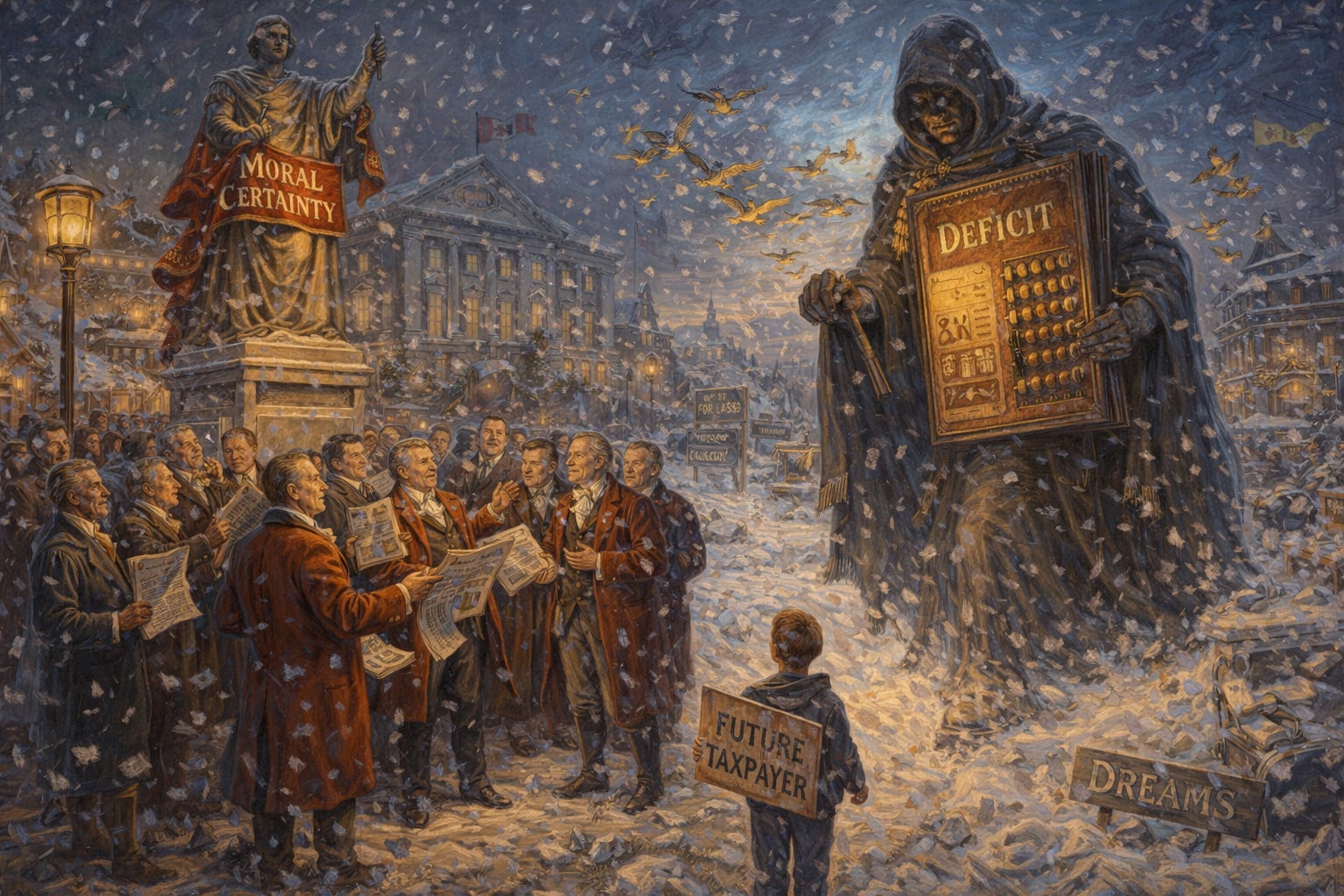
The danger, then, is not merely bad policy, though there is plenty of that. The greater danger is civic indifference to bad policy so long as it is attractively narrated.
Fragility in political systems rarely announces itself dramatically. It appears first as a soft tolerance for decline, a willingness to accept worsening outcomes provided they are accompanied by the right tone, the right branding, the right accredited face. That is where Canada now seems to be: governed by presentation, narrated by advocacy, and buffered from revolt by a public taught to consume politics as mood.
The Revolutionary Gentleman thrives in such a country.
He can moralize without producing, posture without sacrificing, and fail without consequence. But reality, unlike media ecosystems and university seminars, does not remain suspended in euphemism forever. Debt eventually arrives. Productivity eventually matters. Inflation eventually bites. Investment eventually leaves. Arithmetic, that most unromantic of political opponents, always returns.
And that is the final point. Dreams are not capital. Aspirations are not productivity. Virtue is not an economic strategy. A country cannot redistribute what it does not first create. Ignore incentives long enough, and they do not disappear; they retaliate. Investment hesitates. Talent relocates. Growth slows. Revenues disappoint. And the arithmetic—treated for years as a nuisance, an ideological inconvenience, a dreary interruption to moral theatre—returns with the patience of winter.
Canada does not lack speeches. It lacks truth. Until it relearns the difference between eloquence and thought, between branding and governance, between advocacy and scrutiny, it will continue applauding its own managed decline.
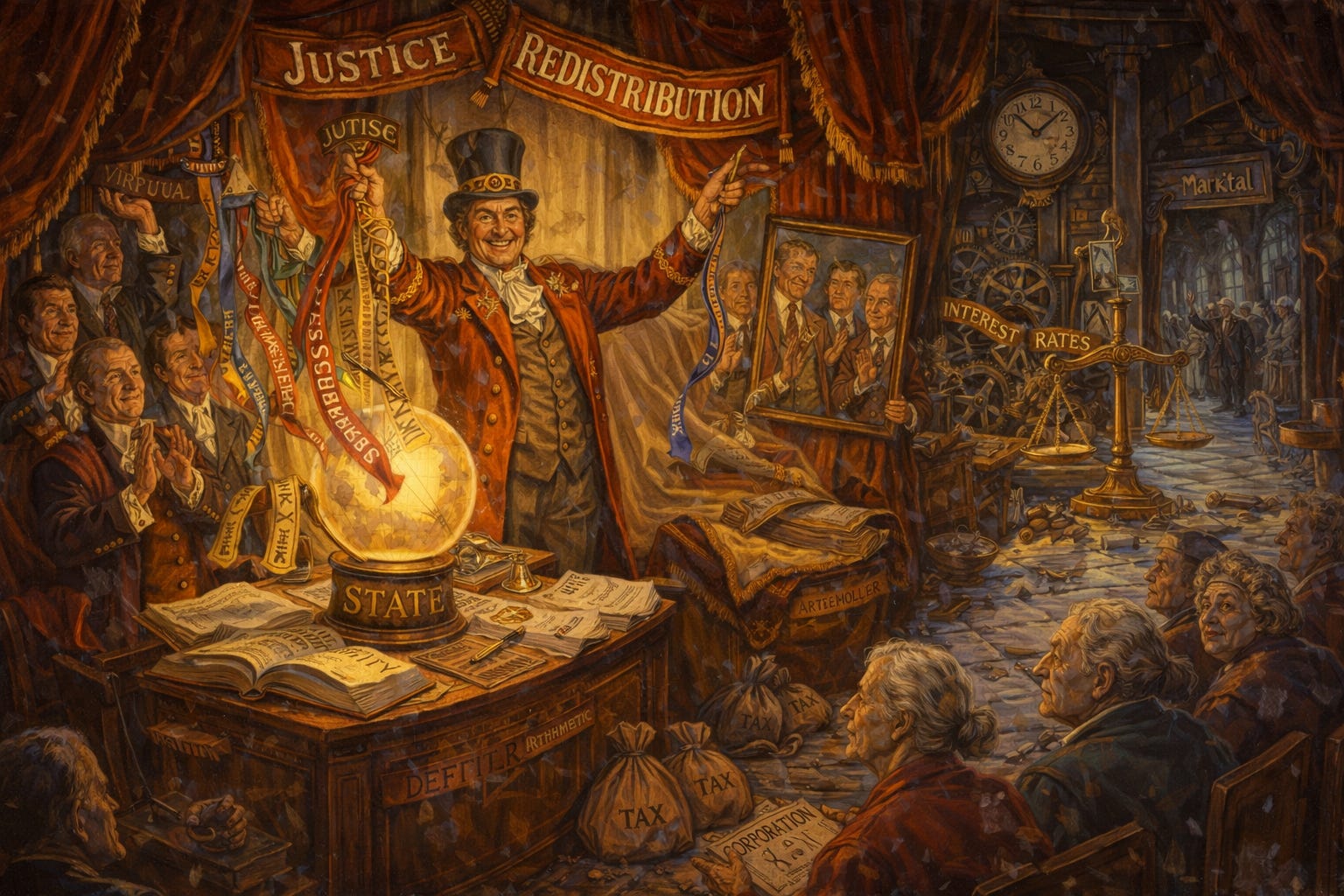
Reality has atrocious manners. It arrives uninvited, refuses rhetorical consolation, and eventually demands payment.
If you found value in this article and wish to support my ongoing work, please consider leaving a tip. Your support helps me continue producing uncensored content on critical issues.
Thank you.
Absolute! How shallow we have become in choosing our political leaders: Appearance over substance; Feel-good over hard truths. Today Churchill wouldn’t stand a chance. Instead we vote for the likes of Carney, Macron, Trudeau, as if good hair will save us, reassure and pacify us!