


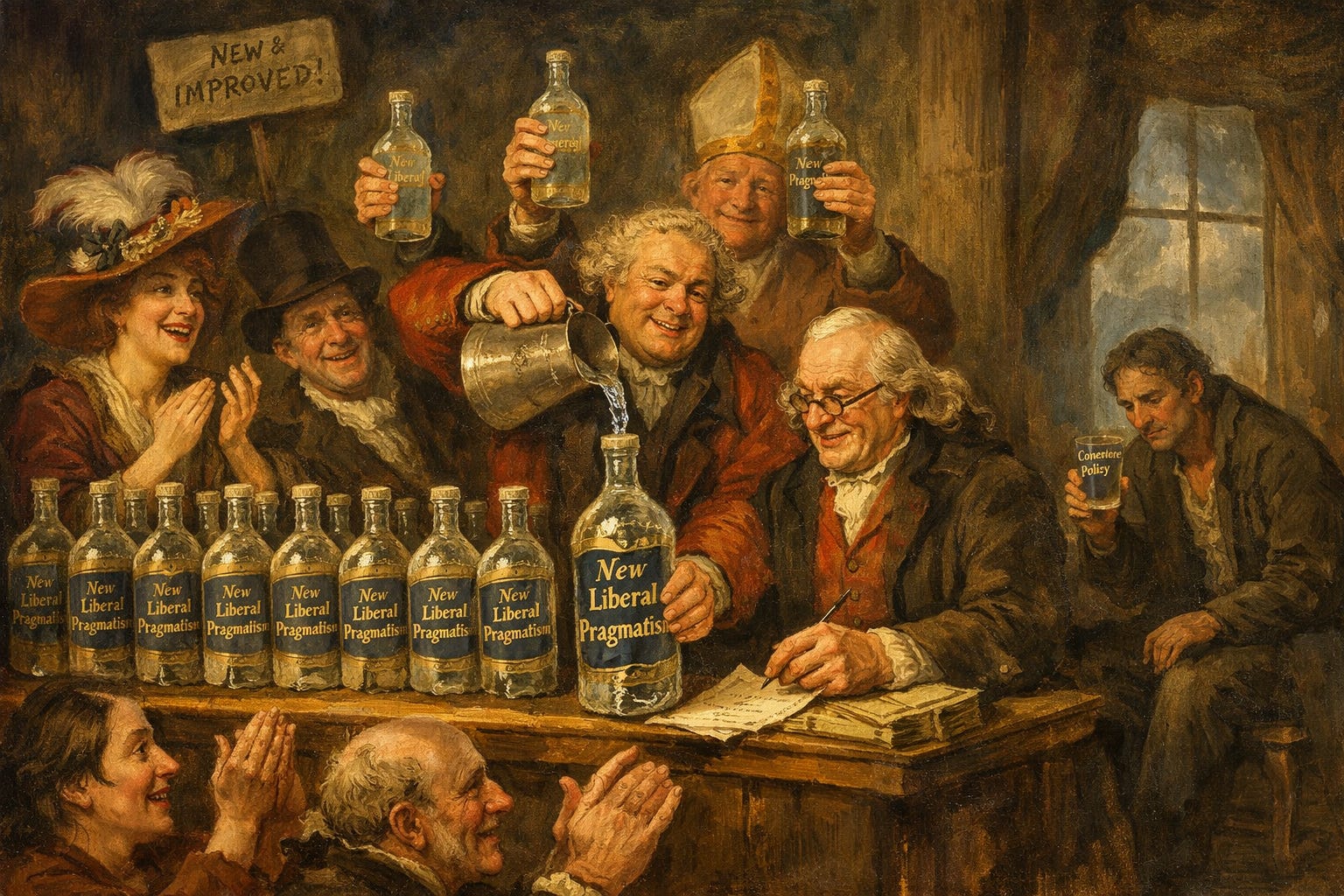
Canadian politics has reached a point of such aesthetic and emotional shallowness that it now resembles a household superstition. My mother-in-law insists bottled water tastes better than tap water. Our tap water is clean, safe, and regulated. So I refill the bottles with tap water, put them back in the fridge, and—miracle of miracles—she continues to insist they taste better.
The bottle, not the content, is doing the work. She doesn’t speak English, won’t read this, and my secret is safe. Sorry Baba.
Canadian Liberal voters, however, do read. And the same phenomenon applies.
After a decade of woke moralising, teddy-bear clutching platitudes, “governing from the heart,” and the immortal line that “the budget will balance itself,” the electorate grew visibly tired of Trudeau. Not radicalised—tired. Tired of therapy-speak, tired of vibes, tired of being governed as if the country were a sensitivity workshop.
So the Liberals did not change the water. They changed the bottle.
They swapped the drama teacher for a banker. They replaced the emotional register with managerial calm. They rebranded the same policy terrain as “pragmatism,” “competence,” and “seriousness.”
They did this while quietly adopting large portions of the Conservative policy framework they had previously denounced as heartless, fascistic, or dangerous.
Mark Carney was not parachuted in from Mars. He was Trudeau’s long-time economic advisor, embedded in the same governing project. What changed was not the governing philosophy so much as the font.
And yet voters swooned. They praised the tone. They praised gravitas. They praised the way he “handles the media.” They complained that Poilievre is “mean,” apparently unaware that the job of an opposition leader is to be unpleasant to those in power, to hold the government to account, not to be a fanboy. Many voters seem to miss the obvious:
You are not electing a boyfriend.
You are not choosing a brand identity.
You are electing a governing approach.
If ideas you once dismissed as fascist propaganda suddenly seem wise when delivered by a different accent and haircut, the conclusion is not that the ideas improved. It is that your criteria for judgment were unserious.
What follows is the evidence. If it looks like a Rotten Tomatoes score, that is unfortunate—but parliamentary bills are not episodic entertainment, however much modern politics pretends otherwise.
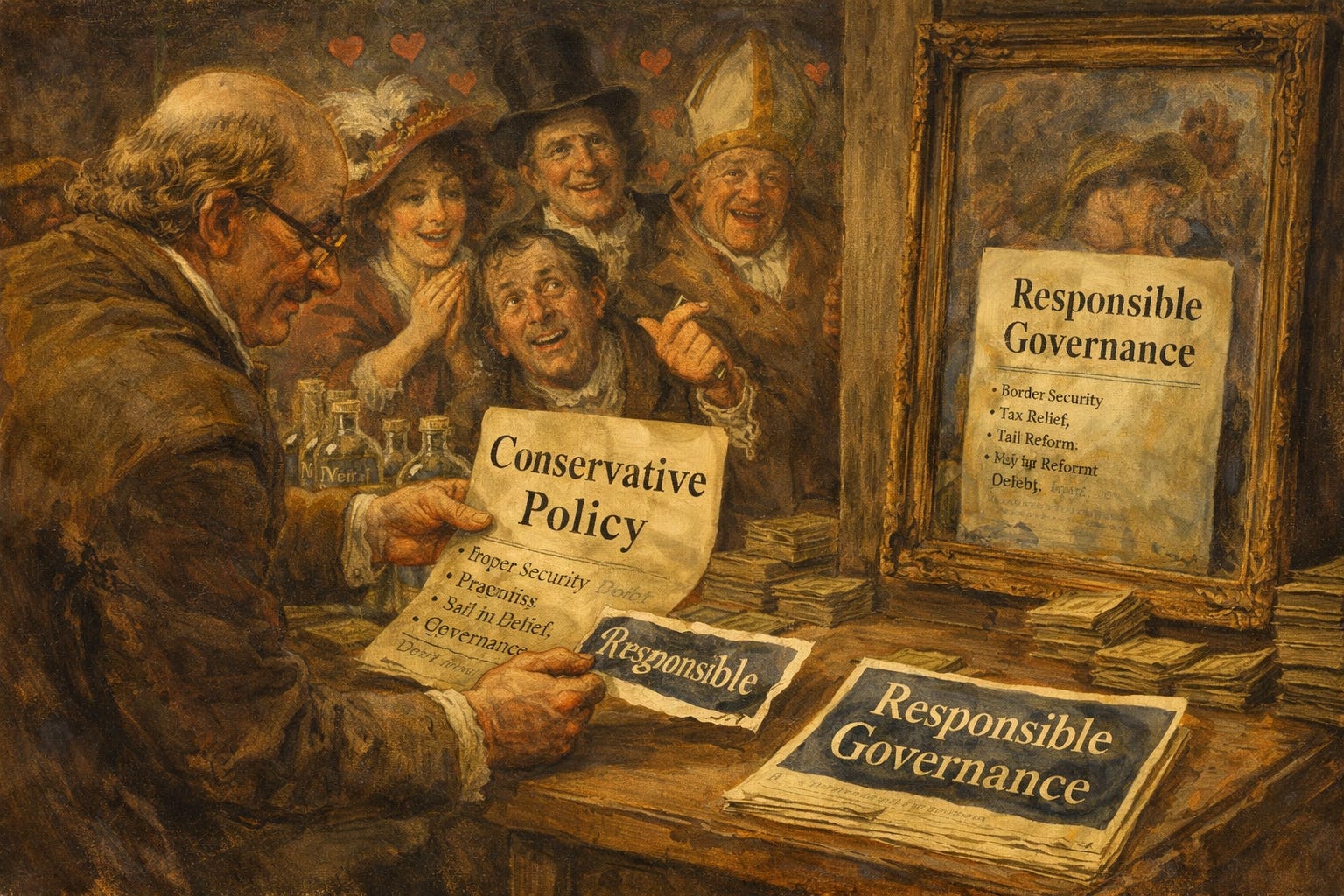
Methodology
Scope:
Liberal government bills listed on LEGISinfo pages 1–3 of the current Parliament (government bills only)
Conservative Party of Canada Policy Declaration (Sept 2023)
Standard for “similarity”:
Not identical wording
Same policy problem space and direction of travel
Rebranding counts as similarity
Bill-by-Bill Policy Comparison Chart
Bill C-1 – Administration of Oaths (Procedural)
Policy area: Parliamentary procedure
CPC analogue: None
Similarity: 0%
Note: Procedural, excluded from similarity denominator. And with all due respect, who cares about this Bill?
Bill C-2 – Strong Borders Act
Policy area: Border security, enforcement
Conservative policy:
Immigration Principles and Border Integrity (Sections T.161–167)
National Defence and Security (Sections V.178–188)
Assessment:
Conservatives campaigned explicitly on border enforcement, sovereignty, and system integrity. Liberals dismissed this as fear-mongering, then introduced a bill substantively aligned with those objectives.
Similarity score: 85%
Bill C-3 – Amendments to the Citizenship Act
Policy area: Citizenship integrity, eligibility, revocation
Conservative policy:
Citizenship and Immigration Controls (T.161–167)
Assessment:
Different rhetoric, same premise: citizenship is not an abstract feeling but a legal status with conditions.
Similarity score: 75%
Bill C-4 – Making Life More Affordable for Canadians Act
Policy area: Tax relief, affordability
Conservative policy:
Tax Relief (E.28)
Supporting Families (E.29)
Housing and Affordability (K.105)
Assessment:
Liberals spent years calling tax relief “regressive.” This bill implements precisely what Conservatives proposed: targeted tax reductions and affordability measures. Carney’s great “helping the middle class by lowering taxes,” in which the bottom tax rate is dropped from 15% to 14.5%, saves a voter who makes $35K per year $ .27 per day. Hardly life-changing.
Similarity score: 90%
Bill C-5 – One Canadian Economy Act
Policy area: Internal trade, labour mobility
Conservative policy:
Interprovincial Trade (G.60–61)
Labour Mobility and Credential Recognition (T.165)
Assessment:
A direct lift from long-standing Conservative complaints about Canada behaving like ten fenced-off economies. Carney promised he’d have this licked by summer 2025, talk, 100%, results? 0%.
Similarity score: 95%
Bill C-8 – Cybersecurity and Telecommunications Amendments
Policy area: Infrastructure security, regulatory modernisation
Conservative policy:
Cybersecurity (V.188)
Communications and Data Protection (N.137–141)
Assessment:
Liberals once framed security concerns as paranoia. Now they legislate them.
Similarity score: 80%
Bill C-9 – Criminal Code / Hate-Related Amendments
Policy area: Public order, criminal law
Conservative policy:
Criminal Justice and Public Safety (M.122–134)
Assessment:
While Conservatives and Liberals differ sharply on speech thresholds, both assert criminal law as the tool for maintaining public order.
Similarity score: 60%
Bill C-10 – Commissioner for Modern Treaty Implementation
Policy area: Indigenous governance, accountability
Conservative policy:
Indigenous Affairs Frameworks and Transparency (L.112–121)
Assessment:
Different moral language, same institutionalisation and accountability logic.
Similarity score: 70%
Bill C-12 – Strengthening Canada’s Immigration System
Policy area: Immigration capacity, enforcement
Conservative policy:
Immigration System Integrity (T.161–167)
Assessment:
This bill is an admission that unlimited intake without infrastructure is unsustainable—exactly the Conservative position.
Similarity score: 85%
Bill C-14 – Bail and Sentencing Reform
Policy area: Criminal justice, repeat offenders
Conservative policy:
Sentencing Reform and Bail (M.123–129)
Assessment:
Liberals arrive, late and reluctantly, at Conservative conclusions under pressure from police, premiers, and reality. Part of the ‘Undoing our own mistakes, and then acting as if the mistake was created by a mysterious conservative force, not the previous Liberal Trudeau government' legislatitive suite.
Similarity Summary Table
Bills analysed (excluding procedural): 9
Bills with clear Conservative overlap: 8
Average similarity across overlapping bills: 81%
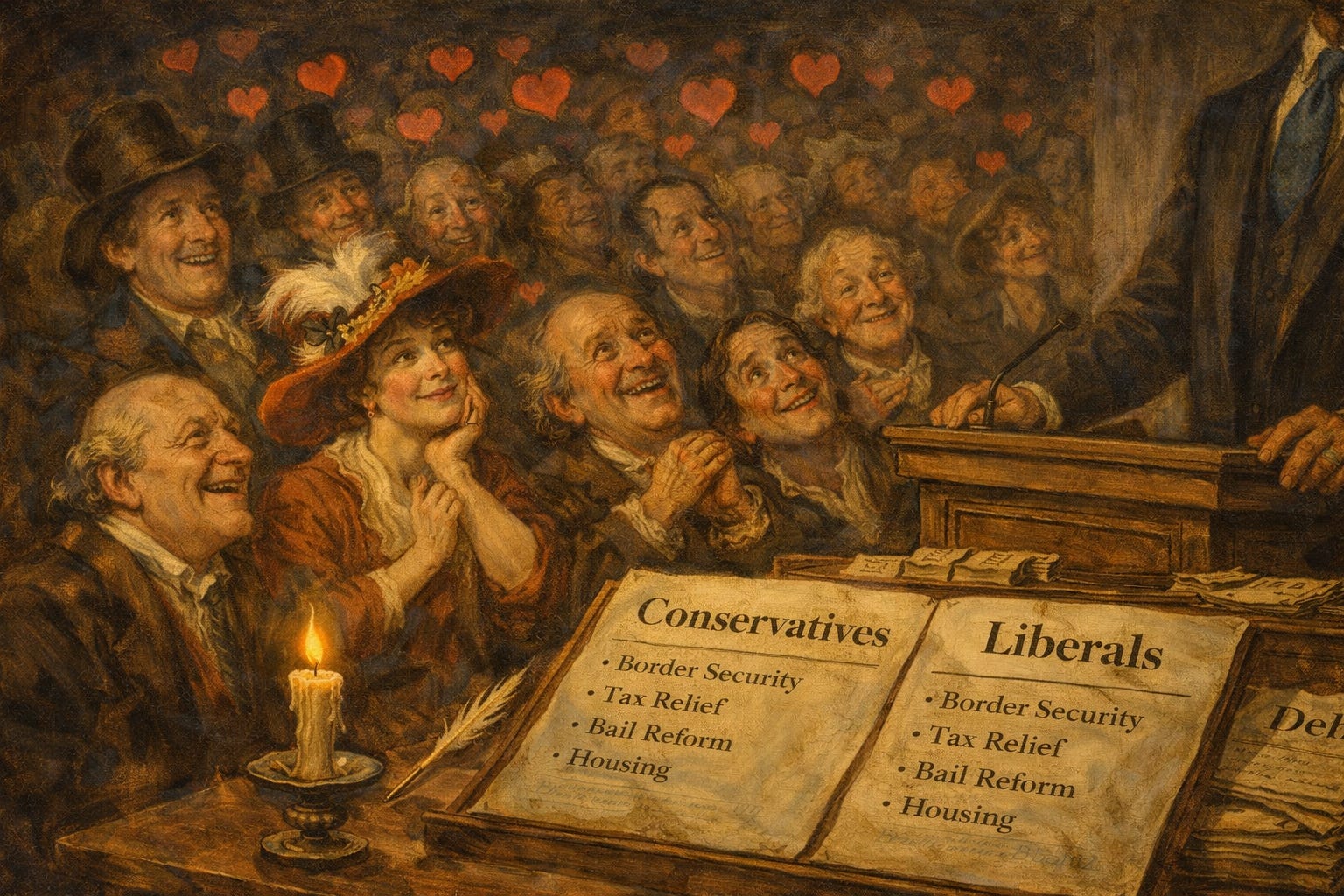
Conclusion
One must also confront the growing demand—voiced most loudly on Twitter by the salon-left, the NGO aristocracy, and the professional moral monitors—that even this level of ideological uniformity is insufficient.
The CBC, the Globe and Mail, the Toronto Star, CTV, Global, and their auxiliary choir of podcasts, panels, and publicly funded “explainer” units already provide wall-to-wall reassurance that Mark Carney is serious, sensible, and safe. Yet still the cry goes up: the National Post must be destroyed.
Why? Because dissent itself has become obscene.
Here, the ersatz Marxist critique is deployed with comic bad faith. The Post is owned by a hedge fund, we are told, as if this revelation alone should prompt the seizure of its presses and the sending of its writers to re-education seminars.
This denunciation comes, of course, from people serenely untroubled by the fact that vast portions of Canadian media are directly subsidised by the federal government, or indirectly sustained by Google transfer payments—an arrangement that would have made an old-school party apparatchik weep with envy.
Capital is wicked only when it is not obedient.
Thus, we arrive at the uniquely Canadian farce: a press class that prides itself on independence while feeding from the public trough, and that simultaneously insists that one of the few dissenting national newspapers must be eradicated for the crime of dissenting. This is not pluralism. It is cartel behaviour with a land acknowledgement.
And still the deeper question remains unanswered:
Why do Canadians swear—hand on heart, nose in the air—that Conservative policies taste better once poured into Liberal bottles?
Is it the media environment, so thoroughly homogenised that disagreement now feels like vandalism? Is it the relentless moral framing, whereby an idea’s worth is determined not by its content but by the pedigree of the person uttering it?
Or is it something more humiliating still: a national identity so hollow that it exists almost entirely as negation?
“I’m not American.”
“I hate Trump.”
“Did you notice my backpack? See my flag?”
“We have healthcare.”
Unless we are playing the United States for Olympic hockey gold, this seems to exhaust the Canadian sense of self. It is not an identity; it is a nervous tic. Into this void strides the managerial Liberal—calm, well-coiffed, and entirely empty—assuring voters that nothing will be required of them beyond nodding gravely and feeling superior.
This is not plagiarism in the strict sense.
That would imply admiration.
This is policy laundering.
Ideas once shrieked down as cruel, fascistic, or extremist when articulated by Conservatives are magically transubstantiated into “pragmatic,” “evidence-based,” and “responsible” when repackaged by Liberals with a gentler accent and a consulting-deck font. The electorate, having mistaken mood for meaning, applauds the relabeling and congratulates itself on its enlightenment.
Nothing fundamental has changed. Not the policies. Not the constraints. Not the trade realities. Not the arithmetic.
Mark Carney did not represent a break with Trudeauism. He represented its last survivable mutation. When the governing class realised that voters were sick of sanctimony, infantilization, and fiscal fantasy, it did not repent. It hired a banker, dimmed the therapy lights, and carried on governing from the same map—one drawn years earlier by the very Conservatives it had spent a decade denouncing.
If you despised these ideas when Poilievre expressed them and adore them now because they arrive wrapped in calmer diction, the problem is not Poilievre.
It is not even Carney.
It is you.
You are not electing a boyfriend. You are not choosing a brand identity. You are not shopping for a temperament. You are electing a governing approach.
And if the same approach tastes better because the bottle is prettier, the problem is not the water.
It is the palate.
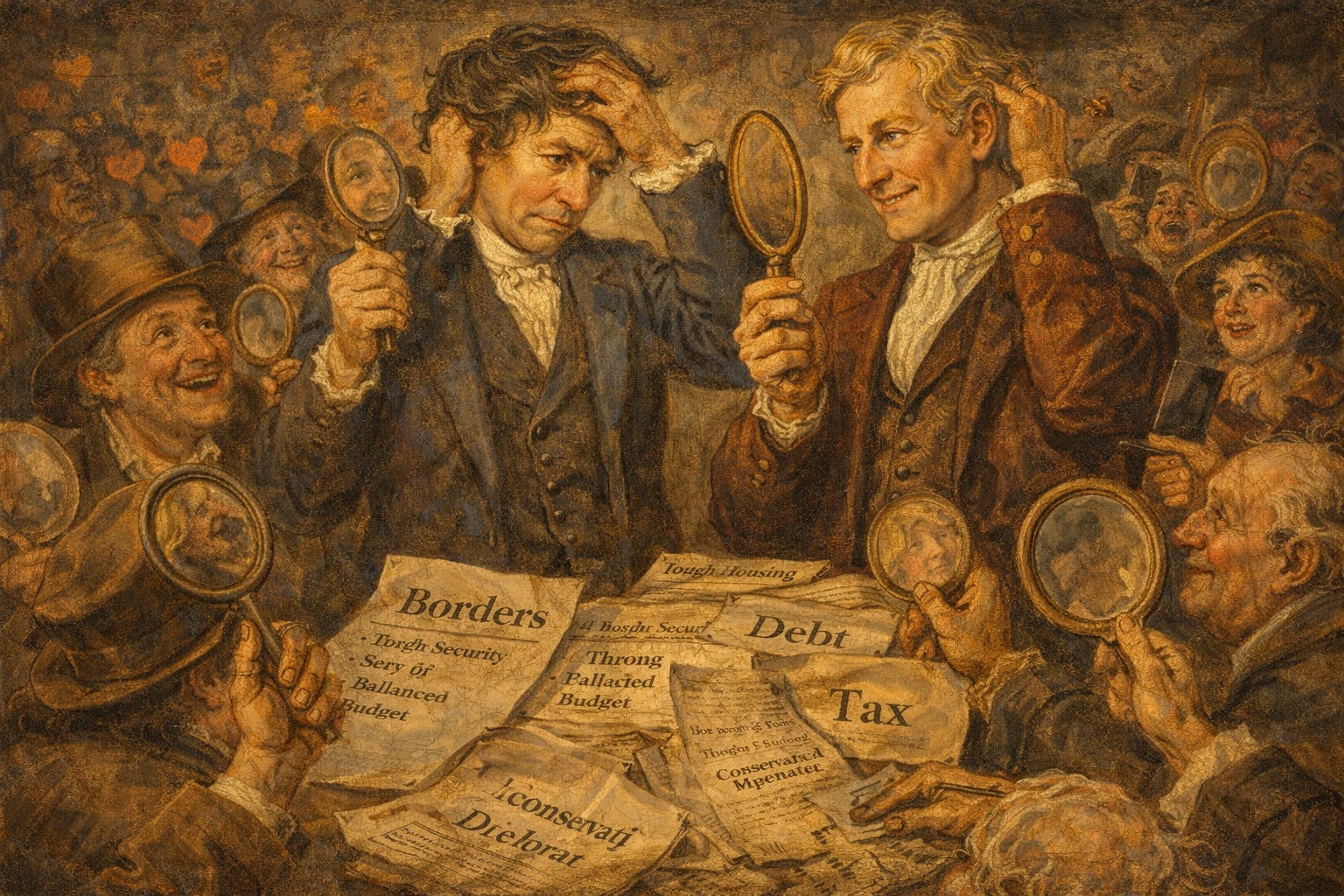
The conservatives lost not because of the policies put forward, but by the person delivering the policies. If you don't believe that fact, fine I wont try to change your mind. Trust the people. In the latest polling both the Liberals and Conservatives are dead even. But in the same polls Pierre Poilievre's approval rating is dropping lower. ( again) In normal circumstances one would think that the opposite would occur. That being said, Within a few weeks time we will find out what conservatives decide with regards to who will lead the party. Even money says Pierre Poilievre. Best of luck to them.
I will leave you with this thought. The reason that the conservatives still maintain support for Pierre Poilievre is actually worrying and a very frightening thought. That they have no other viable candidate to fight the liberals.
Back in 2012 the Liberals were looking for a saviour, unfortunately for us they found one.
If you would like to share with your MP please do so.
used to have a cook in the restarant I worked at that I did the same thing to he said that fountain coke tasted better than caned coke I would switch it every Time he sent me out to get another glass for him . he never knew the difference . in this instance its the same trick is being played on the public good description of the trick