


If you believe in the importance of free speech, subscribe to support uncensored, fearless writing—the more people who pay, the more time I can devote to this.
Please subscribe to receive at least two pieces/essays per week with open comments. It’s $7 per month, less than $ 5 USD.
Everyone says, “Hey, it’s just a cup of coffee,” but please choose my coffee when you come to the Substack counter. Cheers.
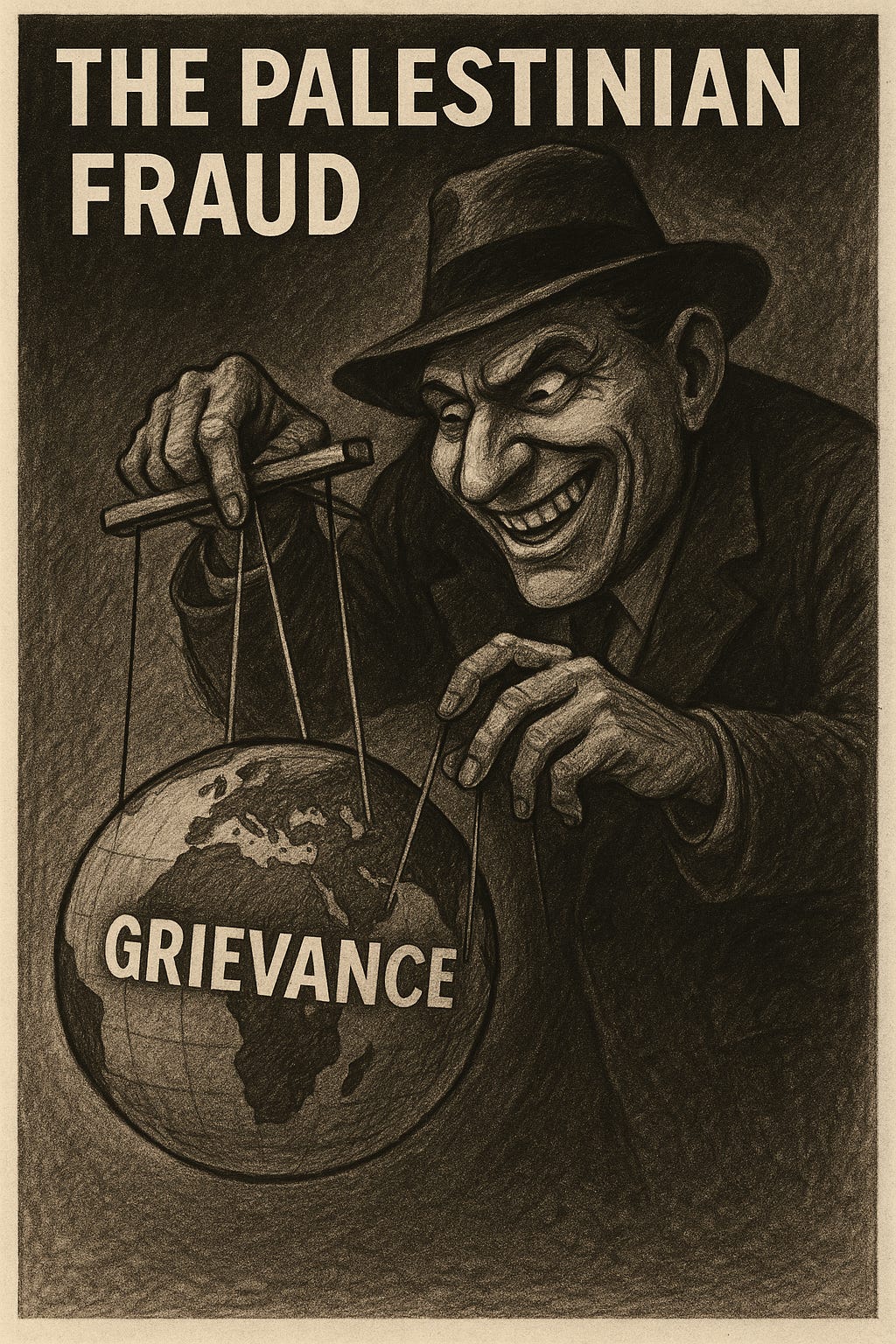
There are lies, there are delusions, and then there is the Palestinian national narrative: a fiction so shamelessly constructed, so uncritically repeated, and so catastrophically indulged that it stands as the most successful political con job of the past hundred years. Everything about it—its alleged antiquity, its supposed indigeneity, its fraudulent claims of dispossession—is a masterclass in fabrication, fortified through sheer repetition and protected by a global ecosystem of cowardice.
To expose the fraud, one must begin at the beginning—not in the 1960s, where the modern myth was born, but two thousand years earlier, when the Romans invented the name.
I. The Roman Punishment and the Fabrication of a Geography
The term “Palestine” enters recorded history not as the name of a nation, a people, or an ethnicity, but as a deliberate Roman insult. After crushing the Bar Kokhba revolt in 135 CE, Rome erased the name Judea and imposed Syria Palaestina—naming the land after the Philistines (Plishtim), a long-vanished Aegean people, precisely to sever Jewish identity from its homeland. It was not an origin story; it was an act of imperial malice.
For nearly two millennia thereafter, “Palestine” functioned merely as a vague geographic label, like “the Levant” or “Scandinavia.” It never designated a sovereign polity. Under Byzantium, the various Islamic caliphates, Crusader rule, and the Ottomans, the region was repeatedly carved, renamed, and reorganised into administrative districts—none of which represented a “State of Palestine.”
There was never:
a Palestinian king
a Palestinian parliament
a Palestinian currency
a Palestinian literature describing the Palestinian nation
a Palestinian army
or even, astonishingly, a “Palestinian” soccer team
Even the Palestinian terrorists before the 1920s did not call themselves Palestinians, because the term had no meaning apart from Jews and foreigners referring to the region. As historian Alan Luxenberg notes, to speak of “historic Palestine” as if it were a country is “a misleading anachronism.” It was a place on a map, not a nation.
Indeed, for two thousand years, “Palestine” meant “the Land of Israel.”
The Jewish paper was called the Palestine Post.
The major Zionist fundraising body was the United Palestine Appeal.
The first Chief Rabbi of Israel was titled “Chief Rabbi of Palestine.”
Are we to imagine that the Palestinians had a Chief Rabbi?
II. The Invention of a People: When Geography Became Ethnicity
A man may call himself a Winnipegger, but that does not make Winnipeggers an ethnicity with ancestral land rights. Likewise, a resident of Mandatory Palestine in 1930 could claim to be a Palestinian in the civic sense, but that did not make “the Palestinians” an ancient indigenous nation. It made them what they were: Arabs of the greater region—Egyptians, Syrians, Transjordanians—who moved and lived there for various reasons.
Arab residents identified as:
Arabs
Syrians
Southern Syrians
Members of their clan or village
The term “Palestinian Arab people” did not exist.
The creation of a “Palestinian people” with a distinct ethnic identity occurred only after successive Arab attempts to destroy Israel militarily failed. The PLO, founded in 1964 by Egypt’s Ahmad Shukeiri, explicitly disclaimed the West Bank and Gaza—because those territories were held by Jordan and Egypt. The only “Palestine” the PLO sought to “liberate” was Israel itself.
Not one PLO attack between 1964 and 1967 targeted the West Bank or Gaza. Every attack was aimed at Israeli cities. Only after Israel’s victory in the Six-Day War did the narrative shift. Suddenly:
Gaza became “occupied Palestine,” though Egypt never proposed a Palestinian state there.
Judea and Samaria—heartlands of Jewish history—became “the West Bank,” a cartographic euphemism invented precisely to avoid acknowledging Jewish roots.
Why “West Bank”? Why not call Jersey City or Hoboken the “West Bank” of the Hudson? Because Arabs had never named Judea or Samaria—it was never theirs.
The Biblical names—Judea, Samaria, Hebron, Bethlehem, Galilee—reverberate through Jewish and Christian scripture. Jesus walked through Judea and Samaria. The prophets lived, wrote, and died there. To claim these places never had Jews is not merely historical illiteracy; it is historical arson.
The modern Palestinian identity is therefore not ancient but reactive: a negative identity forged entirely in opposition to Jewish sovereignty. Palestine, like a spectre, appears only when Israel exists to haunt.
III. The Rejection of Every Statehood Offer
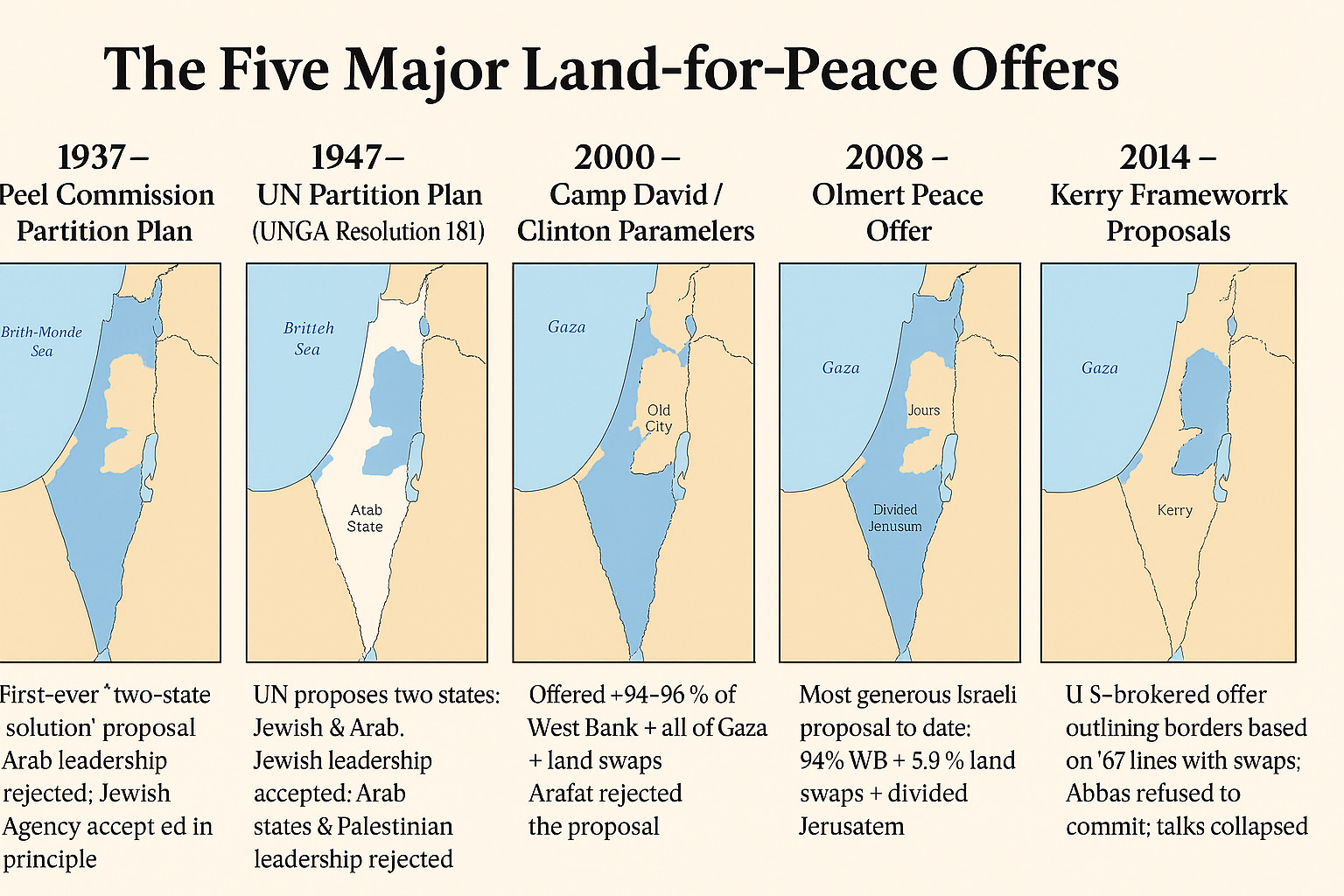
If Palestinian nationalism were genuine, it would have accepted a state when offered one. Instead, history delivers a record of total and consistent rejection:
IV. The Modern Big Lies: From Jesus to “Indigenous Palestinians”
The fraud has metastasised. Having spent half a century convincing the gullible that an Arab “Palestine” once existed, and that “the Palestinians” are a timeless ethnic nation, the propagandists have now advanced to the next phase: claiming Jesus was a Palestinian Arab.
The New York Times has flirted with this heresy.
Mahmoud Abbas, Holocaust denier (only in the NY Times could a Holocaust denier be deemed a moderate!) and financier of terror stipends, denies that there ever was a Jewish Temple in Jerusalem. The Grand Mufti denies Jewish and Christian history alike. This is not merely ignorance; it is annihilationist rhetoric masquerading as an academic tone.
A simple test exposes the lie:
Name a single Arab:
King of Palestine
Prime Minister of Palestine
President of Palestine
Sheikh of Palestine
There were none. Because there was no Palestine.
The land never held an Arab political identity until the PLO invented one for the sole purpose of erasing the Jewish one.
VI. The Future: Area C and the End of the Fraud
Meanwhile, reality moves forward.
More than 750,000 Jews now live in Judea and Samaria, including East Jerusalem.
Area C — the 61 percent of the West Bank that Oslo left under full Israeli control and that every “peace plan” was supposed to hand over someday — now has a decisive Jewish majority. And that, of course, is the real unspoken grievance: not boundaries, not legality, but demographics. The world howls. Israel no longer listens.
The great virtue of enduring 75 years of one-sided condemnations is that one eventually learns to tune out the static: the United Nations, the EU, the Arab League, the Russia–China axis, and the endless parade of Western progressives who could not locate Hebron on a map if their avocado toast depended on it, yet scream about it on Instagram with missionary zeal.
The fraud is dying, though the myth-makers rage harder.
Conclusion: On Fraud, Cowardice, and the Inconvenience of Truth
All frauds share the same anatomy: a hollow centre padded with sentiment, protected by cowardice, and sustained by those who find the lie more comfortable than the truth.
The Palestinian national myth is one such fraud, varnished by repetition until the credulous mistake it for history. It is a confection of recent vintage — a mid-20th-century improvisation, cooked up by the PLO for the sole purpose of donning the fashionable robes of victimhood.
Before that, the term “Palestinian” simply denoted an address on an Ottoman tax ledger or a British census form, much as “Winnipegger” denoted a citizen of Winnipeg rather than a descendant of some lost Mesopotamian tribe.
Yet through sheer propaganda genius — a marketing coup that would make Coca-Cola, Pepsi, and McDonald’s get down on their knees and take notes — a municipal label was re-engineered into an “ancient people” with “ancient rights” to a land whose actual ancient people were already well documented in Babylonian steles, Roman decrees, Jewish scripture, Christian gospels, and Islamic chronicles.
And so the ruse flourished. The West, allergic to spine and addicted to sentimentalism, embraced the myth with the enthusiasm of a child believing in Santa Claus long after the beard had begun slipping off.
Professors sentimentalised it, diplomats romanticised it, and activists weaponised it. Never has a civic identity invented by committee resolution been taken so seriously by people who should have known better.
This is why the parade of “land-for-peace” offers — Peel 1937, UN 1947, Camp David 2000, Olmert 2008, Kerry 2014 — must be understood with unflinching clarity. These proposals were not endorsements of an ethnic claim, nor acknowledgements of Palestinian antiquity — which does not exist — nor recognition of an indigenous right conjured out of 20th-century public relations.
They were pragmatic attempts to secure peace, even at the price of carving pieces off the world’s only Jewish homeland.
It was land for peace, not land for legitimacy. Israel offered territory not because the Palestinian claim was ancient, but because Israelis preferred being alive to being morally fashionable.
The tragedy is that every offer was rejected, often violently, because frauds — once institutionalised — cannot survive a negotiated settlement. Fraud requires perpetual grievance.
And if there is any lesson the world should learn from this elaborate confidence trick, it is this: do not get fooled twice, which brings us, inevitably, to Winnipeg.
Because if the day ever comes when Winnipeggers begin demanding UN recognition as an ancient ethno-nation, insisting on special grants, international pity, and a return to some mythical ancestral homeland centred around Portage and Main, the world should respond firmly and politely:
No. Absolutely not. We got conned once with Palestine — we are not getting conned again.

And frankly, even Winnipeggers might struggle to keep a straight face. It’s hard to build a compelling victim narrative when half the population isn’t entirely sure they want to admit they’re from Winnipeg — especially given how the Jets are playing right now.
History, unlike propaganda, retains its memory. And so should we.
If you found value in this article and wish to support my ongoing work, please consider leaving a tip. Your support helps me continue producing uncensored content on critical issues.
Excellent essay.
The history is the history. Unfortunately, too many have swallowed the marketing pitch and reject the facts.