


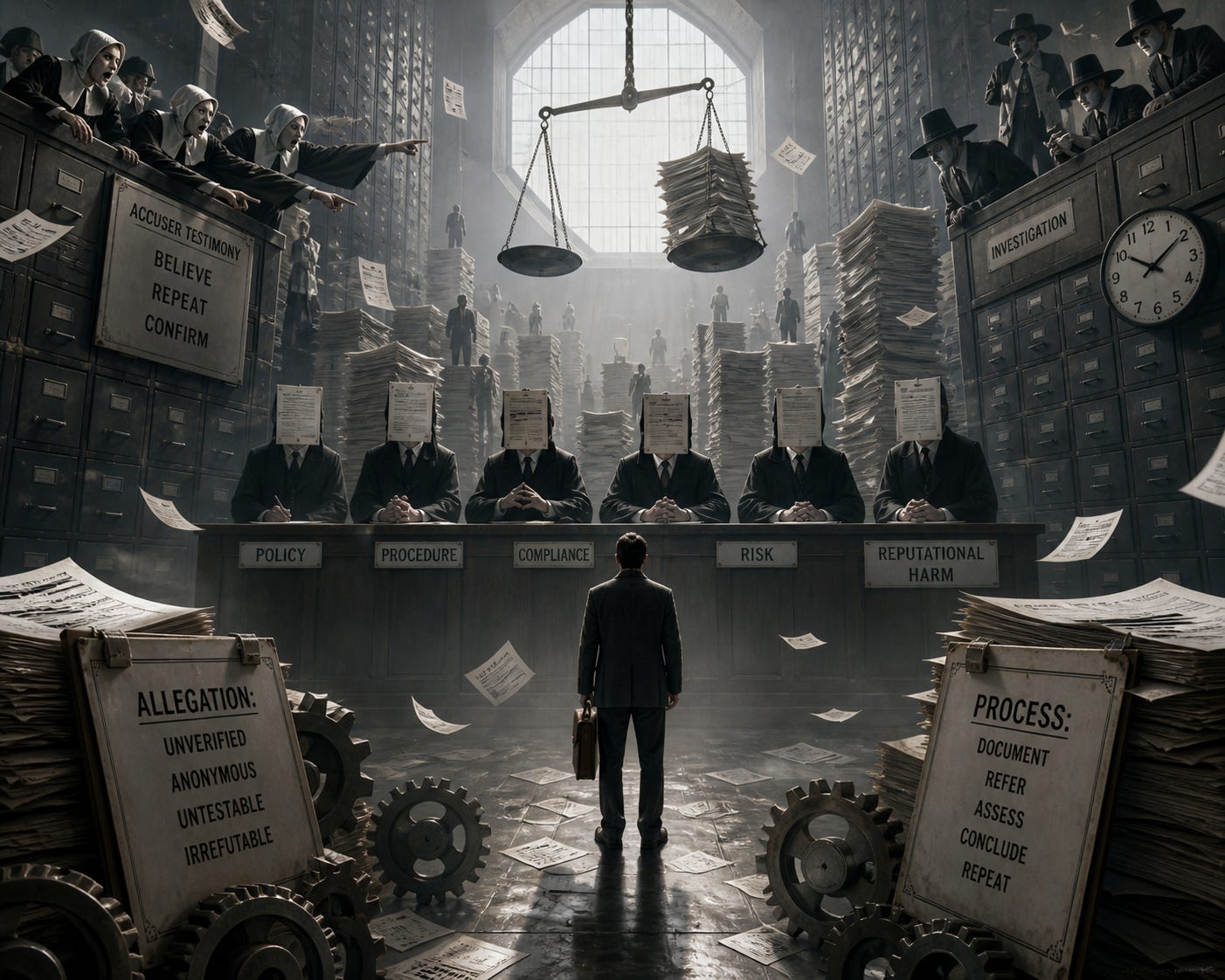
In high school, many of us read The Crucible, Arthur Miller’s dramatization of the Salem witch trials: a warning about hysteria masquerading as justice. We read it at a comfortable distance, almost smugly, as though it described an extinct moral species—the fruit of some ancient, diseased tree that modernity had long since cut down.
We surveyed the accusations, the panic, and the ruined lives and asked: How could they? How could ordinary people become so possessed by rumour and righteous certainty that they destroyed their neighbours without evidence? How could judges mistake accusation for proof, ministers mistake frenzy for virtue, and an entire community become so certain while being so catastrophically wrong?
The better question is: What makes us think we are different?
A journalist who examined my case once said something that has never left me.
“If these accusers had their way,” she said, “they would have killed you.”
She was not commenting on a procedural irregularity or a badly drafted policy. She had recognized something older and more dangerous: hostility fused with moral certainty—the conviction that punishment is not merely permissible but virtuous, and that the accused has forfeited even the right to be heard.
My offence, such as it was, consisted of stating:
I stand with Israel, and Hamas are Nazis.
That, apparently, was enough.
My accuser did not debate me. He did not ask what I meant or attempt an answer. He denounced me to the credulous managers who govern the University of Guelph and Humber College—people who appear to fear controversy more than falsehood, and accusation less than dissent.
Then the institutional choir began.
The human-rights department supplied the pieties. The vice-provost supplied the authority. The accuser supplied the rage. Administrators and activists supplied the chorus. Together, they resembled the drum and fife playing a jaunty ceremonial tune while the condemned man is marched to the gallows.
This was moral inversion conducted at public expense: an exhibition of institutional virtue attached to the punishment of a man for condemning terrorism.
My accuser, a professor deeply involved in anti-Western and pro-Palestinian organizations, reportedly boasted that he would contact tens of thousands of his friends and ask them to write to the university demanding my termination. He did so.
He did not rebut my statement. He pronounced it sinful and summoned the congregation. After encountering a student-altered screenshot of a comment I had made to a man calling for the destruction of Israel, my still-hidden accuser remained gripped by an almost theological fury.
Here the Salem analogy is not decorative. It is structural.
Salem began with an accusation that acquired authority not because it was proved, but because it was delivered with passion. The modern university proceeds in much the same way. The accusation arrives clothed in the vocabulary of harm, safety, equity, trauma, and human rights.
Emotion supplies the evidence. Institutional anxiety supplies the warrant. Repetition supplies the appearance of corroboration.
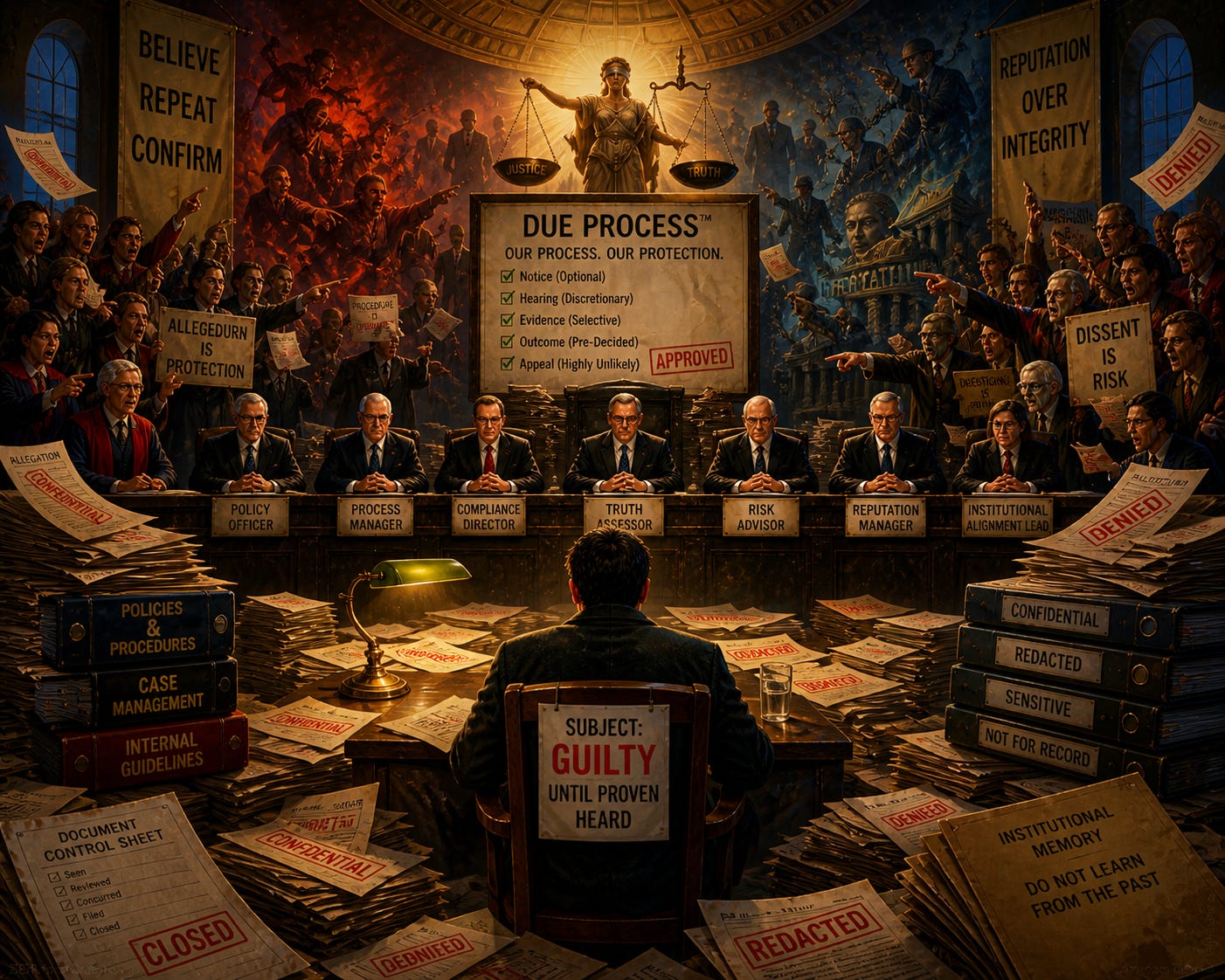
The accusers condemn without confronting the accused. Administrators act without testing the accusation. The process begins not with “What happened?” but with “What must be done about him?”
It is the old cry in updated language: Expel the devil. Purge the contaminant. Restore the community’s moral health.
At Salem, the devil was said to be among the villagers. In the moral inversion of the modern university, the devil becomes the person who condemns a terrorist organization that teaches children to regard the murder of Jews as sacred. The institution turns the moral landscape upside down and congratulates itself for standing upright.
My accuser and lead inquisitor was a Professor Ramadan, a man who never had the courage to introduce himself to me, but who publicly howled for my removal and poured out hostility toward Israel and Jews.
As I have documented it, his public record included blood libels, Holocaust inversion, praise for Iran’s proxies, attacks upon the West, and antisemitic invective.
Yet in the modern Canadian university, such conduct may confer influence rather than disgrace when carried beneath the approved ideological banner. Ramadan claimed to speak for Muslim students, staff, and faculty, and the institution behaved as though the claim itself endowed him with jurisdiction.
Others joined him, swollen with borrowed certainty. They condemned not from knowledge but from affiliation—from the intoxicating righteousness of belonging to a cause they had scarcely examined.
Islam had been offended, the message went. Punishment must follow.
That is where Salem comes into focus. The question is not whether our institutions possess computers, lawyers, policies, investigators, and procedural manuals. Salem had procedures, authorities, experts, doctrines, sworn testimony, and official records. The question is whether the human impulses beneath the machinery have changed.
They have not.
The same forces remain: the narcotic pleasure of accusation; the promotion of fear into proof; the hunger to join the righteous crowd; the conversion of ambiguity into guilt; the belief that doubt is betrayal; the projection of communal anxiety onto a designated offender; and, above all, the exhilarating permission to be cruel while calling oneself compassionate.
We imagine that education has immunized us. We point to science, law, technology, and especially to universities—those self-congratulatory citadels of reason. But progress has not necessarily made us more just. It has often made us more articulate in our certainty and more ingenious in excusing our cruelty.
I was suspended and eventually dismissed amid allegations of serious misconduct—claims advanced with immense confidence despite the absence of supporting evidence, and later withdrawn or acknowledged as unfounded.
These were not minor distortions orbiting somewhere near reality. They were grotesque enlargements, at times almost fantastical: acts of reputational vandalism.
Their abandonment did not repair the damage. One might as well drive a truck through the front of a house and then, standing among the bricks and broken furniture, explain that the brakes failed. Perhaps destruction was not intended. The house remains destroyed.
Before the decisions were made, none of my repeated requests for a meeting produced a conversation with those responsible. There was no genuine confrontation, no hearing in the ordinary human sense, no attempt to understand.
I was not heard.
I was processed.
What remains is not merely a legal dispute waiting to be arranged into numbered paragraphs. It is the lived experience: the sleepless nights, the disbelief, the mind returning helplessly to the same question—why? It is the shock of discovering how little resistance cruelty and betrayal encounter once they have been placed inside an approved procedure.
And the performance continues. The venue is now the Labour Board, where seven lawyers, neatly arrayed, continue to advance insinuations without having met me or heard my account. They marinate in their own professionalism, as though a careful modulation of tone might disinfect the substance of their conduct.
It cannot.
The prose may be polished. The machinery may be decorous. The injury is not thereby made civil.
The months of delay possess their own cruelty. Delay exhausts, isolates, and consumes time until resistance itself begins to appear unreasonable. Salem had the dungeon and the gallows. Bureaucracy has postponement, silence, expense, and attrition. The instruments have changed; the purpose remains recognizable: break the accused before his claims can be heard.
Even evidence that senior figures within OPSEU—the union charged with representing me—had expressed grotesquely antisemitic, pro-Hitler, or other radically anti-Israel views was treated as irrelevant to whether bias might have shaped their treatment of a man whose offence was standing with Israel.
The union accused me on the first day of committing a hate crime, refused meaningful engagement, and ultimately abandoned me.
That was not representation. It was participation.
The magistrates of Salem must have enjoyed much the same self-regard. They, too, believed themselves custodians of order.
Cruelty does not disappear when it acquires credentials. It does not become less cruel because educated people administer it using longer words from behind heavier desks. It becomes more efficient, more insulated, and more certain of itself. It sheds the mob’s vulgarity and assumes the committee’s composure.
What emerges is colder than rage: bureaucratic cruelty. Ideological cruelty. Cruelty conducted in the language of professionalism, protected by “process,” and persuaded that its own privatized documentation is the same as justification.
Salem eventually admitted “spectral evidence”: claims that an accused person’s spirit had appeared invisibly to torment a victim. One woman’s spectre had supposedly choked an accuser in the night. Another had appeared with the devil and demanded a e signature in his book. Invisible familiars attacked the afflicted.
Such claims could not be tested. That was their advantage. They were constructed to make disproof impossible.
The same spectral structure appeared in my case.
Within hours, vivid stories circulated: that I had assaulted a student, ripped his shirt, been handcuffed, and been led away. A staff member claimed to possess “inside knowledge” and “many witnesses.” Anonymous insinuations of sexual impropriety emerged—not stated plainly enough to be answered, but released into the atmosphere so that imagination could complete the accusation.
On Instagram, I had supposedly communicated with and “threatened” two anonymous girls. When I showed the investigator that my account contained no messages from the relevant period, innocence did not follow. The accusation had already acquired the status of moral truth.
Perhaps the most insidious allegation was that I had told students not to report me. I said no such thing. No evidence supported it. Yet it served the same function as the Salem claim that a witch had warned her victims not to reveal what she had done.
“She bids me not tell,” said the accuser at Salem.
“He warned students not to come forward,” says the modern inquisitor.
The structure is identical. The accusation contains its own hidden premise: there must have been wrongdoing to conceal. Once that premise is accepted, the conclusion is already embedded. Silence proves fear. Denial proves deception. The absence of evidence proves how successfully the offender suppressed it.
This is Salem’s logic exactly.
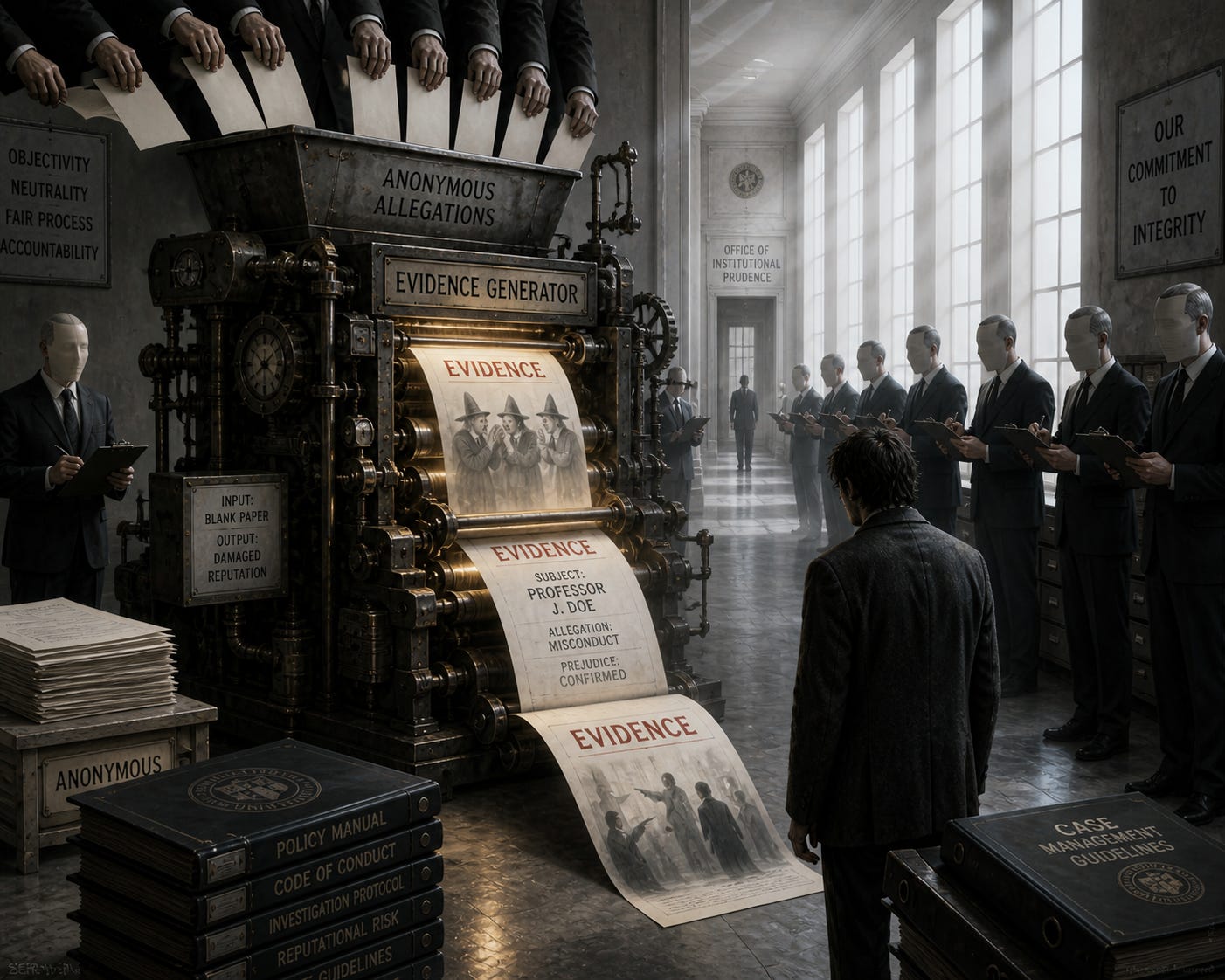
At Salem, denial did not count against the accusation. It was treated as evidence of cunning. The invisible character of the alleged offence made contrary evidence irrelevant. The accused could neither confess without condemning himself nor deny without confirming his deceit.
Modern cancel culture reproduces this closed circle. The complainant’s interpretation proves the offence. The accused’s denial proves his lack of insight. His request for evidence becomes retaliation. His anger becomes aggression. His calmness becomes calculation. Every possible response is absorbed into the theory of guilt.
The accused is invited to participate only by confessing. To defend oneself is to commit the additional offence of resistance.
Spectral evidence indeed.
This is how hysteria grows. A claim is made. It is repeated, embellished, and insulated from verification. Then it ceases to be treated as an allegation and becomes the background assumption against which every later fact is interpreted. The question is no longer whether it is true.
The question becomes: Who would dare doubt it?
At Salem, the accused were nominally permitted to defend themselves, but only within a structure that had already accepted the reality of witchcraft and the reliability of the accusers. The proceedings were not inquiries into guilt. They were performances of certainty.
Those performances were not conducted merely by the ignorant.
The judges, magistrates, ministers, and legal officials of Salem were among the educated figures of their society. They cited doctrine. They followed accepted intellectual frameworks. They believed themselves rational and responsible.
Education did not restrain hysteria.
It refined it.
That is the most uncomfortable parallel. Sophisticated moral panics do not arise merely at society’s margins. They flourish within its intellectual centre.
Universities proclaim devotion to evidence and reason, yet under the correct ideological conditions they become engines of accusation, conformity, and silence.
A community convinced of its moral superiority is especially vulnerable to panic because it interprets doubt not as prudence but as corruption. To question the accusation is to side with the accused. To demand evidence is to compound the harm. To seek proportion is to reveal one’s own moral deficiency.
My case was driven by institutional antisemitism. Not incidentally, not ambiguously, and not as one influence among many. I was fighting an institution that had made its accommodation with antisemitism—and I was punished for refusing to make mine.
This was an institution that permitted Jews to be described as subhuman and as devil worshippers, not once in an unguarded moment, but across hundreds upon hundreds of posts. It allowed officially sanctioned university websites to connect themselves to “From the River to the Sea” campaigns and to material attacking Jews. It placed Palestinian flags on the stage at convocation, converting what ought to have been a shared academic ceremony into a declaration of political allegiance.
These were not stray acts committed at the university’s margins. They were tolerated, connected to, displayed, and thereby legitimized by the institution itself. When hatred is repeated openly, housed under official auspices, and protected from consequence, it is no longer merely the prejudice of individuals. It has become institutional.
And when I fought it, the institution followed the ancient rule of corrupted institutions: it made the dissenter the problem.
Antisemitism is itself a centuries-long Salem—a recurring machinery of accusation, projection, and collective certainty, with Jews eternally cast as the accused. The indictment changes: poisoned wells, ritual murder, financial conspiracy, devil worship, colonial wickedness. The costume alters with the fashion of the age, but the mechanism survives intact. The charge persists not because it is true, but because it satisfies an ancient communal appetite for a culprit.
The deeper failing is human: our preference for accusation over inquiry, certainty over doubt, narrative over evidence, and solidarity with the mob over fidelity to conscience. Institutions magnify that failing. They give prejudice offices, titles, policies, committees, lawyers, and letterhead. They teach cowardice to speak in the grave tones of procedure.
It is cruelty made procedural.
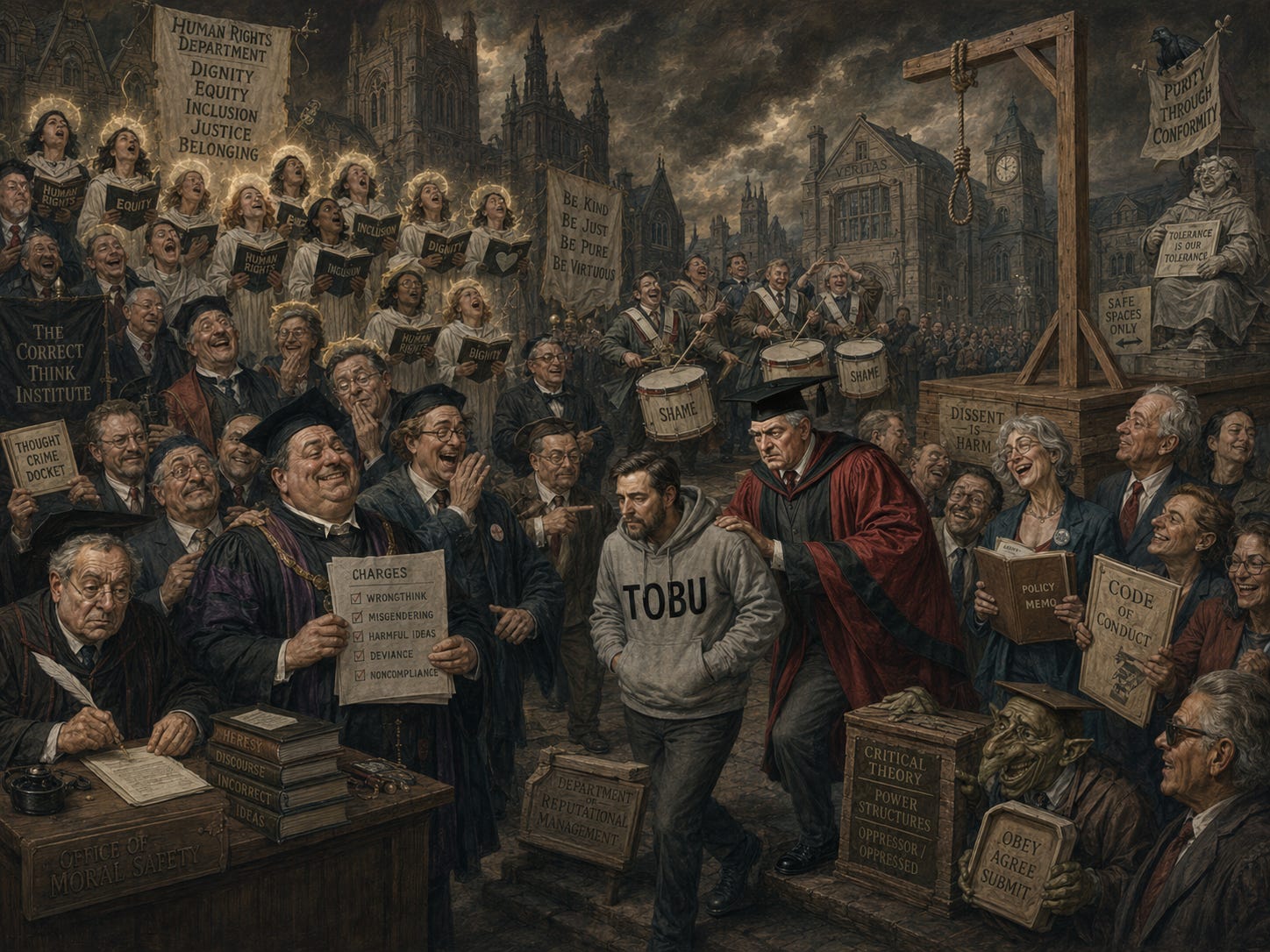
I have rarely encountered people crueler than those who parade their counterfeit virtue through human-rights offices; administrators who speak endlessly of dignity while treating an actual human being as refuse; the vice-provost and provost who were prepared not merely to destroy a career, but to endanger a family, a marriage, a home—the whole fragile architecture of another person’s life; the jackal lawyers who would lie to the devil himself if the exchange could be entered on a timesheet; and the petty bureaucrats who tremble in person yet discover a giant’s courage when safely concealed behind a keyboard.
There is anger in this. How could there not be? But beneath the anger is something more difficult to carry: sorrow.
It is the sorrow of discovering how cheaply people will sell their consciences. The sorrow of watching institutions that advertise compassion practise abandonment. The sorrow of realizing that educated people—people fluent in every fashionable language of inclusion—can look upon the suffering of a Jew and find not a reason to pause, but permission to proceed.
What lingers is the shock of seeing how easily a human being can be placed outside the circle of concern. No one paused to say: We have not heard from him. We should. No one asked what this campaign was doing to a person, a family, or a life. My humanity had become inconvenient, and inconvenience is the one form of diversity the modern university will not tolerate.
We flatter ourselves that we have moved beyond Salem because we no longer burn witches.
But reputations can still be burned. Livelihoods can still be taken. Families can still be placed under intolerable strain. A person can be isolated, defamed, and discarded by people serenely persuaded that they are doing good. The pyre has disappeared; the appetite for sacrifice has not.
That is not progress.
It is adaptation.
Salem’s certainty was religious: a false conviction claiming divine authority. The modern university’s certainty is bureaucratic. It rests upon policies, reports, procedures, and documentation—and upon the complacent superstition that an outcome, merely because it has been formally produced, must therefore be just.
But the witch trials were procedural too. They had hearings, testimony, experts, records, rules, and authorized decision-makers. What they lacked was humility. What they lacked was reflection. What they lacked was the elementary moral courage to ask:
What if we are wrong?
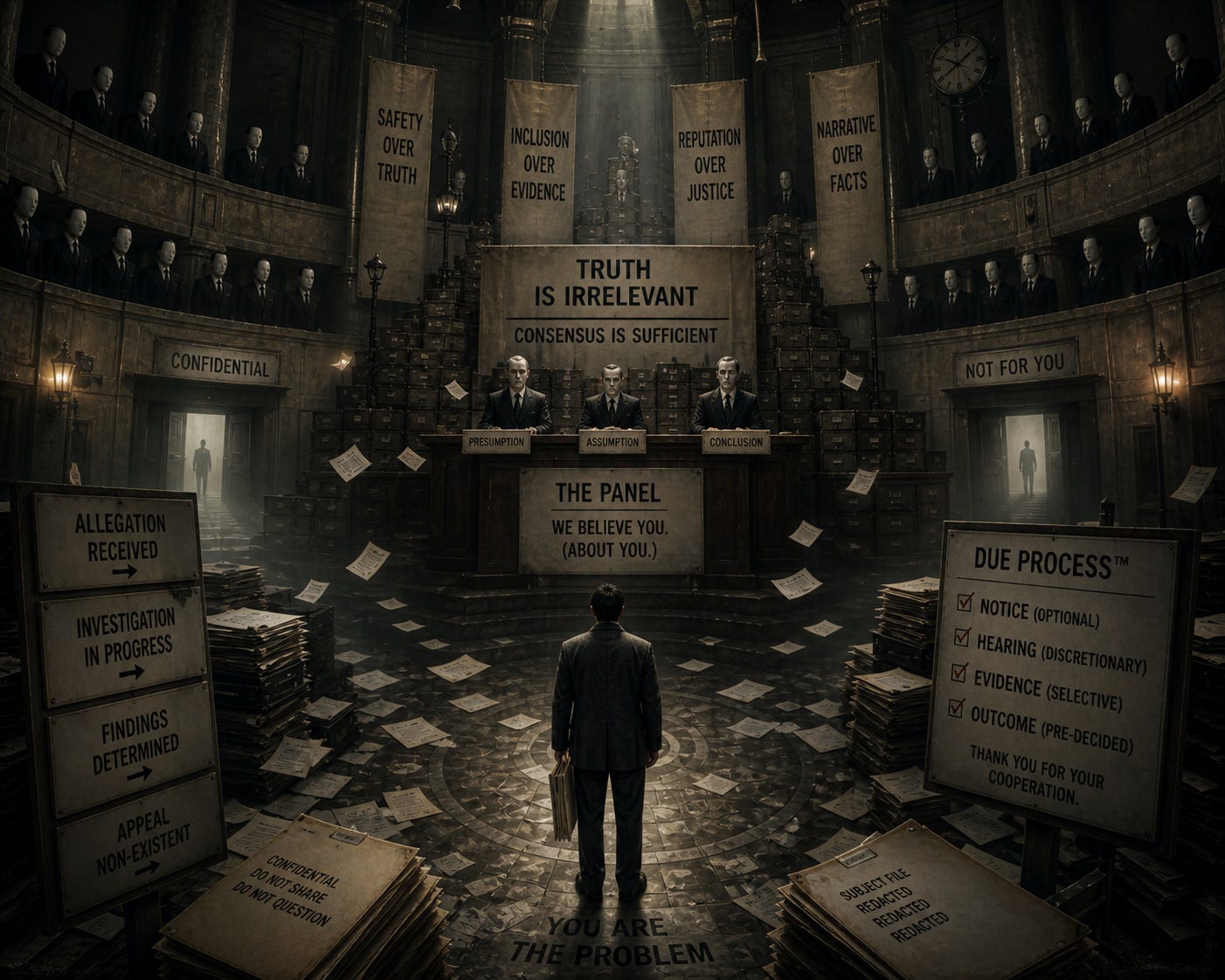
That question—not any policy, office, committee, tribunal, or solemnly worded report—is what separates justice from cruelty.
Without it, process becomes theatre. Accusation becomes verdict. Cowardice becomes collegiality. Prejudice becomes policy. Bureaucracy becomes machinery.
And persecution acquires a letterhead.
We no longer accuse in the village square. We accuse through committees, reports, investigations, and silence.
We no longer rely upon spectres. We rely upon anonymous impressions, subjective harm, insinuation, and testimony that cannot be meaningfully challenged.
We no longer place the accused before a magistrate who believes in witches. We place him before administrators who believe their own institution cannot persecute because it possesses a human-rights department.
In the English witch hunts, the accused were sometimes bound and thrown into water. If she floated, the water had rejected her and she was guilty. If she sank, she was innocent—assuming they pulled her out before the proof became fatal.
It was a perfect system: survival incriminated her, while innocence required her to drown.
We have improved upon it. The modern accused is offered much the same choice without the inconvenience of a pond. Defend yourself, and your resistance confirms your guilt. Remain silent, and your silence does the same. Ask for evidence, and you inflict further harm. Protest the process, and the protest becomes another charge.
The old inquisitors at least required water. We require only paperwork, delay, and a committee sufficiently persuaded of its own goodness.
The difference between then and now is not justice.
The difference is the method—and the melancholy fact that we have learned to drown a person without getting our hands wet.
If you found value in this article and wish to support my ongoing work, please consider leaving a tip. Your support helps me continue producing uncensored content on critical issues.
Such an apt analogy! Would that those screaming hoards of self-righteous, group-think, manipulated people could recognize themselves as the fearful, amoral harpies that truly are.
“It is the old cry in updated language: Get the devil out. Purge the contaminant. Restore the community's moral health.” Of course, the devil is the good guy, the contaminant is gold, the community’s health is worsened. Language is flipped. Reality is replaced by make-believe. War is peace. Freedom is slavery. Ignorance is strength.