If you’ve made it this far in life without being fired, cancelled, or publicly flogged for saying something true, congratulations — you’re ahead of me. I write because I can’t not; because silence feels like complicity, and complicity feels like rot. If this piece leaves you nodding, snarling, or muttering, “Well, he’s not wrong,” then you’re precisely the reader I’m writing for.
You’ll get two essays a week — unapologetically long, occasionally bleak, often funny, always honest. It’s eight bucks a month — less than one coffee in Carney’s Canada, or two if you buy the cheap stuff. Everyone says that, of course: “It’s just a cup of coffee.” Fine. But if you’re only going to buy one cup this month, make it mine. It’s $8 a month, and you can cancel anytime.
Politics is no longer meaningfully divided between left and right.
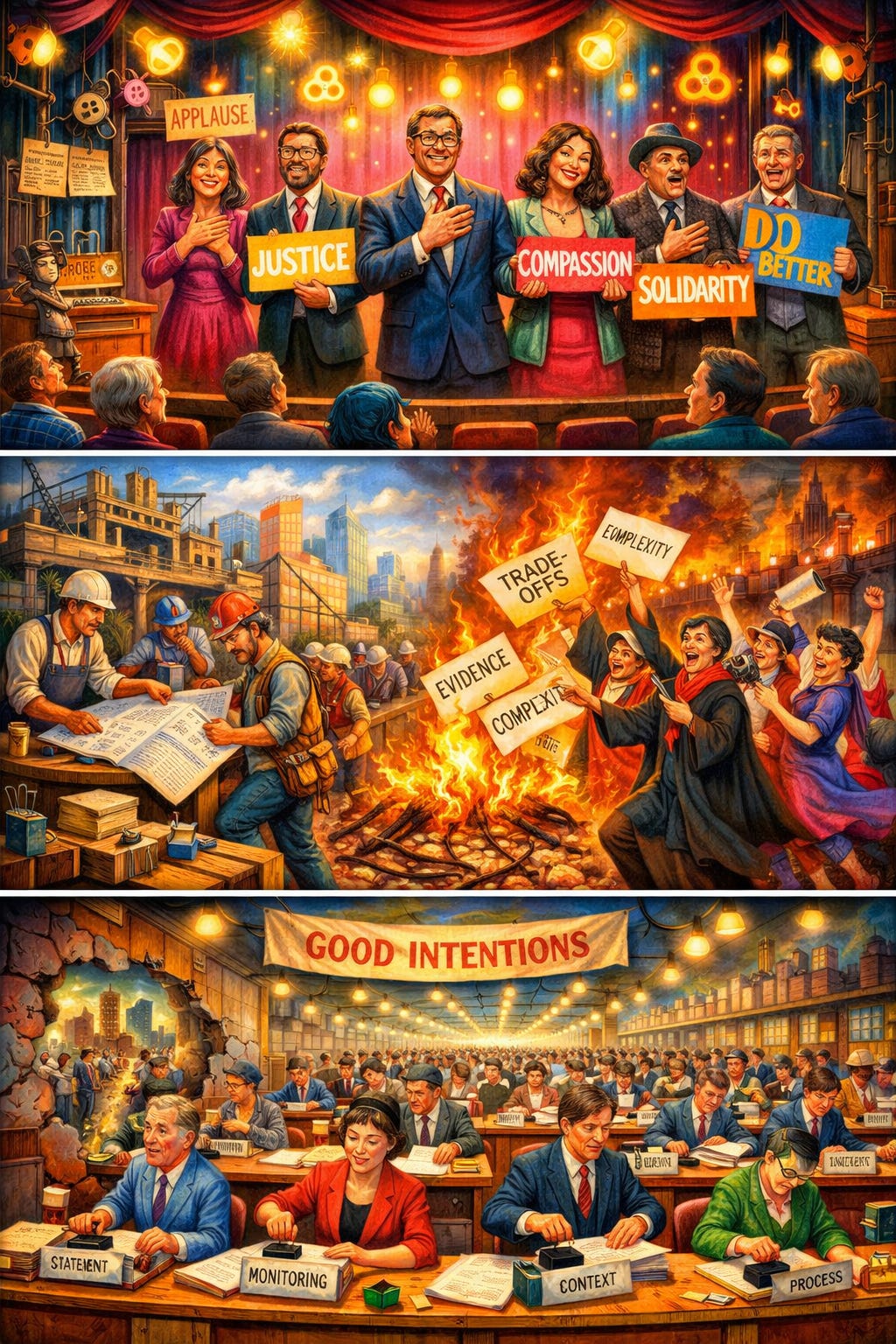
That vocabulary conceals the real fracture now organising public life: the divide between builders and burners.
Builders accept the stubborn constraints of reality—human nature, incentives, trade-offs, unintended consequences—and attempt, however imperfectly, to construct systems that work within them.
Burners begin from moral certainty. They judge ideas not by outcomes but by intentions, not by results but by how virtuous they sound. Where builders ask whether something works, burners ask only whether it feels righteous.
This is not a difference of compassion but of temperament. Burners are the dopamine junkies of moral vanity. Politics, for them, is an emotional economy: outrage as currency, grievance as status, compassion as performance. Good intentions are not a starting point to be tested, but a destination to be admired. To believe sincerely is to be correct. To dissent is to reveal bad character.
If the road to hell is paved with good intentions, burners never bother to walk far enough to notice where it leads.
Builders, by contrast, practice the habit that moral theatre cannot tolerate: self-examination. They ask unfashionable questions that produce no applause and deliver no dopamine hit.
What does this cost? Who pays? What breaks when we try? What happens when incentives collide with human nature? They are unimpressed by emotional blackmail and unmoved by moral exhibitionism. Reality, not virtue, is their referee.
This distinction explains much of modern political dysfunction.
The theatre of virtue enjoys a natural advantage. Moral performance is intoxicating. It offers status without accountability, righteousness without risk, and certainty without evidence. It flatters the ego while bypassing the inconvenience of reality. Most people would rather feel kind than be correct, rather feel superior than be right. A politics that supplies moral reassurance will always outcompete one that demands humility.
Reality, by contrast, is rude. It does not care about intentions. It does not reward sincerity. It punishes error impartially. This makes it an unattractive judge for those who have already decided that their virtue entitles them to authority.
From this asymmetry flows what now parades under the banner of the progressive left: not reform, but resentment farming.
The modern left no longer argues primarily for specific, testable improvements. It traffics instead in grievance. Its currency is bitterness, its theology accusation, its liturgy outrage. Problems are not meant to be solved; they are meant to be curated. A problem resolved is a dopamine stream that has been capped.
The analogy nearly writes itself. This is the preacher who speaks endlessly of damnation while never whispering of grace. Every sermon is a warning, every prophecy a curse. Hell is described in lavish detail; heaven remains conveniently undefined. Cult leaders operate this way: fear maintains loyalty, bitterness enforces obedience, and scapegoats give shape to rage.
One sees this disposition vividly in the Western left’s handling of the Israel–Palestinian Arab conflict. Here, moral theatre reaches its purest form. History, strategy, internal politics, and competing claims are flattened into a Jungian cartoon: oppressor versus oppressed.
Israel is condemned because it is strong, functional, and successful. Palestinians are declared virtuous because they are weak, fragmented, and endlessly portrayed through images of suffering children.
The archetype does all the work. Weakness becomes moral innocence by definition. Strength becomes guilt by existence. Agency disappears. Rockets launched from civilian areas, the rejection of repeated statehood offers, internal repression, and the deliberate instrumentalisation of children as political currency are brushed aside because they complicate the story. Simplicity is rewarded.
Complexity is heresy.
This framing is irresistible to the dopamine-driven mind. It requires no study, no trade-offs, no discomfort. It supplies instant moral clarity and an approved villain. That Jews occupy an awkward place in Western moral hierarchies—simultaneously successful and historically victimised—only sharpens the appeal. Reality is dismissed as propaganda; feeling is crowned king.
This is not moral seriousness. It is moral infantilism. A conflict that demands historical literacy and strategic realism is reduced to an emotional spectacle. The point is not peace, or coexistence, or even justice. The point is righteousness.
The same refusal of self-examination animates domestic policy.
Consider a simple question that routinely confounds otherwise intelligent students: why wouldn’t a government-run grocery store—one that takes no profit and ploughs all revenue back into operations—deliver permanently lower prices for consumers? On paper, the idea seems unassailable. Remove profit, reduce costs, and help the public. What could be more humane? (Mandami in New York has suggested this, and the fact that the initiative has failed repeatedly does not deter him and his burner confederates from using the idea as political succour.)
Yet such schemes reliably fail. Not because markets are cruel, but because government management distorts incentives, dulls price signals, politicises decisions, and replaces competition with bureaucracy. Costs rise, quality falls, innovation stagnates, and losses are socialised. This is not a theory. It is an empirical regularity observed across countries, sectors, and decades.
Builders observe this pattern and revise their beliefs. Burners do not. They retreat into confidence. This time will be different. We will manage it better. The problem was not the model but insufficient moral seriousness.
Their faith is not in evidence but in themselves—in their intelligence, their intentions, their virtue. Markets cannot be trusted. Ordinary people cannot be trusted. Only enlightened administrators can be trusted.
This is where figures like Mandami in New York and Mark Carney in Canada enter not as anomalies but as archetypes. They embody the technocratic conviction that socialism would work beautifully if only it were implemented by people sufficiently intelligent and sufficiently moral—people like themselves. Every failure becomes proof not that the model is flawed, but that the wrong hands were on the levers.
The record could not be clearer. An interventionist government has repeatedly failed spectacularly. Price controls produce shortages. State monopolies breed stagnation. Central planning collapses under information overload. Yet still the refrain persists: one more time. Not because the evidence has changed, but because the ego has not. Beneath it all lies the unexamined belief: I know better, and I am a better person.