


If you’ve made it this far in life without being fired, cancelled, or publicly flogged for saying something true, congratulations — you’re ahead of me. I write because I can’t not; because silence feels like complicity, and complicity feels like rot. If this piece leaves you nodding, snarling, or muttering, “Well, he’s not wrong,” then you’re precisely the reader I’m writing for.
This is your regularly scheduled Sunday post. The appeal to support me in my upcoming fight against the cowards at Humber was a freebie.

You’ll get two essays a week — unapologetically long, occasionally bleak, often funny, always honest. It’s eight bucks a month — less than one coffee in Carney’s Canada, or two if you buy the cheap stuff. Everyone says that, of course: “It’s just a cup of coffee.” Fine. But if you’re only going to buy one cup this month, make it mine. It’s $6 a month, and you can cancel anytime.

The Nakba—Arabic for “the Catastrophe”—refers to the flight, panic, evacuation, and in some cases voluntary departure of roughly 750,000 Arabs during the 1948 Arab–Israeli War. And let us begin with the indispensable fact: that war began not with Jewish aggression but with the armies of Egypt, Transjordan, Syria, Iraq, and assorted irregulars invading the newborn State of Israel within hours of its declaration on May 15th, 1948. The disaster, such as it was, began with their choice.
Meanwhile, the 800,000 to 850,000 Jews who lived across the Arab world—from Baghdad to Tripoli, from Aden to Damascus—exist in a kind of moral Bermuda Triangle. They appear nowhere in the speeches, nowhere in the resolutions, nowhere in the carefully curated grievance theatre. These Jews did not flee a war zone with dreams of returning after the dust settled; they were expelled, robbed, beaten, stripped of citizenship, and told—often explicitly—to pick between exile and death.
It was not a migration. It was a cleansing.
Their homes were looted, their businesses confiscated, their synagogues torched. They did not wait for the next UN plenary session to debate their metaphysical “right of return.” They packed what they could, gathered their children, and fled to the one place on earth that would take them: Israel—and Israel—impoverished, struggling, barely formed—absorbed them without complaint.
This is the shadow Nakba, the Nakba no one ever chants about, the Nakba that does not adorn protest placards, the Nakba that complicates the neat morality play in which Jews are always the powerful and never the persecuted. It outnumbers the Palestinian exodus. It was more violent. It was more final. And yet one hears nothing—no global day of mourning, no keys held high in sentimental pantomime, no international bureaucracy dedicated to perpetuating the grievance into its fourth and fifth generation.
But mention this shadow Nakba, and you can almost watch the world flinch. It ruins the choreography. It contaminates the illusion in which Palestinians are history’s lone victims and the Jews are history’s eternal villains.
And so the silence continues—dutiful, cowardly, politically convenient.
Israel, for its part, has demonstrated a restraint bordering on the absurd. When it returned the Sinai to Egypt in 1982—an act of generosity unmatched in human history—it shattered the ancient rule that conquered territory is kept until kingdom come. Name another nation that has voluntarily relinquished vast, resource-rich land after winning a defensive war. You will find no such precedent. Yet this act of geopolitical magnanimity earns no praise. It is quietly filed away, lest it disrupt the narrative of Israel as a voracious colonial glutton.
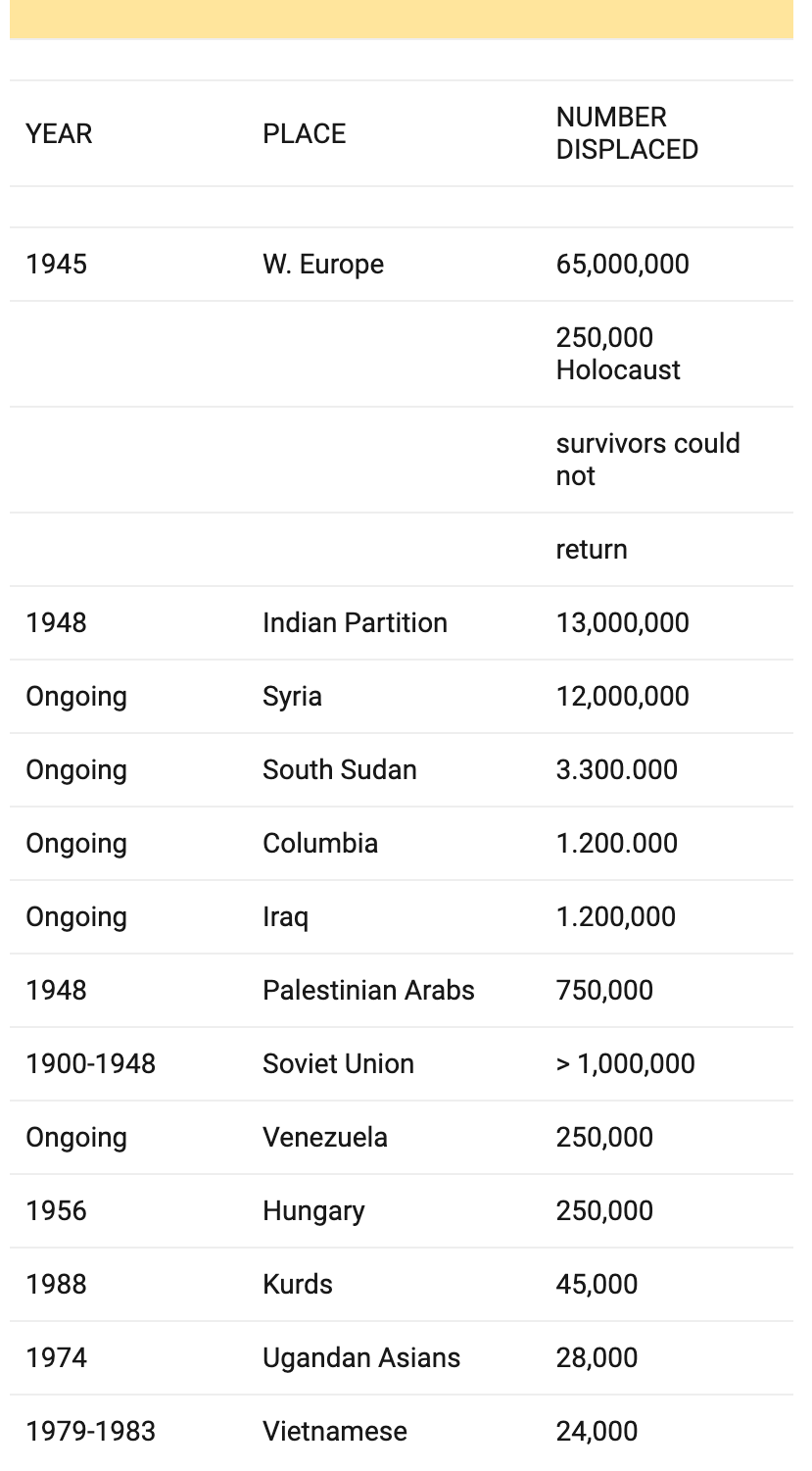
Compare this with the borders redrawn after the great convulsions of the 20th century—after massacres, partitions, invasions, revolutions. There was blood, theft, mass death, and the ripping apart of communities. Yet somehow, those hundreds of millions of displaced souls managed to rebuild their lives without demanding that history be reversed by decree. No armies of international NGOs kept their wounds inflamed. No political clerisy fed them fantasies that the past would come back with enough chanting.
Against this backdrop, the Nakba is not the world’s defining tragedy. It is simply the most politically useful one.
The Palestinian tragedy is real, but it is not unique. What is unique is the decision—endorsed by local tyrants, foreign ideologues, international bureaucrats, and Western sentimentalists—to preserve that tragedy as a permanent shrine, a grievance to be ritually tended, never resolved, never questioned, never allowed to heal.
The Palestinians’ catastrophe is not exile; it is the refusal—encouraged at every turn—to step out of it.
Or perhaps what the world politely calls “Palestinian steadfastness” is nothing more than denial dressed up as heroism—an existential temper tantrum lacquered with the language of resistance. It is easier, after all, to cling to the romance of perpetual victimhood than to confront the dismal arithmetic of one’s own political failures.
Far more flattering to mythologise defeat than to examine, with forensic sobriety, how often that defeat was invited, stoked, and sustained by leaders who prefer their people furious rather than free.
To admit any Palestinian role in the ongoing catastrophe would be to dethrone the idol of grievance, and grievance—more than land, more than sovereignty, more than justice—is the sacred scripture of this political theology.
So we arrive at the final, poisonous irony: a “Catastrophe” invoked endlessly not to remember, not to heal, not to rebuild, but to ensure that the wound never closes. A wound that is reopened at every speech, every rally, every UN resolution that pretends 1948 is a unique cosmic injustice rather than one episode—smaller than most—in the bloody ledger of twentieth-century population transfers.
But one must ask: is such singularity merited?
Even granting the pain of the loss—which no honest observer denies—the Nakba has been elevated into something more operatic than historic. It has become not a scar but a shrine, a wound not permitted to heal because its value lies precisely in remaining open. Other displaced peoples rebuilt. Other shattered communities reassembled themselves from ashes. The Palestinians, urged on by an impressive chorus of international enablers, chose instead to enthrone their grievance, turning catastrophe into catechism and refugeehood into a permanent identity.
They insisted—still insist—that they shall remain, refugees until lands they sold, and lands legally apportioned under UN partition, are restored to them in total. They rejected five separate land-for-peace offers because each required stepping out of the narcotic dream that Israel would eventually dissolve under the heat of their indignation.
Last November’s polling confirms the pathology: 75% of Palestinians reject any peace plan that does not erase Israel “from the river to the sea.”
Only 17% support a two-state solution.
This was not a sudden hardening of heart. Palestinian rejectionism predates Israel’s independence by more than a decade. The 1937 Peel Commission offered Arab inhabitants a state comprising the majority of the British Mandate. It was refused with theatrical outrage. The underlying message has always been the same: better perpetual defeat than the humility of compromise.
And so the culture of grievance metastasised—no longer a political position but something closer to a civil religion. If a rational counsellor were to sit with the Palestinian body politic, they would say the same thing they tell the resentful individual: that victimhood is a sweet poison, intoxicating at first, then ruinous.
The externalisation of blame guarantees only misery. Meanwhile, their neighbours—those inconvenient Jews—took malaria-infested swamps and dunes and turned them into orchards, cities, universities, hospitals, and a functioning state.
But the Nakba did not operate alone; it had accomplices. The UNRWA bureaucracy—unique in human history for turning displacement into a hereditary condition—Hamas, assorted Islamist demagogues, and a global gallery of useful idiots found the Nakba too profitable an instrument to relinquish. For some, it served financial interests; for others, political leverage; for many in the West, it provided a tidy moral alibi for garden-variety antisemitism dressed up as anti-Zionism.
And let us be clear: antisemitism did not spring out of the ground in 1948 like a malevolent mushroom. It predates Zionism, Israel, and even Islam. The world has long found creative excuses for hating Jews; the Nakba is merely the latest fig leaf.
History, as Mark Twain noted, does not repeat, but it rhymes. No two displacements are identical. But if we compare the Nakba to the cataclysms of the 20th century—the Partition of India, the Armenian expulsion, the expulsion of Germans from Eastern Europe, the Balkan wars—its scale and violence do not rank among the top rungs of the ladder. What distinguishes the Nakba is not the number displaced, nor the brutality inflicted, nor the duration of misery. It is its political afterlife.
The Nakba remains famous because Jews were involved, because the Palestinian cause pits the romanticised defeated against the most historically convenient villain.
The Palestinians became the losing football team that refused to leave the pitch, perfecting—over three generations—the art of the noisy spectacle.
And yet, if we strain our ears, quieter truths emerge. Compare the Nakba’s casualties, its scale, and its theft to the other displacements of the century. Statistically, it is dwarfed. In moral terms, it is one tragedy among many, not the cosmic singularity it is theatrically presented to be.
But its mythic status persists because the world’s standards are selectively enforced.
Palestinian displacement is treated as an event beyond history, a perpetual grievance immune to context, immune to comparison, immune to settlement.
This is why it is not merely remembered—it is curated.
This, then, is the irony: the Nakba is not “the catastrophe” because of its scale, but because the world has been persuaded—bullied, guilted, seduced—into treating it as a sacred grievance that must never be resolved.
The tragedy is not the displacement.
The tragedy is the refusal to move on.

If a Palestinian delegate ever wandered into a competent therapist’s office, they would be told the obvious: grievance is not a personality; resentment is not a strategy; and an external locus of control is the surest route to endless misery. One might also whisper the unutterable truth — the neighbouring Jews made the desert bloom not by incantation but by labour.
The Nakba remains world-famous for one reason only: it involves Jews, and the Palestinians are the aggrieved side. The loser in a conflict with Jews automatically becomes a romantic underdog, even when the historical record shows otherwise.
Palestinians are the football team that lost the match, stayed on the pitch for 75 years, and perfected the art of theatrical injury.
Yet if we hush the crowds and consult the quiet historians — the ones without placards — the scale of the Nakba injury begins to shrink into proportion. In the great ledger of 20th-century displacements, the Nakba does not sit at the top or even near it. It is neither the largest, nor the deadliest, nor the most irreversible. It is simply the loudest.
And that loudness was engineered.
For what other refugee population in history has been ordered not to resettle, forbidden from integrating, trained to inherit refugee status by birth, and weaponised as permanent political hostages?
Only the Palestinians.
The UN created a unique refugee definition for them — a bureaucratic invention that ensured the conflict could never be resolved. Palestinians alone were exempted from the 1951 Refugee Convention. They alone inherited refugee status like a royal title. The goal was never resettlement; it was perpetuity. Misery became an export industry.
Meanwhile, Arab states used them as diversions. In 1991, Kuwait expelled 400,000 Palestinians for supporting Saddam Hussein. No protests. No hashtags. No campus sit-ins. Not a single synagogue was torched in Toronto.
“Selective morality” does not begin to describe it.
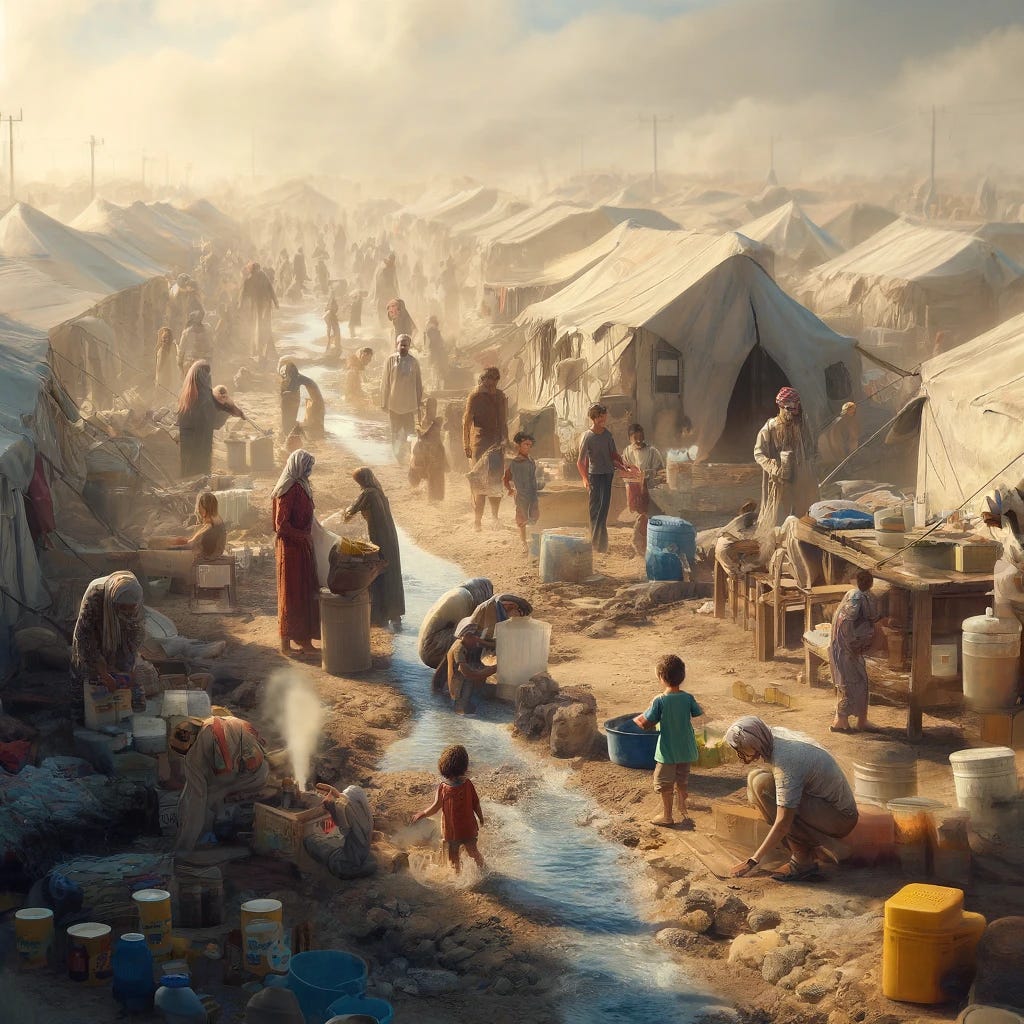
Refugees in Gaza and the West Bank are not “coddled” — they are utilised. Their suffering is curated with exquisite political cynicism. Palestinian leaders prefer to keep their people in camps rather than allow them to thrive. Why? Because a healed wound cannot be paraded. Because misery radicalises. Because a comfortable Palestinian is of no use to Hamas or the courts of Qatar and Tehran.
The right of return — chanted so poetically in Western capitals — is not a humanitarian demand; it is the demographic destruction of Israel by other means.
Jewish politeness, as you might note, was cremated at Dachau.
Hamas, Hezbollah, Iran, Qatar — all adore the Palestinian cause because it is not a cause at all but an endlessly renewable grievance with Jews at its centre. A dead Israeli baby is their favourite trophy; a dead Palestinian baby is merely an acceptable price for public relations.
The problem, therefore, is not Israel. It is that resolving the Palestinian problem would expose the rot of the regimes that sustain it. It would be like stepping naked from a filthy pool — all failures visible, excuses dissolved.
And so the catastrophe is kept alive.
Like medieval Europeans who blamed Jews for plagues and droughts, modern grievance-mongers funnel every Arab failure, misfortune, and political humiliation into the black box labelled “Israel.” The Nakba is treated not as a historical event but as an existential wound in the body of the world — though in reality, it is a modest cut made gangrenous by those who refused treatment.
By now, the grievance serves chiefly as a euphemism for the loss of Jewish subservience. Once, Jews in the Muslim world walked behind their Muslim neighbours, heads lowered. Today, they run their own state, fight their own battles, and refuse to bow. This, more than anything else, is the sore that refuses to scab.
The catastrophe, in essence, is not that the land was lost, but that it was lost to Jews.
The rest is commentary.
There is a reason the bitterness never dulls: bitterness is useful. It is a currency, a narcotic, a birthright passed from cradle to grave. It does not liberate; it immobilises. It does not teach; it corrodes. And yet it persists because it spares a people from the terrible labour of self-reflection. To admit any Palestinian role in the ongoing catastrophe would be to dethrone the idol of grievance, and grievance—more than land, more than sovereignty, more than justice—is the sacred scripture of this political theology.
So we arrive at the final, poisonous irony: a “Catastrophe” invoked endlessly not to remember, not to heal, not to rebuild, but to ensure that the wound never closes. A wound that is reopened at every speech, every rally, every UN resolution that pretends 1948 is a unique cosmic injustice rather than one episode—smaller than most—in the bloody ledger of twentieth-century population transfers.
It is, in the end, precisely as Proverbs warned: “Her end is bitter as wormwood, sharp as a two-edged sword.”
But wormwood can nourish only so long before it becomes self-poison; and swords, when swung blindly and endlessly, have an uncanny habit of circling back toward the hand that swings them.
If you found value in this article and wish to support my ongoing work, please consider leaving a tip. Your support helps me continue producing uncensored content on critical issues.

It’s the humiliation of the loss. The Haganah was barely an army. They had two airplanes they got from Czechoslovakia and had to smuggle in weapons. The Brit’s (yes the colonizers) were more sympathetic to the Arabs and many fought alongside the Arabs during the war. The regular armies of several Arab states all fought against Israel In the minds of the Palestinians how could they lose?
The maintenance of resentment and grievance so aided by western so called progressives is the major obstacle to peace. No other group has been propped up organizationally (UNWRA) to maintain a conflict this long.