


Introduction
History is not chemistry.
No historian possesses a master database cataloguing every siege, humanitarian corridor, civilian warning, territorial withdrawal, hostage crisis, or underground battlefield. Wars resist laboratory comparison. They differ in terrain, technology, purpose, law, and moral character. Historians can identify precedents and patterns; they cannot reduce human conflict to a controlled experiment.
That is the necessary qualification. It should not become an excuse for refusing comparison altogether.
Not every feature of Israel’s war against Hamas is literally without precedent.
Tunnel warfare has precedents. Urban warfare has precedents. Hostage-taking and humanitarian corridors have precedents. The argument is that modern history offers few, if any, conflicts in which so many extraordinary features have appeared simultaneously—and none in which a democracy confronting them has been subjected to quite the same combination of military expectations, moral suspicion, and historical amnesia.
On October 7, 2023, Hamas and associated armed groups crossed Israel’s border under cover of thousands of rockets. Approximately 1,200 people were killed and 251 abducted into Gaza. Entire communities were overrun. Families were slaughtered in their homes. Children and elderly people were dragged into captivity. Sexual violence was committed. It was the deadliest day for Jews since the Holocaust and the most extensive hostage crisis in Israel’s history.
For almost any nation in modern history, the expected response would have been obvious: destroy the organization responsible and recover the captives.
Instead, the moral chronology began to dissolve almost at once. The massacre receded into the background while the response moved to the foreground. The invasion became “context”; the counteroffensive became the crime requiring explanation. Israel’s right of self-defence was ceremonially affirmed and then surrounded by expectations that threatened to render it unusable.
The framework for the war in Gaza is not counter-terrorism; it is war. The war in Gaza is arguably a unique challenge in the history of war. No urban battle had an adversary spend twenty years preparing for battle. No army has had a strategy where the enemy wants their own civilians to be killed so as to maximize their propaganda value. No army has ever forced its civilians to stay in the combat zone like Gaza, where Egypt notably did not allow non-combatants to cross the southern border into the massive Sinai Desert.
What follows is not an argument for Israeli perfection. It is an inquiry into historical exception.
1. The Country Expected to Wage War Without Civilian Deaths
Almost no Western government denied Israel’s right to defend itself. Most affirmed it explicitly. The expectation imposed upon Israel was stranger: it could defend itself, provided the defence did not produce the consequences historically associated with war, especially with urban war.
Israel was expected to destroy a heavily armed terrorist organization embedded beneath one of the world’s densest urban environments, recover hostages hidden underground, protect its soldiers, distinguish combatants who frequently wore no uniform, and somehow avoid civilian deaths on a scale no army has achieved in comparable urban warfare.
The world did not merely ask Israel to obey the laws of war. It expected something approaching a surgical operation against an enemy that had deliberately designed the battlefield to make surgery impossible.
No army has demonstrated an ability to fight an underground urban enemy without killing civilians. The United States could not do so in Fallujah. The coalition could not do so in Mosul. Russia did not seriously attempt it in Grozny. The battles for Manila, Hue, Aleppo, Raqqa, and Mariupol all left civilians dead and cities in ruins.
Yet Gaza presented challenges even those battles did not. Military historian and urban warfare expert John Spencer has argued that no modern army has ever confronted a battlefield in which an enemy constructed hundreds of kilometres of tunnels beneath a densely populated city, prevented much of the civilian population from taking shelter within them, booby-trapped entrances, and repeatedly emerged from beneath hospitals, schools, mosques, apartment buildings, and other civilian infrastructure to attack before disappearing underground again.
The International Committee of the Red Cross states the matter with bleak simplicity: urban warfare kills, injures, and displaces more civilians—and destroys more essential infrastructure—than fighting in open terrain. That is why urban warfare is feared.
The relevant question is not whether every Israeli action was wise or lawful. It is whether any democracy has defeated a comparable enemy while achieving the casualty standard Israel was expected to meet—and whether those demanding such an achievement can identify the military method by which it could have been accomplished.
“Surgical” is not a strategy. It is an adjective employed by people spared the obligation of explaining the operation.
The military expectations imposed upon Israel were extraordinary for another reason. No modern war has ever made the distinction between combatants and civilians a central battleground of propaganda.
Under the law of armed conflict, civilians lose their protection from direct attack while they take a direct part in hostilities. A man or woman carrying ammunition to a fighting position, transporting weapons, firing rockets, acting as a lookout, or emerging from a tunnel to attack soldiers is not rendered a civilian simply because he or she wears jeans and is 14, 15, 16 or 17 years old.
Yet throughout the Gaza war, Hamas frequently asserted that those killed were civilians, often without distinguishing fighters from non-combatants. Those figures were then repeated around the world before any independent verification could occur. The result was a conflict in which the debate often shifted away from military conduct itself and toward competing casualty narratives.
The informational environment was equally unprecedented. Approximately one-fifth of Hamas’s rockets are estimated by Israeli and other military assessments to have fallen short and landed inside Gaza itself. Those failures posed an obvious danger to Gaza’s own population. Yet in the public narrative, almost every explosion was instinctively attributed to Israel, while comparatively little attention was paid to the casualties and destruction caused by misfired Palestinian rockets or by Hamas’s own military practices.
Spencer argues that the closest historical comparison is not a counter-insurgency campaign but the Battle of Manila in 1945. There, approximately 35,000 American troops fought some 17,000 entrenched Japanese defenders while attempting to liberate thousands of prisoners of war and civilians trapped inside the city. By the battle’s end, roughly 100,000 civilians had been killed, and much of Manila lay in ruins.
Few historians regard those civilian deaths as evidence that the United States lacked the right to destroy the Japanese garrison. Rather, they are understood as one of the terrible realities of urban warfare.
The same historical amnesia surrounds many other conflicts.
During the Korean War, civilian deaths are estimated in the millions over three years of fighting, averaging well over 50,000 deaths per month. During the Somali civil war and the humanitarian catastrophe of the early 1990s, between 200,000 and 300,000 civilians died from violence, famine, and state collapse despite repeated international relief efforts, including those led by the United Nations.
These catastrophes rightly received attention, yet they never produced the sustained global protest movement, continuous social-media mobilization, or singular moral focus directed at Israel.
None of this establishes that every Israeli military decision was correct. Democracies remain accountable for the lawful use of force. But it raises a question critics rarely answer. If Israel was expected to defeat Hamas while avoiding civilian casualties on a scale unprecedented in the history of comparable urban warfare, what operational method would have achieved that result? Condemning the outcome is not enough. One must also explain the alternative.
2. The Democracy That Repeatedly Returned Land
Conquering powers have sometimes returned territory, usually through negotiated settlements, military pressure, or imperial collapse. It would therefore be foolish to claim that Israel alone has relinquished land. It is equally foolish to repeat the caricature of a state pathologically incapable of withdrawal.
Under its peace treaty with Egypt, Israel returned the entire Sinai Peninsula, including settlements, air bases, oil fields, and an enormous strategic buffer acquired after repeated wars. The territory was several times Israel's size. The treaty required the withdrawal of all Israeli armed forces and civilians and the restoration of full Egyptian sovereignty.
Israel later withdrew from southern Lebanon. In 2005, it dismantled every Israeli settlement and permanent military installation in Gaza, forcibly removing thousands of its own citizens. Under the Oslo process, it transferred substantial governing authority to the Palestinian Authority.
Returning strategically valuable land is not the normal reflex of victorious states.
Victors generally consolidate their gains until compelled to surrender them. Russia has not returned Crimea as a confidence-building experiment. China does not regard Tibet as a negotiable inconvenience. Turkey has not withdrawn from northern Cyprus. Morocco has not abandoned its claim to Western Sahara.
Israel relinquished territory repeatedly in the hope that land might be exchanged for peace. The result was not always peace. From Gaza came Hamas rule, rocket fire, tunnel construction, and ultimately October 7.
3. The Army That Warned the Enemy’s Civilians
Advance warnings are not an Israeli invention. International humanitarian law requires effective warning when circumstances permit, and other armies have issued warnings in previous conflicts. A warning does not automatically make a subsequent attack lawful. It must be meaningful, civilians must have a realistic opportunity to seek safety, and those who remain do not forfeit their civilian status.
What is unusual is the scale and variety of the warning system Israel developed over successive Gaza conflicts: telephone calls, text messages, leaflets, radio and television broadcasts, social-media announcements, mapped evacuation zones, designated humanitarian routes, and notices preceding major operations.
An International Committee of the Red Cross (ICRC) case study of the 2014 Gaza conflict observed that the IDF frequently communicated warnings through multiple channels simultaneously, at times taking precautions beyond reliance on a single method.
A warning does not reach only the mother gathering up her children. It also reaches the fighter moving his weapons, the commander relocating his headquarters, and the hostage-taker shifting his captives. Every warning that protects civilians also diminishes surprise and may confer a military advantage upon the very force being targeted. Israel repeatedly accepted that trade-off in an effort to reduce civilian casualties.
4. The Creation of Humanitarian Corridors Inside Enemy Territory
Humanitarian corridors are not unprecedented. Civilians have been evacuated through negotiated passages from eastern Aleppo, Mariupol, Sumy, and other battlefields.
Such corridors can save lives. They can also fail, be attacked, or become instruments of coercion. Their creation never relieves an army of its duty to protect civilians who remain.
What is unusual in Gaza is the sustained expectation that Israel must create, protect, and continually rearrange evacuation routes and humanitarian zones inside territory governed by the enemy while preventing that enemy from exploiting them.
A route intended to save civilians can also become a route through which fighters escape. Combatants can enter a humanitarian zone without a uniform. A pause intended to permit civilian movement can allow Hamas to move weapons, relocate commanders, prepare ambushes, or conceal hostages elsewhere.
Israel was expected to create the corridors, protect the people using them, prevent Hamas from exploiting them, and guarantee that no subsequent military necessity would alter their status.
Humanitarian corridors save lives. That should count morally. In Israel’s case, attempts to create them often seemed to generate another category of accusation.
Again, the point is not that Israel’s corridors were flawless. The effort itself was exceptional in scale and duration, particularly when directed toward civilians living among an enemy that treated their presence as a military resource.
5. The Country Feed and Cared for its Enemy
During conflict, countries have permitted humanitarian relief to reach enemy-held territory. Wartime relief has precedents, and international law imposes duties concerning humanitarian access.
Nevertheless, the underlying situation remains extraordinary. During substantial phases of the war, Israel facilitated the entry of food, medicine, fuel, water, and other supplies into territory governed by the organization it was fighting. Aid passed through crossings inspected or operated with Israeli involvement while Israeli soldiers were fighting and dying only miles away.
Did Nazi Germany feed occupied France? Germany extracted enormous resources from France and imposed burdens that contributed to deprivation. Did conventional armies normally provision the populations governed by their enemies while battles continued? More often, war brought sieges, blockades, requisitions, and deliberate exhaustion.
Israel was required simultaneously to destroy Hamas and sustain humanitarian access to the society Hamas governed, a society that polling consistently showed supported Hamas.
Israel had to offer resources to a population among whom its enemy lived, recruited, taxed, and exercised coercive power. Israel had to offer aid to a population that hid hostages amongst them. But aid was necessary because civilians needed it; it was vulnerable to diversion because Hamas remained the governing armed organization.
If Israel inspected aid, it was accused of obstruction. If aid entered and Hamas or criminal groups appropriated it, Israel was blamed for its distribution. If too little arrived, Israel was condemned. If more arrived, the increased flow was treated not as mitigation but as an admission of prior guilt.
6. The Terrorist Organization Treated as a Credible Public Institution
Every modern conflict produces propaganda. Democracies exaggerate and conceal. Dictatorships lie. Terrorist organizations lie.
What is unusual is not that Hamas produced propaganda. The remarkable development is that institutions governed by a designated terrorist organization became routine sources of factual claims for journalists, activists, universities, and members of the public.
During the campaign against ISIS, few serious observers treated an ISIS ministry as a disinterested civil authority. Nazi communiqués were not repeated by Allied broadcasters as presumptively neutral statistics. Saddam Hussein’s government was not granted automatic credibility merely because it issued information through an office bearing an administrative title. His pronouncements became sources of ridicule.
Yet claims originating in Hamas-controlled Gaza repeatedly travelled through Western media before their origins or evidentiary limitations could catch up with them. In recorded history, there has never been an ongoing battle in which ongoing counts of non-combatants were formulated; it is an artificial construct designed for maximum propaganda value.
The initial reporting about the explosion at Al-Ahli hospital offered the most spectacular example. An immediate claim that Israel had struck the hospital and killed hundreds swept around the world. Canada’s government immediately condemned Israel. Protests erupted, embassies were attacked, and political meetings were cancelled before later visual evidence and intelligence assessments showed that it was a Palestinian terrorist cell that had fired the missile that had killed their own people.
The correction walked. The accusation had already flown.
The extraordinary development was not merely that Hamas generated propaganda. It was that so many Western institutions seemed eager to outsource their skepticism.
7. The Terrorist Organization That Acquired Social Legitimacy in the West
History has produced many terrorist organizations. Some attracted political sympathizers and romantic admirers. The Red Army Faction, ETA, the Shining Path, the Tamil Tigers, the IRA, al-Qaeda, ISIS, and others each attracted defenders or apologists somewhere.
What remains extraordinary is the degree to which sympathy for Hamas, or euphemistic descriptions of its violence, became normalized within parts of elite Western culture.
Its slogans appeared at universities. Its massacre was “contextualized” before bodies had been identified. A pro-Hamas social media and anti-Israel propaganda campaign was set up well before Israel responded to the massacre of its civilians.
But Hamas’ violence was described as resistance by people who would never have extended the same indulgence to ISIS, al-Qaeda, Boko Haram, or a white-supremacist organization.
Professors at universities were not only publicly proclaiming Hamas support, but administrations like the University of Guelph treated criticism of support for a terrorist organization as somehow verboten. In spite of calls for violence against Jews, which included “Intifada now” or “Export the intifada,” governments, police forces and university administrations pretend that such threats were passive and political.
At some demonstrations, the moral energy was directed less toward the release of kidnapped civilians than toward the country from which they had been taken. The hostages became a distraction. The massacre became an awkward preface. Hamas dissolved into an abstraction called “resistance,” stripped of its charter, methods, hostages, tunnels, and dead.
The question is why a designated terrorist organization responsible for the deliberate slaughter and abduction of civilians acquired a degree of moral ambiguity in institutions that would have treated comparable violence elsewhere as self-evidently fascistic; it reeks of bad faith.
Historical ignorance explains part of it. Social media explains another part. So does the seduction of the oppressor-and-oppressed template, under which one party is assigned permanent agency and the other permanent innocence.
Once Israel had been designated the oppressor, almost anything done against Israelis could be recategorized as resistance. The act's actual nature became secondary to the political identity of its victim.
That is not moral reasoning. It is the distribution of innocence and guilt according to tribe.
8. The Invaded Country Portrayed as the Principal Aggressor
This may be the most extraordinary feature of all.
Israel was invaded on October 7. Its border was breached. Its civilians were massacred and abducted. The organization responsible pledged to repeat the attack. As has often been stated, what happened to Israel is the same as if 45,000 Americans in Michigan were suddenly massacred in an invasion from north of the border. One expects Trump's reaction to have been unrestrained violence.
Yet within days, the invaded country was increasingly portrayed as the principal aggressor. The massacre became background. The response became foreground. The invasion became context. The counterattack became history.
The chronology itself dissolved.
No one would have described the United States as the initiator of war with Imperial Japan because American bombs later fell upon Japanese cities. Britain did not become the invader when it expelled Argentina from the Falkland Islands. Kuwait did not become the aggressor because a coalition removed Saddam Hussein’s army from Kuwaiti territory.
Israel alone seemed required to defend not only every military decision but the moral legitimacy of responding at all. Its right of self-defence was affirmed in principle and withdrawn in practice through the cumulative imposition of impossible conditions.
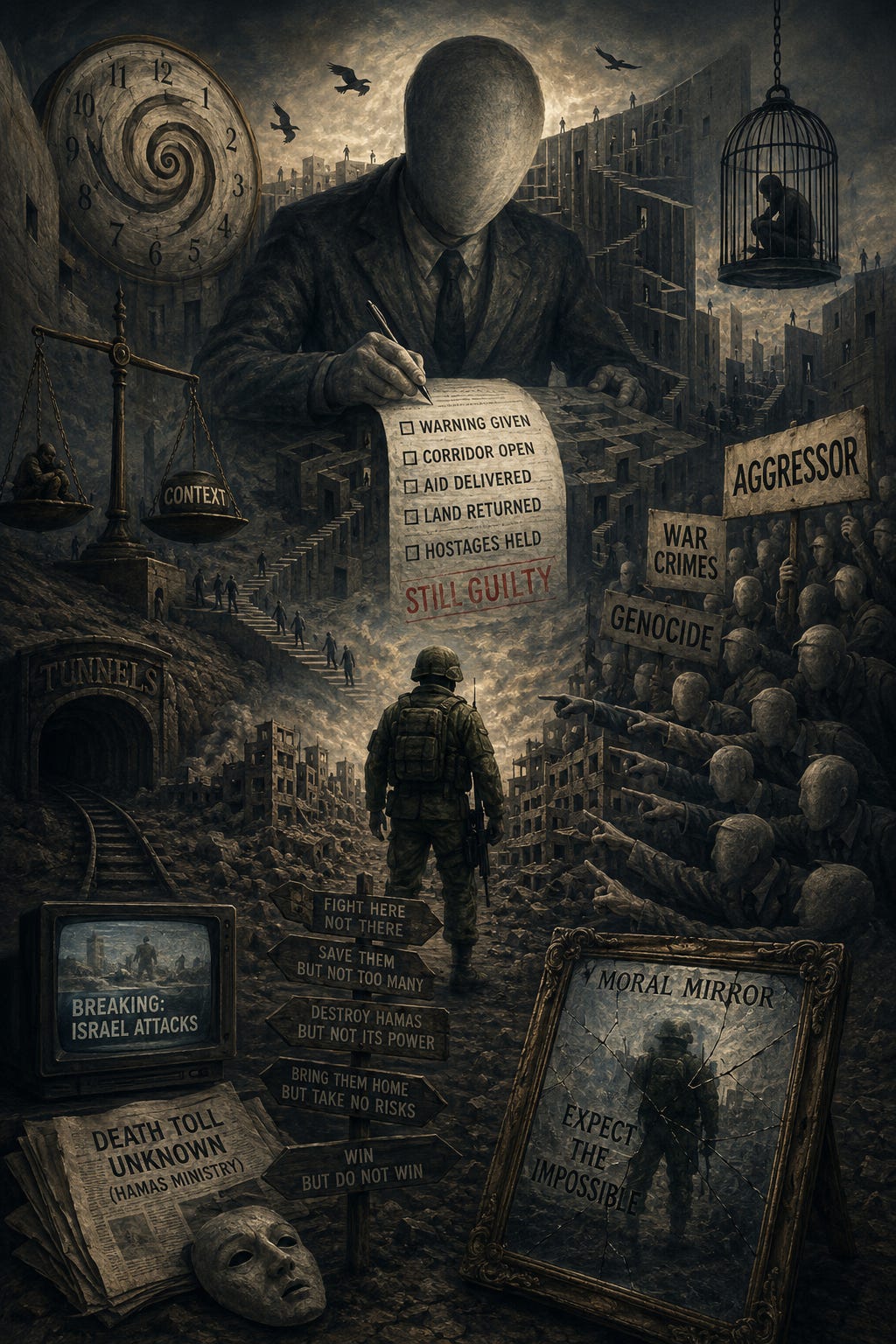
It could fight Hamas, but not where Hamas was located. It could destroy the tunnels, but not damage what Hamas had built them beneath. It could rescue hostages, but not take the military risks that rescue entailed. It could warn civilians, but the warnings themselves became incriminating. It could facilitate aid, but every deficiency in distribution remained its sole responsibility. It could establish corridors, but it could not guarantee either their exploitation by Hamas or the future safety of every destination. It could defeat its enemy, provided the enemy’s strategy imposed no human cost.
This is not a military standard. It is a demand for paralysis.
Perhaps future historians will discover that Franklin Roosevelt should have thanked Imperial Japan for exposing weaknesses in American naval preparedness. Perhaps Britain ought to have apologized to Argentina for resisting the occupation of the Falkland Islands. Perhaps Kuwait’s principal error was objecting too vigorously to Saddam Hussein’s innovative approach to border adjustment.
Until then, the disappearance of October 7 from the moral chronology deserves explanation.
Conclusion
Taken individually, the features of this war have historical precedents.
Taken together, they form one of the most unusual military and political situations in modern history: a democracy invaded; approximately 1,200 people killed and 251 abducted; the enemy entrenched beneath a dense civilian environment in hundreds of miles of tunnels; combatants frequently indistinguishable by uniform; children drawn into the moral and military catastrophe; hostages hidden beneath the battlefield; civilians warned through multiple technologies; humanitarian corridors and evacuation zones created and revised during combat; aid facilitated into enemy-governed territory; strategically valuable land previously relinquished; terrorist propaganda treated as routine administrative reporting; and the invaded state transformed, with astonishing speed, into the sole defendant before the court of enlightened opinion.
This is not an argument for national sainthood. Nations are not saints, and war is not an arena in which sainthood is ordinarily available.
It is an argument about exception.
History does not require us to acquit Israel of every charge. It does require us to compare like with like.
If the standards imposed upon Israel are standards that no army can meet, they are not standards.
They are instruments of condemnation. If every attempt to reduce civilian suffering becomes further evidence of guilt, the argument is no longer about conduct. If no territorial withdrawal counts, no warning mitigates, no corridor saves, no aid delivery matters, no hostage complicates, and no enemy tactic affects the judgment, then the verdict preceded the evidence.
One may condemn particular Israeli actions. One may oppose its government, its strategy, or the war itself. But one should at least possess the intellectual honesty to confront the war Israel was actually fighting.
It was not a surgical procedure conducted in a vacant operating theatre. It was an underground urban war against an irregular army embedded among civilians, governing the territory, holding hundreds of captives, and drawing political advantage from the death of the population beneath which it fought.
That war was going to be terrible for whoever fought it.
The exceptional demand was that Israel alone make it otherwise.
If this assessment is even substantially correct, another question follows. Why has the Middle East’s only liberal democracy become the bête noire of so much of the Western academy, so many international institutions, and so much activist culture? Why are actions that would be tragic necessities in one war presented as singular crimes in another?
No single answer can command certainty. Yet three explanations seem difficult to ignore.
The first is that anti-Semitism did not disappear. It adapted. Long before the State of Israel existed, Jews had been expelled, enslaved, segregated, persecuted, and massacred across successive civilizations. The language changes with the centuries. The habit of exceptionalizing Jews has proved remarkably resilient. That history does not explain every criticism of Israel, nor should it immunize Israel from criticism.
It does, however, make it intellectually reckless to assume that the world’s only Jewish state is judged in complete isolation from two thousand years of inherited prejudice.
The second is the great paradox of the information age. Never has humanity possessed greater access to knowledge, yet genuine understanding often appears to be receding. Information is not wisdom. Access is not comprehension.
Imagine being told that somewhere within a vast continent lie rare but immense deposits of gold, oil, and minerals. If you wander the landscape at random, occasionally striking the ground wherever your eye happens to fall, you are unlikely to discover much of value. The wealth is there, but without maps, geology, and disciplined method, abundance becomes confusion.
The digital world is much the same. The internet contains extraordinary scholarship alongside propaganda, fabrication, half-truths, emotional manipulation, and endless distraction. Those without historical foundations do not merely fail to find the truth; they often become convinced they have found it. The problem is no longer a shortage of information. It is an excess of informational noise.
That helps explain a remarkable paradox. Public discussion of Israel has never been more abundant, yet elementary historical knowledge often remains surprisingly thin.
Many who speak confidently about the conflict know little of Israel’s repeated territorial concessions, rejected peace proposals, the legal and historical claims of both peoples, the political divisions within Palestinian society, or the rights enjoyed by Arab citizens of Israel. Facts without context become raw material for narratives rather than instruments of understanding.
The third explanation is the power of narrative itself. Modern wars are fought not only with missiles and rifles but with stories. Hamas and the broader Islamist movements surrounding it have understood this for decades. The battle for international opinion is not incidental to the conflict; it is one of its principal theatres. In the age of social media, images outrun history, slogans outrun evidence, and moral archetypes outrun careful analysis.
The simple story almost always defeats the complicated truth. Hamas and its parent organization, the Muslim Brotherhood, have proven to be master propagandists.
Nor has this narrative spread through social media alone. It has found sympathetic audiences across parts of academia, segments of the media, activist organizations, labour unions, and international institutions. Over many years, it has claimed intellectual territory. Once a narrative becomes culturally dominant, people often recruit evidence to defend it rather than test it.
None of this proves that Israel is always right. Democracies deserve criticism, and Israel is no exception. But it does suggest that the extraordinary hostility directed toward Israel cannot be explained by military conduct alone.
If Israel is judged by standards that history has never required of any other democracy, then the question is no longer merely what Israel has done. It is why Israel alone is expected to do what no nation has ever been able to do.
The answer is unlikely to be found in a single cause. Instead, it lies at the intersection of an ancient prejudice, an information age drowning in noise, and the extraordinary power of modern political storytelling.
Only by recognizing all three can we begin to understand why one of the most historically exceptional wars of the modern era has so often been transformed into history’s simplest morality play.

I’m stunned at the insane genocide accusation against Israel coming from people who should know better . Jew hate never left . The vile geno accusation is a denial of the Holocaust itself and love of the fake Palestine narrative is a cultist manifestation . Lots of sick dangerous people out there
Hamas refuses to wear uniforms so therefore it cannot be distinguished from civilians, and uses civilians as shields, but if Israel did the same it would be condemned.