


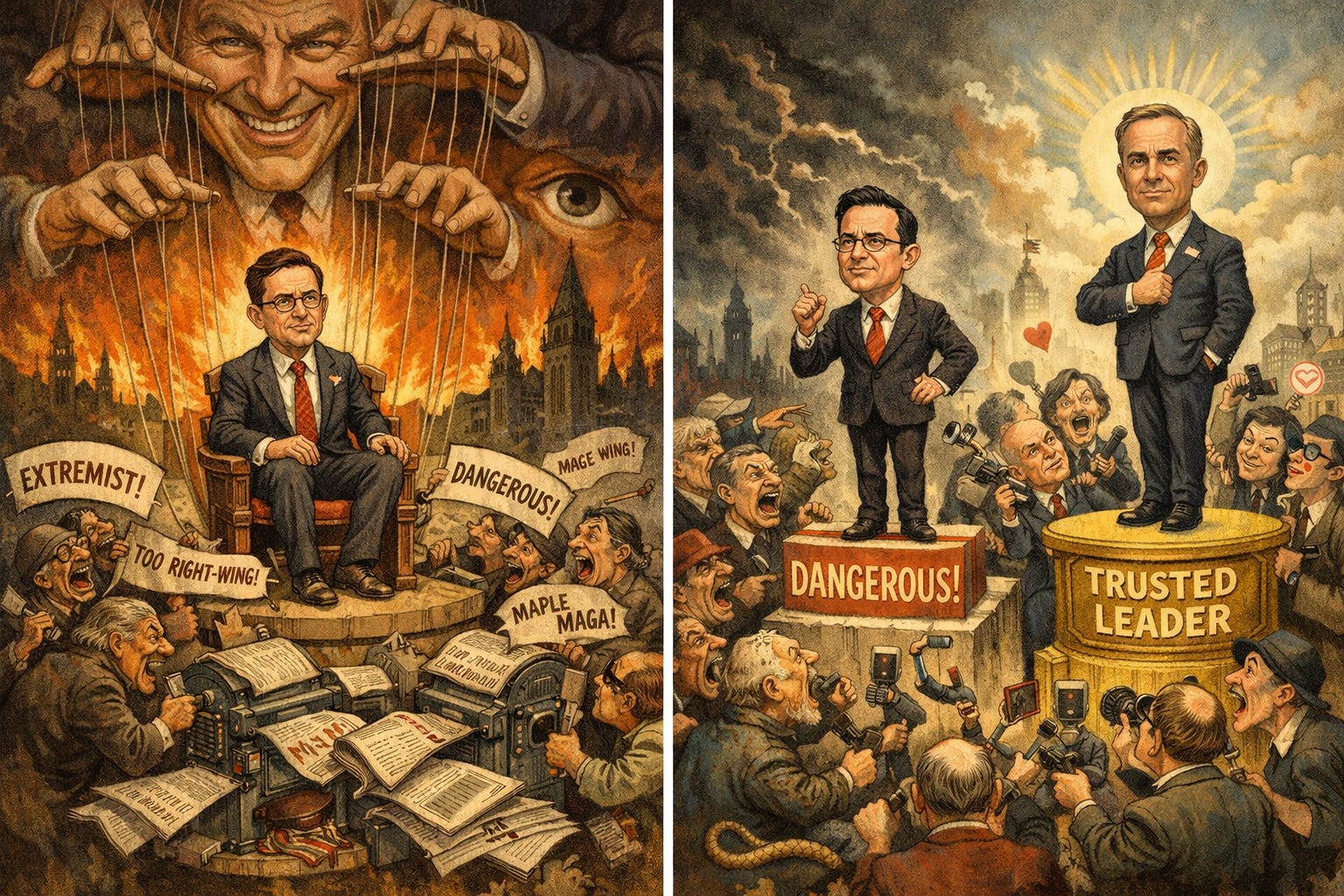
There is a well-established principle of persuasion—frequently attributed to Nazi Propaganda Minister Joseph Goebbels—that a claim, repeated often enough, acquires the texture of truth. Not because it has been demonstrated, and certainly not because it has been seriously examined, but because it has been heard and heard again, until familiarity replaces evidence.
This principle goes a long way toward explaining the strange case of Pierre Poilievre, a man who, in the Canadian imagination, has been successfully recast as a species of political extremist. The labels are delivered with a kind of casual certainty—“too right-wing,” “dangerous,” “Maple MAGA”—as though they were conclusions reached after careful inspection rather than slogans absorbed through repetition.
What is striking is not merely that these descriptions circulate, but that they are so rarely substantiated. They arrive fully formed, requiring neither argument nor evidence, and are accepted in precisely that spirit.
One is t…
