


I came to the subject in the way one often comes to subjects that matter: badly and late.
I am reading a biography of Dietrich Bonhoeffer, the Lutheran pastor who broke with the Nazified German church, helped build the underground Confessing Church, joined the resistance, and was hanged in 1945 for his involvement in the conspiracy against Hitler. I had reached the point at which Hitler had just become chancellor—not by storming the Reichstag at the head of a mob, but by being handed the office by respectable men who were certain they could contain him.
That is worth remembering. Hitler did not steal the chancellorship. Germany’s political establishment made an appointment.
What startled me, though, was something more embarrassing. I listened to translations of Hitler’s early speeches from 1933. He did not always sound like a lunatic. He could sound, to the ear he was courting, like he respected Christian values - though not to anyone paying serious attention to doctrine.
But Hitler was not auditioning for a theology faculty. His target market was the German Protestant ear, already softened by humiliation, inflation, national grievance and the mythology of betrayal after Versailles. He knew the vocabulary. Providence. Moral renewal. National redemption. Duty. Sacrifice. The restoration of a people humiliated by decadent forces.
The Deutsche Christen—the “German Christians”—did not have to be dragged kicking and screaming into Nazism. Many arrived early, enthusiastically, and carrying hymnals.
I had lazily assumed, as we often do with historical monsters, that the machinery of extermination must have announced itself as machinery of extermination. It did not. It introduced itself as moral restoration and allowed the churches, universities, newspapers, professions and drawing rooms to do much of the fitting.
This is the part of the story we skip because it is less satisfying than the ending. We prefer Hitler screaming.
Screaming is legible. It activates the alarm system.
What is harder to notice is the long period before the screaming, when respectable groundwork makes the eventual scream sound like the logical conclusion of things sensible people have already half accepted.
By the time Kristallnacht arrived in 1938, the cultural work had been underway for years. Fantasies about Jewish financiers, Jewish conspiracy, Jewish treachery and German victimhood had not been confined to drunken cranks in beer halls. They had been argued, footnoted, lectured, printed and dignified by people with academic chairs.
The state did not invent all of this hatred. It inherited, organized and weaponized it.
I am not comparing Canada in 2026 to Weimar Germany. That comparison collapses under the weight of its own melodrama. We do not have Weimar conditions, Nazi paramilitaries (just violent pro-Palestinian mobs), anti-Jewish legislation or a dictatorship. What we have is something less cinematic and therefore harder to discuss: the slow accretion of permission.
Accretion simply means accumulation by tiny additions. A grain here. A concession there. An incident excused. A sentence allowed to pass. Nothing decisive enough to produce an alarm, but enough small permissions eventually to change what a culture considers normal.
And here, I think, we often have the arithmetic backwards.
We ask what percentage of the population holds antisemitic beliefs, as if that were the only number that matters. It matters, of course. If nearly half the world can endorse one or more familiar antisemitic propositions, that is not a statistic to be waved away. But ugly beliefs have existed at troubling levels for centuries without automatically producing pogroms.
The more consequential number may be harder to poll: what percentage of decent people will interrupt the ugliness when it appears?
At the dinner table. In a faculty meeting. On the sidewalk. In the newsroom. At church.
History does not turn only on the presence of committed haters. It also turns on the absence of interruption.
I have recent, unpleasant and thoroughly unglamorous evidence of this from my own life, which I mention not because I wish to make myself the subject, but because one should be suspicious of arguments that become vague precisely where personal knowledge begins.
After October 7, I said publicly that I stood with Israel. What followed at my university was not some theatrical declaration that antisemitism had become official policy.
Nothing so vulgar was necessary. I encountered a fellow professor whom I had never met using language about Jews and Zionists that struck me as eerily familiar: “Jewish Bolsheviks,” Jews as devil worshippers, Jewish responsibility for mass death and historical calamity—the old Nazi accusation in slightly refurbished packaging.
All this from a nice professor at the nice University of Guelph-Humber in goody-goody two-shoes Canada.
I objected.
The institutions involved found ample energy to investigate my objection and, remarkably, no enthusiasm for confronting the rhetoric I objected to. The eventual institutional conflict became far larger and more complicated than that single episode, and I do not propose to relitigate it here. The relevant point is narrower.
Nobody announced that antisemitism was acceptable.
They merely failed, at repeated junctions, to treat it as so unacceptable that it required action. In my own case, the institutional inversion became almost absurdly complete: after I formally complained about a professor’s use of language such as “Jewish Bolsheviks,” the complaint itself became part of what the university later characterized as reprisal and relied on to terminate me.
Fired in 2025 for objecting to someone recycling Hitlerian rhetoric. For objecting to a man who jokes about Jews skinning people alive and making clothing from the skin. Ouch.
That is how permission is often created. Not by endorsement, but by exemption.
Nobody needs to declare Jews unwelcome if Jewish life can simply be made tiresome, socially expensive, professionally awkward and perpetually subject to a different evidentiary standard. A culture can alter its moral weather without passing a single law.
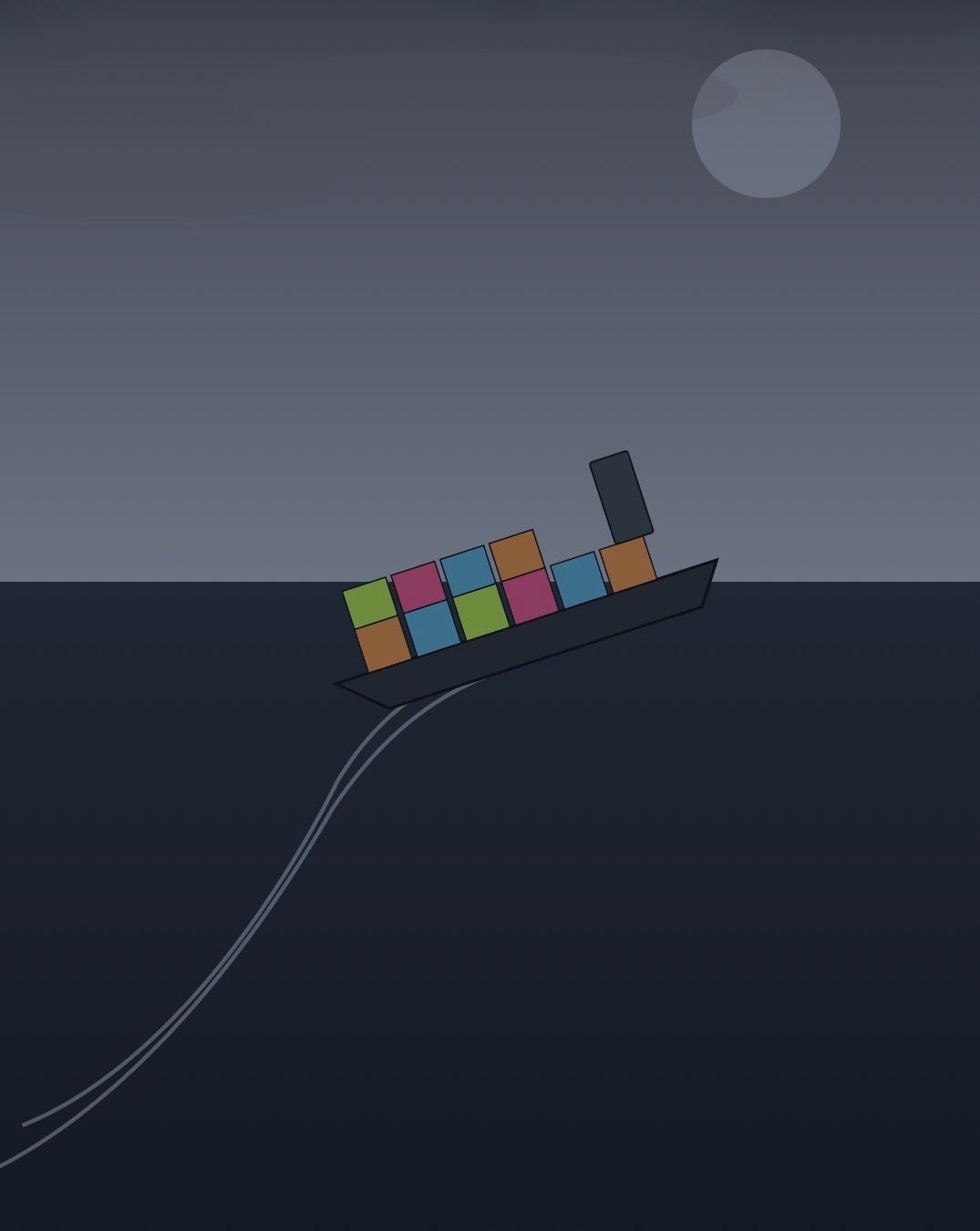
Culture, in this sense, behaves more like a container ship than a light switch. It does not instantly snap back to its old heading when the immediate crisis passes. It moves ponderously. Then the new heading becomes the baseline from which the next shift is measured.
Nobody wakes one morning and announces, "Today is Kristallnacht."
First come a thousand smaller refusals to intervene, a few nights of the long knives in which ideological opponents are purged, with each teaching everyone what will be tolerated next time.
Our information environment accelerates this process in ways Nazi Propaganda Minister Joseph Goebbels could only have dreamed of. Modern propaganda seldom needs to invent.
It can simply crop.
Real suffering. Real corpses. Real grief. Real terror.
Remove the history that produced the image, compress causation into twelve seconds, attach an accusation, and let an engagement algorithm distribute it. A three-second image of a grieving child will always travel faster than twenty minutes of tedious chronology, footnotes, competing claims and moral complication.
Goebbels did not have TikTok. He would have understood it instantly and admired the efficiency. It performs, for free and at planetary scale, one of propaganda’s oldest tasks: not necessarily persuading people of a complete ideology, but making explanation itself appear indecent.
None of this requires a conspiracy. Scapegoating is simply one of politics’ most durable technologies. Governments of every stripe discover that a foreign villain is more useful than a domestic spreadsheet. When productivity stalls, investment weakens, taxes bite or public services deteriorate, there is always a temptation to point somewhere else.
Donald Trump has become an extraordinarily convenient explanation for Canadian difficulties, including some that plainly predate him or arise from Canadian choices: taxation, productivity, internal trade barriers, regulation and chronic underinvestment. That does not mean Mark Carney is preparing to blame Jews for the economy. It means only that scapegoating works, and successful mechanisms get reused.
The oldest and most practised receptacle for this particular kind of blame in Western history is the Jew.
Which is why the casual revival of old language matters. “Jewish Bolsheviks” is not an eccentric phrase dropped harmlessly into the present. It comes with luggage.
It is tempting to answer all of this with the comfort of law — surely nothing serious can happen here, since Jewish equality is written into the Charter and the Criminal Code. But law is not upstream of culture; it is downstream. In a democracy, Parliament tends over time to legislate what the electorate has already decided it will tolerate, not the other way around.
A right that exists on paper while the surrounding culture has quietly decided the people it protects are more trouble than they’re worth is a right whose expiry date simply hasn’t been scheduled
But the mechanism that eventually makes a country unlivable does not begin with camps.
It begins with accommodation.
It begins with people who privately agree that something is ugly and publicly decide that saying so would be inconvenient. It begins in churches that prefer harmony, universities that prefer procedure, workplaces that prefer silence and dinner parties where objecting would spoil dessert.
A friend recently told me about one such dinner. Nice people. Respectable people. One guest remarked that if Hitler had killed one more Jew, it would not have been one too many.
My friend remembered it because, of course, one remembers a sentence like that.
I asked the obvious question.
“What did everyone say?”
Nothing, he told me. They changed the subject.
There it is.
No torchlight procession. No smashed glass. No uniform. No screaming man.
Just a table of civilized people, an obscenity placed among the plates, and the collective decision that challenging it would be socially awkward.
Bonhoeffer understood something that becomes harder to understand the farther we stand from catastrophe. Evil does not require everyone to become evil. It does not even require anything close to unanimity. A loud, disciplined, empowered minority can move a culture surprisingly far if the majority decides that resistance is somebody else’s responsibility.
Someone else will object. Someone else will complain. Someone else will take the social risk. And because everyone assumes someone else will, very often no one does.
That is the part we misunderstand when we repeat the comforting line about good men doing nothing. Of course good men do nothing. That is precisely why the mechanism works.
But even that is not the end of it, because silence is psychologically unstable. It is difficult to live indefinitely with the thought: “This is wrong, I know it is wrong, and I am doing nothing about it.” The mind dislikes that contradiction. It produces cognitive dissonance, and human beings are remarkably efficient at resolving it.
So the thought begins to move.
“This is wrong, but I don’t want to get involved” becomes “Well, perhaps there are two sides.” Then: “They do have a point.” Then: “The reaction is probably exaggerated.” Then, in some cases, remarkably quickly: “Actually, they are right.”
The easiest way to stop feeling like a coward is to persuade yourself that courage was never required.
A comforting objection is available here, and it deserves to be taken seriously rather than waved off.
Someone might say, "I would never do that." I might dislike Israel, or dislike a policy, but I would never tell a Jewish family they had to leave Canada, and I would never stand by while someone was beaten in the street.
That is probably true, and it is also beside the point. Nobody crosses a wide pond in one leap — you’d be right to say you can’t, and right to refuse the jump.
But a pond crossed by stepping stones is a different problem. Each stone changes where you’re standing relative to the next one, and changes what stepping onto it costs you.
The psychologist Ervin Staub, studying how ordinary people come to participate in genocide, described this as a continuum of destruction: a sequence of small, individually forgivable steps, each of which alters the person taking it and normalizes the next.
On this reading, the first stone in my friend’s story wasn’t agreement with the sentiment about Hitler and one more Jew. It was just silence — the sentence allowed to stand, the subject changed.
That step doesn’t guarantee the next one. Most people get off the stones and swim back. But the ones who don’t rarely get there by a sudden conversion to hatred. They get there by taking one more step from a position slightly further out than the one before.
And once people begin doing that, a vocal minority no longer needs merely to intimidate the majority into silence. It can recruit the majority into rationalizing the silence. Acquiescence becomes sympathy. Sympathy becomes conviction. Conviction becomes enthusiasm.
This is how movements that begin with relatively small numbers can acquire the appearance of inevitability. They do not need to persuade everyone at the beginning. They need only to persuade enough people to speak loudly, and enough others to keep quiet long enough that the new language starts to sound normal.
The important question, therefore, is not whether we can recognize Hitler once he is screaming.
Of course we can.
The question is whether we can recognize the moment before that—when nobody is screaming, everyone is respectable, the loudest people are still a minority, and changing the subject still feels like the polite thing to do.
Note to readers: Please consider a paid subscription. I won’t patronize you with the usual “it costs the same as two cups of overpriced coffee a month” routine. Keep the coffee. Enjoy the coffee. For the love of all that is holy, however, please don’t put Coffee-Mate in it. Life is difficult enough without voluntarily introducing that substance into your bloodstream.
If a paid subscription isn’t possible, please repost this. You’re unlikely to read much like it in the CBC, Toronto Star or Globe and Mail. Between federal support and Google money, much of Canadian media has become remarkably domesticated. I prefer to remain housebroken only in the most technical sense.
Consider leaving a tip if you want to support Freedom To Offend
