


There is a curious habit in Western progressive politics of discovering victims in precisely the wrong places. It is not an accident, but an instinct—and it is now on full display in the indulgent treatment of the Islamic Republic of Iran.
This is a regime that executes hundreds of its own citizens each year, imprisons thousands for speech, dress, and dissent, and shoots protesters in the streets when patience runs out. That violence is not episodic; it is systemic. In recent days, demonstrations sparked by economic collapse have spread well beyond Tehran into Iran’s rural provinces, including Lur-majority regions long neglected by the clerical state. At least seven people have already been killed.
These are the largest protests since 2022, driven not only by inflation, currency freefall, and the rial’s accelerating depreciation, but by chants directed squarely at the theocracy itself. Bread shortages ignite the spark; forty-five years of repression provide the fuel.
Iran ranks among the world’s leading executioners per capita. Clerical families siphon off vast fortunes while ordinary Iranians queue for bread, medicine, and exit visas. President Masoud Pezeshkian’s tentative signals of “dialogue” are drowned out by the sound of batons and gunfire, as they always are when the regime feels its grip loosening. None of this is disputed. It is documented, filmed, and reported—when it is reported at all. What is unfolding is not merely an economic protest cycle but a familiar Iranian pattern: financial collapse exposes moral bankruptcy, and the regime responds not with reform, but with force.
And yet, across Western capitals and university towns, the regime has been carefully repackaged as a misunderstood victim of “Western aggression.” Not the Iranian people—the women tearing off hijabs, the students chanting against the Supreme Leader, the workers striking despite the certainty of prison—but the regime itself. “Iran” is spoken of as though it were synonymous with its rulers, while the people being beaten, jailed, and executed are quietly erased.
I saw this inversion plainly when my own union, CUPE, announced what it styled a “pro-Iran” action. Whatever the intention, the language aligned neatly with the interests of the mullahs rather than their victims. It was solidarity without dissidents, sympathy without scrutiny, and politics conducted entirely at the level of slogans.
The moral error here is not subtle. Outrage is rationed according to ideology, and tyranny is forgiven so long as it offends the correct enemies. Not the Iranian people. The regime.
This is not confusion. It is reflex.
Iran today is ruled by a gerontocratic caste of clerics who have spent forty-five years crushing dissent, policing women’s bodies, executing homosexuals, exporting terror through proxies, and looting the country into moral and economic ruin. Thousands of Iranians are imprisoned for speech. Hundreds have been killed since the “Woman, Life, Freedom” uprising triggered by the death of the woman who dared not wear a hijab - Mahsa Amini. These are not contested facts. They are the regime’s résumé.
And yet, in London, Toronto, New York, and Paris, one finds progressive rallies denouncing “Western aggression against Iran,” warning darkly of “escalation,” demanding an end to sanctions—while performing an astonishing act of omission. The slogans are instructive: Hands off Iran. Stop bombing Iran. Rarely Down with the mullahs. Rarely Freedom for Iranians.
The distinction is not semantic. It is moral.
Opposition to war is a legitimate position. Indulgence toward tyranny is not. What we are witnessing is the Left’s oldest and most discreditable habit: confusing anti-Westernism with ethical seriousness. If a regime defines itself in opposition to America or Israel, it is granted a provisional moral amnesty, no matter how barbaric its internal conduct.
This is the same intellectual disease that once romanticised Castro, excused Mao, rationalised Pol Pot, and now—without irony—defends Hamas. The enemy of my enemy becomes my friend, even when that “friend” governs by the lash, the noose, and the prison cell.
Recent unrest in Iran has exposed this pathology with brutal clarity. Iranian-British commentator Mahyar Tousi has noted—correctly—that much of the Western media has mischaracterised the current upheaval as a series of isolated “economic protests.” This is evasive. The collapse of the rial may have been the spark, but the fire has been burning for decades. What is unfolding is a nationwide revolt against the Islamic Republic itself.
Protesters chant against Supreme Leader Ali Khamenei. They tear down regime symbols. They do not chant “Death to America.” They chant Death to the dictator.
This revolt did not materialise overnight. Networks of opposition have been forming for years, nourished by accumulated rage dating back to 1979—the year a functioning, outward-looking society was hijacked by clerics and transformed into a theocracy enforced by terror. For many protesters, the demand is no longer reform but replacement: an end to clerical rule, a referendum on Iran’s future, a secular state governed by law rather than scripture.
Some invoke the Pahlavi era not out of nostalgia, but because it represents a remembered possibility: a country where women were not state property and dissent was not a capital crime.
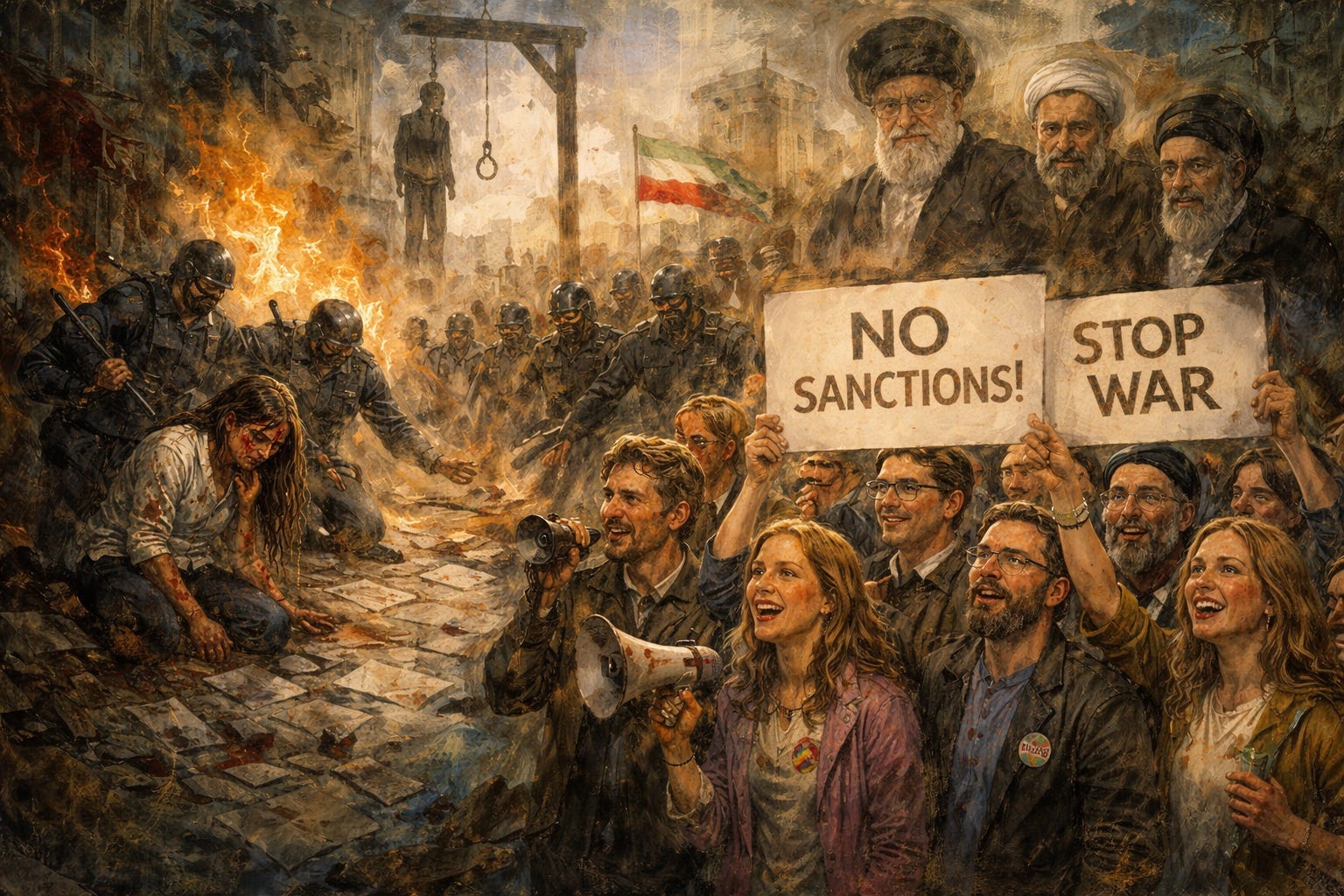
Western progressives, who claim to stand with women, minorities, and dissidents, routinely erase this reality. They condemn sanctions while ignoring corruption. They warn against “provocation” while ignoring the regime’s proxies—Hezbollah, Hamas, Islamic Jihad—exporting violence across the region. Pressure aimed at the regime is recast as violence against the people it represses, a distinction Iranians themselves understand perfectly and Western activists stubbornly refuse to learn.
