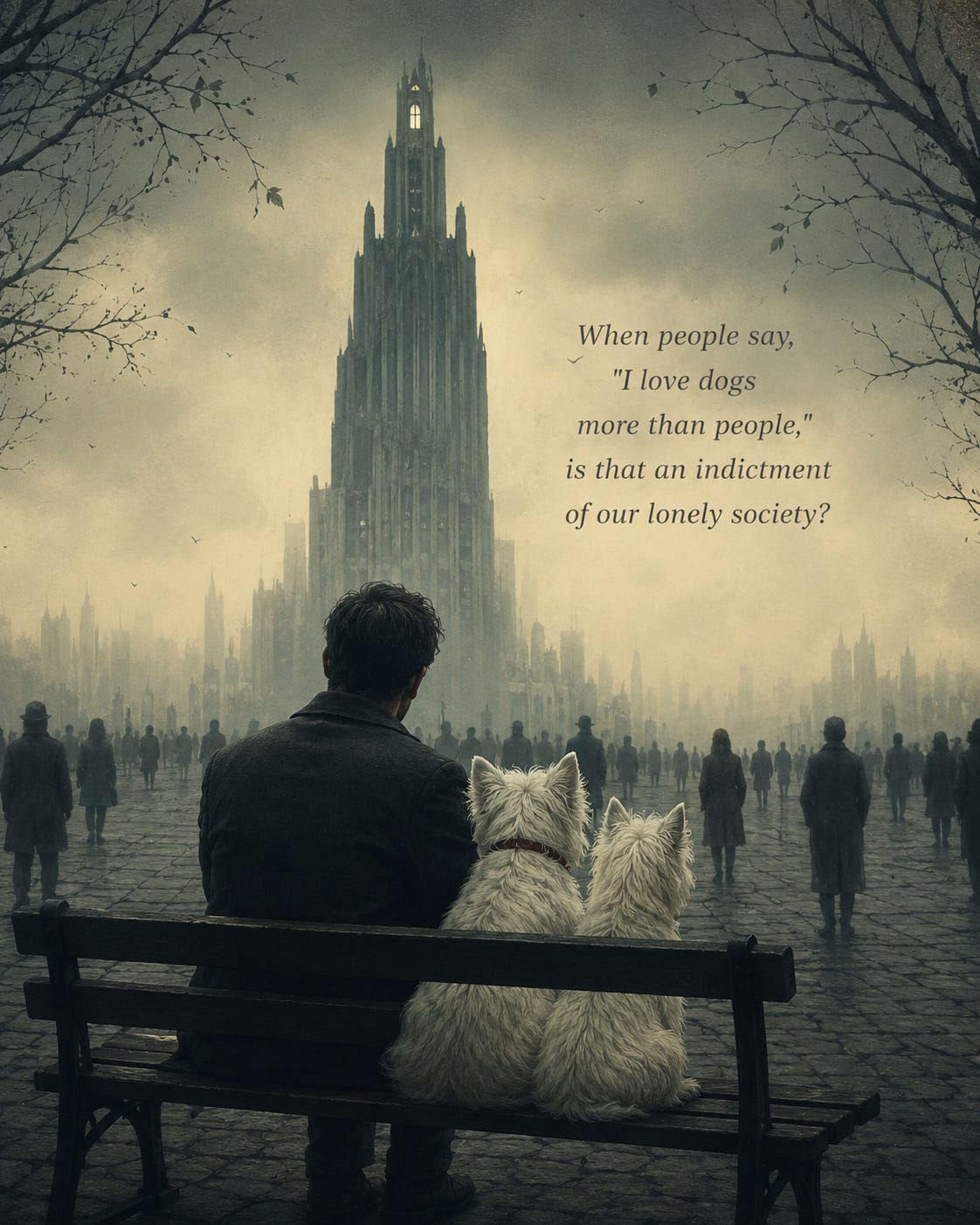
The Last Loyal Creature
Why So Many People Prefer Dogs to Humans—and What That Confession Reveals About Our Lonely Age
The scientific evidence does not permit us to declare that canine love is identical to human love. It does, however, strongly support the conclusion that dogs form genuine, owner-specific attachments and value human affection as something more than a way to fill their stomachs.
There is a sentence one hears with increasing regularity, usually delivered with a laugh that does not entirely conceal its seriousness:
“I prefer dogs to people.”
It sounds like a joke about human disappointment. People are treacherous; dogs greet us at the door. People remember grievances, withdraw affection, cancel plans, betray confidences and sometimes vanish without explanation. Dogs wait.
But perhaps the sentence deserves more attention than we give it. Is it merely the complaint of the jaded? Is it misanthropy disguised as animal affection? Does it express a desire for companionship without the work of communication, compromise and forgiveness? Or does it reveal something sadder about a society in which people have become increasingly connected by technology and increasingly isolated from one another?
The comparison itself is unfair. Dogs and humans do not occupy interchangeable positions in our lives. Preferring one to the other is, in some respects, like preferring music to architecture, apples and oranges. Each provides something the other cannot.
Yet the declaration persists because it expresses an emotional truth. For a growing number of people, the dog has become the most reliable source of affection in the house.
This is not difficult to understand.
A dog does not care whether its owner is impressive. It does not become distant because someone more interesting has entered the room. It does not compare incomes, reputations, appearances or social reach. It does not find its aging owner insufferable because he can barely work his iPhone or has asked the same technological question twice. Nor does it abandon him for someone younger, quicker, more fashionable or more socially adept.
It does not decide that loyalty has become embarrassing.
Dogs watch the door. They recognize the sound of a familiar car and the rhythm of familiar footsteps. They follow us from room to room, not because the destination matters, but because we are going there. They sleep beside the chair, wait outside the bathroom and greet a return from the mailbox as though their master had recently escaped from a gulag in the deepest tundra.
To a dog, an ordinary person may become the organizing centre of the universe: the source of safety, touch, play, food, routine and belonging. To be loved with that degree of uncomplicated attention is no small gift, particularly in an age when human attention is fragmented, conditional and easily withdrawn.
It is tempting to dismiss all this as sentimentality—to say that owners merely project human emotions onto animals that have learned where dinner comes from. Dogs are certainly motivated by food, and anyone who has opened a package of cheese crackers within their hearing knows it. But the evidence suggests that the relationship cannot be explained by appetite alone.
In one experiment, researchers placed awake, unrestrained dogs in an MRI scanner and compared their neural responses to signals predicting food with signals predicting praise from their primary human handler. Most of the dogs showed reward-system activation for praise that was equal to or greater than their response to food. Their neural preferences also predicted whether they would later choose interaction with their owner or approach a bowl of food.
This does not prove that a dog contemplates love as a human being does. It does show that affection from a familiar person has intrinsic reward value. The owner is not merely a mobile tin opener.
Other brain-imaging work found that the scent of a familiar human produced the strongest activation in a reward-associated region of the canine brain when compared with the scents of unfamiliar humans and familiar or unfamiliar dogs. The familiar person was absent during the experiment, making it difficult to reduce the response to an immediate expectation of feeding.
Behavioural research points in the same direction. Dogs use their owners as a secure base from which to explore and solve problems. The owner’s presence can reduce stress, encourage exploration and provide a “safe haven” during threatening situations. Researchers have adapted methods originally developed to study attachment between human children and caregivers and found recognizably similar patterns in dogs.
There is even a biological feedback loop between the species. Sustained mutual gazing between dogs and owners has been associated with increased oxytocin in humans, which in turn encourages further affectionate interaction; the researchers described it as an oxytocin-mediated positive loop resembling mechanisms involved in human attachment.
One should be cautious with the word love. Science can observe behaviour, hormones and neural activity; it cannot climb inside the private experience of another species and translate it into a human sentence.
But if love includes attachment, preference, trust, proximity-seeking, distress at separation, reassurance through reunion and delight in the presence of a particular individual, then it becomes unnecessarily stubborn to insist that dogs feel nothing worthy of the name.
Their love is genuine, even if it is not human.
Lord Byron understood this long before the MRI scanner. When his Newfoundland, Boatswain, died in 1808, Byron commemorated him in an epitaph contrasting canine virtue with human vanity and betrayal. The poem ends with the bleak confession:
“I never knew but one—and here he lies.”
The “one” was his dog.
Byron’s grief sounds strikingly modern. The dog is praised not merely because it was affectionate, but because its affection exposed something shabby in human beings. The animal possessed loyalty without calculation, courage without vanity and companionship without intrigue. The dog’s goodness became an indictment.
Perhaps the modern refrain—“I prefer dogs to people”—contains the same judgment.
Human relationships are difficult because another person possesses a will equal to our own. Other people misunderstand us, contradict us, need things from us, judge us and sometimes leave. They require explanation, patience, apology, boundaries, forgiveness and repeated negotiation. We cannot simply summon them when lonely and dismiss them when tired.
A dog requires care, but it does not require the same moral labour of mutuality. It does not ask whether we have listened closely enough. It does not challenge our politics, remember an insult from six years ago or tell us that our version of events is self-serving.
(Although with my family dog growing up, I once went down to her bowl and pretended to eat her food. She saw and forever ran to her bowl when I came in the room. Sorry, Misty girl. )
It offers a relationship that is demanding in practice but comparatively safe emotionally.
This may make dogs especially attractive to people who have been hurt.
Someone betrayed by a spouse, abandoned by friends, rejected by family or quietly discarded by colleagues may discover that human intimacy feels less like comfort than exposure. The dog becomes the creature who cannot humiliate him deliberately, disclose his secrets or decide that he has become socially inconvenient.
The preference for dogs may therefore be misanthropic, but it is often wounded misanthropy. It is not always hatred of humanity. Sometimes it is the exhaustion of continuing to trust it.
Yet something larger is occurring. The modern person lives amid unprecedented communication and diminishing presence. We can reach almost anyone instantly, but increasingly do so without sharing a room. We send messages instead of visiting, react instead of answering, watch instead of participating and maintain awareness of hundreds of people while being deeply known by very few.
Digital communication can sustain real relationships, especially across distance. It is not intrinsically isolating. But the World Health Organization now identifies excessive or harmful digital-media use as one factor contributing to social disconnection, particularly among younger people, while warning that loneliness and social isolation have serious consequences for physical and mental health.
The modern person may therefore be surrounded by evidence of human existence while deprived of human presence.
There are messages, photographs, videos, voices and notifications everywhere. But there may be no one sitting in the chair across the room.
A dog is stubbornly physical and, without intention, retro. It cannot be maintained entirely through an app. It must be fed, walked, touched, cleaned, noticed and allowed into the rhythms of daily life. It creates routine in a culture of fragmentation. It needs its owner to inhabit the same space.
The dog restores something digitization steadily erodes: uncomplicated embodied companionship.
It also pulls the owner into the world. A dog must be walked. It provides a reason to leave the house, enter a park and speak to strangers. Recent research suggests that people often experience their relationships with dogs as highly satisfying and particularly strong in companionship, care and dependable support. Yet those relationships do not appear simply to replace weak human relationships; rather, they provide a distinctive and complementary form of connection.
This is important because the evidence on pets and loneliness is mixed. Pet ownership has sometimes been associated with lower social isolation and, particularly during the pandemic, lower loneliness.
But systematic reviews have not found that owning an animal consistently eliminates loneliness across populations. A dog may help profoundly without supplying every kind of connection a human being needs.
A dog can sit beside grief, but it cannot interpret grief with us.
It cannot remember our father, or a mother lost in childhood that one can now barely pull up in their mind’s eye, nor can it help us understand why a marriage failed or tell us that we have become unfair. It cannot share responsibility for a moral decision, exchange memories of a childhood or argue with us until a deeper understanding emerges. It can provide affection, but not the full reciprocity of human friendship.
That limitation does not diminish the dog. It defines the tragedy.
The dog may bridge the gap created by human loneliness. It may soften the gap, interrupt it and make it survivable. It may even lead its owner back toward other people. But it can also make withdrawal easier. After enough disappointment, the safer creature may become preferable to the riskier one.
And dogs are safer.
They do not drift away in search of a more successful social circle. They do not become embarrassed by age, illness or diminished usefulness. They do not regard a person as disposable because his career has failed or his conversation has slowed. Their world contracts around those they love rather than continually expanding in search of replacements.
It feels good to be needed that completely.
It feels even better to be welcomed.
This is why “I prefer dogs to people” sounds both humorous and sad. It celebrates one of the most remarkable relationships human beings have been given. Yet it may also confess that ordinary human connection has become too fickle, exhausting or dangerous to trust.
Dogs are not substitutes for people. They are not miniature humans, unpaid therapists or emotional appliances. They are another kind of creature offering another kind of relationship—one with genuine attachment, distinctive limits, extraordinary beauty and a love that seems pure.
The question is therefore not whether dogs deserve our love.
They do.
Nor is the question whether their love is real. The evidence, both scientific and ordinary, strongly suggests that it is.
The harder question is what has happened to human society that the steadfastness of a dog increasingly feels less like a wonderful addition to human companionship and more like the last dependable refuge from its failure.
Postscript
I have written this without making myself the subject, but perhaps one personal admission belongs at the end.
I love my dogs.
Years ago, I lost my beloved Westie, Nika. I can still barely speak about that morning I found her on the cusp of death under my daughter’s bed without feeling the old pain return. Grief of that kind is sometimes treated as excessive because the creature lost was “only a dog.”
But anyone who has loved a dog knows the poverty of that phrase.
Nika was not interchangeable. She was not merely a pet occupying a category that could be refilled. She was a particular presence, a particular personality, a particular source of companionship and joy. She had woven herself into the ordinary structure of life so completely that her absence altered the shape of the house.
Perhaps this is why the question matters to me.
The love between a person and a dog is not imaginary, childish or second-rate. It is one of the real consolations of human life. The grief that follows its loss is real because the love was real.
(My dogs today)


What a lovely essay! Brought me to tears and made me miss my dog Winston, who passed two years ago. That's Winston and me in the little photo adjoining this comment. Woof woof.
Actually, I’m more of a cat person!