


You are a child again, and a parent sits by your bed. You are drifting toward sleep. They begin to read...
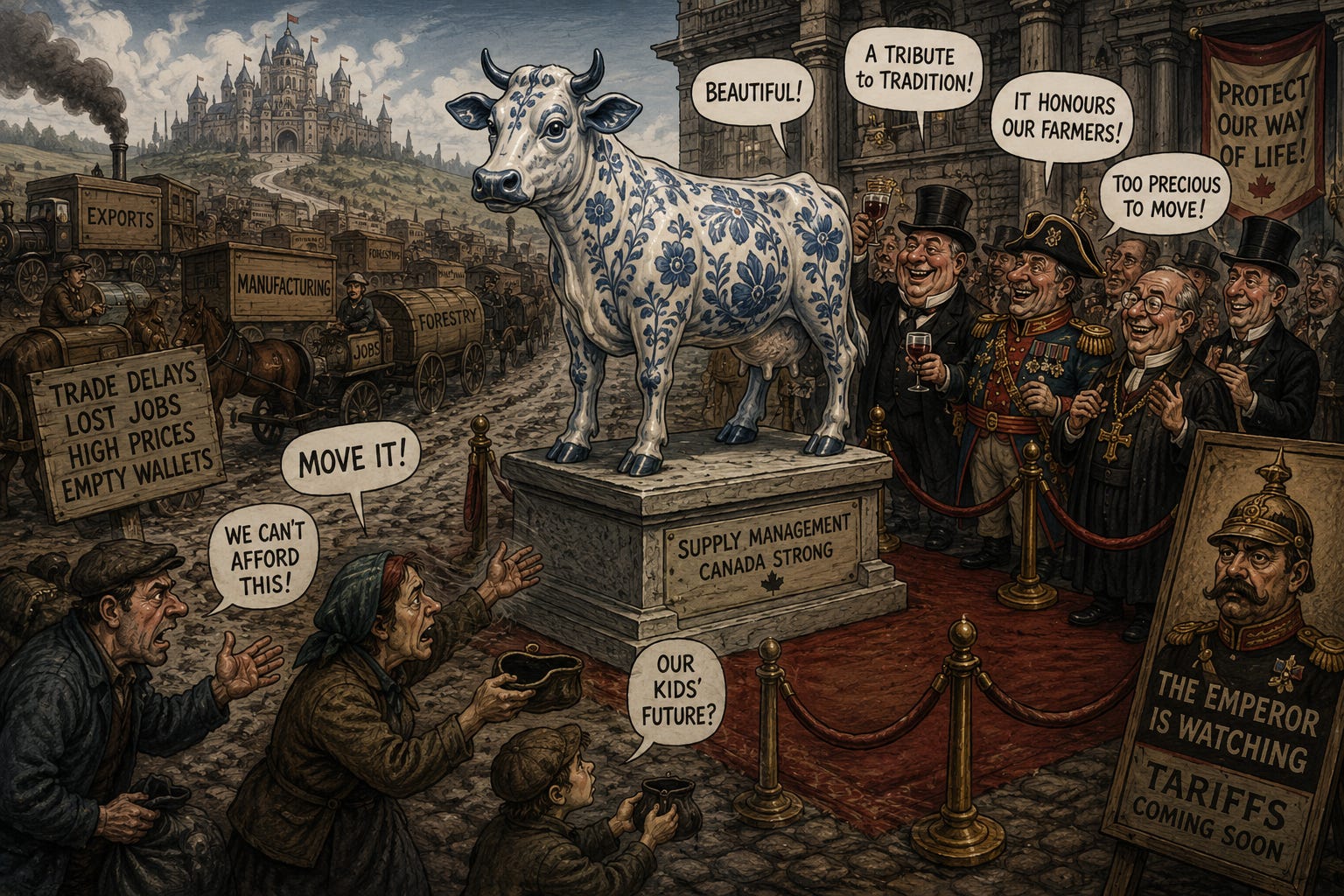
Once, a northern king owned a small porcelain cow.
The cow was neither beautiful nor particularly valuable, but the king loved it because it reminded him of simpler times. For some reason, the king, saying he was doing it out of respect to the farmers and the country, placed the porcelain cow on a pedestal in the middle of the kingdom’s busiest road.
As the years passed, merchants complained that the cow obstructed traffic. Wagons carrying timber, grain, machinery and iron had to slow down to go around it. Some carts were overturned. Others took longer routes. Lines to avoid the porcelain cow grew long. Trade slowed. Prosperity faded, almost imperceptibly at first.
When his advisors pleaded with him, the king still refused to move it.
“It honours our farmers and our country,” he declared.
Then a neighbouring southern king demanded that the road be cleared of the obstructive cow. That king was vain, unpredictable and easily offended. He was also impulsive and childish; he would threaten to send his soldiers to remove the cow, then pay it no attention for months. When the northern king refused, the southern king imposed heavy tolls on every merchant entering the northern realm.
The royal treasurer quietly calculated the cost.
“Your Majesty,” he said, “the porcelain cow is at most worth one chest of silver. Yet we are now spending one hundred chests of gold every year to protect it.”
The king frowned.
“If we move it now,” he replied, “my subjects may think we should have moved it years ago. I will look foolish.”
So the kingdom kept losing one hundred chests of gold, and the southern king continued to bluster, threaten and lament the existence of the porcelain cow. But each subsequent year the price of protecting the porcelain cow grew larger and larger. The southern king refused to trade and grew angrier and angrier. The northern king said the cow would remain in the road forever.
A farmer’s boy one day stood at the gates of the northern king and said he had a question. The king opened the gates, and the boy finally asked the question that none of the king’s ministers dared ask.
“Have you done the arithmetic?”
That is no longer merely a fairy tale.
It is Canada’s supply management system.
For decades, the debate has been conducted almost entirely in the language of emotion and sentiment. We are lectured about family farms, rural communities, Canadian values and food security, as if our fruit-bottomed sugary yogurts cannot be imported from anywhere south of Windsor. There may be some legitimate considerations. But arithmetic is also a Canadian value—or at least it ought to be.
The real question is not whether dairy farmers matter; everybody loves the romantic notion of the farmer up at dawn squeezing a cow’s teat and sending a stream of milk into a silver bucket (though cows are milked automatically through electronic milking parlours while the farmers sleep today).
The question is whether the rest of Canada is paying twenty dollars per cow, perhaps one hundred, to preserve a single dollar of benefit.
No government or political party seems to have the courage to show Canadians the complete ledger.
So let us begin.
1. Canadians already pay billions more at the grocery store. Yes, with a ‘b’.
Published estimates differ, but they all point in the same direction: Canadians pay significantly higher prices for dairy, eggs and poultry because foreign competition is tightly restricted. Anytime competition is throttled, and in Canada about 46% of our industry is protected, prices go up.
Reasonable estimates put the annual consumer cost somewhere between $5 billion and $10 billion.
That surge of dopamine you feel when you listen to the Canadian music and see the handsome farmer standing by his dairy herd in the TV ad is pricey.
Every litre of milk and every block of cheese contains a hidden transfer from millions of consumers to a relatively small protected industry made up of rich farmers from Quebec and Ontario.
2. Taxpayers have paid billions more.
But when Canada signs a trade agreement and reluctantly grants even limited additional access to our dairy market, the government compensates quota holders.
Ottawa has already committed approximately $4.8 billion in compensation following CETA, the CPTPP and CUSMA. For some reason, when the rest of us lose our jobs because of circumstances beyond our control, we suck it up, apply for EI, move on and don’t view our previous lifestyle with such an air of entitlement.
Think about the logic.
Consumers pay more because competition is throttled.
Then taxpayers compensate producers because competition expands slightly.
So we have found a way to pay twice for the same policy.
3. The highest cost is the one nobody measures.
What is the opportunity cost? That’s a question that should be tattooed on the arm of everyone in the civil service who spends taxpayer funds, whether those funds come from taxpayers today or from our grandchildren through debt.
Donald Trump has become triggered by our dairy protectionism. No one can honestly claim that supply management costs us nothing in negotiations.
Every negotiation requires bargaining chips. Give and take.
Canada repeatedly spends one of its most crucial bargaining chips just to preserve the existing system. That porcelain cow costs more than one made of solid gold.
What could we have received instead?
Would better access to automobiles help?
Steel? Aluminum? Forestry? Technology? Professional services?
Who knows.
That is really the problem.
4. Parliament refuses to show Canadians the math.
Imagine the governing board of a major Canadian corporation proclaiming:
“We have no idea what this policy costs the company, but if you question it, we will smack you up.”
No responsible board would accept such reasoning.
Yet Parliament has.
Instead of producing a serious cost-benefit analysis, governments of every political stripe simply repeat that supply management must be protected. Even the champions of the working class and the poor, the NDP, seem to forget that this porcelain cow costs the average poor family hundreds of dollars per year in after-tax dollars because of the raised dairy prices. Everyone eats, and the poor spend a higher per cent of their budget on food.
5. Why is dairy different?
Every year Canadians lose jobs. I just lost mine. Substack is a side gig, not a job.
Factories close. Technology makes some workers unnecessary. Universities reduce hiring. Businesses make bad decisions and fail; consumer preferences change. Governments cannot guarantee every displaced worker the grand total of their future earnings. Nor should they. So why is dairy different?
And even if one supposes Canada paid every dairy farm $1 million to transition. The bill would be roughly $9 billion.
That sounds horrific—until one considers that Canadians may be shelling out something close to that every year through higher dairy prices alone.
A one-time transition might ultimately prove cheaper than defending the existing system forever.
At the very least, it deserves to be brought up. But our politicians fear the dairy lobby.
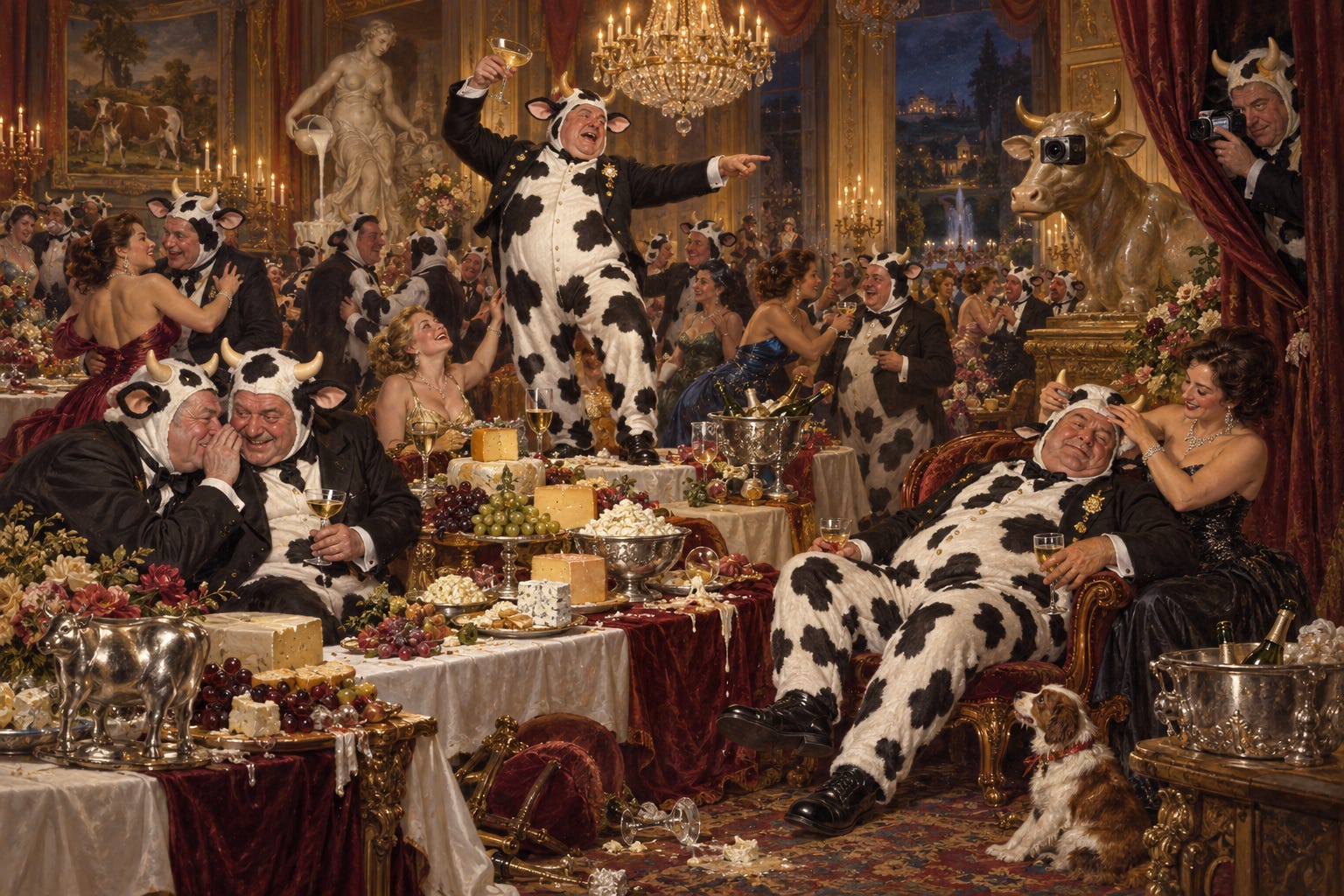
Or perhaps the dairy marketing board some years ago had a party with all the political heavyweights, and there was a lot of booze and even more paid working girls and boys, and there emerged hours of compromising videos of our politicians dressed up like cows doing things that one wouldn’t want to see in a family-focused cottage cheese commercial?
Maybe?
6. Why does no politician ask these questions?
It’s because the benefits are concentrated.
The costs are dispersed. A dairy producer thus has every incentive to organize, lobby, vote and defend the existing system.
Even if the average consumer loses a few hundred dollars each year, it’s not a cost they see; no sign above the dairy case at Freshco says, “if not for supply management you’d pay three dollars less.”
Economists have understood this political reality for generations. Concentrated benefits. The costs spread so thin nobody can see them.
This phenomenon explains much more than supply management. It explains a lot of our modern government.
7. Show Canadians the numbers
This should not be a debate about whether we love farmers. My father was a farmer turned professor; my family on the Irish side goes back 700 years of farming. God love them all.
It should be a debate about math. We need to state clearly: for every dollar of dairy income preserved:
How many consumer dollars are wasted?
How many export dollars end up at risk? How much negotiating leverage vanishes? How much investment is taken off the plate? How much economic growth is quietly sacrificed?
New Zealand eventually had the political courage and civic maturity to put its porcelain cow in the museum.
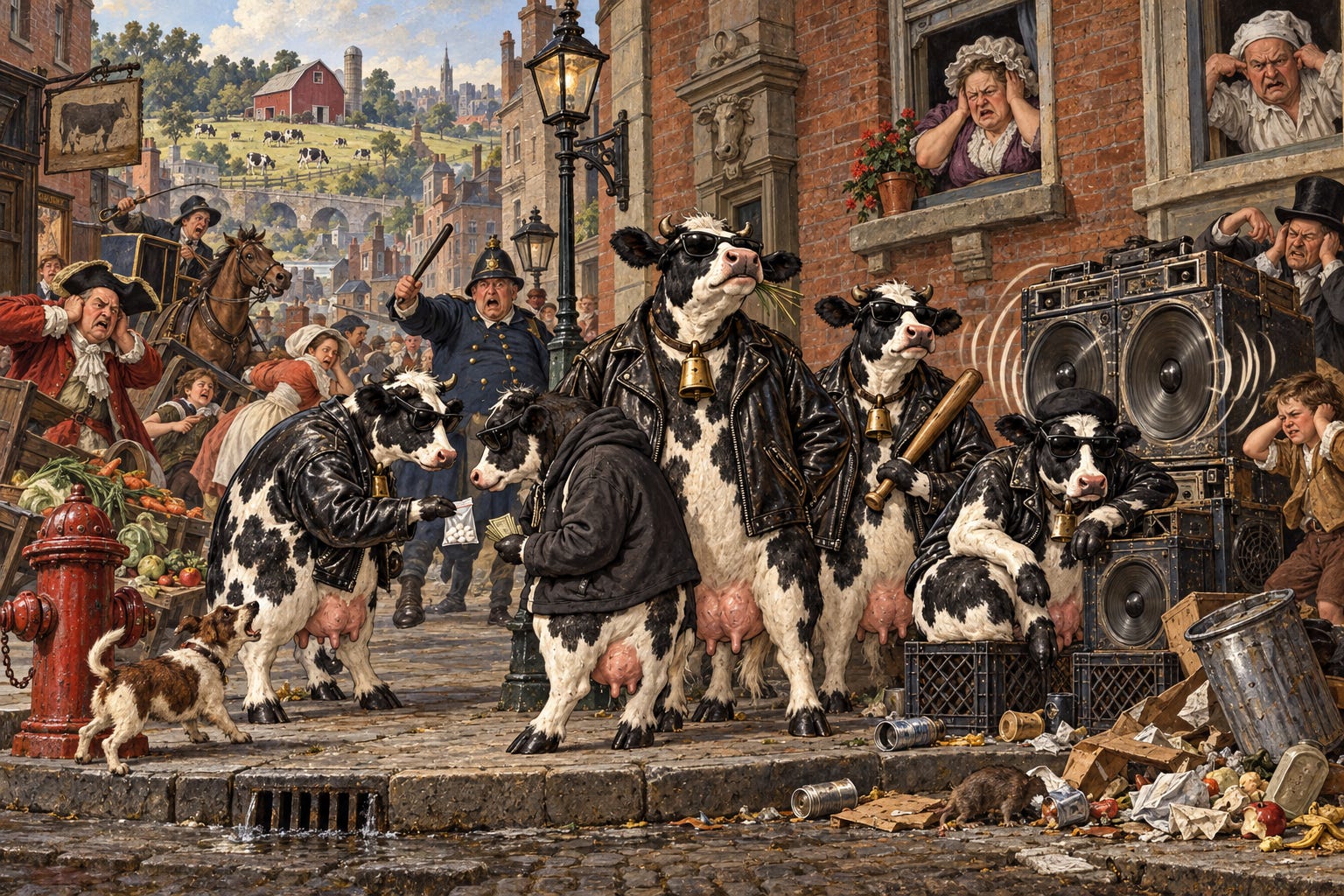
And surprise - its farmers did not vanish. Its countryside did not collapse. Gangs of abandoned dairy cows did not form violent gangs, start dealing crack and move into the cities hanging out on street corners playing insufferable music.
Civilization survived.
Canada, meanwhile, continues to sanctify its porcelain cow every election, bow before it, wrap it in the flag, declare it untouchable, and send yet another trade envoy south to explain why this ceramic ornament is worth more to us than another concession, another dispute, another tariff, and billions of dollars.
Somewhere, one might surmise, that even our porcelain cow is acquiring a sense of shame.
Canadians can do math. Show them the numbers. And then, for the love of all that is holy and sane— move the porcelain cow.
Note to readers: Please consider a paid subscription. I won’t patronize you with the usual “it cost the same as two cups of overpriced coffee a month” routine. Keep the coffee. Enjoy the coffee. For the love of all that is holy, however, please don’t put Coffee-Mate in it. Life is difficult enough without voluntarily introducing that substance into your bloodstream.
If a paid subscription isn’t possible, please repost this. You’re unlikely to read much like it in the CBC, Toronto Star or Globe and Mail. Between federal support and Google money, much of Canadian media has become remarkably domesticated. I prefer to remain housebroken only in the most technical sense.
Supply management should’ve been dealt with years ago. I’ve been farming for nearly 60 years and it has always frustrated me that that particular branch of farming was treated with such political favoritism that all Canadians paid for. I’m sure it has nothing to do with the fact that, as was pointed out, most dairy farmers are from Quebec and Ontario?
You could just as easily be describing the UK.
Things can only get worse because nobody is willing to allow themselves to look unpopular and risk not getting votes.
When you sacrifice justice for thousands of young girls from deprived areas of the country, just to keep the votes of a certain section of 'the community' and their enablers, you're not going to suddenly locate your moral compass.
We almost starved during WW11 because food supply chains (notably wheat from USA) were understandly disrupted.
We had initiatives to grow our own food at home etc and we managed.
But we've forgotten the lesson we learned then.
The Ukrainian wheat and grain production and distribution has led to mass suffering in parts of Africa, thereby demonstrating the fragility of relying on other nations to feed you.
But subsequently we had 'butter mountains' and 'milk lakes'when EU farmers ovwrproduced and had to throw vast amounts of produce away.
I have no idea what the answer is because some leaders seem happy to weaponise food if it suits their objectives.