


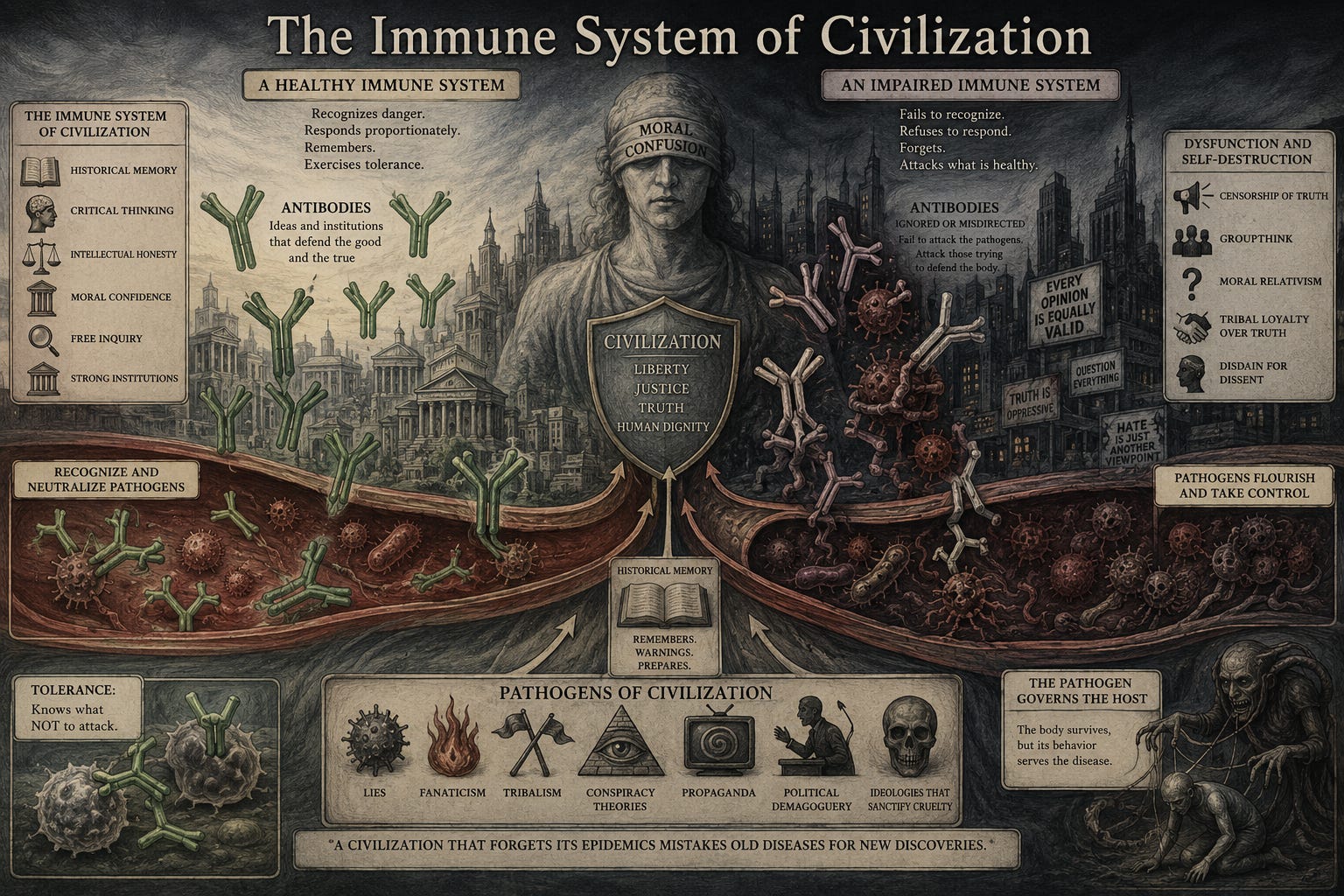
Viruses seek entry. Bacteria probe for weakness. Mutated cells emerge. Foreign proteins circulate through the bloodstream. Yet most of us notice none of it because an extraordinary biological system works quietly and continuously for us. Health is not the absence of pathogens. Pathogens are everywhere. Health is the presence of an immune system that can recognize what belongs to the body and what threatens it.
A healthy immune system performs four indispensable tasks.
It recognizes danger.
It responds proportionately.
It remembers previous infections.
And, just as importantly, it exercises tolerance, refusing to attack the healthy tissues it exists to protect.
Civilizations require precisely the same capacities.
The transition works best by deepening the metaphor: the danger is not merely that pathogens exist, but that a civilization may become incapable of recognizing them because it has trained itself to regard every diagnosis as prejudice.
Their immune systems are not made of white blood cells but of historical memory, critical thinking, intellectual honesty, moral confidence, free inquiry, and institutions that can distinguish truth from propaganda, justice from vengeance, and disagreement from hatred.
Every society lives amid pathogens: lies, fanaticism, tribalism, conspiracy theories, propaganda, political demagoguery, and ideologies that sanctify cruelty. These are not inventions of the digital age. They are permanent features of human nature.
The problem, however, is not merely that these pathogens exist. It is that much of the modern West has lost the confidence to recognize them as pathogens.
We have cultivated the consoling fiction that beneath every cultural difference lies essentially the same liberal-democratic aspiration. We imagine that unfamiliar customs, doctrines, and political traditions are merely a thin patina of awkwardness or surliness covering people who, at heart, already share the assumptions of the post-Enlightenment West.
We persuade ourselves that every culture ultimately values individual liberty, freedom of conscience, equality before the law, religious pluralism, democratic government, the rights of women, and the protection of dissenters—and that, upon crossing a border into Canada, the United States, or Western Europe, these supposedly universal convictions will naturally reveal themselves.
But they are not universal convictions. They are historically unusual achievements.
Cultures are not decorative variations upon a common liberal foundation. They contain moral systems, religious doctrines, political assumptions, loyalties, taboos, hierarchies, and conceptions of justice that may differ profoundly. Some of those values are compatible with Western liberal democracy. Others are indifferent to it. Some are openly hostile to it.
A culture, movement, or ideology can hold principles fundamentally opposed to freedom of speech, equality between men and women, religious liberty, democratic pluralism, or the right of individuals to reject inherited belief.
To acknowledge this is not racism. It is not an assertion of biological superiority. It is the elementary recognition that ideas differ, that cultures transmit ideas, and that some ideas are more compatible with human freedom than others.
Yet cultural relativism has made even this modest observation appear morally suspect. We have been taught that judging another culture is inherently arrogant, that differences are mostly superficial, and that any attempt to distinguish between liberal and illiberal values is merely prejudice disguised as analysis. As a result, we often refuse to name fanaticism when it appears, excuse authoritarian beliefs as cultural authenticity, and treat hostility toward Western freedoms as simply another equally valid way of arranging society.
We tell ourselves that this refusal is kindness. We call it empathy, tolerance, openness, and inclusion. But frequently it is something less admirable. It is cowardice: the fear of being called racist, xenophobic, intolerant, or culturally insensitive. That fear becomes so crippling that we deny what is plainly before us. We stop examining ideas by their content and instead judge criticism by the identity of the person being criticized.
The pathogen is permitted to circulate because the immune system has been trained to attack the diagnosis.
This does not mean immigrants are pathogens, foreign cultures are diseases, or Western civilization is pure. The biological metaphor applies to destructive ideas, not to races or peoples. Western societies have generated their own fanaticisms, lies, conspiracies, hatreds, and totalitarian movements. No civilization is naturally immune from moral corruption. The point is that a healthy society must examine every ideology—including its own—with honesty and moral confidence.
A functioning immune system does not hate the body it protects. Nor does it condemn every unfamiliar organism as dangerous. It distinguishes. It identifies. It responds proportionately. But it cannot protect anything if it has been taught that discrimination itself—the act of distinguishing one thing from another—is immoral.
The question, then, is not only whether the pathogens exist.
The question is whether the civilization can still recognize them, name them, and resist them without collapsing into shame at the very act of judgment.
The Western reaction to October 7 suggests that ours has become dangerously impaired.
This essay is not primarily about Israel. Nor is it an attempt to resolve the Israeli-Palestinian conflict. It begins with one proposition accepted across the mainstream historical record: Hamas and associated armed groups crossed into Israel on October 7, 2023, murdered approximately 1,200 people, abducted 251 hostages, and committed documented atrocities, including sexual violence. One may debate military strategy, humanitarian law, proportionality, or the conduct of the war that followed. Those are legitimate subjects of argument.
The metaphor now makes a crucial clarification: the “pathogens” are destructive ideas and ideologies, not immigrants, ethnic groups, or cultures treated as biological entities.
The subject here is different.
It is the reaction.
Like physicians, we often learn more from the body’s response to infection than from the pathogen itself.
October 7 became an immunological test of liberal democracy.
The first function of any immune system is recognition.
Can it identify the pathogen?
One might have expected the answer to be obvious. Instead, almost immediately, the massacre was denied, minimized, justified or transformed into someone else’s crime. Documented atrocities became “contested narratives.” Hostages disappeared beneath ideological abstractions. The moral vocabulary itself seemed to dissolve.
Recognition had begun to fail.
The digital world did not invent this failure, but it accelerated it dramatically. Father Charles Coughlin spread antisemitic conspiracy theories through radio nearly a century ago. The Protocols of the Elders of Zion travelled internationally without algorithms. Human beings have always had a remarkable talent for believing falsehoods that flirt with and procreate our bias.
What has changed is how efficiently they spread.
Modern digital platforms reward outrage, repetition and tribal affirmation. They learn what captures attention and amplify it. They do not create every prejudice, but they can reinforce existing ones with extraordinary speed. Falsehoods no longer require years to circulate. They require minutes.
A pathogen that once spread village by village now travels globally before breakfast.
Recognition becomes more difficult when the infection arrives carrying a million identical voices.
The second function of an immune system is response.
Recognition without response is biologically useless.
Here, too, the reaction proved revealing.
Universities, media organizations, professional bodies and other institutions often appeared uncertain whether they could condemn the massacre without first surrounding the condemnation with qualifications, explanations or political calculations. The ‘enemy of my enemy is my friend’ heuristic transformed enemies of Trump into friends, and that model of thinking created friends in Iran and turned a blind eye to barbarism.
A healthy immune response distinguishes between recognizing an infection and debating the best long-term treatment. One can argue vigorously about military policy while still recognizing an atrocity as an atrocity.
When the immune response hesitates because the pathogen has become politically fashionable, the infection gains ground.
The third function is memory.
One of biology’s great achievements is that the immune system remembers previous encounters. It does not begin every battle from ignorance.
Civilizations require the same capacity.
The evidence of this amnesia is not anecdotal. A 2020 Claims Conference survey of American Millennials and members of Generation Z found that 63 percent did not know that six million Jews were murdered in the Holocaust, 36 percent believed that two million or fewer had been killed, and 48 percent could not name a single concentration camp or ghetto.
Eleven percent said they believed that Jews themselves had caused the Holocaust. The survey did not find that an entire generation denied the Holocaust outright. Its findings were, in a sense, more revealing: enormous numbers possessed so little reliable knowledge that distortion, inversion, and conspiracy could enter the space where historical memory should have been.
Canada cannot regard this as an exclusively American failure. In a Claims Conference and Azrieli Foundation survey of Canadian adults, 62 percent of Millennials did not know that six million Jews had been murdered, 52 percent could not name a single concentration camp or ghetto, and 22 percent had either not heard of the Holocaust or were unsure whether they had heard of it. Among Canadians of all ages, 54 percent did not know the number of Jewish victims, while almost half could not name a single camp or ghetto.
These numbers matter because historical memory is not ornamental knowledge. It is part of a civilization’s immune system. A society that does not remember how antisemitic propaganda developed, how conspiracy theories became political doctrine, how respectable institutions normalized exclusion, or how dehumanizing language prepared the ground for violence will not necessarily recognize those processes when they return in altered form. It may hear an ancient accusation and mistake it for a fresh insight. It may encounter propaganda with a modern vocabulary and fail to recognize the older structure underneath it.
The same weakness appears in public understanding of October 7. The barbarity of the Oct. 7 massacre has been verified by research; indeed, the Hamas attackers and those who joined in made no effort to hide it. Families were burned alive, 19 children slaughtered, teenagers violated, and further barbarisms; but in a 2024 Pew Research Center survey, only 58 percent of Americans under thirty said the manner in which Hamas carried out the October 7 attack was unacceptable, compared with 86 percent of those aged sixty-five and older. Among the under-thirty group, 34 percent said Hamas’s reasons for fighting Israel were valid, while 35 percent said they were unsure.
People increasingly hold strong opinions without the chronology needed to test them. They know the slogans, the images, and the emotional vocabulary, but not always what happened first, what followed, who made which decision, or which claims have been independently established.
A civilization that forgets its previous epidemics mistakes old diseases for new discoveries. It may even welcome them as progress.
The digital age has not simply accelerated information. It has accelerated amnesia. Every generation increasingly behaves as though history began with the latest viral video. Events are severed from the decades that preceded them, images are stripped of provenance, and political judgments form before the most elementary facts are established. The result is not merely ignorance. It is a population left immunologically exposed: highly stimulated, morally certain, and historically defenceless.
The fourth function is perhaps the most remarkable.
Tolerance.
A healthy immune system knows what not to attack.
An autoimmune disease is different. The immune system mistakes the body’s own healthy tissues for hostile invaders. The system designed to preserve life begins consuming the organism from within.
This may be the most illuminating analogy for parts of the contemporary West.
Free inquiry becomes “dangerous.” Due process becomes an inconvenience. Presumption of innocence becomes optional. Historical scholarship becomes suspect. Objective truth becomes merely another exercise of power. Universal moral principles give way to tribal loyalties. The absurd notion of Islamophobia and the idea that Islam cannot be criticized is an intellectual autoimmune disease that may end up costing Western civilization its existence.
The antibodies themselves become the enemy.
No civilization survives indefinitely when it begins attacking the institutions and habits that once protected it.
This helps explain why October 7 became such an important diagnostic test.
The question is not whether every Palestinian shares the same beliefs. No honest observer could know the private convictions of millions of people living under authoritarian rule, amid war and fear. Nor should entire populations be reduced to a single moral category.
Cultures, however, are judged by their public norms.
When public celebrations accompany atrocities, when documented educational materials glorify violence or martyrdom, when hatred becomes honourable rather than shameful, and when moderation retreats into silence, one need not conclude that every individual is infected. A physician does not examine every cell before diagnosing the patient. He examines the symptoms.
Advanced disease makes pathology easier to recognize.
The purpose of observing it is not to condemn one patient but to understand how disease progresses.
The West has not reached that stage.
But it would be folly to assume that immune systems fail all at once.
Suppose, merely as a thought experiment, that the increase in antisemitic incidents recorded across parts of Europe and North America over the past two years were to continue for another decade. Perhaps it will not. Social trends rarely move in straight lines. They may accelerate, plateau or reverse.
But if they did continue, when would we stop describing the phenomenon as isolated? At what point would we conclude that something more fundamental had gone wrong—not merely in politics, but in the civilization’s capacity to recognize and resist one of history’s oldest pathogens?
That question is not really about Jews.
It is about the patient.
No physician celebrates a diagnosis. Diagnosis exists so that treatment remains possible.
The same is true of civilizations.
When recognition fails, infection spreads. When response weakens, pathogens flourish. When memory disappears, old diseases return. When tolerance collapses, the immune system begins attacking the healthy tissue upon which its own survival depends.
Biological death occurs when disease overwhelms the organism.
Civilizational death is quieter.
The buildings remain standing. Elections continue. Markets open. Universities grant degrees. Outwardly, everything appears normal.
But inwardly, the organism has forgotten what it exists to defend.
October 7 did not reveal a new pathogen. Hatred, propaganda, and fanaticism are ancient companions of mankind.
It revealed something more troubling.
It suggested that parts of the democratic world may no longer recognize the difference between disease and health—and that an immune system confused about what it should defend can become almost as dangerous as the pathogens it was created to defeat.
Biology teaches a lesson that is neither sentimental nor ideological. When an immune system fails to identify and destroy genuine pathogens, disease spreads. When that same immune system begins attacking the healthy tissues it was designed to protect, the consequences are often even more devastating. The organism weakens, its vital functions deteriorate, and, if the process continues unchecked, sickness gives way to collapse and ultimately death.
Civilizations are no different. Their immune systems consist not of antibodies but of institutions, laws, cultural norms, historical memory, and the moral instincts that distinguish liberty from tyranny, truth from propaganda, and civilization from barbarism. When those defenses lose the ability to distinguish friend from foe—when they protect the destructive while condemning those attempting to preserve the society itself—they cease to function as an immune system at all.
The result is not always immediate collapse. Nations rarely disappear in a single dramatic moment. More often they continue to function outwardly while decaying inwardly. The institutions remain. The elections continue. The economy limps forward. Yet the culture increasingly serves the very forces eroding the principles upon which it was built.
Biology offers a remarkable phenomenon. Some pathogens do more than infect a host; they alter its behaviour in ways that advance the pathogen’s own survival.
Rabies, for example, invades the central nervous system, provoking aggression, excessive salivation, and biting—the very behaviours that increase its transmission to a new host.
Likewise, the parasite Toxoplasma gondii appears to reduce rodents’ instinctive fear of cats, making them more likely to be eaten and thereby allowing the parasite to complete its life cycle in its feline host.
In such cases, the pathogen is no longer merely living within the organism. It is, in important respects, redirecting the organism’s behaviour toward its own ends rather than those of the host.
Healthy civilizations possess intellectual immune systems that recognize dangerous ideas before those ideas become socially normative. But when that immune system is weakened, propaganda ceases merely to circulate within the culture. It begins to shape the culture’s instincts. The civilization still believes it is acting in its own interest, even as its institutions, moral vocabulary, and public discourse increasingly serve the propagation of ideas that are hostile to the civilization itself.
That is the danger confronting much of the Western world today.
If our cultural immune systems continue to mistake civilization for the disease and its enemies for the cure, we should not be surprised by the outcome. Biology has already written the ending. An immune system that cannot recognize what it exists to defend does not preserve the organism. It presides over its slow replacement.
The buildings may still stand. The flags may still fly. The constitutions may still exist on paper. But a civilization that no longer possesses the moral capacity to defend itself has already begun the long transition from a living society to something that merely imitates one.
Note to readers: Please consider a paid subscription. I won’t patronize you with the usual “it cost the same as two cups of overpriced coffee a month” routine. Keep the coffee. Enjoy the coffee. For the love of all that is holy, however, please don’t put Coffee-Mate in it. Life is difficult enough without voluntarily introducing that substance into your bloodstream.
If a paid subscription isn’t possible, please repost this. You’re unlikely to read much like it in the CBC, Toronto Star or Globe and Mail. Between federal support and Google money, much of Canadian media has become remarkably domesticated. I prefer to remain housebroken only in the most technical sense.

The failure of the West to get the Israel situation properly is already a sign of its impending collapse. I no longer have any faith in the capacity of modern society to get things right, even with its progress on all scientific and technological fronts. Like ancient Rome, it is already collapsing from within, however long it takes. Your biological metaphor is interesting. As a sociologist who is a fan of Niklas Luhmann, I place the West's inability to see what it has created and to value it lies in the paradox of its own functioning. Modern democracy turns on the bifurcation of power at the top, bringing in its wake the growing inclusion of the population in all its diverse forms and platforms. Government of the people, by the people, for the people is one of its formulations, however misleading as an accurate description of politics. This in turn leads people living in democracies to think all societies are like theirs because societies are made up of people, not the structures of expectation that they in fact are. Hence they are unable to see that other societies generate structures of expectation that may be totally antithetic to theirs, as Muslim societies in fact operate, and so miss the danger. All that the western populaces see is that there are people everywhere on the short end of the stick and conclude they should garner their sympathy, just as they believe the unfortunate at home should. When sociologists and other academics give theoretical coverage to this misunderstanding of how societies work they "infect" everyone, elites and the street, with this delusion, and prevent a society like western society, truly diverse and tolerant, from defending itself from its enemies. They also project this misconception onto conflicts far from home, like the one between Israel and the muderous gangster Palestinians, and wind up supporting the gangsters. As the saying goes, what starts with the Jews never ends with them. Western society has prove itself cognitively blind and morally worthless at Jews' expense for the second time in a hundred years. It is beyond saving.To put the paradox in another succinct way: in modern society people are taught that societies are made up of people when in fact they are made up of ways of organizing difference which produces structures of expectation. But if you think societies are made up of people, you wind up thinking we are all at heart the same, desire the same aims, share the same values, vibrate the same way. Which even the literature of modern societies shows is not true at all. That said, I appreciated your piece for showing how a blithely tolerant country like Canada is losing its mind.
Fantastic insights and theory, Paul.