


If you believe in free speech—not the slogan, but the dangerous, untamed variety—then subscribe to support uncensored, heretical writing. Every paid subscription buys more time to write without asking permission from the sort of people who think “problematic” is an argument.
Please subscribe to receive at least two pieces /essays per week with open comments. It’s $6 per month, less than USD 4. And now take 50% off.
Everyone says, "Hey, it’s just a cup of coffee," but please choose my coffee when you come to the Substack counter. Cheers.
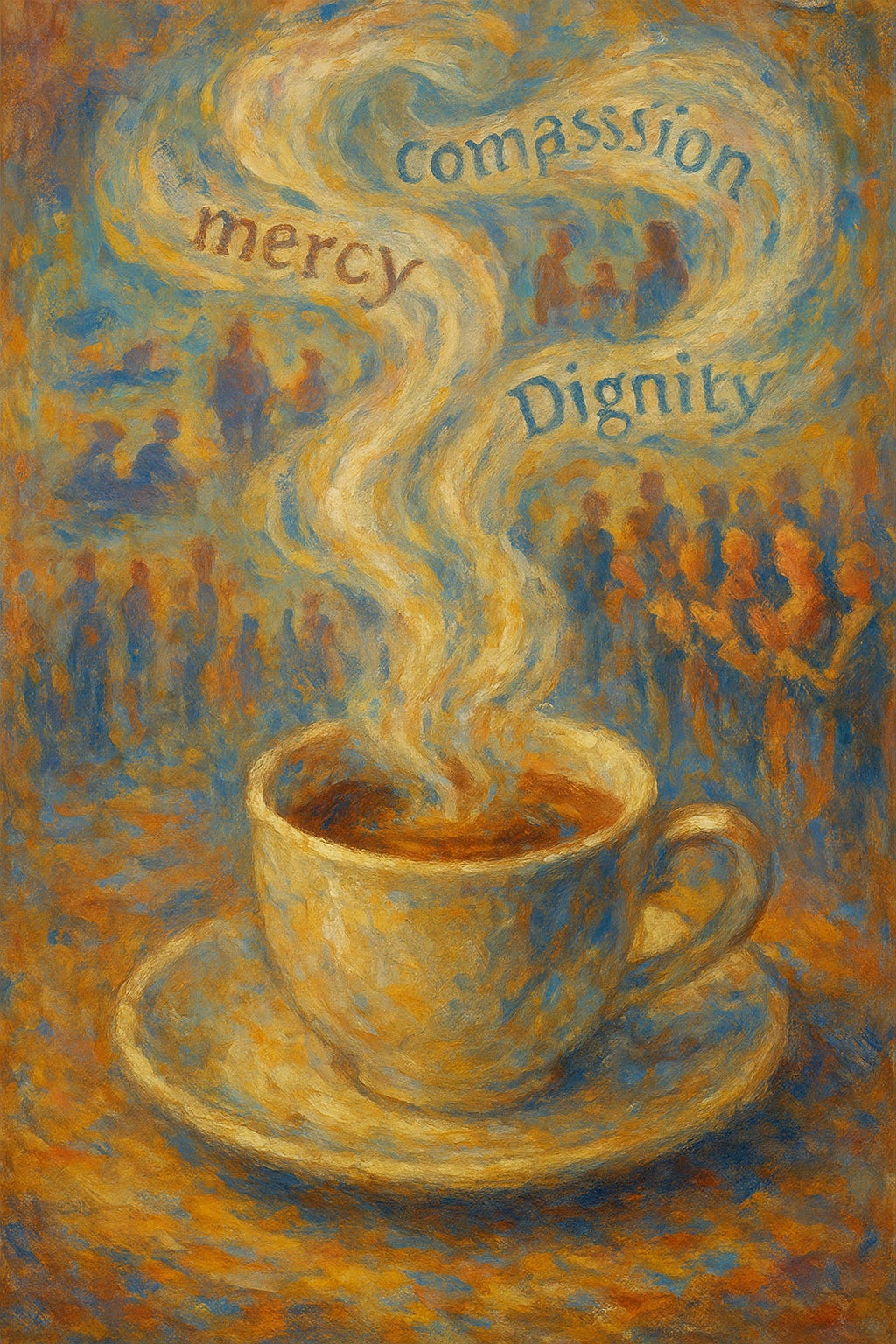
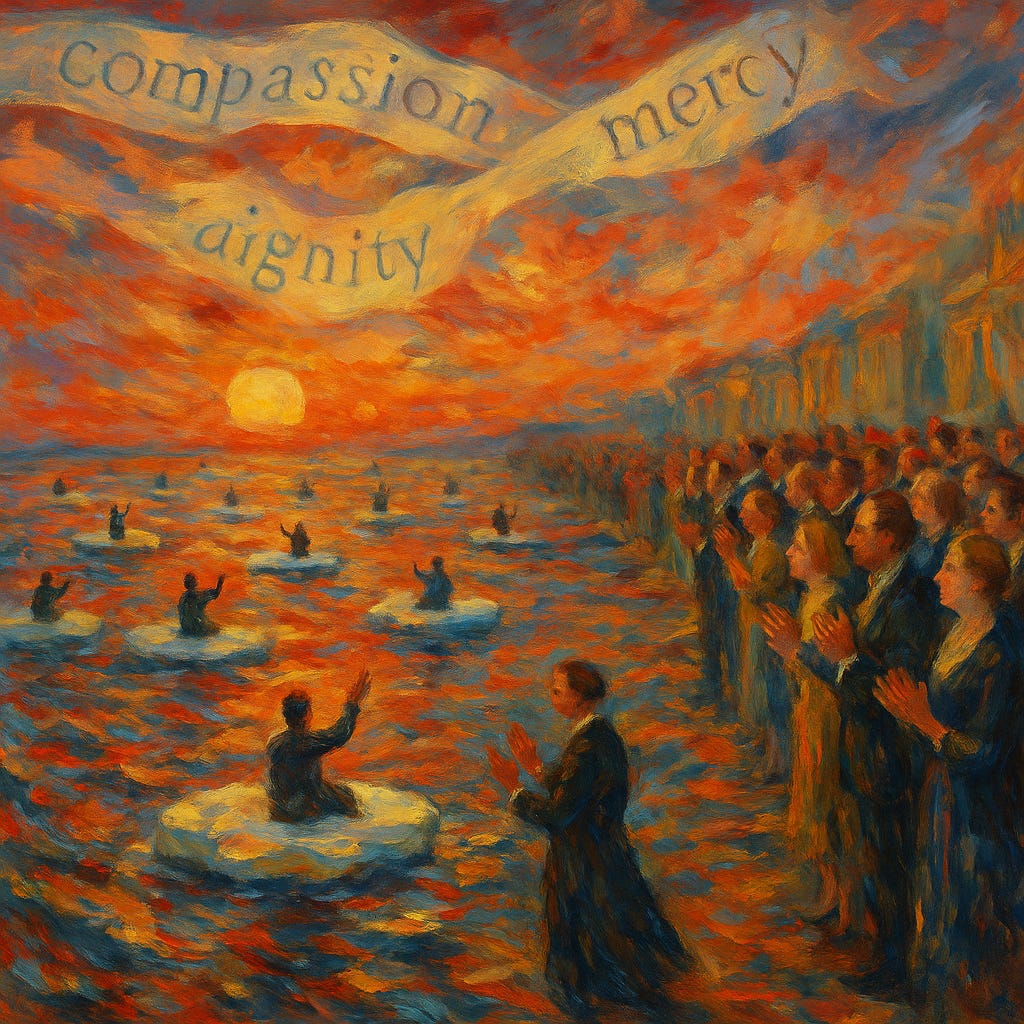
“The ice flow is not always forced; sometimes it is volunteered.”
We have long wrestled with the question of how a society should treat the dying, the suffering, and the vulnerable. Euthanasia—helping a person die to end intolerable suffering—is as old as human civilisation. In Sparta and other harsh polities, the weak and deformed were exposed or discarded, the individual sacrificed for the supposed health of the whole.
For most of history, life was short: in antiquity, the average life expectancy was barely into the 30s or 40s. Old age was rare, and with it came the temptation to view the elderly not as storehouses of wisdom but as surplus mouths. Some cultures, like among the Inuit, have legends of elders walking out onto the ice when they felt themselves a burden. Modernity stretched our lives into our 70s and 80s, and with antibiotics, anaesthesia, and ventilators came new agonies of survival — people living longer, but also lingering in pain, confusion, or dependency.
“The ice flow is not always forced; sometimes it is volunteered.”
Assisted Drifting
From last-resort compassion to first-resort convenience
It is against this backdrop that modern societies, beginning in the late 20th century, legalised euthanasia or assisted suicide under carefully circumscribed conditions.
In Canada, the euphemism is MAID (Medical Assistance in Dying). Legal since 2016, it permits either clinician-administered euthanasia or assisted suicide under conditions of “grievous and irremediable medical condition,” intolerable suffering, and reasonably foreseeable death. The public was told — and wanted to believe — that this was about mercy, autonomy, and dignity.
And sometimes, it still is. The terminal cancer patient in unspeakable pain, the neurodegenerative sufferer gasping their last in misery: these cases are not difficult to defend. To deny such people a controlled exit is not reverence for life; it is barbarism.
This condition we are calling stage one, when the patient is suffering, and death is forthcoming and assured.
But the danger is not in stage one. It is in what follows. Policies drift. Bureaucracies metastasise. Incentives whisper louder than principles. And so we arrive at what I call assisted drifting: the process by which a culture teaches its sick, its poor, its weary to shuffle toward the exit — not with a shove, but with a bureaucratic smile.
Canada’s numbers should jolt the conscience. In 2023, MAID accounted for 4.7% of all deaths. It would be higher for those over 75. One in twenty. In some provinces, the rate is higher still. That is not a medical anomaly. It is a national habit. And habits, once sanctified by paperwork, harden into entitlements.
If Canada’s sprint into the top tier of euthanasia states — again, 4.7% of all deaths — doesn’t make one pause, then what would? Speed alone should give us pause; the fact that we are now virtually tied with the Netherlands for liberalised killing ought to slow any sober-minded polity.
Yet the old refrain returns: “Trust the experts; we know what we’re doing.” Spare me. History shows that those exact words are the most dangerous thing a clinician can say.
Remember Semmelweis in Vienna, laughed out of the maternity ward for insisting that doctors wash their hands; remember thalidomide, once hailed as a miracle medicine, until whole limbs vanished into deformity; remember the mania for eugenics in Canada, not some crank on a street corner, but a movement endorsed by the learned classes.
In Alberta, the Sexual Sterilisation Act of 1928 remained on the books until 1972, during which sterilisation boards, armed with the blessing of cabinet ministers and the signatures of physicians, ordered the cutting of more than 2,800 people — mostly Indigenous women, the poor, the institutionalised.
In British Columbia, a parallel law sanctioned the same practice, justified in the language of “public health.” Canadian doctors and professors, those apostles of progress, spoke of pruning the “unfit” from the population as if humanity were a garden in need of weeding. Eugenics was taught in universities, funded by governments, and applauded in polite society; it was considered respectable, even forward-looking — science with its conscience surgically removed.
And the Germans noticed. Nazi legal scholars studied these Canadian statutes, along with sterilisation programs in California and Virginia, as useful precedents. The infamous Nuremberg Laws had a genealogy that ran through prairie legislatures and American statehouses.
Where Alberta sterilised thousands, Berlin sterilised hundreds of thousands — some 400,000 by 1939, under the Law for the Prevention of Hereditarily Diseased Offspring. Where Canadian doctors spoke of “mental defectives,” German physicians refined the vocabulary into lebensunwertes Leben — life unworthy of life.
The movement had its champions: Ernst Rüdin, the Swiss-born psychiatrist who became the Reich’s “father of racial hygiene,” preached sterilisation with evangelical fervour. At the Kaiser Wilhelm Institute for Anthropology, Eugen Fischer and Otmar von Verschuer used pedigrees, twins, and skulls to “prove” their hierarchies of human worth. It was the same pseudoscience, only with more jackboots and more funding. And what began with sterilisation metastasised into euthanasia.
Aktion T4 — the program of “mercy killing” for the disabled and mentally ill — murdered roughly 70,000 people by 1941, with buses retrofitted as mobile gas chambers and clinics piping carbon monoxide into sealed rooms. The techniques were then exported wholesale to Auschwitz, Treblinka, and Sobibor. Behind it all lay a philosophy chilling in its rationality: humanity as livestock, life as breeding stock, the state as farmer. Canada and California supplied the footnotes; Berlin supplied the efficiency.
Recall, too, the arsenic tonics and Fowler’s Solution peddled as panaceas, mercury chewed for syphilis until jaws and minds gave out, radium elixirs that irradiated rather than healed, laudanum handed out like a kindly sop while dependence and death accumulated in the margins, and the fashionable lobotomy, which left thousands reduced to docility in the name of progress.
And lest anyone be comforted by the antiseptic sound of modern hospital accounting, note this small, ugly reality: a clinician caught on video cheerfully describing gender transition surgeries — double mastectomies on healthy young breasts, hysterectomies, vaginoplasties, phalloplasties, the surgical remaking of bodies that were not diseased — as “huge money makers.”
And the institution, with a straight face, hurriedly assured the public that the revenue was “immaterial,” as if a multimillion-dollar line item could be dismissed with a mere mention of jargon.
One is asked to believe, with a straight face, that hospitals expand entire gender programs out of pure altruism, not because the procedures are billed in the tens of thousands apiece. They count the revenue quietly in back rooms while denouncing anyone who mentions it as a bigot.
This is the oldest hypocrisy in medicine: pretend it is about compassion, when in fact it is about cash.
Whether that isolated moment is evidence of systemic rot is arguable; the point that matters is simpler and less polite: hospitals run on budgets as well as ethics.
When the clinic’s ledger rubs up against the clinic’s conscience, incentives whisper. That does not prove venality across every operating theatre — but it does mean we should not be gullible when the same guardians who once recommended bloodletting now insist we must accept ever faster, ever broader permission to kill ourselves with a statute’s blessing.
So yes: a pause. Not because we don’t trust doctors, but because we should not be gullible about the infallibility of institutions that, across centuries, have been repeatedly humbled by their mistakes.
“Shut up, laypeople, and let us do what’s best” is a dangerous sermon when history shows the pulpit has long been used to sell poisons. If we are to meddle in life’s last and most consequential chapter, let it be with caution, scepticism, and a memory that will not be bullied into silence.
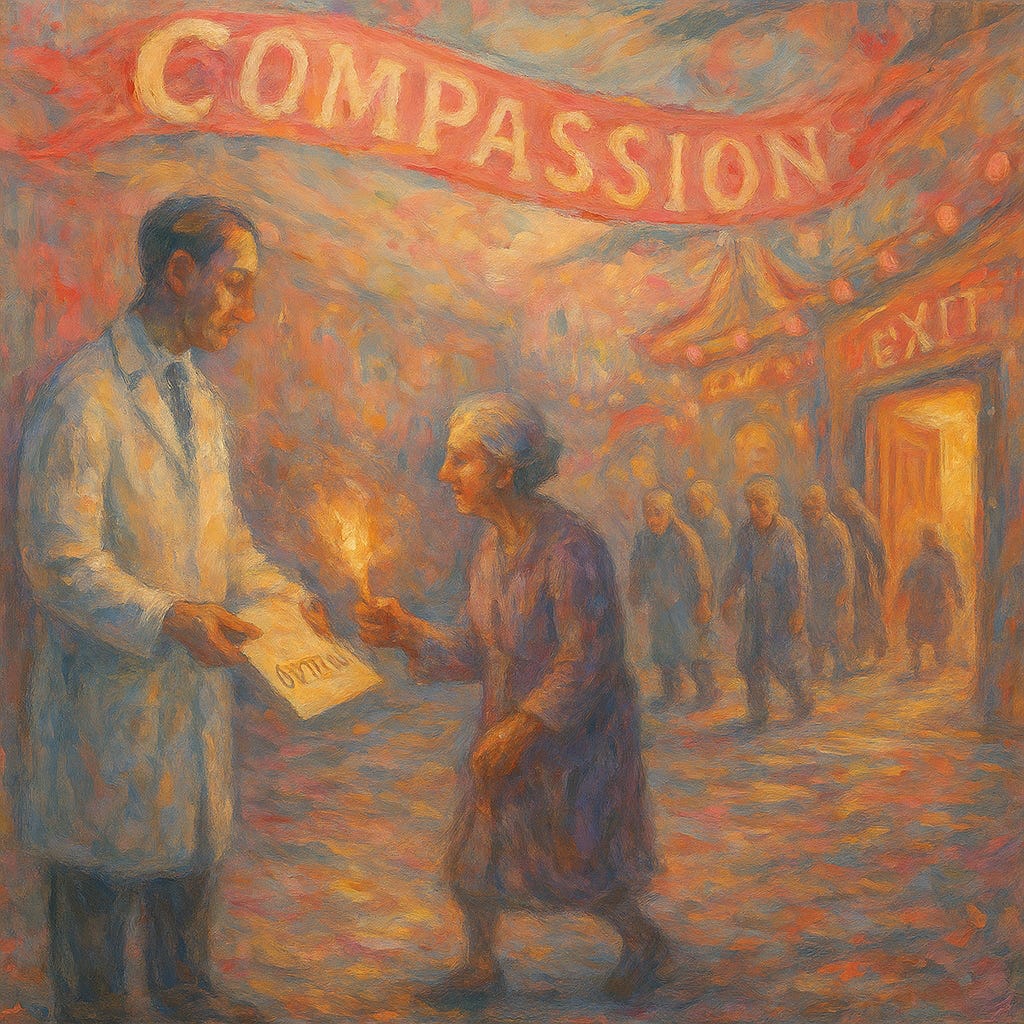
This condition we are calling stage one, when the patient is suffering, and death is forthcoming and assured.
Stage One: “Do you meet the strict qualifications?”
This was the case that seduced the skeptics: grievous, irremediable illness. Clear consent. Independent assessors. A waiting period. In theory, a process insulated from family pressures, from medical burnout, from administrative convenience.
In practice, this requires strict external gatekeeping. Assessors with no stake in the outcome. Proof that real alternatives exist — not brochures handed out like coupons, but appointments actually booked—screens for coercion, and for subtler cousins like guilt and fear.
If we mean “last resort,” we must act like it. This version of MAID is not an outrage. It is a grim concession to the limits of medicine, administered with the gravity of a death penalty for pain.
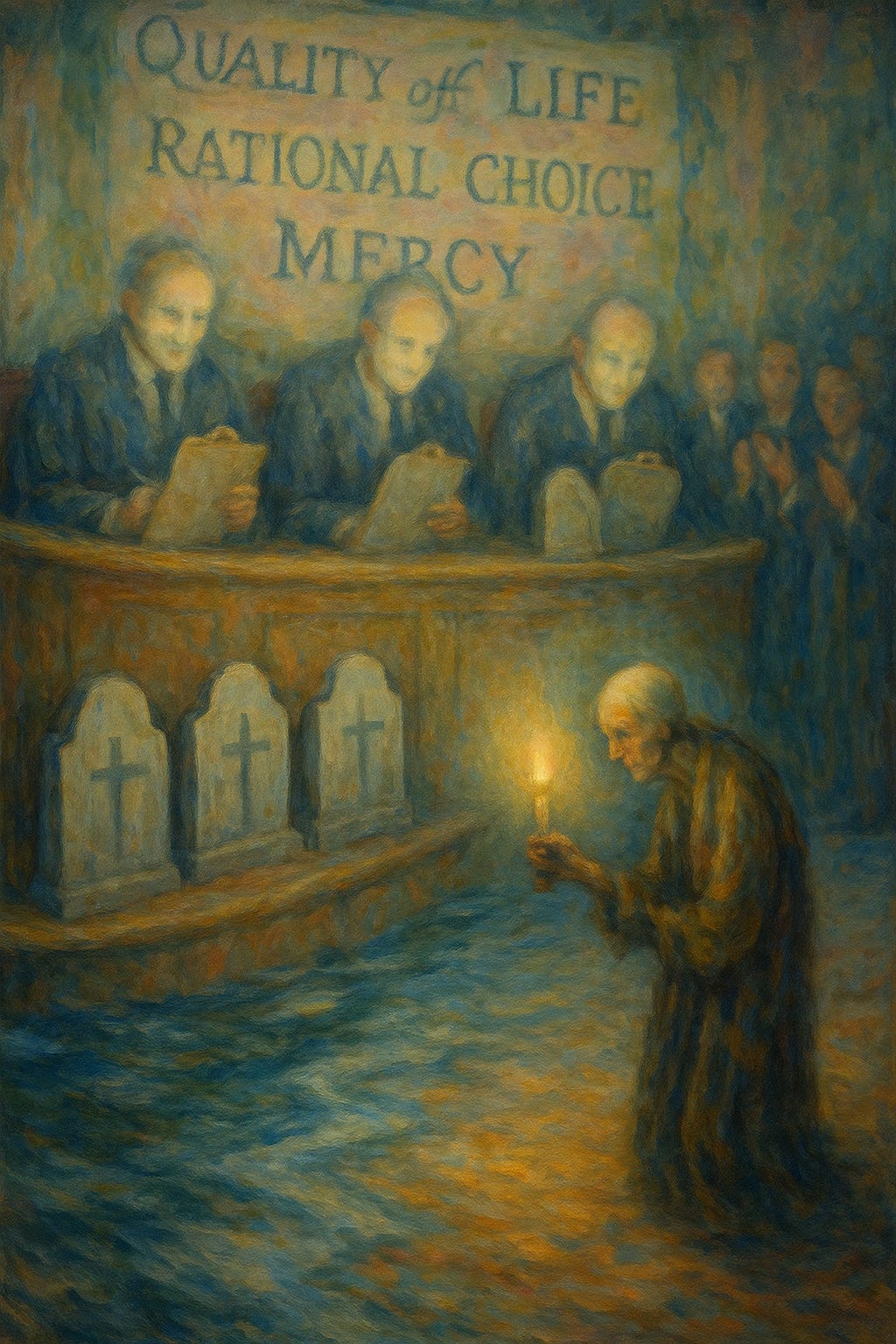
Stage Two: “Do you want to die?”
Here the slope begins. Once eligibility expands beyond the imminently dying, MAID ceases to be an emergency brake and becomes an option. And options in bureaucracies are never neutral. They appear on forms. They creep into discharge planning. They become part of the conversational repertoire of overworked clinicians who have beds to free and budgets to balance.
The question itself carries a freight of psychology: “Do you want to die?” It is not coercion in the crude sense.
It is not a shove, nor a demand. It is a suggestion — and suggestion, in moments of despair or weakness, can be more potent than command. A suggestion lingers in the room like a whiff of smoke: you may inhale it without knowing. The patient hears it not merely as information but as an evaluation of worth. “Perhaps,” they think, “my suffering is not just mine; perhaps it is selfish of me to remain.”
This is the sly genius of soft manipulation. Nobody says, “You ought to die.” Instead, the system trains patients to ask themselves the question until it feels like their own idea. A doctor raises it neutrally; a social worker frames it as “options”; a family member sighs across the dinner table; an administrator slips it into discharge planning — and soon the patient has internalised the suggestion as an obligation.
The inner voice becomes: “I should probably go. I’m costing too much. I’m in the way.”
The psychology is not mystical. Modern social science shows how priming and framing change choices by altering the mental context in which decisions are made. Prime people with words or images and their actions follow; frame a medical option one way and uptake shifts measurably.
Clinical trials and simulation studies demonstrate that the language clinicians use — neutral-sounding phrasing, comparative risk statements, and subtle rhetorical nudges — influences the outcome of end-of-life decisions. Framing comfort as “refusal of burdensome treatment” or invoking the impact on family changes what patients perceive as their duty and their right.
The empirical record in Canada is already telling. In the federal MAID data, nearly half of applicants report “perceived burden on family, friends or caregivers” among their reasons for requesting assistance in dying — a strikingly social, not purely somatic, motive. In the 2023/2024 reports, this figure continued to rise; in 2022, it had already become a dominant theme among reported reasons. These are not abstractions: they are people telling surveys that guilt and isolation pushed them toward death.
You know the anecdote as well as I do: a man in Ontario who applied for MAID because he could not obtain adequate disability housing — “I don’t want to die,” he said, “but I don’t want to live like this either. I feel like I’m making life harder for everyone around me.”
If a state cannot provide shelter, help with care, or a humane path to live with disability, the “option” of a quick, tidy death begins to look like a public-policy workaround for social failure. That is not compassion; it is administrative convenience posing as mercy.
Here lumbers the first elephant: cost. The cheapest death is the one that comes first. The final year of life is a disproportionate drain on health budgets — a concentrated, visible, and politically salient issue. Whether you measure the last 12 months or the last 24, expenditures spike, hospital use concentrates, and budgets are tight.
Officials do not need to instruct anyone to prefer death over costly care; the arithmetic of constrained resources does the whispering for them. When nursing care waits months for a bed and a lethal injection can be scheduled next Thursday, the “option” ceases to be neutral.
It becomes the only door anyone can realistically open.
We must name the mechanism. Psychologists call it a conversion of suggestion into obligation: framing, social context, and scarcity produce a moral calculus in which the agent becomes the judge of their own worth.
The obligation often arises from our sense of membership in a “we”—and from the fear of losing our cooperative identity within that “we.” Guilt is the lever. “Would you like to help your family?” becomes “You should help your family,” without anyone ever speaking the imperative aloud.
And then there is the economic and systemic pull. Hospital administrators know how many beds are freed by discharge; financiers know what revenue lines look like; program directors know which services are reimbursed promptly and which are never fully funded. When the system quietly counts the cost of long-term disability supports versus the relative administrative simplicity of a single MAID form, the incentive structure is obvious — even if unspoken.
The clinician who jokes on camera that certain procedures are “huge money makers,” and the institution that shrugs the revenue off as “immaterial,” are not anomalies; they are features, not bugs, of a system where budgets, billing codes, and scheduling realities shape what choices are available in practice. (One need not suspect every administrator of malice; the machinery itself produces outcomes.)
Take another look at how suggestions work in real-life cases. A neutral-framed question in a clinic — “Have you considered MAID?” — is a contextual seed.
Patients in pain, in poverty, in isolation, with carers stretched to breaking, will tend to hear that seed as an answer: “Yes, I suppose I should consider it.”
Family members, exhausted, unconsciously mirror relief at the mention.
The result is cruelly efficient. The patient’s “choice” comes not from an unconstrained deliberation among genuinely available alternatives, but from a bounded set of real options: long waits for nursing care, death on schedule.
And when death arrives with a signed consent form, the system applauds: no one pushed, no one forced — merely autonomous choice. The irony is naked: autonomy in a corridor of closed doors is merely a simulacrum1. It is a choice made amid scarcity and social expectation, presented as moral courage rather than survival calculus.
If this sounds like a conspiracy theory, it is not. It is a simple application of human psychology — priming, framing, and social obligation — to a healthcare system under strain. The records reveal a pattern: social reasons (burden, isolation) are major, clinical suffering is often not the primary driver, and administrative realities shape the options patients face.
The moral challenge is to stop excusing institutional failings by rebranding them as patient choices. The ethics of mercy become the ethics of cost-shifting unless we insist on robust support first.
Stage Two is the age of insinuation. It is where a question becomes a verdict, a suggestion becomes an internalised obligation, and a person walks to their death thinking it is their duty to family and society. And when the paperwork is signed, and the show of compassion applauded, no one needs to confess the structural cowardice beneath: we merely retell the story that he chose freely. That, more than anything, is the institutional magic trick — choice as absolution.
Stage Three: “Are you sure you don’t want to die?”
The option grows inquisitive. A clinician, striving for “comprehensiveness,” raises it. An exhausted relative mentions it “just to see.” An administrator, trained in implication, learns to suggest without suggesting.
This is how soft coercion works in modern states. It doesn’t come with a cudgel. It doesn’t come with a knock at midnight. It comes as a leading question in a sanitised room, with a professional tone of voice, tidy paperwork, and a plausible motive. In such environments, saying no begins to feel eccentric — as though one were resisting not death, but reason itself.
Here arrives the second elephant: obligation. The suffocating sense that one ought to go for the family’s sake, for the dignity of not being a burden, for the relief of a strained system. This is euthanasia by social psychology. We are teaching the frail to apologise for lingering.
It is the same old story in modern clothes: the gentle but inexorable pressure to step onto the ice flow, believing it is one’s duty to leave quietly, while no one on shore raises a hand to call them back.
Psychologists have a term for this: internalised coercion. It is the moment when suggestion mutates into duty. Nobody commands the patient to go, yet they begin to hear the command in the pauses of a conversation, in the sighs of a caregiver, in the casual bureaucratic reminder that “this is always an option.” The weight of guilt is a force.
Canadian reports confirm what intuition already tells us: many MAID applicants cite not unrelenting physical pain, but “loss of dignity” and “feeling like a burden” as reasons for their decision.
In 2022, more than 40% of MAID cases listed “burden on family or caregivers” as a primary motivator.
One woman with multiple sclerosis told a journalist, “I didn’t want to die, but I felt like I was holding everyone else hostage to my illness. It seemed selfish to stay.”
What is this, if not the transformation of suggestion into moral obligation? A culture where saying yes is rewarded with nods of compassion and neat administrative closure, while saying no is met with awkward silence, weary glances, and a quiet sense that one is imposing on others. The pressure is not overt; it is ambient. It is breathed in with every conversation until refusal feels like rudeness.
This is how cultures drift. What was once extraordinary becomes routine, and what was once a choice becomes an expectation. In the Netherlands, where euthanasia has been legal for decades, studies show that family fatigue and caregiver guilt often drive requests as much as pain itself. Canada risks following a similar trajectory: death not as an emergency concession, but as the “responsible” choice.
And here is the grim paradox: the more often dying is suggested, the more it begins to look like the civic duty of the sick. Not only are the frail apologising for existing, but they are also trained to imagine that ending their own lives is a gift to others. The patient no longer hears, “You can go if you want.” They hear, “Are you sure you want to stay?”
Thus, Stage Three is the age of insinuation. It is the point where refusal becomes defiance, where the vulnerable are made to feel selfish for surviving, and where the ice flow waits — no longer as myth, but as policy.
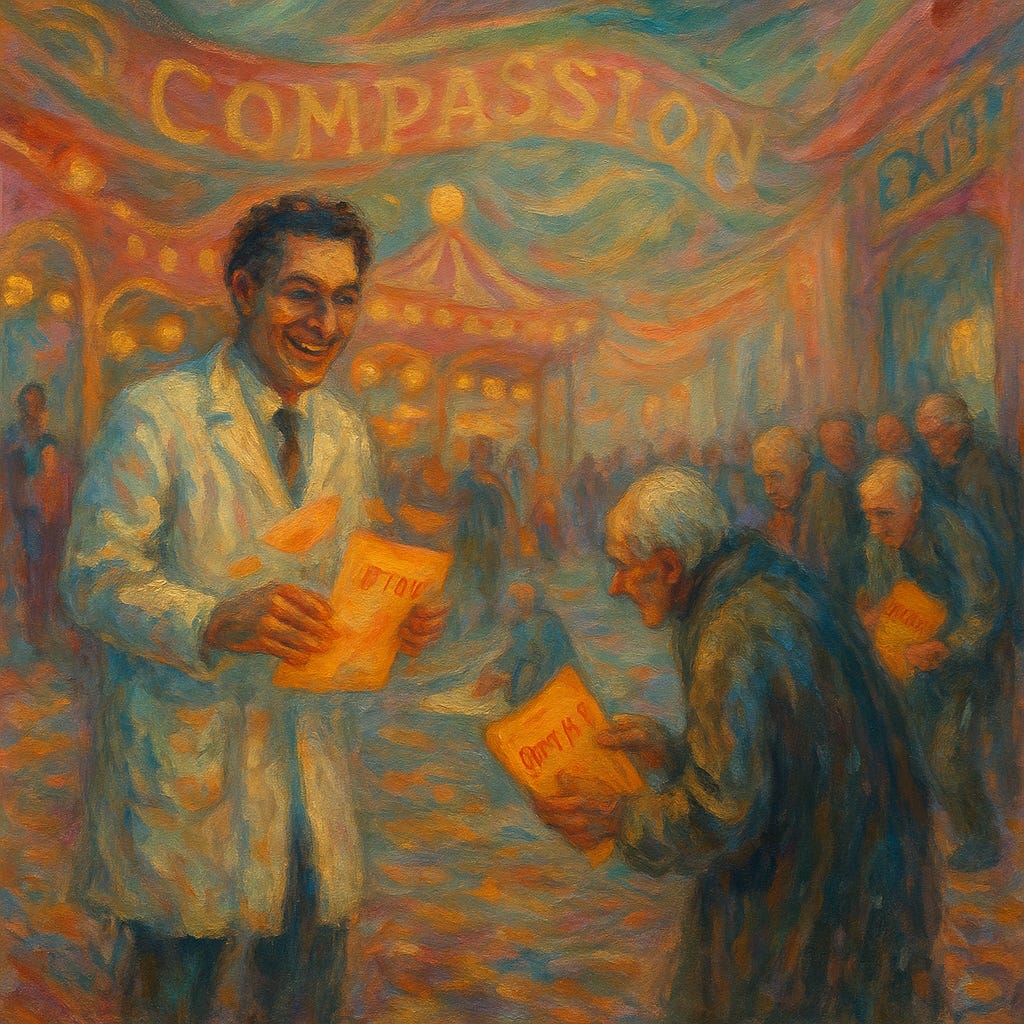
Stage Four: “Why are you alive?”
This is not dystopia; it is the logical endpoint. The culture that began with compassion ends with suspicion. To persist in living becomes the eccentric choice.
The logic is embalmed in soothing language: “quality of life,” “rational choice,” “realism.” But history should make us shudder. Canada embraced eugenics within living memory. Alberta and British Columbia sterilized the “unfit” under the banner of public health. In Nazi Germany, Aktion T4 — the bureaucratic killing of the disabled — was designed not by ghouls in basements but by professors, doctors, and administrators at the finest universities in Europe.
The lesson is not that we are Nazis. The lesson is that we are human. And humans — especially when educated, incentivized, and convinced of their own compassion — will slide downhill with terrifying ease.
At this stage, the question is no longer even posed. The silence speaks for itself. To continue living in advanced age or with disability is treated less as a choice than as a curiosity.
A patient who resists the drift is not congratulated for their resilience but quietly pitied, perhaps even resented. “Why are you still here?” becomes the unspoken refrain — not asked aloud, because that would be cruel, but pulsing underneath every strained family conversation, every budgetary meeting, every “case review.”
This is the point where the sick no longer feel merely guilty. They feel judged. Remaining alive is reclassified from a private right into public eccentricity. The culture, having absorbed the language of mercy, now regards survival as indulgence.
The ice flow is no longer offered as a choice; it is assumed as destiny. The elder who refuses to step onto it is seen not as courageous, but as obstinate, selfish, and unreasonably clinging.
The Mental-Health Elephant
Here arrives the proverbial elephant in the room: mental illness as the sole criterion. Today, Canadian law explicitly excludes MAID when mental illness is the only medical condition.
Parliament extended that exclusion in 2024, pushing the eligibility date to March 17, 2027. Until then, people suffering solely from depression, bipolar disorder, or schizophrenia are not legally eligible. However, barring another delay, they will soon be. And this is no minor technicality — it is the most dangerous frontier yet.
Psychiatrists themselves are sounding the alarm. The Centre for Addiction and Mental Health warns there is “no clear consensus on when a mental illness can be considered ‘irremediable’ for MAID purposes.”
The Society of Canadian Psychiatry has been blunter:
“A significant number of individuals receiving MAID for sole mental illness would have improved and recovered.”
They point out that suicidal thinking itself is a symptom, not a signal of competence, and that,
“Individuals with suicidal ideation symptomatic of mental illness cannot be differentiated from those seeking MAID for sole mental illness.”
In plain English, we cannot tell despair apart from decision. To allow MAID here is to confuse the suicide note with the consent form.
Dr Sonu Gaind, chief of psychiatry at Sunnybrook, put it starkly:
“When people are particularly at risk of suicidality, and it’s fueled by social isolation or marginalisation, feeling [like] a burden is really concerning.”
In other words, the very feelings that drive someone toward self-destruction are the ones that the state would validate as a rational medical request.
This is not autonomy. It is abandonment in therapeutic language. It is the cultural equivalent of telling the mentally ill:
“You are right. You are a burden. The noble choice is to die.”
And Canada would not be alone. Belgium and the Netherlands already permit euthanasia for psychiatric suffering under certain conditions.
Belgium recorded 370 deaths between 2002 and 2021 on psychiatric grounds alone — roughly 1.4% of all their euthanasia cases.
What began as rare, exceptional, and tightly controlled is becoming a normalised precedent. Canada, with its record-breaking rate of expansion, is poised to follow that path at double the pace.
Imagine the reality: people with treatment-resistant depression, bipolar disorder, schizophrenia, or PTSD being coached, even gently, toward death. No imminent physical decline. No terminal diagnosis. Just despair, loneliness, or social failure dressed up as “rational choice.”
One Ontario patient already described the drift:
“I don’t want to die. But I don’t want to live like this either. I feel like I’m making life harder for everyone around me.”
What happens when Parliament calls that logic compassionate?
The Final Inversion
Philosopher Ian Dowbiggin, writing on the history of euthanasia, noted that once societies redefine death as a rational, responsible act, those who reject it risk appearing irrational or irresponsible. That is where Canada now teeters. To accept MAID is seen as pragmatic, compassionate, and dignified.
To reject it — especially if one is poor, disabled, or mentally ill — is framed as a drain, a stubborn refusal to do the decent thing.
One man with ALS described the pressure bluntly: “
When I said I didn’t want MAID, the doctor looked at me as if I were naive. As if I didn’t understand the burden I was putting on everyone else.”
Stage Four is the final inversion: the moral tables turned so completely that survival itself must be justified. The patient must explain why they remain. They must apologise not only for their suffering, but for their existence.
And here is where the ice flow returns in its most chilling form. At stage one, it is a myth; at stage two, it is presented as an option; at stage three, it is suggested as a duty. But at stage four, the current carries you onto it whether you will or not. Nobody pushes. Nobody pulls. Everyone simply steps aside as you drift out to sea — and calls it compassion.
The Minimum Terms of a Moral Peace
If we are to prevent assisted drifting, the safeguards cannot be vague platitudes. They must be clear, enforceable, and understandable even to those who will never read a medical journal. Otherwise, what begins as mercy ends as management. Here are the minimum terms of any moral peace:
Independent gatekeeping.
No one should be both judge and participant in the decision to end a life. A patient’s own doctor, exhausted or conflicted, cannot be the sole arbiter of their care. Families, with their tangled loyalties and inheritances, are even less trustworthy. We need outside assessors with no emotional or financial stake in the outcome. Imagine a referee wearing the home team’s jersey; would you trust the outcome of the match? Yet that is how we allow the most final decision of all to be made.Proof that real alternatives exist and are underway.
It is obscene that you can book a lethal injection faster than a pain clinic appointment. “Offered nursing care” too often means “handed a glossy pamphlet.” No. The bar must be higher: treatment is scheduled, support is delivered, and appointments are underway. If a man with crushing depression asks for death, but can’t even get an intake date with a psychiatrist, that is not mercy — it is abandonment in a syringe.Teeth against coercion.
Coercion doesn’t always stomp in boots. More often it sighs across a dinner table: “Maybe it’s for the best.” The frail internalise guilt like oxygen: I’m costing too much. I’m in the way. I should go. That is not a choice; it is moral blackmail. Pressure from families, clinicians, or even culture must be treated as abuse, with criminal penalties attached. Otherwise, we teach the vulnerable that continued existence is selfish.
A red line against mental illness as the sole criterion.
This is the frontier of the obscene. Despair is not consent. To validate suicidal ideation as a rational “choice” is to confuse the suicide note with the consent form. Picture a 25-year-old with depression: today, he sees no future, but with treatment, he could live 60 years more. A society that offers him euthanasia instead of help is not compassionate. It is wicked.
Fear as Clarity
None of this assumes cartoon villains. It assumes what history shows again and again: people, especially when gathered in committees, tend to opt for the lazier option while congratulating themselves on their compassion.
Canada can maintain a narrow, defensible margin of mercy. However, it will not survive on sentiment alone. Systems obey incentives. Cultures absorb examples. Already, one in twenty deaths is by appointment. The burden of proof now lies with us to demonstrate that mercy has not become a management tool.
And let’s not delude ourselves. Panic blinds; fear clarifies. If MAID is allowed to creep, it will not politely stop. It will slide until the obscene question becomes routine: Why are you still here?
At that point, no one will need to apply force. People will simply feel in their marrow that staying alive is indulgent. A culture that normalises this will not call it cruelty. It will call it compassion.
It will resemble the ancient ritual in modern guise: the elder stepping onto the ice flow, convinced it is noble to drift away, while those left on shore learn to call abandonment love.
And that, as Hitchens might have said, is where the true evil begins — not in the scream, but in the soothing, respectable, murderous whisper. And if we fail to resist, we will watch the ice flow drift away, carrying those who believed it was their duty to leave, while we on the shore convince ourselves we are civilised.

If you value this work, consider leaving a tip. It’s cheaper than therapy, less pious than public broadcasting, and the only censorship here is my bad taste. On second thought, it’s bad therapy.
It is an imitation that pretends to be real, even when the real thing is absent or destroyed.
From Latin simulacrum: image, likeness, phantom, idol.
Historically: a statue, effigy, or false appearance.
The term is most famously developed by Jean Baudrillard, who argued that in modern societies we increasingly live among simulacra—symbols and narratives that no longer describe reality but manufacture it.
I see strong parallels between the wicked coercion by purported health professionals, administrators, and bureaucrats in the context of MAID and what happened five years ago with the mandating of “vaccinations“ and demonization of anyone with second thoughts, regardless of their reason (including the millennia old proven belief that in 2021 suddenly became superstition, namely that recovery from viral infection generally confers decades if not lifelong natural immunity), making all out to be selfish “grandma killers”, not to mention “mostly racists and misogynists” who “shouldn’t be tolerated”, you know, for deigning to exercise their bodily autonomy under the Nuremberg Code (the audacity!), while endangering no one, especially the “vaccinated” if in fact the jabs stopped infection and transmission as initially represented by the makers, marketers, media and regulators of these “miracle drugs”…with no long term efficacy or safety data.
In both instances there was and still is a depraved indifference not just to “my body, my choice” (unless of course it involves terminating a developing human life form - see: “Eugenics”, ”Planned Parenthood and “irony”), but to the sanctity of life generally, stemming largely, in my observation, from the loss of religion (particularly Christianity) by a strong plurality if not majority of people in the west over the past 50+ years whose morality likewise went MIA as a result. Unless and until more people discover/rediscover their individual spark of divinity, the more I fear we’ll see even more people unable to recognize humanity in themselves and consequently others, including the widow and the orphan, and those suffering perpetual emotional and psychological torment many of whose lives could be improved and saved if offered alternatives to MAID.
I believe with all my heart all of this.