



The smoke that rose from Nöam, the Jewish-owned restaurant in Montreal, its façade charred by firebombing, is material witness to a reality that our public discourse works overtime to obscure.

To say, “This isn’t Canada,” is no longer true. That is precisely the problem. This is Canada.
For three consecutive years, Canada has set new records for antisemitic incidents. B’nai Brith Canada’s Annual Audit documented 5,791 incidents in 2023, 6,219 in 2024, and 6,800 in 2025—the highest numbers ever recorded since national tracking began in 1982.
What was once extraordinary has become routine. Jewish schools have been shot at. Synagogues have been firebombed. Jewish businesses have been attacked. Children now pass armed security guards on their way into classrooms.
Some Jewish organizations and commentators have described Montreal as the antisemitism capital of North America.
This is not the Canada many Canadians imagine themselves to inhabit. It is the Canada they have permitted to emerge.
A nation does not become what it tolerates overnight. It becomes what it repeatedly excuses, repeatedly minimizes, and repeatedly refuses to confront.
It is joined in evidence by torched school doors, security guards posted outside synagogues, and polls showing a Jewish population increasingly afraid to wear the emblems of its identity in public.
For the moment, we are apparently to regard it as an extraordinary coincidence. Jewish schools are vandalized. Jewish synagogues are attacked. Jewish community centres are targeted. Jewish businesses are damaged. Now a kosher restaurant is set on fire. Yet we are invited to assume that each incident exists in splendid isolation, unrelated to the others, and that no broader pattern should even be contemplated.
Perhaps Jewish institutions simply suffer astonishingly bad luck. Perhaps those setting out to throw bricks, fire shots, or commit arson possess no particular interest in Jewish targets whatsoever. They merely wander the streets at random, and probability, with uncanny consistency, delivers them to Jewish schools, synagogues, community centres, and businesses.
If that explanation strains credulity, it is because it should.
We do not yet know who set fire to this particular restaurant, nor what motive drove the act. No innocent person should ever be judged guilty because of his religion, ethnicity, or membership in a statistical category. One unresolved criminal investigation, though, cannot erase the established rise in antisemitic incidents or the broader body of evidence concerning antisemitic attitudes.
The broader evidence is not obscure. Survey after survey records markedly higher levels of antisemitic belief in most Muslim-majority societies, and the countries and territories at the top of the ADL’s antisemitism index are overwhelmingly Muslim-majority.
The West Bank and Gaza—the sentimental darling of so much of the Western Left—records an antisemitism rate of 97 percent. Yet this infantile evasion has become compulsory. Unless every member of a group shares an attitude, we are told that no pattern may be discussed at all.
Correlation must be denied, evidence must be blurred, and anyone who notices what the surveys plainly reveal must be accused of Islamophobia. The accusation functions not as an argument but as a fire alarm: discussion stops, everyone evacuates, and the underlying facts are left comfortably untouched.
It is against this background that Mark Carney assures us that “Islamic values are Canadian values.”
Which Islamic values, precisely? Those held by peaceful, law-abiding Muslims who accept pluralism, equality, and freedom of conscience? Certainly. But those values are not uniquely Islamic; they are the liberal democratic principles to which every Canadian should be expected to conform.
The more difficult question is whether Canada and the West in general should also be expected to avert its eyes from the documented currents of antisemitism, religious supremacism, and hostility to liberal society that exist within parts of the Muslim world and among some of its ideological movements.
But apparently, even raising the question is indecent.
The principal accelerants feeding contemporary antisemitism are to be discussed without naming them. We may speak endlessly of “hate,” “division,” and “intolerance,” provided we never inquire too closely into who is propagating them or what doctrines are being invoked. We are permitted to condemn the smoke, but forbidden to identify the fire.
And so a convenient vocabulary has been devised. The offenders are not Muslims but “Islamists,” a supposedly self-contained species with no meaningful relationship to Islam, Islamic texts, Islamic history, Islamic institutions, or political movements that openly describe themselves as Islamic. The distinction can be useful when it separates peaceful believers from ideological extremists. It becomes absurd when it is used to declare that an avowedly Islamic political ideology has no connection whatsoever to Islam.
This is not tolerance. It is enforced incuriosity. It is also a lie.
It is the kind of comfortable, self-serving falsehood that polite society tells itself as the foundations of its own civilization begin to tremble.
In the tradition of those who prefer hard truth to soft comfort, we must be willing to say what is demonstrably the case: that the dominant source of the new antisemitism in Canada, the United Kingdom, and Europe comes from Muslim communities; that it is driven by an ideology with deep roots in scripture and history; and that our relentless policy of appeasement is not merely failing—it is a species of cowardice masquerading as virtue.
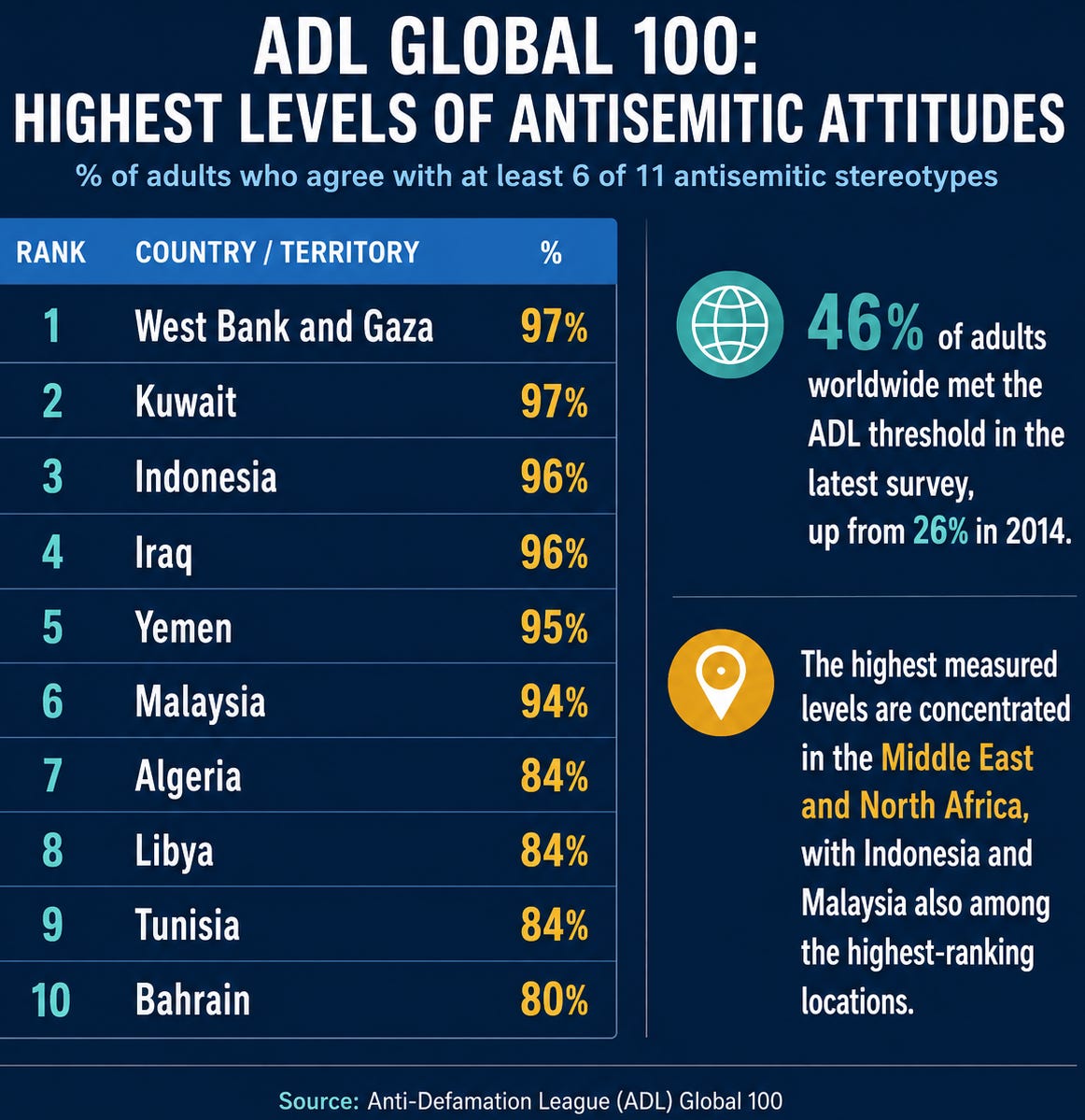
The Polling Data: An Inconvenient Empirical Reality
The evidence for this assertion is not anecdotal, nor is it drawn from the fevered imaginations of bigots. It is the product of rigorous, repeated, and eminently verifiable polling. The data force us to confront an uncomfortable reality: significant minorities, and sometimes majorities, of Muslim populations in the West hold views profoundly at odds with the foundational principles of liberal democracy.
And do we think that those who come from countries where Jew hatred dominates somehow have a road to Damascus moment as they move through airport immigration? Does the mere vibe of our Western liberal values move them to repentance and a new acceptance of the Jews, Christians and non-Muslims in general?
In the United Kingdom, polling has consistently found that substantial minorities of British Muslims support the introduction of Sharia law in some areas of Britain. Surveys have shown that roughly one-third regard the implementation of Sharia within twenty years as desirable, compared with only a fraction of the general public. Support for criminalizing depictions of the Prophet Muhammad has reached majority levels in some polls, while roughly one-quarter of British Muslims have viewed violence as a legitimate response to such acts.
The picture on antisemitism is equally stark. In Western Europe, surveys have found that nearly one-third of Muslims hold dominant antisemitic views, a figure that climbs to well over forty percent in certain regions and among particular demographics. Polling has found that only one-quarter of British Muslims accepted that Hamas committed murder and rape on October 7, compared with nearly two-thirds of the general public, while sympathy for Hamas reached approximately forty-six percent in the same poll.
“But it is not a majority of Muslims,” comes the familiar reply. That may be true.
But the assumption that a movement must command majority support before it can dominate institutions, intimidate opponents, or transform a culture is historically false. Organized minorities have repeatedly prevailed over larger populations that were divided, complacent, frightened, or unwilling to resist.
The Chinese Communist Party offers a striking example. At its founding congress in 1921, it had only about 57 members. Even by 1949, as it was taking control of a country of more than 500 million people, the party had roughly 3.3 million members—well under one percent of the population.
Its strength lay not in majority membership, but in organization, ideological discipline, military power, and its ability to exploit the weakness and division of its opponents.
These figures do not describe a fringe. They describe a substantial ideological bloc—and history shows that such movements do not require majority support to dominate a society.
Hitler’s Nazi Party never won a majority in a free national election; at its electoral peak in July 1932, it received 37.3 percent of the vote, yet exploited institutional weakness, intimidation, and the passivity of its opponents to seize power.
The central lesson of history is clear: a disciplined, vocal, and institutionally protected minority can reshape the conduct of a much larger but hesitant majority. Numbers matter, but organization, confidence, ideological commitment, and control of institutions often matter more.
Ruud Koopmans’ multicountry survey of Germany, France, the Netherlands, Belgium, Austria, and Sweden found religious fundamentalism far more prevalent among Sunni Muslims. Roughly forty-four percent consistently endorsed returning to the roots of the faith, the existence of one correct interpretation of the Quran, and the supremacy of religious rules over national law—compared with fewer than four percent of Christians.
In France, data indicate a rising tendency among younger Muslims to prioritize Sharia over republican law, with a majority of fifteen-to-twenty-four-year-olds in one study taking this position.
In Canada, polls show markedly lower acceptance of homosexuality and same-sex marriage among Muslims than among the general population.
The Pew Research Center’s global data, covering many Muslim-majority countries, found median support for Sharia as official law at seventy percent or higher in South Asia, the Middle East, North Africa, and Southeast Asia. Substantial proportions of Sharia supporters endorsed death for apostasy—including majorities in Egypt, Pakistan, and Afghanistan—as well as severe corporal punishments.
These are not merely the opinions of “extremists.” They are mainstream views among a significant portion of the global Muslim population.
Since September 11, 2001, the overwhelming majority of people killed by terrorist organizations around the world have been killed by groups acting in the name of Islam. Depending on the database and methodology used, estimates generally place the figure well above 80 percent and, in many analyses, close to 90 percent.
Doctrine and History: The Problem Is in the Texts
The claim that all of this is a modern political invention, cynically labelled “Islamism,” is a convenient fiction—a distinction without a meaningful difference. Classical Islamic sources and the four major Sunni schools, along with major Shia traditions, treat apostasy by an adult male as a capital offence, grounded primarily in hadith—for example, the saying recorded in Bukhari: “Whoever changes his religion, kill him.”
Homosexual acts, particularly male penetrative acts, are condemned through the Quranic narrative of Lot and through hadith prescribing severe penalties—death in some schools and lesser corporal punishment in others.
Early Islamic expansion involved military conquest, the imposition of the jizya poll tax upon non-Muslims living under dhimmi status—protected but subordinated and subject to restrictions—and incentives and pressures toward conversion. Forced conversion of pagans occurred. People of the Book were generally permitted to remain, but under inferior status. Apostasy was often treated as political betrayal of the community.
The political project of establishing a global caliphate governed by Sharia is not an aberration. It is a consistent, if not the most literal, application of the faith’s foundational texts. The Muslim Brotherhood, the grandfather of modern Islamic movements, laid out this strategy for North America decades ago.
The document “An Explanatory Memorandum on the General Strategic Goal for the Group in North America” was written in Arabic in May 1991 by Mohamed Akram (also known as Mohamed Adlouni), a senior Muslim Brotherhood official in North America.
The memorandum became public after it was discovered in the Muslim Brotherhood’s North American archives and was later introduced as evidence in the U.S. government’s prosecution of the Holy Land Foundation for Relief and Development.
The document listed organizations established in North America to advance this plan, including the Islamic Society of North America, the Muslim Student Association, the North American Islamic Trust, and the Council on American-Islamic Relations.
This is not a conspiracy theory. It is a documented strategy, translated from Arabic and entered into evidence in a federal terrorism trial. The plan calls for “settlement,” “establishment,” “stability,” “empowerment,” and “rooting”—a program intended to make Islam “part of the nation,” “stable in its land,” “rooted in the souls and minds of its people,” and “empowered over the life of its society.”
To ignore this is not intellectual sophistication. It is wilful blindness.
The “Few Bad Apples” Lie
This brings us to a central lie of our age: the “few bad apples” argument. It allows us to dismiss Bondi Beach, the beheading in France, the many murders in Britain, or the synagogue attack in Manchester as the work of deranged individuals who have somehow “perverted” a religion of peace.
Yet this is an indefensible position. If we are to believe, as we are constantly told, that “Muslim values are Canadian values,” then we are either hopelessly naïve or deliberately mendacious. If the core tenets of a faith call for the subjugation of women, the punishment of homosexuals, and the eventual dominion of the world under a single religious law, then those tenets are not compatible with a secular, pluralistic, and democratic society.
The problem, then, is not merely the violent actors. It is the ideology that sanctions, enables, and inspires them.
Even if the attack on the Montreal restaurant were not an act of antisemitism—even if it were merely vandalism—must we really rehearse the entire catalogue?
The seniors’ home surrounded by pro-Palestinian thugs. The Montreal CF soccer match where the presence of a professional Israeli soccer player on the New England side brought about chants from the fans of “Death to Israel!” The schools struck by gunfire. The chaos in the streets.
In Montreal, a kosher restaurant and surrounding businesses were vandalized with swastikas only days after gunfire targeted a synagogue in Toronto. These are not isolated incidents. They reflect a dangerous reality: antisemitism is escalating, and Jewish communities are being targeted simply for living openly as Jews.
Appeasement and Its Fruits
The response of our political and cultural elites has been a chorus of grovelling and accommodation. The charge of “Islamophobia” has been weaponized to silence criticism of the religion itself, collapsing the distinction between bigotry toward individuals and legitimate criticism of a coercive ideology.
This is not a strategy for integration. It is a strategy for surrender. It encourages institutions—from schools to police forces—to censor themselves for fear of accusations of racism. When a government creates official definitions of “anti-Muslim hate” that function as de facto blasphemy laws, it is not merely protecting a minority. It is constructing a privileged sphere of immunity around an illiberal ideology.
British government guidance treats the possibility of offending Muslims as a constraint upon school activities. Anti-Muslim hate crimes are twice as likely to be prosecuted as antisemitic ones. Discussion of the grooming gangs—the Rotherham inquiry documented the exploitation and sexual assault of approximately 1,400 children between 1997 and 2013—has repeatedly been hampered by fear of accusations of racism and Islamophobia.
We are not supposed to say how, in many areas, most of the rapes were committed by ethnic Muslim Pakistani offenders, with many times the offenders saying explicitly that their religion gave them the right to violate young white “kaafir slags.”
British police, though, often avoid recording data about ethnicity and religion.
This is the real-world cost of appeasement. When fear of being labelled “Islamophobic” prevents authorities from investigating crimes committed in the name of Islam, the victims are not Islamophobes. They are women, young girls, and Jewish citizens.
Weak politicians are so afraid of losing the Muslim vote, and so addicted to the dopamine rush of moral superiority they gain as they apply selective - and thus anti-Semitic- standards against Israel, that they refuse to confront a society visibly coming apart.
Over 60% of Reform voters in the United Kingdom, and others surveyed, believe that civil war is coming, driven by violence, the social fracture produced by waves of Muslim immigration, the grooming gangs, and the refusal of many newcomers to accept and observe British values.
The people, thankfully, are often wiser than their politicians. They see the changing demographics of their neighbourhoods. They see the effect of intimidation at pro-Palestinian marches, the creeping restrictions on what they are permitted to say, and the double standards in law enforcement.
They also see public spaces - including Westminster Abbey grounds - increasingly commandeered for large Islamic demonstrations—roads blocked, civic squares occupied, turned into stages for mass prayer.
The transition should not claim that religious commitment automatically equals civic disloyalty. The stronger argument is that liberal democracy faces a genuine problem when a substantial minority seeks to give religious commands legal authority over speech, conscience or civil law.
Whatever the private sincerity of individual worshippers, prayer conducted on this scale, in politically charged settings, is no longer merely a private act of devotion. It becomes a public assertion of presence and power—one that many surrounding citizens understandably perceive as carrying the message: we are here, and you will make way.
A pluralist society cannot survive if one group’s public display is treated as sacred while everyone else’s discomfort, history and equal claim to the public square are dismissed.
The question, however, is larger than the use of one street or the obstruction of one public space. It concerns the terms upon which a liberal democracy receives people formed by religious and political traditions that do not always share liberal democracy’s assumptions.
Theocracy and liberal democracy are not merely different arrangements of government. They begin from opposing premises. Theocracy places revealed authority above public argument; liberal democracy places laws under continual scrutiny by free citizens.
Theocracy asks what God has commanded; democracy asks what equal citizens may legitimately impose upon one another. Where religious law is treated as supreme, freedom of expression, freedom of conscience, equality between believers and unbelievers, and the right to leave or criticize a faith cannot remain secure.
It is therefore not bigotry to ask whether newcomers accept the constitutional order of the country they have entered. It is one of the elementary questions any self-respecting civilization must ask.
The polling does not permit the comforting claim that this tension is imaginary.
A major 2016 survey of more than 3,000 British Muslims found that 41 percent supported introducing “particular aspects” of sharia in place of British law. An older British survey found that 28 percent preferred living under sharia law, compared with 59 percent who preferred British law; among respondents aged 16 to 24, support for sharia rose to 37 percent.
More recent polling in selected British areas suggests that the conflict is not confined to abstract constitutional theory. In that survey, 52 per cent of Muslim respondents supported criminalizing public depictions of Muhammad, compared with 17 per cent of the general population; 63 per cent supported criminalizing the burning of holy books, compared with 37 per cent of the public; and 24 per cent regarded violence as potentially legitimate in response to burning the Qur’an or depicting Muhammad, compared with 10 percent of the wider sample.
The same recent British research found that 63 percent of its Muslim respondents ranked religious identity first, compared with 12 percent of the general population.
That is precisely why the usual incantation—“not all Muslims”—is so intellectually useless.
Of course not all Muslims hold the same views. No individual should be condemned for the opinions of a co-religionist, and religious identity is not evidence of individual guilt.
But social analysis becomes impossible if every measurable pattern must be denied until it applies universally.
Cigarettes do not kill every smoker; that does not make tobacco harmless. Not every adherent of a religious tradition favours theocracy; that does not require us to pretend that substantial support for religious restrictions upon law, speech and conscience is irrelevant.
The Economist Intelligence Unit’s current index does not classify any Muslim-majority country as a full democracy. Some possess competitive elections and meaningful political pluralism; others are hybrid regimes or dictatorships.
The point is not that Muslims are biologically or permanently incapable of democratic government—an absurd and indefensible proposition. It is that liberal democracy is historically unusual, culturally demanding and institutionally fragile. It cannot safely assume that everyone arriving beneath its protection already understands, accepts or values the principles that made that protection possible.
And here the Western frog sits serenely in the warming water. We do not merely tolerate mounting antisemitism while refusing to identify its ideological sources.
We increasingly permit the principles that would enable us to resist it—free speech, equal citizenship, secular law and freedom from religious coercion—to be chipped away in the name of avoiding offence.
The accusation of Islamophobia is then deployed not merely against hatred of Muslims, which deserves condemnation, but against scrutiny of Islamic ideas, organizations and political demands. The worst actors are thereby granted the most useful immunity imaginable: a frightened society that refuses to describe them.
This helps neither Muslims nor the West. It abandons liberal and reformist Muslims to the very clerics, activists and communal enforcers most determined to speak in their name. It tells those who accept democracy that their courage is unnecessary, while teaching those who oppose it that intimidation works. A society unwilling to distinguish between protecting Muslim citizens and protecting Islamic doctrine will eventually fail at both.
That is the necessary prelude to any defence of the West—not because the West is racially superior, morally immaculate or incapable of barbarism, but because its central political inheritance is worth defending.
Common people know that Western culture is a thing. It is chiefly our so-called elites who appear embarrassed by the admission. It is a glorious, messy, imperfect and relentlessly self-critical inheritance stretching from Athens and Rome, through Jerusalem, the Magna Carta, the Renaissance, the Reformation, the Enlightenment, the common law, and the hard-won conviction that every individual stands equal before the law. It is not a blank slate, and it did not materialize out of nothing.
Nor did these principles emerge naturally. For most of human history, they were astonishing exceptions. The normal condition of mankind has not been liberty but servitude; not democracy but autocracy; not freedom of conscience but enforced orthodoxy; not equality before the law but privilege, caste, tribe and arbitrary power.
Liberal institutions are difficult to build, easier to imitate than to practise, and remarkably easy to destroy. Their scarcity should make the West more protective of its inheritance, not less.
Those liberties were not bestowed by fate. They were argued for by philosophers, defended by reformers, codified by jurists, expanded by abolitionists and suffragists, and preserved at immense cost by generations willing to fight—and, when necessary, to die. The cemeteries of Europe, North Africa and Asia bear silent witness to the price paid to defeat fascism, militarism and totalitarianism. Millions shed their blood so that free societies governed by law rather than arbitrary power might endure.
We should not apologize for this inheritance. We should preserve it. History’s overwhelming lesson is that liberty is not the natural state of civilization. It is an achievement—rare, fragile and purchased at extraordinary cost.
The Fables That Warn Us
Appeasement has never worked. Winston Churchill, who understood the nature of the totalitarian threat before it became fashionable to do so, warned that “an appeaser is one who feeds a crocodile—hoping it will eat him last.” He knew that one cannot stroke a tiger into becoming a kitten. He knew that the choice was between war and dishonour, and that to choose dishonour was merely to choose war later.
The other fitting story is that of the Scorpion and the Frog, an old fable that has appeared in various forms over the centuries.
A scorpion asks a frog to carry him across a river. The frog hesitates, reasonably enough, because the scorpion may sting him during the crossing, in which case the frog will die. The scorpion reassures him that he would never do such a thing, since it would cause them both to drown. Persuaded by this logic, the frog agrees. Yet midway across the river, the scorpion stings him anyway. As they begin to sink, the dying frog asks why. The scorpion replies that it is in his nature.
The lesson is not merely about the inherent evil of man. It is about hope placed in defiance of evidence. Trusting a predator to overcome its own nature is an optimism doomed from the beginning.
Islam is as much a program of imperial expansion and political strategy as it is a handbook by which the individual seeks a relationship with the divine. What we are witnessing in the growth of antisemitism, and in the war and slaughter of Christians in Nigeria, is not the work of a few bad apples. It is the nature of the holy writ being permitted to take root and flourish.
So it is with the ideology confronting us. The Muslim Brotherhood’s documents tell us exactly what its adherents intend. Their speeches and manifestos call for the elimination of Jews and other non-Islamic faiths, and for a world dominated by Islam. They tell us that they intend to prevail.
And we, like the frog, persuade ourselves that if we are only kind enough, accommodating enough, and willing enough to carry them across the river, they will not sting us.
We are wrong.
The Central Failure
The long-term answer cannot be collective blame. Nor can it be endless reassurance that every violent Muslim is an inexplicable aberration with no meaningful relationship to any doctrine, preacher, or institution.
The people most urgently needed in this debate are Muslims willing to say clearly:
I am a Muslim, and no one should be punished for leaving Islam.
I am a Muslim, and civil law must take precedence over religious law.
I am a Muslim, and women must possess the same rights before the law—and the same freedom, dignity, and opportunity in society—as men.
I am a Muslim, and gay people possess the same civil rights that I do.
I am a Muslim, and criticism of my religion is not violence against me. My beliefs are entitled to legal protection; they are not entitled to immunity from scrutiny, satire, disagreement, or offence.
I am a Muslim, and I respect the right of every free person to criticize my religion, to reject it, to satirize it, and even to publish or display drawings of Muhammad. I may answer with words, argument, persuasion, or peaceful protest—but never with threats, intimidation, or violence.
I am a Muslim, and terrorism committed in Islam’s name must be confronted intellectually and theologically, not merely condemned ceremonially after innocent people have died.
I am a Muslim, and no grievance—historical, political, or religious—justifies antisemitism, intimidation, or violence.
I am a Muslim, and the laws of the democratic country in which I live take precedence over any religious code.
I am a Muslim, and integration is not humiliation. Equality is not persecution. Criticism is not hatred. And reform is not betrayal.
The silence is deafening.
Yet when a Muslim family was deliberately run down and murdered in London, Ontario, Canadians responded as they should have. Christians, Jews, people of other faiths, and people of no faith gathered by the thousands in solidarity with Muslims. The Prime Minister came. The Premier came. Senior political leaders came.
Canadians proclaimed, clearly and publicly, that hatred of Muslims was an attack upon the entire country.
That solidarity was right. It represented Canada at its best.
But when Jews are murdered, assaulted, threatened, or terrorized, when it is shown to have been driven in the name of Islam, where are the comparable crowds?
Where are the thousands of Canadian Muslims filling the streets and declaring, loudly and without qualification, “Not in my name”?
There have been individual Muslim voices of courage and decency, and they deserve recognition. But they have remained individual voices—isolated exceptions rather than the visible expression of a broad communal movement.
And when people challenge this response—when they ask, “Where is your humanity? Why is there so little visible grief for murdered Jews?”—the answer is often not engagement, explanation, or self-examination. It is the immediate accusation of Islamophobia.
The term ‘Islamophobia’ seems to function primarily as a rhetorical shield: one places one’s fingers in one’s own ears while placing a muzzle over someone else’s mouth.
Instead of answering criticism, the critic is pathologized. The question itself is declared hateful. Concern for Jewish victims is transformed into evidence of bigotry against Muslims.
That is not a good-faith response to persecution. It is a method of censorship. It says, in effect: the Muslim political and religious claims may be expressed as forcefully as they choose, including claims that vilify Israel or rationalize violence against Jews, but criticism of those claims will be treated as a moral defect in the speaker.
One side is permitted anger, accusation, and sweeping condemnation; the other is told that even asking for reciprocity, sympathy, or accountability is evidence of prejudice.
The tragedy is that much of the mainstream media, rather than challenging this imbalance, has reinforced it. Journalism is supposed to correct distortions, test claims, and represent events with accuracy and proportion.
Instead, too many journalists now appear to regard their trade as narrative construction: selecting language, images, sources, and omissions that consistently advance an anti-Israel—and too often implicitly anti-Jewish—interpretation of events.
As Warren Kinsella argues in The Hidden Hand, language is central to this manipulation. Euphemisms soften perpetrators, obscure ideology, and sentimentalize extremists. Hamas operatives and Islamist radicals convicted of murdering or plotting to murder Jewish civilians are described as militants, activists, political leaders, prisoners, or resistance figures.
Men responsible for campaigns of terror are portrayed as kindly elders, spiritual leaders, or grandfatherly community figures, while their victims are reduced to abstractions or treated as inconvenient obstacles to the preferred narrative.
This is not merely a disagreement over emphasis. Language determines how the public understands moral responsibility. A murderer becomes a militant. A terrorist organization becomes a resistance movement. Hostages become detainees. A massacre becomes an escalation.
Jewish self-defence becomes aggression, while the aggression that made it necessary is compressed into a subordinate clause—or omitted altogether.
This pattern has appeared repeatedly across mainstream coverage. Atrocity is contextualized until it nearly disappears; terrorism is explained until it begins to resemble justification; and Israeli actions are described in emotionally charged language while the conduct of Hamas is filtered through euphemism, uncertainty, and passive construction.
Hamas understands this battlefield extremely well. It has developed a sophisticated and world-class propaganda and social media operation designed to provide journalists and Gen Z with emotionally powerful images, unverifiable casualty claims, carefully selected spokespeople, and a ready-made moral vocabulary. Yet rather than maintaining professional distance from that machinery, large parts of the media have adopted its premises, terminology, and framing.
Jewish people and pro-Israel voices should not have to wage a second battle merely to obtain fair representation after surviving the first. They should not have to prove that murdered children were innocent, that kidnapped civilians are hostages, that terrorists are terrorists, or that a democratic country has the same right of self-defence routinely granted to every other nation.
With honourable exceptions, much of the mainstream press has abandoned impartiality precisely where impartiality is most urgently required.
It has ceased merely reporting the propaganda war and has become one of its principal theatres.
Nor does that theatre end with the media. Our universities have become incubators in which hostility toward Israel—and increasingly toward Jews—is taught, rewarded, and disguised as moral enlightenment.
Consider a university like the University of Guelph-Humber in Toronto where a proud Muslim professor can boast to students about his campaign to have a colleague fired because that colleague said he stood with Israel; consider a case where that same Muslim faculty member can publicly call for Israel’s elimination, compare Hamas, Hezbollah, and the Houthis to Ukrainian resistance fighters, or celebrate October 7; where the same Muslim professor can call Jews “subhuman devil worshippers” while depicting the IDF as baby killers - and after all this the Muslim professor while leading a ‘polite pogrom’ and raising up an ignorant, defamatory and anti Semitic mob against the pro Israel professor he is embraced by the department ironically sporting the title “Human Rights” on their office door.
Consider a union vested by law with the extraordinary privilege of extracting mandatory dues from more than 200,000 workers, including Jews and those who stand with them. One might imagine that such an institution would regard even a public expression of admiration for Hitler’s genocidal ambitions as a bright moral line.
One would imagine wrongly.
When journalists exposed a senior OPSEU executive publicly celebrating Hitler’s genocidal mission and disseminating a catalogue of antisemitic libels—material that anyone may verify for themselves through Canary Mission—one might have expected at least the faintest flicker of institutional shame. Instead, the union announced that no disciplinary action would follow.
Consider the sequence. Twenty-seven Jewish members concluded that their own union had become so persistently and systemically hostile that they sought the assistance of national Jewish organizations to bring a complaint before the Human Rights Tribunal of Ontario. Reflect for a moment on the absurdity of that sentence. A union that exists to protect its members had driven some of those very members to seek protection from the union itself.
Meanwhile, OPSEU’s president, JP Hornick, publicly advocates the boycott, divestment, and sanctioning of the Middle East’s only full democracy while proclaiming that the union will violently defend those who unlawfully occupy public property, even when such encampments have become environments in which Jewish students, faculty, and staff report explicit and implicit intimidation against them for supporting the world’s only Jewish state.
This is not an institution that has merely lost its way. It is an institution that has lost its moral compass. That is not institutional neutrality. It is institutional moral collapse.
Consider a publicly funded university that posts “From the river to the sea” on its own social-media account, and calls for the eradication of Israel yet dismisses a professor for condemning Hamas because his words offended a Muslim complainant.
The deeper problem is the assumption that only for Muslims the declaration “I am offended” ends the inquiry rather than begins it.
It is institutional submission dressed up as compassion. The narrative of Islamophobia has become so deeply embedded in university management and human-rights departments that reflexive acquiescence to any Muslim claim of injury is mistaken for virtue, while the speech, reputation, and rights of the accused become expendable.
The frog continues blithely across the water with the scorpian on its back.
This does not protect Muslims or strengthen social harmony but teaches that accusations need not be tested and that the loudest and most easily offended person acquires the greatest power. It rewards grievance, encourages ideological intimidation, and abandons the basic democratic obligation to distinguish genuine discrimination from disagreement, criticism, or inconvenient truth.
To borrow Churchill’s famous expression, it is feeding the crocodile in the hope that it will eat you last.
That is not sensitivity toward Muslims. It is the toleration of antisemitic propaganda and the elevation of ideological grievance above truth.
When universities protect those who vilify Jews while punishing those who condemn terrorism, they cease educating students. They begin training them in moral inversion—and turning the next generation of Canadian leaders into its most confident messengers.
This is profoundly anti-democratic. Democratic life requires that beliefs, institutions, movements, and public conduct remain open to criticism. No religion and no community can claim a unilateral right to speak while declaring scrutiny of its ideas psychologically diseased or morally forbidden.
Calling every uncomfortable question “Islamophobia” does not answer the question. It merely attempts to disqualify the person asking it.
The result is a particularly effective form of moral coercion: anti-Jewish rhetoric is defended as political expression, while criticism of that rhetoric is recast as hatred. The aggressor claims the status of victim, the actual victims disappear, and anyone who objects is placed in the dock.
That is how moral inversion protects itself. It does not merely deny the suffering of Jews; it tries to punish those who insist that the suffering be acknowledged.
We can defend Muslims against hatred while also confronting antisemitism where it is disproportionately present. We can acknowledge that many Muslims may not hate Jews while still recognizing that a very large minority can shape the atmosphere of an entire community—especially when the majority does not visibly and collectively resist it.
Conclusion: The Fire This Time
The flames consuming a Jewish-owned restaurant in Montreal signify more than the destruction of a building. They, and a myriad of other attacks on innocent Jews, are a warning that something has changed in our society.
Whatever our political allegiances, pretending that this trend is insignificant is no longer credible.
We must stop pretending. We must examine the deaths and injuries caused by terrorism in the West and admit that the overwhelming majority have been inflicted in the name of Islam.
We must look at the Pew data and the like and accept that the attitudes it reveals are not aberrations. We must admit that the problem lies not merely with “Islamists,” but with an interpretation of Islam that is mainstream and has been codified in its foundational texts for more than a millennium.
This is not a call for discrimination. It is a call for intellectual honesty. It is a demand that we stop lying, stop grovelling, stop calling appeasement tolerance, and begin defending the principles that make a free life possible.
Appeasement is not working. It never has.
Neville Chamberlain, the British prime minister who believed that supplicating before Adolf Hitler—through concessions, accommodation, and repeated demonstrations of goodwill—could preserve peace, became history’s enduring warning about appeasement.
Hitler had openly declared his expansionist ambitions, yet Chamberlain persuaded himself that each concession might finally satisfy them. History remembers him not as a statesman who secured peace, but as a leader who mistook wishful thinking for statesmanship and discovered, catastrophically, that an expansionist ideology interprets appeasement not as generosity, but as weakness.
Winston Churchill understood what Chamberlain did not: ideologies that proclaim their intention to dominate are not pacified by concession. They are encouraged by it. Every retreat is read not as generosity, but as weakness. Every concession becomes an invitation to demand the next.
The scorpian will not be appeased.
With few exceptions, the political class across the West has become the heir to Chamberlain’s fatal instinct.
Faced with intimidation, they rename it sensitivity. Faced with ideological aggression, they call for dialogue. Faced with growing evidence that integration has too often become accommodation, they insist that the greater danger lies in speaking honestly about the problem.
Our elites mistake moral posturing for moral courage, and in doing so leave the very civilization entrusted to their care increasingly undefended.
We must stand against the misuse of the accusation of Islamophobia, because surrendering this argument means surrendering the intellectual defences of our civilization.
A free society cannot survive if one set of religious ideas is placed beyond criticism while every other political and religious doctrine remains open to examination.
The conclusion should make the historical progression unmistakable: tolerated hatred becomes normalized hatred; normalized hatred becomes organized exclusion; exclusion becomes violence.
The time for pleasant fiction is over. The smoke rising from Nöam in Montreal is not merely the smoke of a single crime. It is a signal flare warning of a deeper fire already spreading beneath the foundations of our society. We may continue to avert our eyes, repeat comforting slogans, and hope that reality will accommodate our illusions.
Or we may do what free people have always been required to do: look the truth squarely in the face, defend our civilization without apology, and refuse to appease those who would gladly see it diminished or destroyed.
For appeasement does not merely tolerate antisemitism. It permits antisemitism to become endemic. And endemic antisemitism does not remain forever a matter of slogans, placards, classroom theories, vandalized windows, or frightened Jewish children.
History must be our teacher. Hatred that is excused becomes hatred that is normalized; hatred that is normalized becomes hatred that is organized; and hatred that is organized eventually acquires fists, fire, weapons, and laws.
The truth is that the dominant source of anti-Semitism in the West can be found in Islam.
There can be no legitimate discussion of anti-Semitism without stating that. We can continue to be the foolish frog crossing the river, but our empty assertions that there is no danger and all is well do not change material fact.
Germany did not pass in a single night from social prejudice to Auschwitz. The descent was gradual. Antisemitism already existed, but first it was tolerated by respectable society. Then politicians exploited it. Universities dignified it, amplified it, and eventually expelled Jewish scholars. Jewish professionals were excluded. Jewish businesses were marked and attacked. Then came Kristallnacht. Then deportation. Then the ghettos, the mass shootings, the camps, and genocide.
At every stage, those who refused to see the direction of travel reassured themselves that the next stage was unthinkable.
It was thinkable. It happened. Nor did Nazi antisemitism remain confined within Germany.
Haj Amin al-Husseini, the former Mufti of Jerusalem, sought an alliance with the Axis, met Hitler in Berlin in 1941, broadcast antisemitic propaganda into the Arab and Muslim worlds, and helped mobilize Muslim support for the Nazi war effort.
He also assisted recruitment for the 13th Waffen Mountain Division of the SS “Handschar,” a German-controlled Waffen-SS formation composed largely of Bosnian Muslims, whose members wore SS uniforms and whom al-Husseini personally inspected.
Hasan al-Banna’s Muslim Brotherhood likewise displayed pro-Axis sympathies and developed contacts with Nazi Germany, while al-Banna later praised al-Husseini’s struggle against Zionism with German assistance.
The precise extent of German funding to the Brotherhood remains disputed, but the ideological and political affinities were real.
And it can happen again. Not necessarily in the same uniforms, under the same banners, or by the same machinery. History rarely repeats itself with such theatrical neatness. It does not repeat; it rhymes.
But the sequence is familiar: contempt, indulgence, normalization, exclusion, violence. We are already far beyond the first step.
Churchill’s generation learned, at terrible cost, that appeasement does not purchase peace. It postpones confrontation while strengthening those who seek it.
Our duty now is to confront the dominant contemporary source of antisemitic agitation in Western society: the Islamic movements and antisemitic currents operating within substantial parts of Muslim communities.
This requires no persecution and no comforting euphemism. It requires honesty, moral confidence, enforcement of the law, and an unambiguous refusal to allow religious or political intimidation to dictate what may be said.
Michel Houellebecq’s satirical dystopian novel Submission, in which France democratically moves to become Islamized, to where its ruling party has joined forces with a Muslim Brotherhood party, should not be read as a prophecy to be fulfilled, but as a warning to be heeded.
Civilizations rarely collapse because they are conquered overnight. More often, they drift. They grow accustomed to each small concession, each avoided argument, each comforting fiction, until one day they discover that what once seemed unthinkable has quietly become ordinary.
We are all too capable of drifting across the river while assuring ourselves that nothing is amiss. History counsels otherwise. It asks us to look carefully at what we are carrying upon our backs, to judge it honestly rather than sentimentally, and not to mistake deliberate self-deception for tolerance or wisdom.
A free civilization survives only so long as it possesses the confidence to see reality as it is, to speak truth without fear, and to defend the principles that made it free in the first place.
Or subscribe (cancel anytime)
The problem with the "few bad apples" aphorism:
Let's say I decide to go apple picking. When I arrive at the orchard, the farmer takes my money and then cautions me, almost as an afterthought, that there might be a few bad apples in there.
"How bad are these apples," I ask him.
"Do you believe in the God of Apples?"
"No."
"Well then...they might kill you. But it's not their fault! They believe that a perfect apple a long time ago had revelations from the God of Apples, and now it's their duty to bring Him to all the peaches and pears and unbelievers, and kill those who refuse His divine guidance."
"Give me my money back. That's not a few bad apples. That's a bad orchard, and I'm not going in there."
Clear thinking! Kudos!