



Writer Colby Cosh1 recently pointed to a familiar and growing feature of Canadian justice: sentences that bend—not primarily around the crime—but around the biography of the criminal.
You see it often now.
The offender stands before the court, fully sane, fully aware, fully responsible in any ordinary sense—and yet, not quite. Because we are invited to consider something else. His background. His history. His identity. His inherited trauma. His immigration status.
And so the sentence shifts. Not because the act changes—but because the narrative does.
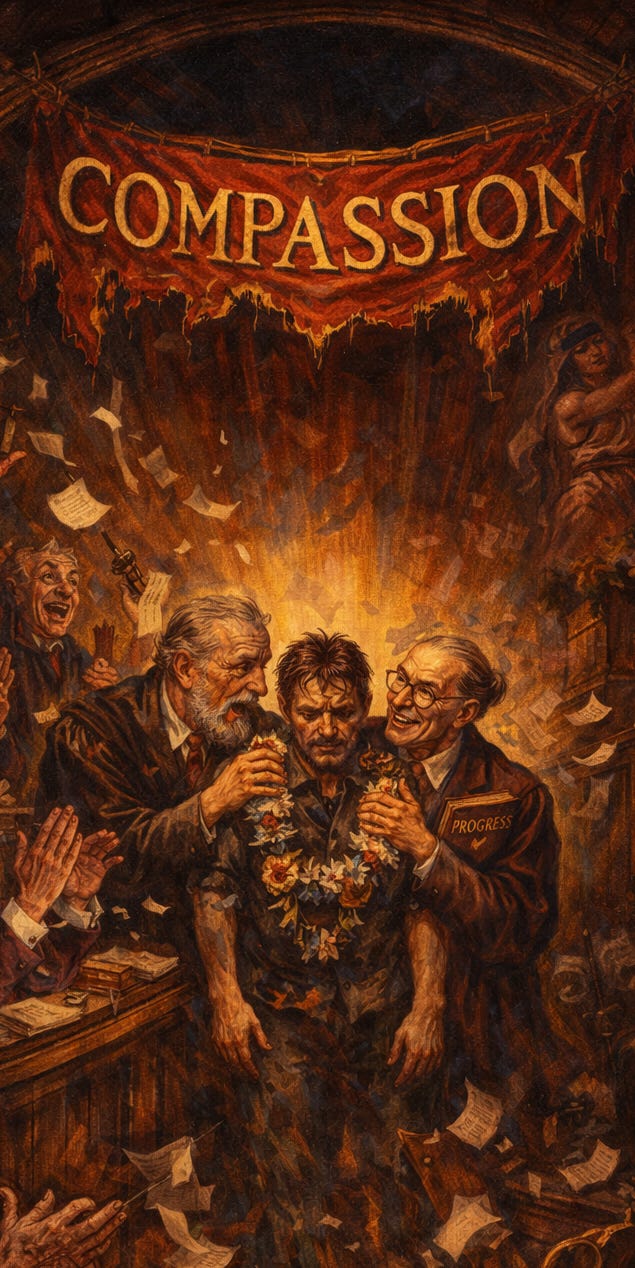
We are told this is compassion. We are told this is progress. We are told this is justice, finally informed by history.
But one is entitled—indeed obligated—to ask:
Is this kindness? Or is it the quiet dismantling of moral responsibility?
From Judgment to Explanation
There was a time when the law spoke plainly.
You did the act.
You knew it was wrong.
You are responsible.
That was not cruelty. That was dignity. It treated the person before the court as a moral agent—someone capable of choosing between right and wrong.
Now we are drifting into something else.
Now, the courtroom increasingly sounds like a sociology seminar. We are told that behaviour must be understood in terms of upbringing, social conditions, inherited trauma, and identity.
And the more we explain, the less we judge.
This is not a minor adjustment. It is a philosophical shift.
Because a system that explains behaviour as the product of forces beyond control slowly comes to believe in human agency at all.
The Logic That Eats Itself
Follow the reasoning to its conclusion.
If trauma reduces culpability…
If disadvantage reduces culpability…
If social conditions reduce culpability…
If identity reduces culpability…
Then what remains?
Are we heading toward a system where prison exists only to protect the public from dangerous individuals—but no longer to hold them morally accountable?
Where the state says: You are not truly blameworthy, but you are still unsafe, so we will contain you?
That is not justice. That is risk management.
And the logic does not stop where its architects think it will. Because every life, examined closely enough, contains hardship, influence, and explanation.
The principle does not refine responsibility.
It dissolves it.

The Insult Hidden in the Sympathy
Let us say the quiet part out loud.
When courts reduce responsibility based on race, background, or inherited hardship, the underlying message is unmistakable:
“You cannot help yourself in the way others can.”
Dress it up however you like—but that is what it says.
You are less capable of restraint.
Less capable of choice.
Less capable of meeting the standard.
That is not equality.
That is condescension.
A particularly insidious form of it—because it arrives wearing the mask of compassion.
When You Remove Agency, You Remove Hope
There is a deeper harm here.
When you begin telling people that their actions are largely the product of forces beyond their control—heritage, skin colour, upbringing, immigration status—you are not performing an act of liberation.
You are performing an act of diminishment.
You are saying, in effect, you are not like others. You are not fully capable of restraint. You are not expected to meet the same standard. You are, in the most politely phrased sense, damaged goods.
And having said that, you proceed—under the banner of compassion—to remove from them the one thing without which no human being can stand upright: agency.
Because hope depends on agency.
Hope says, "You can choose.”
Hope says, "You are not bound by your past.”
Hope says: " You are responsible—and therefore you are free.
But what does this new doctrine say?
It says, "It is not your fault.”
And the silent companion to that statement—the part never spoken aloud, but always present—is this:
You cannot do any better.
You are as you are because you must be.
That is not mercy. That is a life sentence of a different kind.
Because once you tell a person that their conduct flows inevitably from their identity, their history, their condition, you have closed the door they might otherwise have walked through. You have informed them that the ordinary expectations of self-command do not apply to them, and worse, cannot apply to them.
The result is not dignity, but quiet despair.
A person so explained is a person diminished. A person so excused is a person confined—not by bars, but by lowered expectation. You have not merely reduced their culpability; you have reduced their horizon.
And in doing so, you perform a final cruelty: you make criminality seem almost natural to them, and improvement seem almost unnatural.
Remove agency, and you do not produce compassion.
You produce hopelessness.
And hopelessness, unlike punishment, does not end when the sentence does.
As Immanuel Kant understood, morality rests on the assumption that human beings are capable of choice. Remove that assumption, and the entire structure collapses.
What remains is not justice tempered with mercy.
It is condescension—elevated, systematized, and enforced—dressed up as kindness, and delivered with a clear conscience. These judges are killing people with their kindness.
What About the Victims?
And then there is the question no one seems eager to ask.
What about the victims?
Many of them are Indigenous. Many of them are black. Many of them come from the very communities this doctrine claims to protect.
What are we saying to them?
We are saying, in effect, the person who harmed you is less responsible than we would normally say—because of who he is.
And so the sentence is reduced.
Which means the victim’s family meets him again—on the street, sooner than they should.
What does that communicate?
That their suffering counts for less.
That the life taken, or shattered, weighs differently on the scales.
It is an extraordinary moral inversion.
In trying to show compassion to the offender, we quietly diminish the victim.
The Comfort of Moral Vanity
There is, however, one group that benefits.
With few exceptions, the white-saviour judiciary has taken to the business of excuse-making. And not merely at the margins—right up to Chief Justice Richard Wagner, who has already arranged to walk past his own bronze likeness, as if posterity were a foregone conclusion.
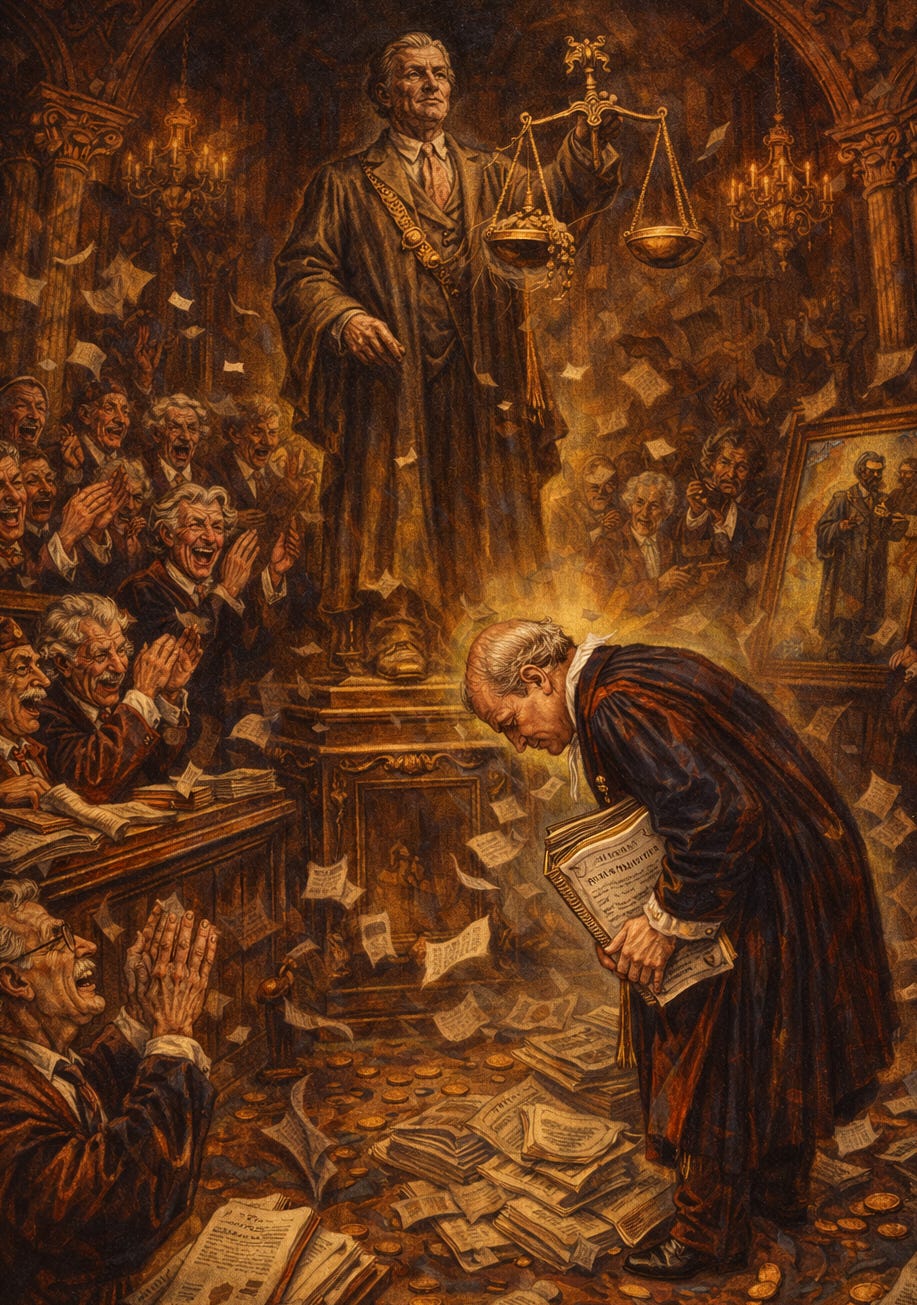
Because it feels good. It feels enlightened. Humane. Progressive.
There is a certain moral pleasure in it—a sense of standing above the harsher instincts of the past.
But as C. S. Lewis warned, the most dangerous tyrannies are those exercised “for the good of their victims.” Because they are done with a clean conscience.
They feel righteous.
And that is precisely why they are so rarely questioned.
A Harder, More Respectful Truth
There is an older, sterner view of human beings.
It does not deny hardship.
It does not ignore history.
It does not pretend suffering is irrelevant.
But it insists on something essential. That people are still capable of choosing.
Still capable of doing wrong.
Still capable of being held accountable.
Still capable of doing right.
That is not cruelty.
That is respect.
Because it treats every person not as a product of forces, but as an agent.
The Question We Should Be Asking
Of course, we should be compassionate.
But compassion that erodes responsibility is not compassion.
It is surrender.
So the real question is this:
Are we building a justice system that affirms human dignity by holding people accountable?
Or one that replaces accountability with explanation—and calls it progress?
Because once we begin telling people they are not fully responsible for their actions…
We are not lifting them up.
We are lowering them down.
And we are calling it kindness.

This piece was free. Please consider signing up as a paid subscriber for $8.35/month to support my work and avoid those bloody paywalls. Or . .
If you found value in this article and wish to support my ongoing work, please consider leaving a tip. Your support helps me continue producing uncensored content on critical issues.
https://shorturl.at/FULOt
The same mentality leads Canada to support murderous Palestinians over peace-loving Israelis. Apropos your essay: Earnest Gaines: A Lesson Before Dying. Beautiful book.
They started this in the EU, giving lighter sentences to immigrants. It's part of the anti-white trend in the UK called two-tier policing. It's clearly wrong, morally, judicially, in every sense. Before that the idea that someone's background could be a mitigating factor was introduced by sociologists in the 1970s, as I recall, and has been controversial ever since. It negates the idea of free will and moral responsibility by excusing bad actions as the result of upbringing. The problem is that many people who had bad backgrounds turned out to be law-abiding citizens, while some privileged people turned into criminals. So it's not a good argument.