If you believe in the importance of free speech, subscribe to support uncensored, fearless writing—the more people who pay, the more time I can devote to this. Free speech matters. I am a university professor suspended (since fired) because of a free speech issue, so I am not speaking from the bleachers. The button below takes you to that story.

Much of the modern university has become a bloated credential mill, spinning out degrees with little regard for the minds behind them.
The panic over artificial intelligence—ChatGPT and its ilk—reveals not a crisis of technology but a deeper rot: the thoughtless surrender of education to the gods of credentialism.
Administrators and faculty, complicit in their silence, have allowed learning to be replaced by a grim pantomime of grades, bums in seats, and tuition dollars.
The hysteria over AI is merely the latest symptom of a disease that has metastasized for decades, and the irony is as bitter: universities fear AI not because it undermines learning, but because it exposes how little learning was happening in the first place.
Consider the student who pours 700 words of raw ideas into ChatGPT, asking it to refine and expand them into a 1000-word essay. Is this cheating? Or take the diligent soul who runs their essay through AI for spelling and grammar corrections, only to trip the same AI detectors that flag the lazy plagiarist who copy-pastes an entire assignment.
The detectors, blunt as a bureaucrat’s soul, cannot distinguish between these acts. This is not a flaw in the technology but a mirror held up to the university’s failures.
If education were about fostering critical-thinking skills, using AI as a tool, whether for organizing thoughts or polishing prose, would be a non-issue. Instead, the obsession with catching “cheaters” reveals a system that values compliance over creativity, rote memorization over reasoning.
The stats are damning. Studies like those by Arum and Roksa (2011) in Academically Adrift show that 45% of college students demonstrate no significant improvement in critical thinking, complex reasoning, or written communication after two years of study. By graduation, a third still show no gains.
Worse, research by Blaich and Wise (2018) indicates that students one year out of a course perform no better on subject-specific assessments than those who never took it.
The university seems to be where knowledge dies, replaced by the ritual of “presenting content” from publisher-provided test banks and PowerPoint slides. These are not tools of education but props in a farce, where instructors, many of whom have never worked in, studied, or even read the textbook for their assigned subject, teach students not to think but to game the system.
But let me be fair to the university for a moment, because the sophisticated defence deserves a hearing. The facts fade, the defence says, but the frameworks remain — and there is real science behind the claim.
Psychologists have known since Ebbinghaus that forgotten knowledge is not erased: it is relearned at a gallop, in a fraction of the original time, because the scaffolding remains in the walls even when the furniture and perhaps the roof have fallen to the ravages of time.
Harry Bahrick, who tested alumni on their school Spanish and algebra decades after graduation, found that learning fades steeply for three to six years and then levels off into what he called “permastore” — a residue that can survive half a century untouched.
Five semesters of Spanish left roughly 60 percent of the language intact twenty-five years later. Nor is recall the only residue. Researchers speak of “preparation for future learning”: the educated person may not remember the answer, but he knows which questions to ask, where the knowledge lives, and how to judge it when he finds it. He thinks with everything he studied, even the parts he can no longer recite.
It is a beautiful defence.
It has one defect: every one of these residues must be earned, and the price is exactly what the modern university refuses to pay. Bahrick’s own data deliver the verdict.
The students who learned least — one course, crammed and shallow — became indistinguishable from people who had never studied the subject at all within about six years.
Permastore is not a participation trophy; it admits only knowledge that was learned deeply, practised, and revisited over time. Savings in relearning presuppose that something was genuinely learned in the first place.
Preparation for future learning presupposes a mind that was taught to inquire, not to game a test bank. The credential mill produces none of these conditions. It produces the one kind of learning the science says evaporates without remainder. The university cannot plead the frameworks in its defence, because the frameworks are the very thing its classrooms no longer build.
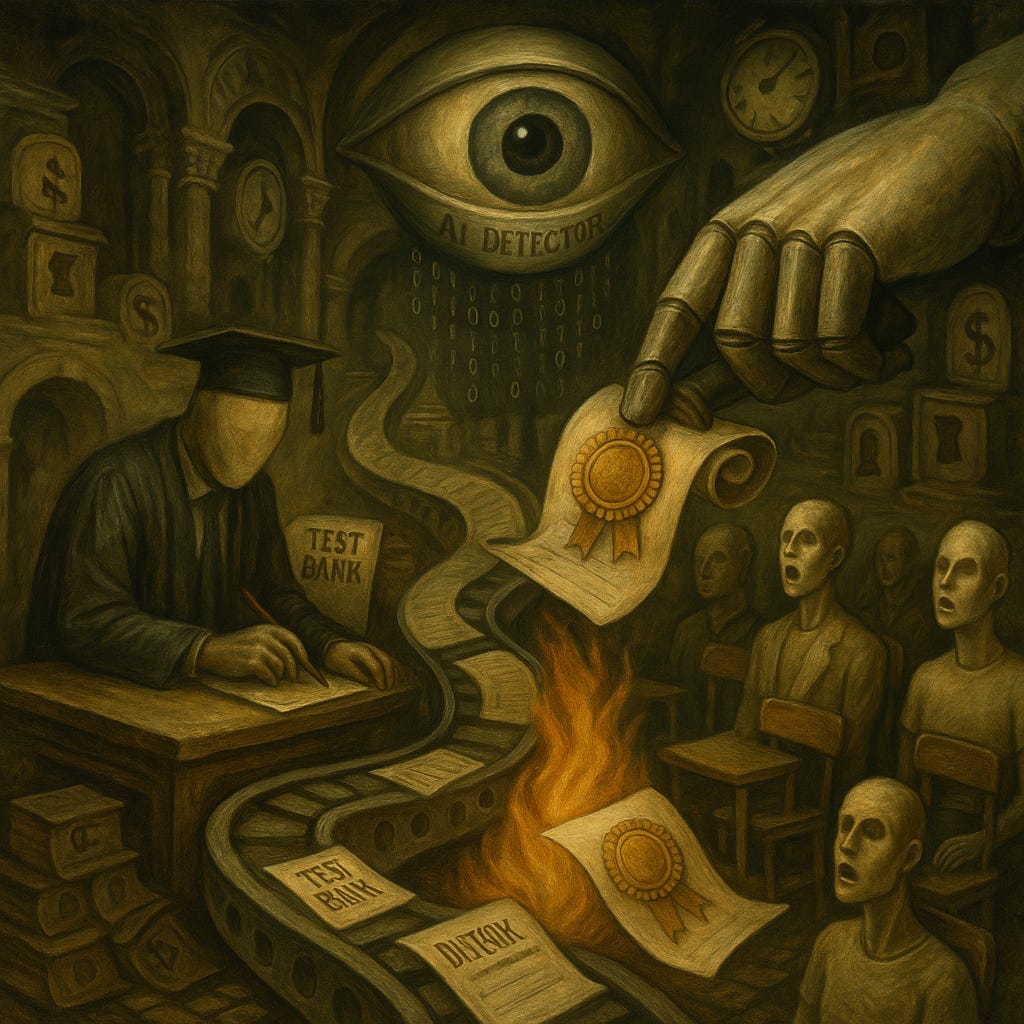
This is the real scandal, and it predates ChatGPT.
For years, I fought a quixotic battle against using publisher test banks. These glorified glossaries, with their multiple-choice questions designed to test memorization of terms rather than understanding, were not just lazy; they were corrosive. Armed with the same online answer keys as their instructors, students learned not marketing or finance but how to cheat efficiently. The implicit message was clear: education is an obstacle course, a toll booth to a career, not a pursuit of truth.
When I protested, I was told to shut up—one professor, who had never worked a day in the field he “taught,” threatened to file a complaint for questioning his “integrity.”
His integrity, it turned out, consisted of ladling out grades and killing time for 12 weeks, secure in the knowledge that a 15% grade bump and an 85% average would silence any student pushback.
Hypocrisy wafts through the lecture halls like cheap cologne, and students, with their keen noses, smell it from a mile away.
The AI panic is a distraction from this deeper betrayal. Banning ChatGPT or policing its use with detectors is like using a lawnmower to deal with dandelions.
AI is a tool, not the enemy. It can be a research aid, a writing coach, or a brainstorming partner. The problem isn't that students use it, but that they’re incentivized to use it as a shortcut. Why wouldn’t they, when the system rewards grades over growth? Management’s silence on learning’s decline—their obsession with enrollment numbers and their willingness to hire instructors who treat teaching as a side hustle—ensures that the classroom is where passion withers.
The most bored person in the room is often at the front, droning through slides they didn’t create about a subject they don’t care about.
So what is to be done? The answer lies not in banning AI but in reimagining the classroom as a place where intrinsic motivation is nurtured, not crushed.
Studies, like those by Essel et al. (2024), suggest that interaction with ChatGPT can enhance critical, reflective, and creative thinking when guided by active pedagogical strategies.
For example, at Georgia Gwinnett College, students used ChatGPT in chemistry courses to draft essays, revise outputs, and validate information, significantly improving their confidence to ask insightful questions and analyze complex concepts (Guo & Lee, 2023).
The key was structured engagement: students were not left to flounder but guided to use AI as a tool for deeper inquiry.

Universities could adopt similar approaches. Handwritten, in-class essays require students to synthesize ideas without outsourcing the task to AI. Other assignments could make AI the object of scrutiny: generate a draft, then identify its faulty logic, unsupported claims and omissions. Students could use AI to explore competing perspectives, then defend their conclusions in an oral examination. The emphasis would shift from producing an answer to understanding and defending it—from recall toward Bloom’s analysis, evaluation and creation.
But better assessments require a change in institutional priorities. Universities must hire and reward instructors who know their subjects and can kindle curiosity. That means smaller classes, proper support for committed adjuncts, and assessments that reward ideas rather than regurgitation. It also means abandoning the credentialist promise that everyone needs a degree, which fills classrooms with students pursuing a diploma rather than an education.
Universities have helped create the cynicism they now condemn. By selling education as a transaction, they have taught students to see AI as another shortcut to buy.
Critical thinking was already losing ground to test banks, grade inflation and administrative indifference before ChatGPT arrived. If universities want students to use AI thoughtfully, they must first make thought worth the effort.
Education, the familiar saying goes, is the lighting of a fire, not the filling of a pail. Yet too many instructors have no fire to share, and administrators are too absorbed in their ledgers to notice the cold classrooms below. The dark satanic academic mills keep turning, pressing linen rags into diploma paper while the minds those diplomas certify remain unkindled.
Note to readers: Please consider a paid subscription. I won’t patronize you with the usual “it costs the same as two cups of overpriced coffee a month” routine. Keep the coffee. Enjoy the coffee. For the love of all that is holy, however, please don’t put Coffee-Mate in it. Life is difficult enough without voluntarily introducing that substance into your bloodstream.
If a paid subscription isn’t possible, please repost this. You’re unlikely to read much like it in the CBC, Toronto Star or Globe and Mail. Between federal support and Google money, much of Canadian media has become remarkably domesticated. I prefer to remain housebroken only in the most technical sense.
Consider leaving a tip if you want to support Freedom To Offend