


There was a time when Canada measured itself against the best. We compared ourselves to the strongest economies in the democratic world and expected to compete with them. We did not aspire merely to remain respectable; we expected to lead. We thought of ourselves as a country with abundant resources, sound institutions, an educated population, and a political culture capable of producing sustained prosperity.
Today, the conversation has quietly changed.
We no longer ask whether Canada is gaining ground against its peers. We ask whether things are “good enough.” We no longer expect to stand on the podium. We are relieved simply to make the finals.
That, more than any individual statistic, is the story of modern Canada.
Economists disagree on many things, but they tend to agree on the broad measures that reveal a nation’s long-term economic health: productivity, real GDP per capita, business investment, labour-market performance, and housing affordability. On each of these measures, Canada’s trajectory over the past decade has raised increasing concern from institutions such as the OECD, the IMF, and domestic economists. Productivity growth has lagged many comparable advanced economies. Business investment has weakened. Housing has become progressively less affordable. Growth in living standards has slowed. Increasingly, Canada’s headline economic growth has depended more on rapid population growth than on producing more wealth per person.
None of these trends suggests imminent collapse. They suggest something quieter and, in many ways, more dangerous.
They suggest relative decline. The distinction matters.
A nation does not have to become poor to become poorer than its competitors. Olympic athletes understand this instinctively. The silver medallist is still extraordinary. But if a country that once routinely competed for gold spends a decade slipping to sixth, then eighth, then tenth, something important has changed. The country has not become incompetent. It has simply stopped improving as quickly as everyone else.
Canada increasingly resembles that athlete.
We used to expect medals. Now we congratulate ourselves for qualifying.
Yet this deterioration has produced remarkably little political consequence. Why?
The fashionable explanation is ignorance. Voters simply do not understand economics.
That is comforting, but I doubt it is true. The real explanation is far more human.
People do not vote based on national averages. They vote based on personal experience.
The economy is not experienced through OECD reports or Statistics Canada releases. It is experienced through a paycheque, a mortgage payment, a grocery bill, and the quiet confidence that next month will resemble this month.
As long as those things remain intact, national decline remains largely invisible.
Imagine a street with five homes.
One homeowner loses his job. His savings evaporate. The mortgage becomes impossible to pay. His children postpone university. Eventually, he sells the family home.
The other four households continue living comfortably.
From an economist’s perspective, that street has experienced a serious labour-market failure. Twenty percent unemployment on a single street is devastating.
From the perspective of democracy, however, eighty percent of the voters may conclude that life is carrying on quite normally.
That is the uncomfortable truth about aggregate statistics.
Economic pain is intensely personal. Economic averages are not.
This is why deteriorating national indicators often fail to generate electoral punishment. Productivity can stagnate. Young people can struggle to find meaningful work. Housing can drift further out of reach. Business investment can slowly migrate elsewhere. None of this necessarily changes how a comfortable homeowner votes if his own circumstances remain stable.
People rarely vote for the national economy. They vote for their own.
Governments understand this better than economists. There is another political advantage that incumbents enjoy. Households must eventually live within their means.
Governments can borrow.
Debt allows today’s difficult choices to be postponed until tomorrow. Spending can continue. New programs can be announced. Ambitious infrastructure projects can be unveiled. The political rewards arrive immediately, while the financial costs are deferred to a future Parliament and, more importantly, a future generation.
Debt is not merely an economic instrument. It is a political one.
It softens today’s pain by asking tomorrow’s taxpayers to absorb it.
Then there is the media.
In a Westminster parliamentary system, the official opposition exists to scrutinize the government. That is its constitutional purpose. Journalism has traditionally served a similar democratic function by examining whether those in power are governing effectively.
Yet modern political coverage often seems to drift toward personality rather than performance. Discussions of style, rhetoric, tone, and political theatre can crowd out sustained examination of long-term economic outcomes. Whether intentional or not, public debate risks becoming less about whether the country is becoming more prosperous and more about whether the opposition appears sufficiently reassuring.
The question quietly changes.
Instead of asking, “Is Canada becoming stronger?”
We ask, “Do I like the alternative?”
Those are not the same question.
One measures results. The other measures comfort.
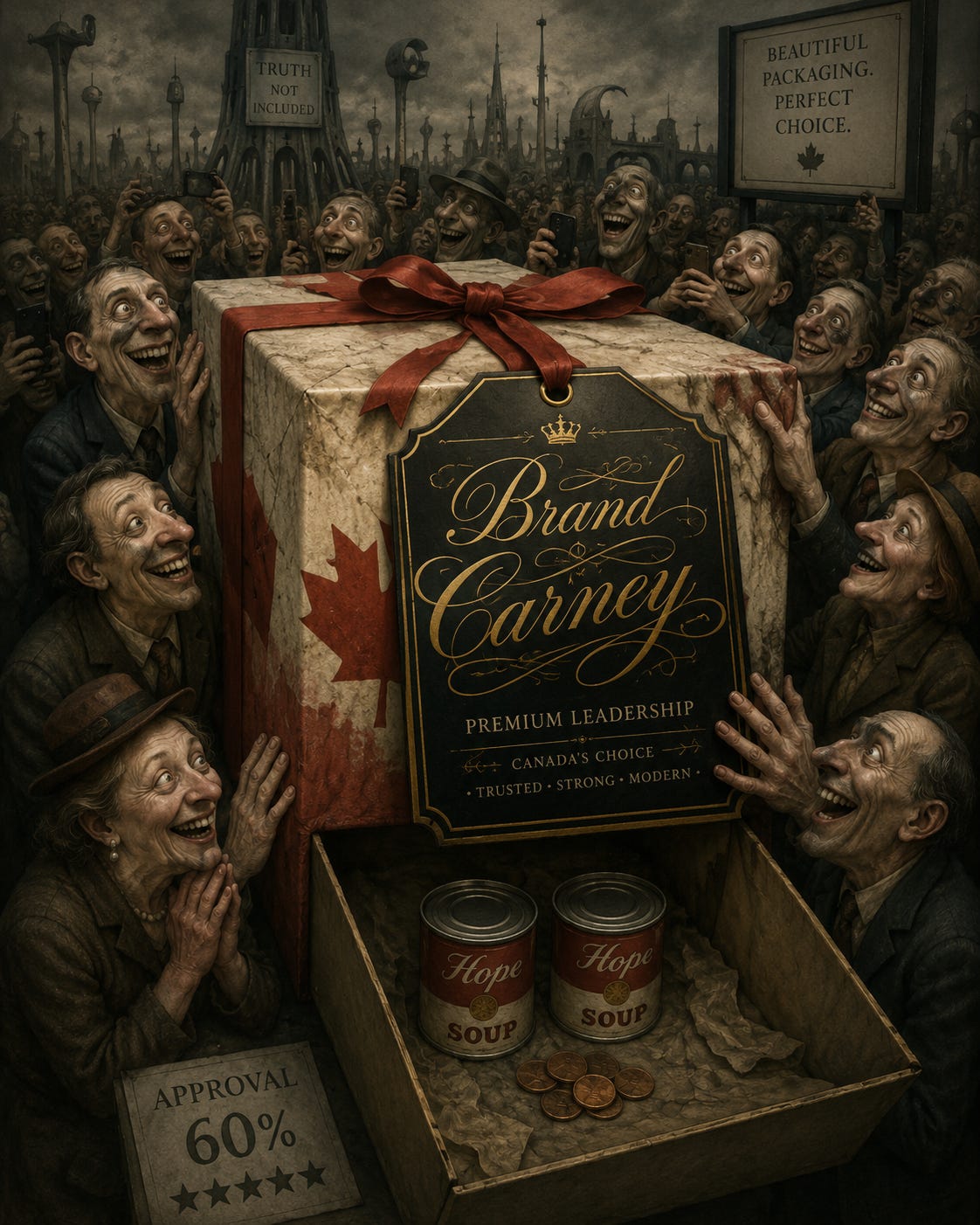
Branding fills the gap.
Politics has become increasingly psychological. A calm demeanour is mistaken for competence. International credentials become proxies for effective domestic policy. A reassuring style creates the impression that difficult problems are being managed, even when many of the underlying indicators continue moving in the wrong direction.
Presentation begins to substitute for performance.
That is not unique to Canada.
But Canada appears especially susceptible to it. Perhaps because we have become accustomed to gradual decline rather than dramatic crisis.
History teaches that nations rarely collapse overnight.
They drift. Productivity weakens a little. Investment slows a little. Housing becomes slightly less attainable each year.
Young graduates leave for opportunities elsewhere, one family at a time.
Living standards stop rising as quickly as those of comparable countries.
None of these developments, by itself, feels revolutionary.
Together, they reshape a nation.
This raises a more unsettling question.
What percentage of the electorate must personally experience economic deterioration before it becomes politically decisive?
Is it enough for young Canadians to struggle if older homeowners remain comfortable?
Is it enough for graduates to leave if established professionals remain employed?
Is it enough for productivity to stagnate if supermarket shelves remain full?
Or does democratic accountability require something harsher—that a plurality of voters must first feel the decline in their own households before they demand a different course?
Perhaps there is another possibility.
Perhaps what is required is not greater hardship but greater empathy.
A society capable of looking beyond its own driveway would recognize that a country is not judged solely by whether today’s mortgage payment clears. It is judged by whether its children will inherit greater opportunity than their parents enjoyed.
That used to be Canada’s quiet promise.
It should be again.
The real paradox of Mark Carney’s popularity is therefore not about Mark Carney himself. It is about the nature of democratic politics when supported by media that function more as advocates than critics.
Governments can remain popular while a country’s relative position slowly weakens because relative decline is almost invisible to those who have not yet been touched by it. Prosperity can erode long before most citizens notice. Nations seldom vote against decline while it is statistical. They usually do so only after it becomes personal.
By then, history suggests, the medal ceremony is already over.
Agree. Good observations. I'm surrounded by the people you described. Canada's decline is insidious. The people you describe will only change tack when there is no food to buy and pensions disappear.