


There was a time—not so very long ago, though it now feels like a prior moral century—when one might have asked what it meant to be Canadian and received, if not a compelling answer, then at least a confident one. Today, the question produces something closer to a shrug wrapped in a flag. We are told, with a certain defensive pride, that we are polite, that we queue, that we apologize with almost liturgical regularity. But these are manners, not meaning. A nation, like a man, cannot live indefinitely on etiquette alone.
Indeed, the shrug has, in a moment of curious candour, been elevated almost to the status of a doctrine. As Justin Trudeau once remarked—with the sort of airy assurance that mistakes vacancy for virtue—“There is no core identity, no mainstream in Canada.”
One is tempted to admire the honesty, if not the implication. For if a country truly believes it has no centre, no defining thread, then it should not be surprised when its public life begins to fray into a collection of gestures rather than a coherent whole. What is presented as openness begins to look, on closer inspection, like a studied refusal to answer the most basic of questions: not merely who we welcome, but what, if anything, we are inviting them into.
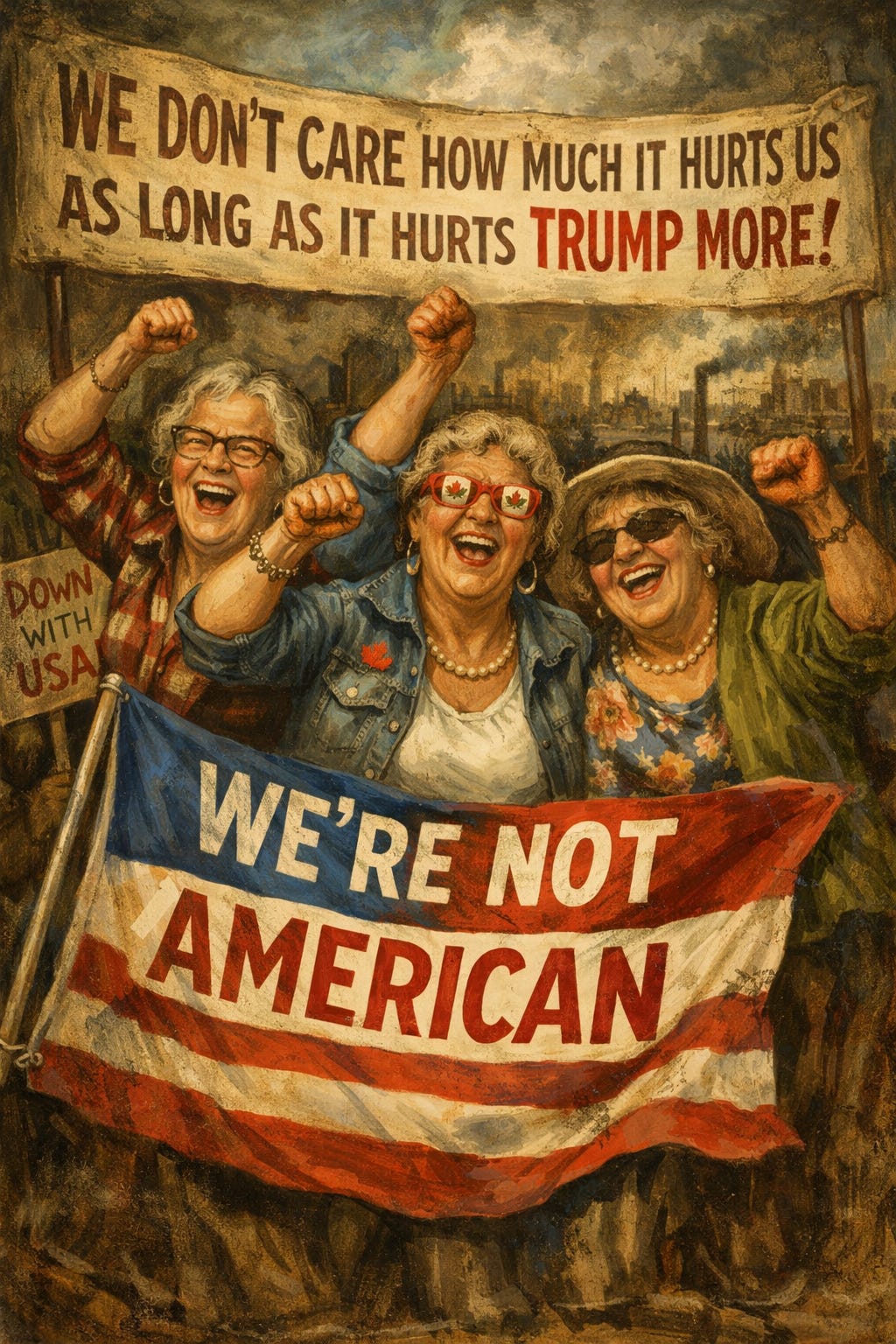
What has crept in to fill the vacuum is something more brittle: an identity formed not on conviction, but on negation. We are, above all, not American. This has become the quiet catechism of the Canadian self. It was there in the student’s backpack, adorned with the maple leaf less as a celebration than as a disclaimer.
“Do not mistake me,” it seemed to say. “I am not one of them.” And from such small gestures a national psychology has been constructed: one part insecurity, one part superiority, and no small measure of dependence.
The difficulty with building an identity on what one is not is that it requires a permanent object of contrast. Remove the American, and the Canadian is left staring into an existential mirror with very little to report back. The cost of this hollowness is not merely philosophical. It is political.
Because people are uncertain of what they will seize, with uncritical enthusiasm, upon anyone who claims to defend what they are not.
