


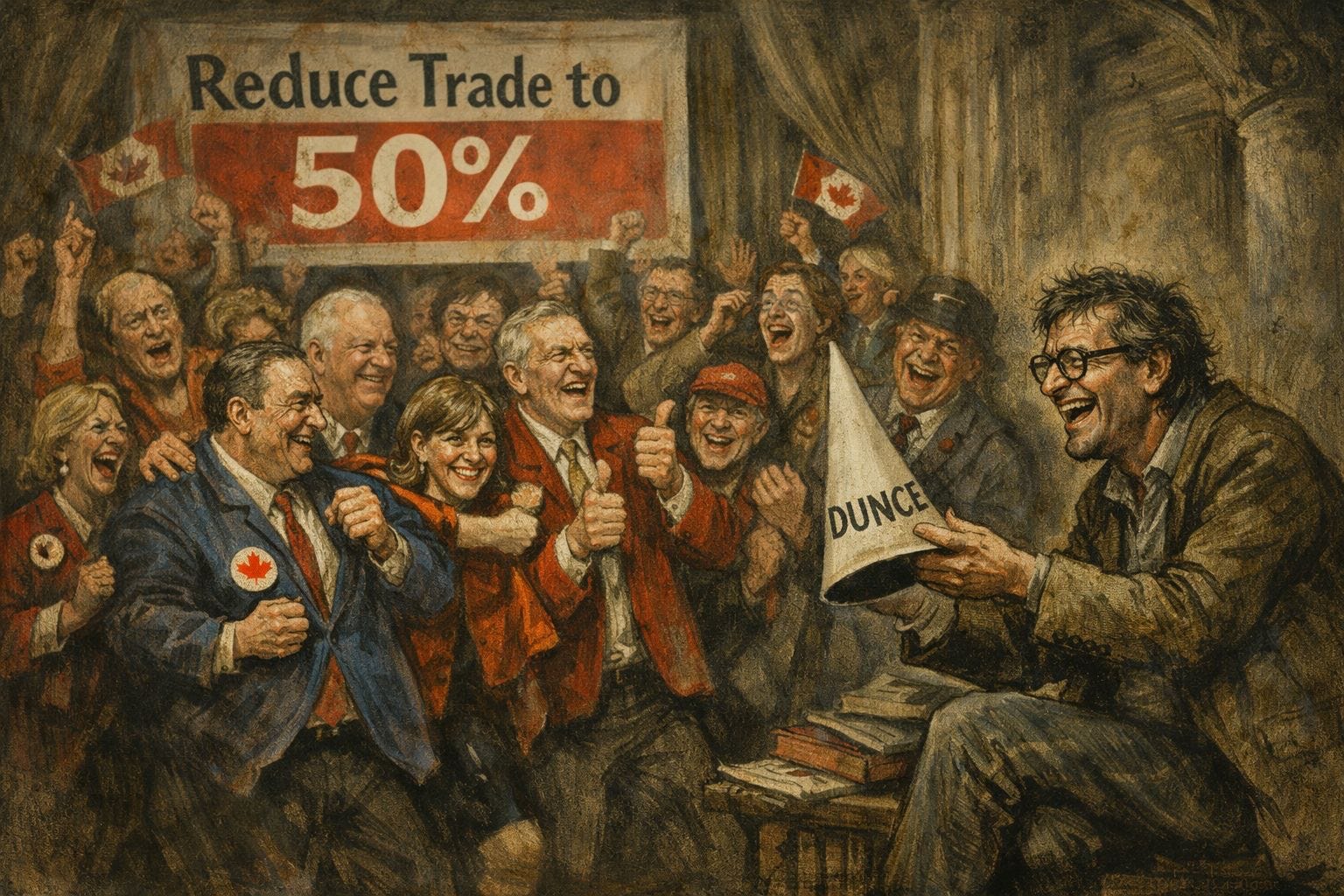
At a recent Liberal Party convention—highlighted by National Post Columnist Terry Newman1—a slide was presented proposing that Canada reduce its trade with the United States to roughly 50 percent.
Not floated. Not debated. Presented.
And in a room filled with the nation’s self-appointed stewards of policy and intellect, not one person rose—politely or otherwise—to observe that the numbers do not, in any recognizable universe, add up.
Let us begin with the charitable assumption. No one, not even in our more experimental corners of governance, is proposing to deliberately sabotage trade with the United States. To do so would be to replace a functioning circulatory system with interpretive dance. Supply chains would snap, exports would collapse, and jobs would vanish with admirable efficiency.
So if the American share is not to be reduced by force, it must be diluted by expansion elsewhere.
And here, regrettably, we collide with arithmetic.
Canada presently sends roughly 75 percent of its exports south of the border. The remaining 25 percent goes everywhere else combined—the vast, teeming remainder of the planet. To transform that ratio into a tidy 50–50 split without shrinking the American side, the rest of the world must rise from 25 to 75.
It must, in other words, triple.
This is not a matter for econometric modelling or the hushed incantations of central bankers. It is not even a problem requiring a calculator. It is the sort of thing that, in a more rigorous age, would have been dispatched by a mildly attentive twelve-year-old.
And yet the slide was shown. The room nodded. The conversation proceeded.
Now, one might forgive an error in calculation. What is more difficult to excuse is the complete absence of that small internal alarm—the one that activates when someone suggests that three times 328 is 4,050 and expects applause for the insight. You may not know the exact answer, but you know—instinctively, almost physically—that something has gone terribly wrong.
That instinct appears to have been retired.
We are not speaking here of marginal adjustments or incremental diversification. We are speaking of taking an already vast export base—hundreds of billions of dollars—and inflating it by two hundred percent, as if markets were balloons and policy makers possessed the requisite breath.
There is no modern precedent for this. Developed economies will not simply will a tripling of external trade with new partners into existence, particularly while maintaining their primary relationship intact. Geography, infrastructure, supply chains—these are stubborn, unfashionable facts.
Yet the idea is offered. It is received. It enters circulation as something like seriousness.
And this is where the problem ceases to be economic and becomes civilizational.
Because this was not a gathering of eccentrics or passersby. This was a room of professionals—politicians, advisors, strategists, and those who intend to govern. And still, no one asked the most elementary question in public life:
How?
At that point, one is no longer dealing with policy failure, but with the quiet evaporation of numeracy. Not advanced mathematics—no one is demanding differential equations—but the basic capacity to recognize when scale has been abandoned and proportion ignored.
You do not need a doctorate to see it. You need only to grasp that if 75 is to become half of something, the rest must grow to meet it.
And if that simple fact can pass unchallenged, then the guardrails are gone. Trade can be “rebalanced” by aspiration. Economic unions to which we are geographically and politically ineligible can be discussed as if awaiting our RSVP. Vast infrastructure projects can be waved through on the strength of sentiment and PowerPoint.
Reality, in short, becomes advisory.
Now let us indulge the fantasy—briefly—that such a transformation were possible. That Canada could, by declaration, triple its non-American trade. This would not be ambitious; it would be miraculous. There is no recorded instance of a developed economy achieving anything of the sort without first tearing down large portions of its own internal structure.
And let us not forget: we cannot even manage free trade within our own borders.
Interprovincial barriers remain stubbornly intact—despite Mark Carney’s confident assurances that he would have that particular nuisance resolved by the summer of 2025.
The deadline passed. The barriers did not.
The press, meanwhile, appears to have misplaced the entire episode—no doubt distracted by more photogenic pursuits: a well-timed jog, a borrowed line from Havel, or another enthusiastic mangling of Thucydides, who by now must be rotating in his grave at a speed sufficient to generate electricity.
One is left to admire the scale of the ambition—if not the acquaintance with reality required to sustain it.
And that, inconveniently, is the point.
Trade is not something governments “do” to one another over canapés and memoranda. It is conducted by private actors—firms, investors, producers—who make rational decisions about costs, proximity, regulation, and profit. The much-advertised memoranda of understanding, which seem to send certain commentators into a state of near-erotic excitement, are, in economic terms, little more than polite letters of intent. They do not compel trade. They do not create markets. They do not cause a Saskatchewan farmer or an Ontario manufacturer to redirect decades-long supply chains simply because a minister has shaken hands in Brussels or Beijing.
If one truly wished to engineer such a shift, one would have to do something far more radical—and far less congenial to the current political temperament. One would have to open the economy. Fully.
Nearly half of Canadian industry remains, in one form or another, hermetically sealed from the vulgar intrusion of competition—cushioned by tariffs, quotas, regulatory hedgerows, and that soft, suffocating paternalism in which the state takes such proprietary pride. Supply management endures like a protected species; telecoms operate as an oligopoly with the manners of a cartel; banking is concentrated to the point of ritual; airlines are insulated from the indignity of real rivalry.
If one were serious—truly serious—about inviting the world to trade with us at scale, one would have to begin by dismantling this cozy architecture. That would mean ending supply management and, not incidentally, relieving Canadians of the peculiar national burden of paying extortionate prices for mediocre cheese—a culinary indignity elevated, by policy, into a patriotic obligation.
Even interprovincial trade—within the same country, under the same flag—remains encumbered by barriers that would embarrass a minor customs union.
And yet we are to believe that, without dismantling any of this, we will somehow persuade the rest of the world to triple its commercial engagement with us.
Unless, of course, we are contemplating a sudden conversion to a rather Trumpian species of mercantilism—directing trade flows by fiat, subsidizing preferred industries, and compelling outcomes by political decree. One suspects this is not quite what is being proposed. Or, more precisely, not what is understood to be proposed.
Because the alternative is obvious: if you want others to trade with you at scale, you must allow them to compete with you at scale. You must open markets, invite pressure, and accept the consequences. You must, in short, abandon the very protectionism and managerial paternalism that have long been features—one might say comforts—of the Canadian model.
I, for one, would welcome it. Let competition loose. Dismantle the cartels. End the quiet monopolies. If the ambition is genuine, then by all means—let us have at it.
But somehow, one suspects this is not the ambition at all.
It is, rather, the economic equivalent of a child confronted with numbers and deciding—on grounds of pure feeling—that one of them ought to be larger.

No mechanism, no process, no comprehension—merely the assertion, delivered with confidence and received with applause.
And here, dear reader, the fog begins to lift. Is it any wonder that voters, marinated in this atmosphere of arithmetic-free aspiration, now express a touching enthusiasm for joining the European Union? An enterprise to which Mr. Carney, while stopping just short of formal advocacy, has nonetheless attached himself in that peculiarly modern fashion—drawn less by feasibility than by its agreeable aura: aspirational, continental, and, above all, not American. One imagines visions of longer-lasting baguettes dancing in their heads, perhaps even bread that expires at a more civilized pace.
The same instinct produces an eager appetite for grand continental rail schemes—the sleek, whizzy European choo-choo trains—admired for their aesthetics, their symbolism, their promise of arrival somewhere vaguely superior.
What is never asked—what must never be asked—is the vulgar question of cost. How much, exactly, will each journey require in subsidy? (Hint: north of a thousand dollars per ticket.)
And so we arrive at the true difficulty. When an electorate becomes incurious, innumerate, and faintly bored by the discipline of reality—when its highest political virtue is not judgment but enthusiasm—then the field is ceded to those who can best traffic in mood. The successful politician becomes not the master of execution, but the curator of aspiration, the impresario of vibe.
That, I’m afraid, is not much of a democracy.
Canada trades heavily with the United States because it is efficient, proximate, and deeply integrated. That is not a policy error. It is a fact of life—rather like gravity, only with more paperwork. One may diversify at the margins, cautiously and over time. One does not, by declaration, triple non-U.S. trade from an already enormous base.
At some point, someone in the room ought to have said so.
That they did not tells us rather more than the proposal itself.
I confess I come to this as a man of letters rather than numbers—an English degree, followed by the regrettable indulgence of a master’s in the same. I am, by training, precisely the sort of person who should be kept well away from national accounting.
And yet, here I am, obliged to point out that 25 cannot become 75 without consequence.
There is an old Groucho Marx line about declining membership in any club that would have him. One feels a similar hesitation here. When it falls to the literary class to correct the arithmetic of the governing class, it is not a sign of unexpected brilliance. It is a sign that the standard has sunk.
We have, after all, seen this before. Not long ago, an entire Parliament rose in ovation for a gentleman introduced as a war hero who had “fought the Russians”—a detail that, had it been subjected to even the faintest historical scrutiny, would have revealed that the Russians were, at that particular moment, on our side. By a simple process of elimination, one arrived at a rather uncomfortable conclusion.
That episode was dismissed as an unfortunate oversight. But it was, in truth, diagnostic.
And this, I’m afraid, belongs in the same category.
When basic arithmetic no longer constrains political ambition—when scale, proportion, and reality itself are treated as optional extras—democracy does not function as advertised. It becomes something looser, more impressionistic, governed less by fact than by tone.
And in such a system, it scarcely matters what we choose to call it.
Because a democracy that cannot count is, in the end, counting on very little at all.
Warning: The following may impair reason, distort proportion, and erode elementary arithmetic.
Second warning: Explanations may exceed a comfortable 100-word tolerance.
Remedy: In case of cognitive distress, administer two hours of bear cubs riding motorcycles—preferably AI-generated—until symptoms subside.
Warning: Reading the following slide may have damaging effects on your IQ.

She is a brilliant writer and a very nice person to boot, but she may, like me, be an English major. We spoke a few times, and she never mentioned calculus to me.
“Math is hard!”is one of those ‘Liberal values’ they’re always bloviating about.
I was at a public event in November in which one of the federal government’s economists working on trade diversification gave a presentation showing a “prudent” scenario of 65% of trade going to the U.S. by 2035 and an “ambitious” scenario of 55%.