


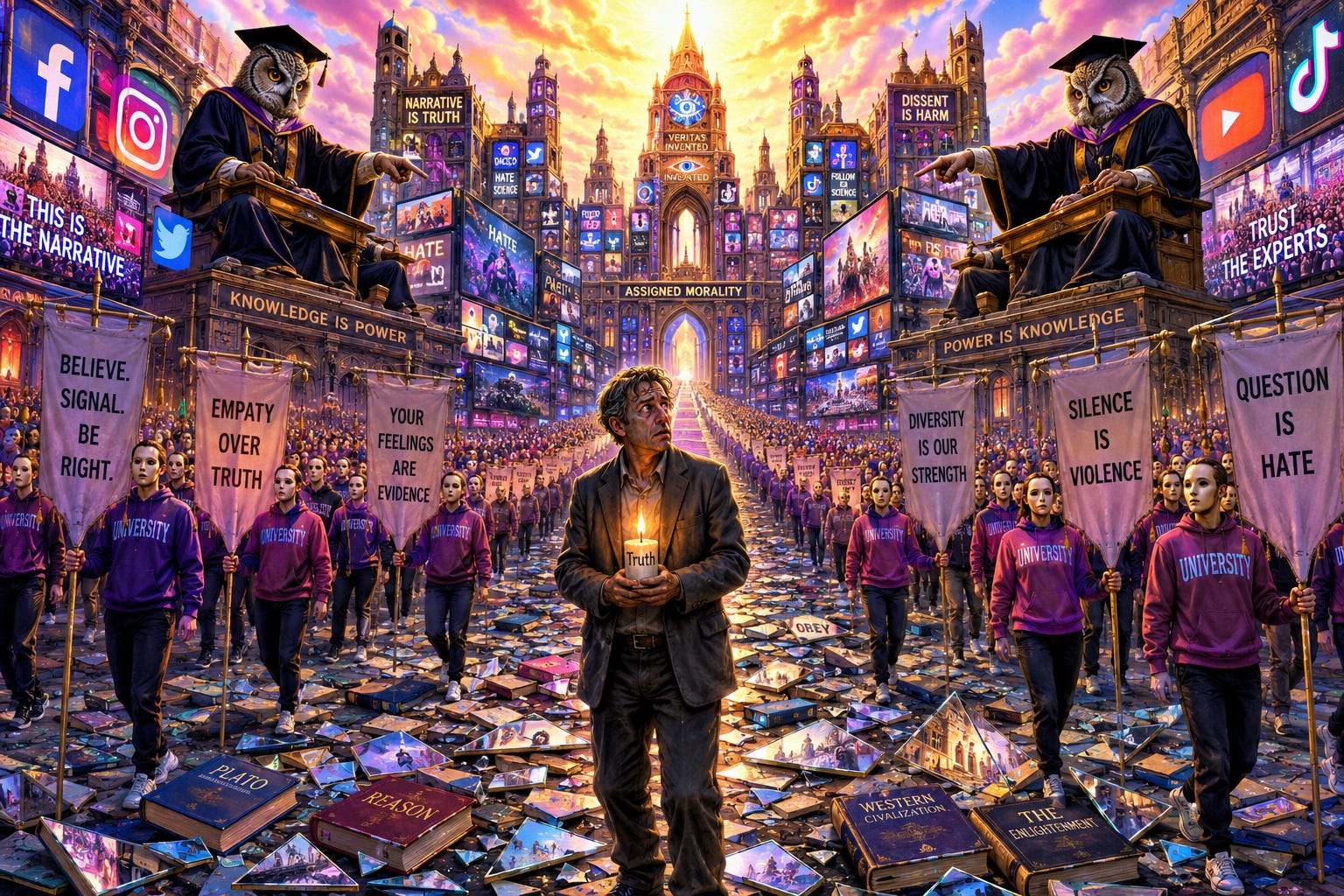
I recently watched an interview with a Stanford student who described herself as “pre-med,” one of those credentialed modern labels intended to signal seriousness, intelligence, ambition, and entry into the professional elite.
Stanford, needless to say, is not some mediocre institution tucked beside a freeway exit. It is one of the premier universities in the Western world, a great credentialing factory for the managerial class, producing future doctors, lawyers, professors, regulators, journalists, administrators, and political leaders. And this young woman admitted, almost casually, that in the days immediately following October 71, she believed that Israel had invaded Gaza on October 7th. Not that Israel had responded afterward. Not that Israel had escalated a conflict.
She literally believed the initiating event of October 7th was an Israeli invasion of Gaza.
And she did not arrive at this conclusion after examining evidence. Not after reading timelines. Not after reviewing eyewitness testimony, videos, or historical context. She simply absorbed the narrative; she captured the vibe.
But the truly chilling part was not that she was wrong. Human beings have always been wrong. Ignorance itself is not civilization’s greatest danger because ignorance can be corrected. The truly chilling part was the certainty. The moral intoxication. She wore the keffiyeh. She screamed slogans. She hurled abuse at Jews on campus. She joined the ecstatic mob, certain of their righteousness, without once undertaking the elementary discipline of checking whether the foundational claim itself was true.
And this was not some anonymous internet crank marinating in conspiracy theories online. This was Stanford University. This was the future professional elite of the West.
Eventually, to her credit, she was deprogrammed. Somehow, through exposure to facts, through conversations, through reality itself battering against the walls of ideological hysteria, she escaped the narrative prison she had entered. But that only makes the story more disturbing.
Because it means that an intelligent young woman at one of the most prestigious universities on earth could be swept almost instantly into a condition of moral certainty so powerful that she was prepared to publicly vilify strangers, scream abuse at Jews, and participate in a collective frenzy without once pausing to ask the most primitive intellectual question imaginable:
“Is this even true?”
Not long afterward, I read another story, even darker. A family hired a babysitter. Later, after reviewing footage from security cameras inside their house, they convinced themselves that something inappropriate had happened with their children. No evidence existed. No injury. No visible abuse. No corroboration whatsoever. But they disliked his body language. They “felt” something was wrong. So they took the babysitter into the desert, tortured him, abused him, and murdered him.
Later, after arrests were made, investigators determined that absolutely nothing had happened. The babysitter had harmed no one. The accusations were fantasies constructed out of suspicion, emotional projection, and hysteria. The criminal justice system — one of the last institutions in Western civilization still partially tethered to evidence — actually did something extraordinary by modern standards: it investigated before reaching conclusions. Reality intruded too late. The young man was dead because people preferred emotional certainty to factual uncertainty.
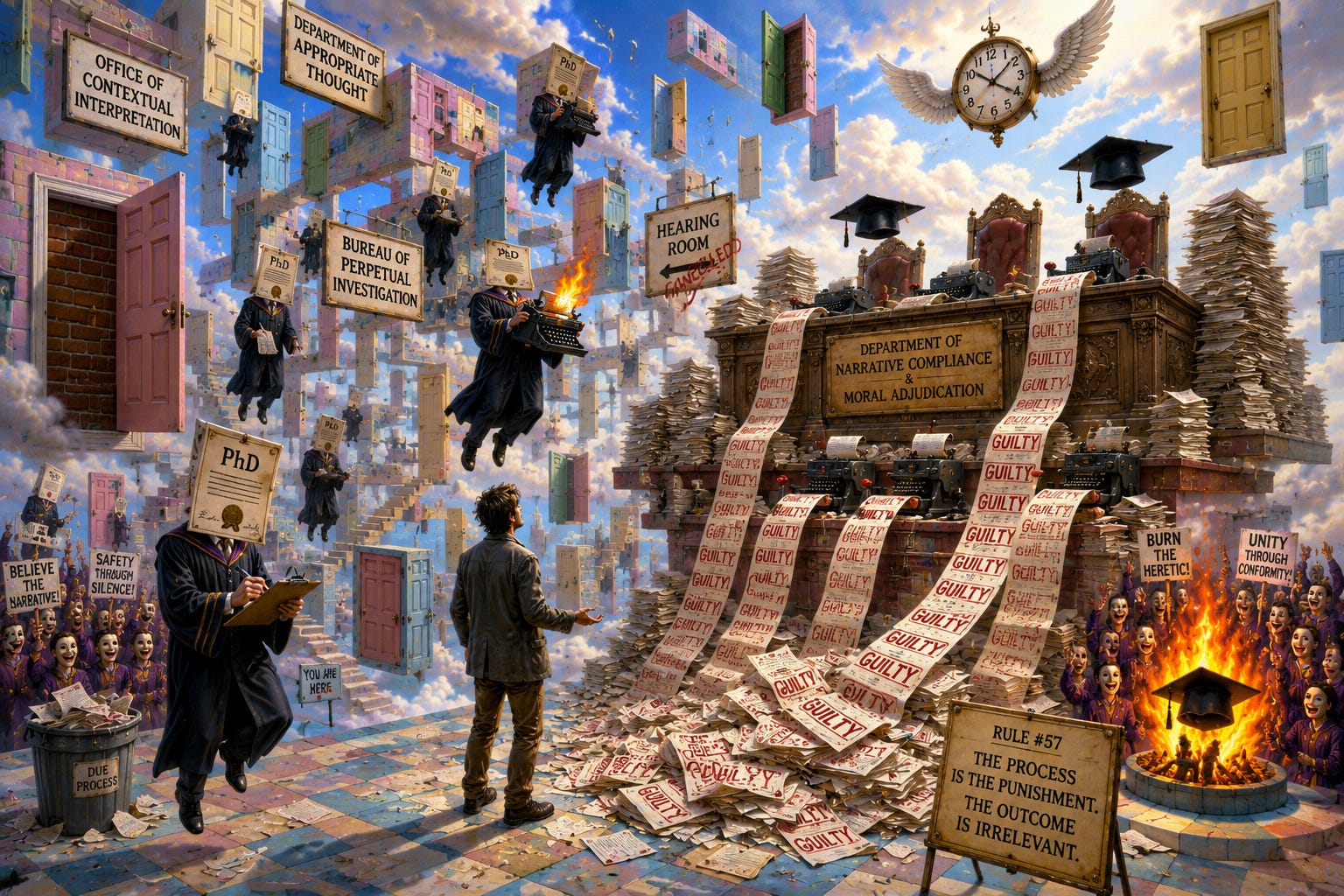
These are not isolated stories. They are warning flares from a civilization that increasingly no longer reasons its way toward conclusions but instead selects narratives first and scavenges afterward for supporting evidence.
And lest one imagine this tendency belongs merely to the ignorant masses, the socially marginal, or the uneducated, the evidence increasingly suggests precisely the opposite. The worst offenders are often the credentialed class itself, those marinated for decades inside institutions that no longer teach inquiry but narrative conformity.
I know this because I lived it.
My own descent into institutional madness began with a statement that, in any sane civilization, would have produced either agreement or disagreement, perhaps even an ugly argument, but certainly not a professional death sentence.
Shortly after October 7, I said to a stranger outside the university that Hamas were Nazis owing to the historical ideological affiliations between the Muslim Brotherhood and Nazi Germany, a historical relationship that is not controversial among serious historians.
Hamas openly calls for genocidal violence against Jews. It glorifies mass murder. It celebrates the burning of families alive. It elevates exterminationist rhetoric into moral theatre. To compare such an organization to Nazism was not some deranged invention. It was a historical and moral analogy.
But what followed was not disagreement. It was hysteria.
A solemn, medieval, witch-trial-like hysteria rose up almost instantly around me. Not because I had advocated violence. Not because I had threatened anyone. Not because I had harassed students.
But because I had violated a sacred narrative: that Muslim offence was untouchable, sacrosanct, morally sovereign. The man who publicly referred to Jews as subhuman devil worshippers, who praised those who burned entire families alive, who engaged in grotesque anti-Semitic rhetoric online — his offence was treated as holy writ. If he was offended, then I must be banished. Purged. Cast out. The witch must be burned at the stake.
And the atmosphere became genuinely frightening. I am convinced one of the few things that prevented actual violence against me was simply the fact that I was already at home and away from campus when the hysteria erupted. That is how fevered it became. That is how quickly narrative selection bypassed every civilizational safeguard supposedly embedded within higher education.
And then came the truly astonishing part. Four weeks before I ever received formal allegations, the university's vice-provost was reportedly walking around openly telling faculty and staff that, no matter what happened, I would be terminated. Before evidence. Before inquiry. Before testimony. Before hearing from the accused. Before any process remotely resembling natural justice. The punishment had already been determined.
And not one of the highly educated people surrounding this process appeared troubled by that fact.
Not the provost.
Not the assistant vice-provost.
Not the dean of veterinary science at the University of Guelph.
Not the administrators drafting the determination letters.
Not the investigators.
Not the human rights bureaucracy.
These were not ignorant people. These were learned people. Highly educated people. People with doctorates, publications, conferences, prestige, institutional authority, and careers built within organizations supposedly devoted to reason, inquiry, and evidence. This is not happening at the fringe of society. It is happening at the centre of society.
And the truly grotesque part is this: the people who ultimately determined my fate never met with me. Not once. They never spoke with me. They never allowed a meeting. They never responded to a single email. I wrote appeals. I pointed out contradictions. I demonstrated how their own written procedures were being openly violated. I explained how the basic tenets of natural justice — the very foundations underpinning Western legal civilization — were being discarded in real time. I pointed out that the accusations were anonymous, the evidence untested, the conclusions predetermined, and the process abandoned.
There was no response.
Not one.
Instead, my so-called hearing, my so-called trial, was simply cancelled, and I was fired.
And then came the final obscenity. The more I defended myself, the more the institution treated my defence itself as a form of wrongdoing. The act of advocating for myself became “harassment.” The act of pointing out procedural collapse became “reprisal.”
Think carefully about the insanity of that proposition. The accused man, arguing for due process, became, in their framework, the aggressor. The man pointing out falsehoods became the problem. The act of applying critical thinking at a university became evidence of guilt.
I was expected to go silently to the pyre.
I was expected to accept exile quietly.
And ultimately, of course, I was fired.
This is the University of Guelph. This is Humber College. And the truly sad thing is that these are not outlier institutions. They are representative institutions.
They are mainstream Canadian academic institutions filled with highly credentialed professionals who nevertheless abandoned the most elementary principles of fairness, inquiry, and natural justice the moment a preferred ideological narrative presented itself. That is precisely what makes this so disturbing. If this were happening only at the margins of society, among fringe activists or unstable ideologues, it would be alarming but containable.
But it is not. It is happening within the institutional core of Western society itself — within universities, bureaucracies, tribunals, unions, media organizations, and administrative systems staffed by people who sincerely believe themselves to be enlightened, compassionate, rational, and morally evolved, even as they abandon the foundational principles that once defined civilized inquiry.
And I mention this not to marinate this essay in personal grievance, but because it serves as a perfect illustration of the broader disease now consuming Western civilization.
The modern university increasingly does not train people to think critically. It trains them to select approved narratives and defend them emotionally.
Entire sections of the humanities have ceased functioning as disciplines of inquiry and instead operate as ideological churches where conclusions are predetermined, and evidence is admitted only if it reinforces the approved moral framework.
And what exactly is a narrative in the modern age?
A narrative is no longer a hypothesis to be tested. It is not a provisional framework awaiting evidence. It is a tribal identity marker. A branding exercise. A moral fashion accessory.
People no longer ask:
“Is this true?”
They ask:
“What does believing this say about me?”
Narrative adoption has become moral cosmetics. The individual selects a narrative the way one curates an Instagram profile or chooses fashionable clothing. It signals membership, compassion, enlightenment, sophistication and righteousness.
And so we accumulate narratives by the dozens until public life itself begins to resemble less a civilization engaged in inquiry than a civilization trapped inside an endless hall of ideological mirrors.
Canada’s identity consists primarily of not being America.
Every Canadian economic failure can be blamed on Donald Trump.
Hamas is fundamentally a resistance movement rather than a theocratic death cult.
Palestine has always existed as a coherent nation-state.
Western civilization is uniquely evil among civilizations.
Slavery was uniquely Western despite millennia of Arab, African, Ottoman, and Asian slave systems.
All indigenous societies existed in ecological and moral utopia before European arrival.
Criticism of Islam is inherently hateful, while criticism of Christianity is enlightened sophistication.
Masculinity itself is intrinsically dangerous.
Disagreement constitutes violence.
Emotional discomfort constitutes harm.
Silence is violence.
Objective truth is oppressive.
Biology is subordinate to ideology.
Women can possess penises, and questioning the proposition itself constitutes wrongdoing.
All disparities are evidence of discrimination.
“Lived experience” supersedes empirical evidence.
Accusations themselves constitute proof.
Intent no longer matters.
Censorship protects democracy.
Free speech is dangerous.
Meritocracy is inherently unjust.
Feelings authenticate truth.
The West is systemically racist while non-Western societies are somehow exempt from moral scrutiny.
“Misinformation” increasingly means disagreement with elite consensus.
Universities are engines of inquiry rather than ideological sorting mechanisms.
Emotional validation is morally superior to critical examination.
Borders are immoral in the West but liberatory elsewhere.
Nationalism in Europe or North America is dangerous, while nationalism elsewhere is an anti-colonial virtue.
Capitalism is uniquely exploitative while communist regimes merely “made mistakes.”
All social problems can be solved through administrative bureaucracy.
Diversity itself is evidence of institutional virtue regardless of institutional competence.
Anti-Semitism must endlessly be contextualized and excused while every other prejudice is treated as civilization-threatening.
Canada is a fundamentally genocidal nation despite being among the freest and most prosperous societies in human history.
The Kamloops residential school graves narrative required no evidence before national hysteria and international condemnation were unleashed.
“Decolonization” is a coherent governing philosophy rather than an elastic slogan stretched to cover wildly contradictory impulses.
Western history should primarily be understood as a catalogue of oppression rather than one of the greatest engines of liberty, prosperity, science, and human rights ever constructed.
The nuclear family is oppressive, but bureaucratic dependency is liberation.
Emotional sincerity outweighs factual accuracy.
Feelings are evidence.
None of these narratives survives prolonged scrutiny particularly well. But scrutiny itself has become socially offensive. And that is the real crisis. Not that falsehood exists. Falsehood has always existed. The crisis is that examination itself is increasingly treated as aggression.
The Enlightenment, for all its flaws and hypocrisies, rested upon several stubborn assumptions: that truth exists, that evidence matters, that contradictions matter, that objective reality exists independent of emotion, and that reason is humanity’s best instrument for approaching truth imperfectly but honestly.
But over the last half-century, large sections of academia, particularly in the humanities, have steadily dismantled those assumptions. Under the influence of postmodern thinkers such as Michel Foucault and Jacques Derrida, truth itself became reframed not as discoverable reality but as an expression of power. Truth, we were told, is socially constructed. Objectivity is an illusion. Facts are merely narratives produced by systems of dominance.
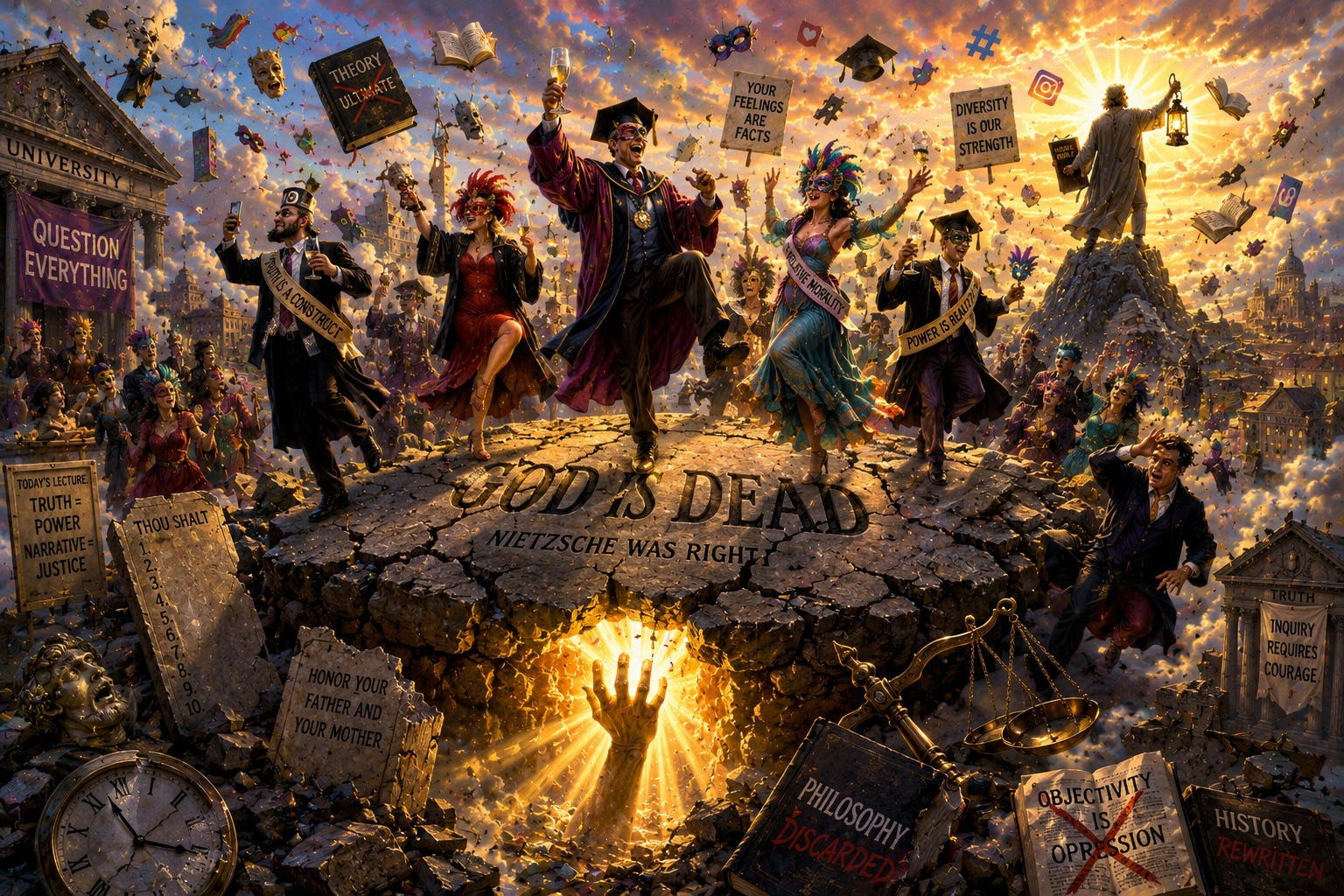
And academia, in its arrogance, has increasingly convinced itself that it has killed the Judeo-Christian God. Through moral relativism, narrative absolutism, and the worship of subjective identity over objective truth, many within our intellectual class now behave as though they are dancing triumphantly upon God’s grave.
They believe the old moral architecture of the West has been dismantled forever. They believe that truth itself is infinitely malleable, that morality is merely performance, and that power alone determines meaning.
But they are wrong.
God is not dead.
And the terrifying instability now spreading through Western civilization is not evidence of liberation from transcendent truth, but evidence of what happens when a civilization attempts to sever itself from the moral foundations upon which it was built.
This postmodern doctrine is extraordinarily seductive because it flatters the ego while simultaneously liberating ideology from accountability. Once objective truth dies, all that remains is narrative warfare. And narrative warfare rewards emotional manipulation over disciplined inquiry every single time.
Politicians understand this instinctively. A politician no longer needs to solve difficult policy problems. He merely needs to curate emotional identities. Mark Carney does not need to answer for the collapse in productivity, the decline in per capita wealth, housing dysfunction, bureaucratic paralysis, or national stagnation. He merely needs to project the narrative of the calm paternal technocrat protecting Canada from the barbarian Trump.
Trump himself operates similarly through narratives of grievance, restoration, resentment, and national humiliation. This is not exclusively a Left-wing phenomenon. But it is unquestionably more deeply institutionalized on the modern Left because universities, bureaucracies, unions, activist organizations, media institutions, and much of the educational system now function primarily as mechanisms for narrative enforcement rather than as institutions of inquiry.
And beneath all this lies another uncomfortable truth modern society increasingly refuses to discuss openly: the feminization of public morality. This has nothing to do with dresses, mannerisms, or caricatures of femininity.
It refers instead to the elevation of emotional safety over inquiry, emotional validation over confrontation, consensus over truth, empathy over rigour, and feeling over examination. A feminized moral culture increasingly interprets disagreement itself as aggression. Thus, skepticism becomes cruelty. Questioning becomes harmful. Inquiry becomes violence. And institutions increasingly reward emotional conformity while punishing intellectual courage.
The irony, of course, is staggering. We live in the first civilization in human history with near-infinite access to information. Every historical claim, economic argument, statistical assertion, or political narrative can be investigated within minutes. The average citizen now possesses access to more information than the greatest libraries of antiquity. And yet perhaps no civilization has been less willing to examine evidence honestly.
But there is still a problem.
Critical thinking is exhausting.
It requires humility. Patience. Contradiction. Uncertainty. Self-doubt. The willingness to discover one is wrong.
Narratives require none of these things.
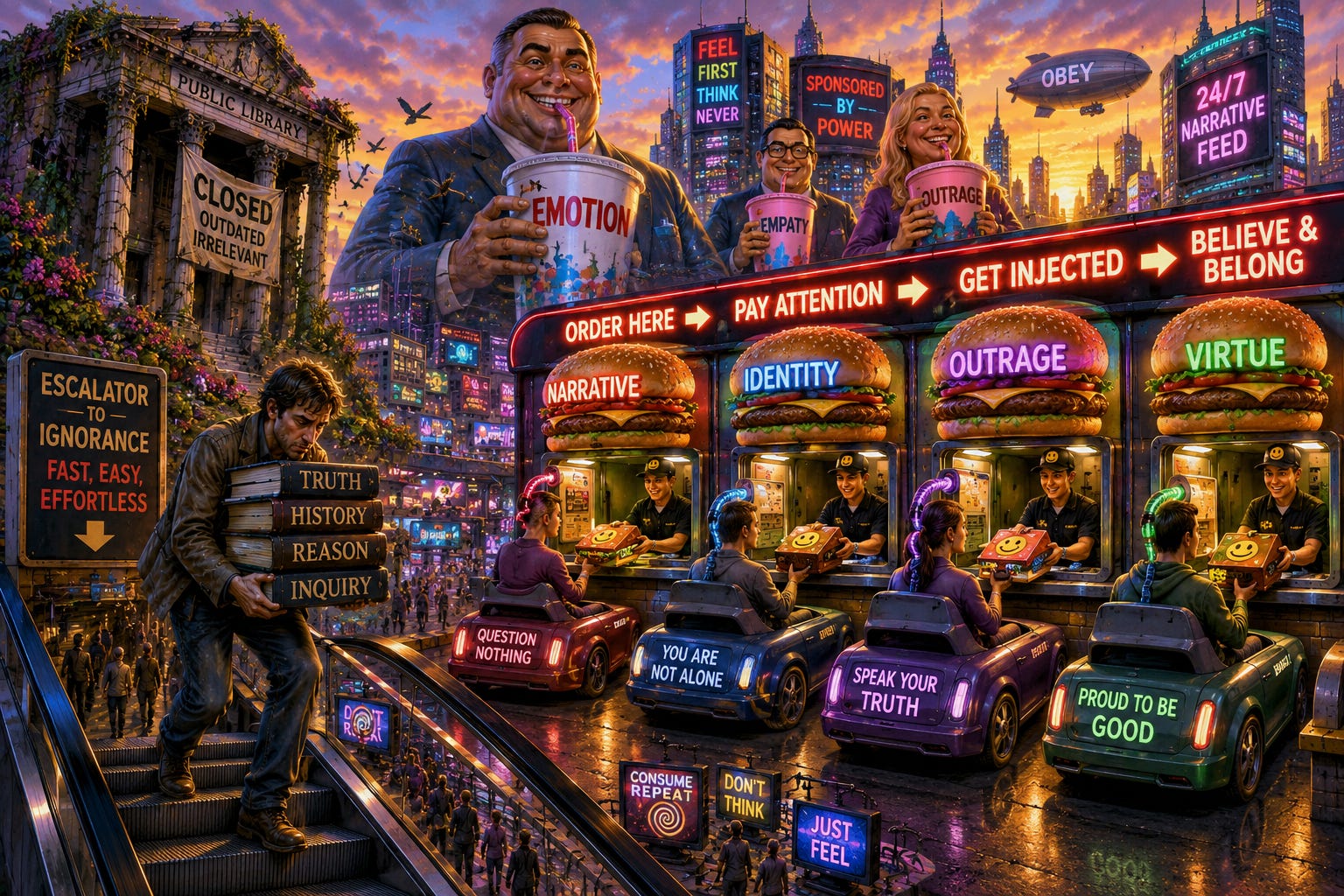
Narratives are intellectual fast food. They are processed cognitive calories: easy, immediate and emotionally satisfying. Critical inquiry burns energy. Narrative consumption requires only appetite. And like processed food, narratives gradually destroy the organism consuming them while providing temporary pleasure and stimulation. A civilization raised on narratives develops the intellectual equivalent of diabetes.
I think there is value in writing what I have written above, although I increasingly suspect that the pursuit of ultimate meaning through reasoned argument alone may itself be futile. As the writer of Ecclesiastes put it, it may well be “a chasing after the wind.”
Perhaps this essay itself is chasing after the wind.
And the reason it will likely have little effect is not merely because of its lack of reach, although that is certainly true. I am not a major media figure. Nor is the reason simply that modern society increasingly cannot tolerate reading more than a few hundred words without drifting into distraction and exhaustion. We are, after all, a civilization now consuming thought in fragments, slogans, memes, emotional spasms, and algorithmically optimized outrage.
But that is not the real reason.
The real reason is that the dominant power structures in our society prefer narrative adoption because it is vastly easier to maintain power through narratives than through reason and the testing of ideas. Narrative management is simple. It is emotionally efficient. It is politically profitable. It is the fast foodization of thought itself.
Reason is laborious.
Inquiry is slow.
Truth is often uncomfortable.
Testing ideas creates instability.
Narratives are effortless.
Narratives can be packaged.
Branded.
Repeated.
Monetized.
Weaponized.
And institutions built on ego, branding, bureaucratic self-preservation, and ideological conformity do not want populations trained to think critically. They want populations trained to consume emotionally satisfying narratives and then defend them tribally.
And so perhaps Ecclesiastes is right. Perhaps much of this is chasing after the wind.
And yet one thing has emerged from my own torturous two-and-a-half-year ordeal, with the torture still continuing through the inanities of institutions such as the Ontario Labour Relations Board that may very well conclude, in its Kafkaesque echo chamber of self-righteousness, that a union which stated plainly in writing, “We refuse to represent you,” nevertheless provided adequate representation.
Consider the internal contradiction embedded in that proposition.
Non-representation as representation. Love as hate. War as peace.
A category error so absurd that it would once have embarrassed serious institutions.
Yet this is now presented as wisdom by our noble administrative order.
Because beneath all of this lies the true governing narrative — the sacred assumption upon which the entire modern labour architecture now rests: the union are the good people. Their intentions are presumed righteous before evidence is even examined.
The labour board does not truly approach the matter asking, “What occurred?” but rather, “Surely they must have meant well.”
And once intention replaces conduct as the standard, reality itself becomes negotiable.
The emails saying “we refuse to represent you” become unfortunate misunderstandings. Eleven months of silence become “strategic consideration.” Abandonment becomes discretion. Ideological hostility becomes merely “communication difficulties.” The member pleading for representation becomes the problem because his existence threatens the narrative itself.
And now we arrive at the truly grotesque part of the story.
The very union OPSEU that treated my statement — “Hamas are Nazis” — as though it were some species of moral transgression severe enough to justify abandonment has recently had one of its own campaign managers publicly exposed by the organization Canary Mission for expressing admiration for Hitler’s exterminatory project against the Jews.
The allegation was not that this individual misspoke awkwardly about Middle Eastern politics. The allegation was that he lamented not being alive during Hitler’s era so he too could have participated in the “glorious” mission of ridding the world of Jews.
Pause for a moment and consider the moral inversion required here.
A professor saying “I stand with Israel” becomes radioactive.
A union activist allegedly glorifying Hitler becomes, at worst, an uncomfortable administrative inconvenience. The union refuses to terminate him.
And one suspects — indeed one already sees the outlines forming — that this too will be rationalized away by the labour apparatus. It will become context. Nuance. Complexity. An isolated matter. Perhaps irrelevant. Perhaps unfair to mention. Perhaps merely another “communication issue.”
Because again, the narrative must be protected at all costs.
The union are the good people.
Therefore, evidence contrary to the narrative cannot truly matter.
And once institutions begin from the premise that certain actors are morally sanctified in advance, no amount of evidence can overcome the presumption. A Jewish member abandoned by his union becomes suspicious. A union activist allegedly praising Hitler becomes redeemable. The institution does not follow facts to conclusions; it begins with conclusions and edits the facts afterward to preserve them.
That is the true sickness here.
Not merely bias. Not merely cowardice. But the complete replacement of moral reasoning with ideological tribalism masquerading as justice.
For if a union can act vindictively, ideologically, discriminatorily — if a labour institution can knowingly permit non-representation while still calling it representation — then the mythology cracks. The comforting fable collapses. The public might begin to realize that institutions do not remain moral merely because they describe themselves as moral.
And so the system bends itself into intellectual pretzels to preserve the story.
The union tried.
The union meant well.
The union are the good guys.
Even when they explicitly abandon the member.
Even when they refuse to read his emails.
Even when they sided, functionally and ideologically, with the employer against the worker, they were legally obligated to defend.
The narrative must survive because the narrative is now more important than the facts.
And where does one go after that?
Where have I gone?
This piece is not meant to proselytize. I was raised in the Christian faith. I left it for nearly twenty-five years. I considered myself too rational, too sophisticated, too intellectually evolved for religion. But I have returned to it.
And at the end of the day, while I will stand ideologically beside my Jewish brothers and sisters against the madness consuming the West, it is ultimately my Christian faith to which I return.
That is now the bedrock beneath my life in a civilization increasingly corrupted by ego, branding, self-enrichment, institutional vanity, and collective delusion masquerading as enlightenment.
Perhaps I am chasing after the wind by writing this.
I know I will not catch the wind.
And I know now that my true foundation will not be found in the approval of institutions, in labour boards, universities, administrators, journalists, or ideological mobs. It will be found in faith, in truth that transcends branding and narrative, and in the stubborn belief that there remains something eternal beneath all this noise and hysteria.
“Vanity of vanities,” saith the Preacher, “all is vanity… and vexation of spirit.”
— Ecclesiastes 1:14
Or perhaps more plainly:
“Professing themselves to be wise, they became fools.” — Romans 1:22
And more ominously still:
“Pride goeth before destruction, and a haughty spirit before a fall.” — Proverbs 16:18.
A civilization that abandons truth for narrative eventually does more than merely confuse justice with hysteria, inquiry with propaganda, or wisdom with performance. It begins to lose the very faculty required to distinguish reality from fiction at all.
And that is the true danger of narrative culture.
Not simply that people choose a conclusion first and then backfill the evidence afterward — intellectually dishonest though that already is — but that the process itself slowly corrodes the civilization’s respect for truth as an objective concept. Truth becomes unfashionable. Evidence becomes secondary. Reason itself becomes suspect, even emasculated, because reason is slow, disciplined, and often inconvenient to the emotional satisfactions of ideology.
And in the vacuum left behind, society descends from truth into “truthiness” — that poisonous modern doctrine in which something need not be true so long as it feels morally satisfying to the tribe repeating it.
At that point, falseness is no longer considered a defect. It becomes a political instrument.
Narratives become sacred. Evidence becomes editable. Language becomes elastic. Institutions cease to ask, “Is this true?” and begin asking only,
“Does this serve the story we wish to tell?”
And once a society reaches that stage, it is already wandering into Orwellian territory, whether it possesses the courage to admit it or not.
Because democracies rarely collapse in one dramatic moment. They decay gradually through the normalization of intellectual cowardice. Through bureaucracies that reward conformity over honesty. Through institutions that protect narratives over facts. Through citizens trained to fear social exile more than falsehood itself.
Then one morning, people awaken, bewildered, staring at the ruins of freedoms they assumed were permanent, asking: How did this happen? How did we arrive here?
But the answer will have been visible the entire time.
We were warned the moment truth became negotiable.
If you value this work, consider leaving a tip. It’s cheaper than therapy, less pious than public broadcasting, and the only censorship here is my bad taste. On second thought, it’s bad therapy.
October 7, 2023, refers to the Hamas-led terrorist attack launched from Gaza into Israel in which approximately 1,200 people were murdered and more than 240 taken hostage, including civilians, children, elderly people, and foreign nationals. The attack included mass shootings, kidnappings, torture, sexual violence allegations, and the burning of civilians alive in homes and shelters. It was the deadliest massacre of Jews since the Holocaust and served as the catalyst for the subsequent Israel–Hamas war in Gaza.
The denial and disinterest in evidence production is strange. As an example, I see this with survey and polling data. If I cite a poll, I frequently hear "well, polls can say anything". Not, what is the survey methodology? --which would be a proper response. This comes up a lot in polling of Islamic populations in the West as to radical tendencies and opinions within those communities. Polls and surveys can be useful and there are scientific statistical standards that can be applied as to sample size and other criteria. It's kind of anti-science to just reject survey data outright.
Canada became like the Soviet Union.
Only uglier. Much uglier.