


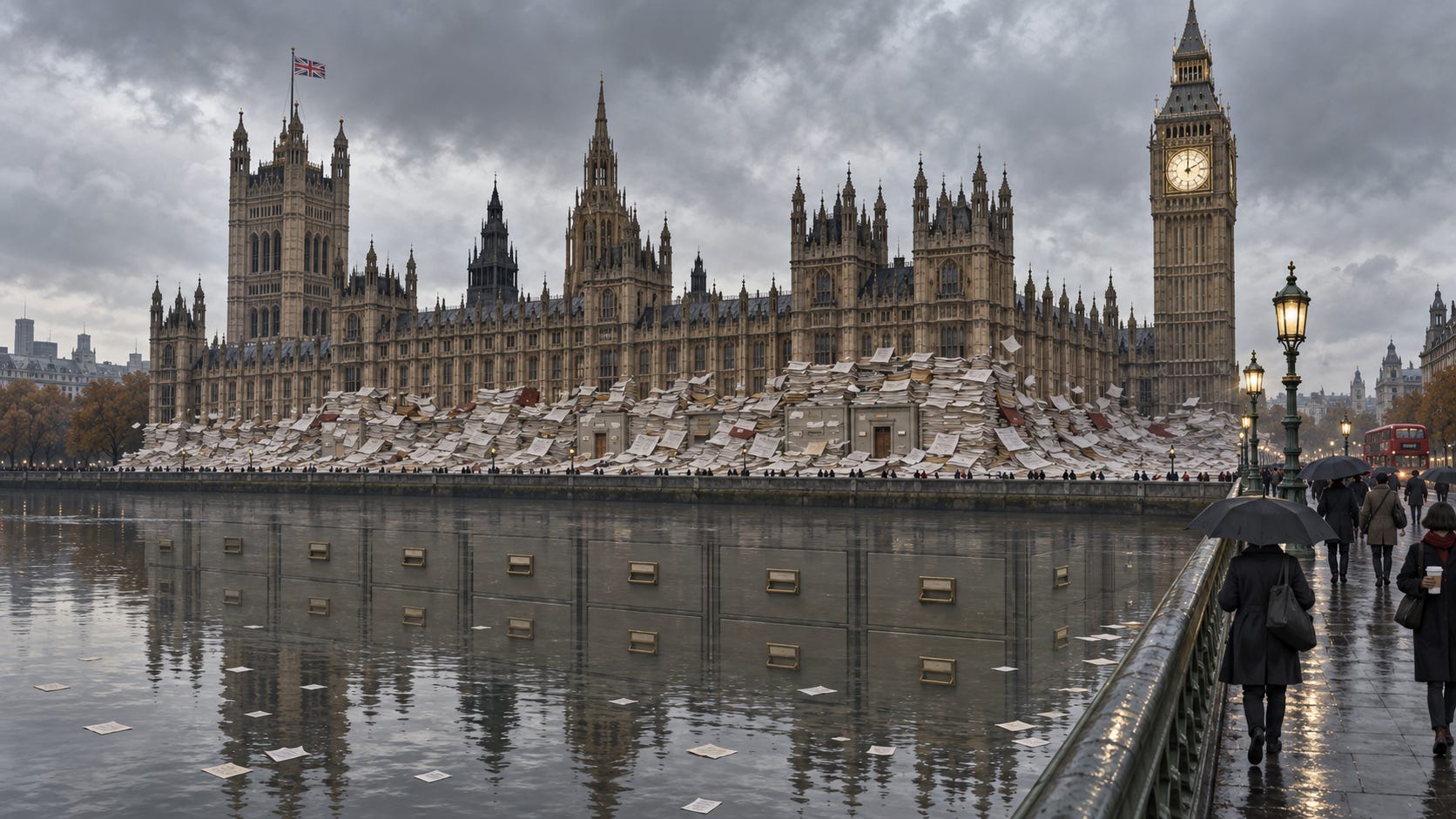
The interview took place in an undisclosed location in London in October, 2050.
There was nothing particularly remarkable about the view. Parliament was still there. The British flag still flew. The bells of Westminster still marked the hour. Tourists crowded the pavements, though only around the most famous tourist hot spots, and rather fewer than there had been twenty years before.
Britain remained a parliamentary democracy. Officially anyway.
There had been no coup, no revolution, no suspension of elections. No foreign army had occupied London. No explicit forced conversions, just a lot of conversions that seemed in people’s best interests. Blood had not run in the streets. The monarchy remained; Harry and Meghan were in their 60s now - Meghan had a cooking YouTube channel where she talked about racism, her fictionalized impoverished upbringing in Compton, and crowed about her shiny new $75,000 stove. The BBC remained, but they made sure that a high-ranking Muslim Imam was on every political panel discussion.
Football remained almost entirely untouched. Chelsea still had more money than God.
The country had simply changed.
The government formed after the election of 2049 was a minority administration supported by an alliance of the Green Party, the Liberal Democrats and a small parliamentary bloc associated with Britain’s political-Islamist movement that - although they denied it at the time - was now widely accepted to have been the Muslim Brotherhood.
Various Muslim countries, including Egypt and the UAE, had warned Britain, but their admonitions fell on deaf ears. The domestic political arrangement—eventually known by the creepy tag, the Shared Future Party—had evolved gradually over almost twenty years and had never acquired a particularly satisfactory name. Its constituent parties had been in and out of government for much of that period. Today, though, they held power in a minority Parliament, sustained by an agreement among three parties that guaranteed enough votes to keep the government alive without formally merging them into a coalition.
Religious arbitration with Sharia courts now had a recognized place within almost all family and civil law. Universities had undergone substantial changes in curriculum, governance, gender separation and funding. Relations with Israel had effectively ceased. Most of Britain’s Jewish population had bolted during the previous decade, the largest movement occurring after the disturbances of 2044 and the government’s subsequent Resettlement Assistance Programme (RAP).
Nobody called it an expulsion.
RAP had been voluntary but seemed a foregone conclusion after the riots in 2042 when an Arab girl said (but later recanted) that an old Jewish man had ripped off her hijab. This slander grew into sexual assault allegations. Twelve synagogues were burned that winter night, and one week later there was the bombing at the Edgware United Synagogue in London with hundreds left dead.
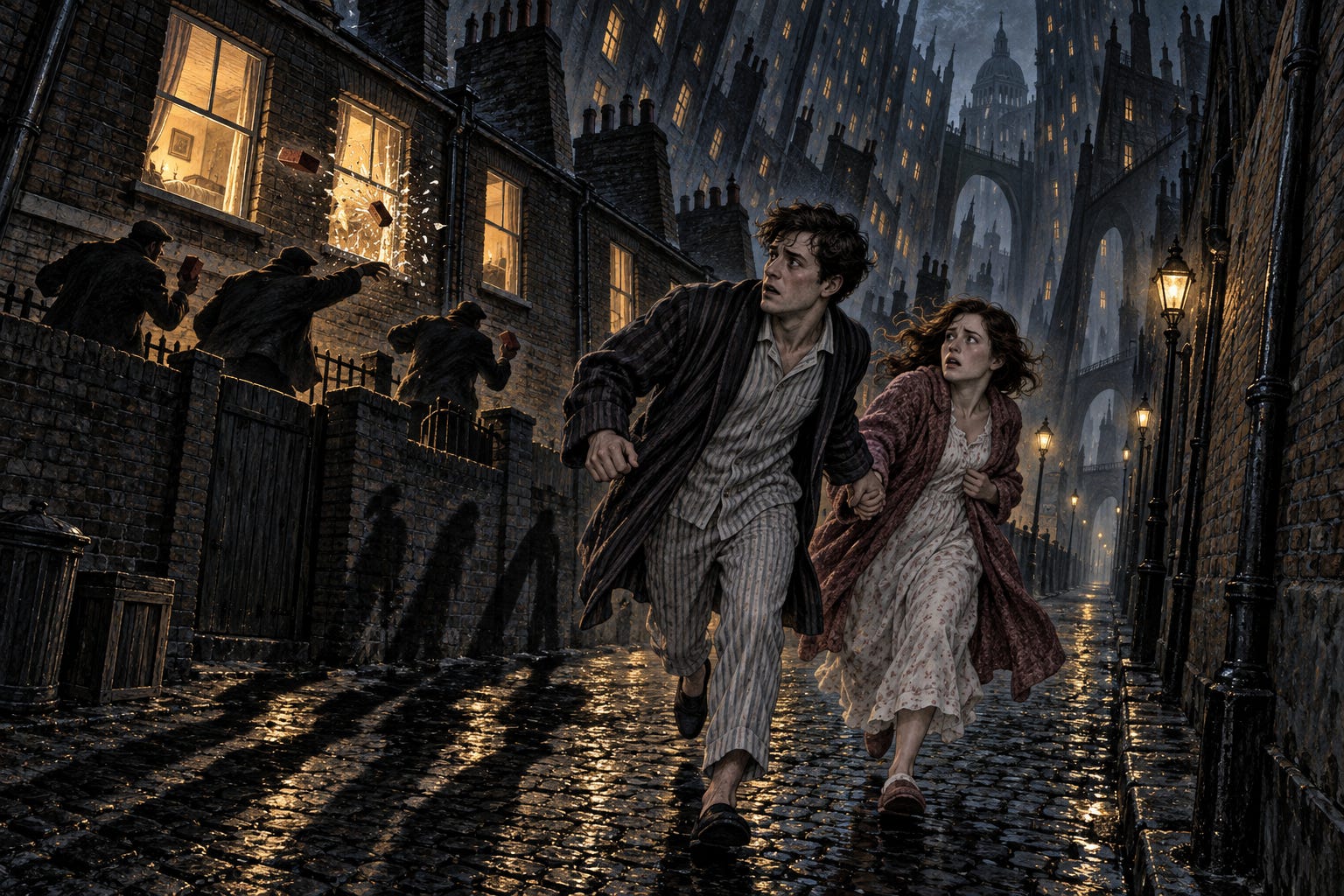
Yes, it was clear that Great Britain was not safe for Jews even though most of them had changed their surnames to ones that did not hint at Jewishness. But the name change database had unfortunately been hacked, and the Jewish name changers had been doxxed, resulting in two frightened families running barely clothed down their back lane as miscreants hurled bricks through their windows.
Jewishness couldn’t be hidden in a digital age.
But Britain in 2050 was not officially an Islamic state.
Alcohol was legal and available, except on Muslim holidays and only to those who showed their state ID, which now included religion. Eating in public was banned in Ramadan. Some women worked throughout government, medicine, business and the professions, but it was discouraged.
Churches remained open, though increasingly empty. Same-sex relationships were legal in private, and civil partnerships remained recognized, but marriage had been redefined some years earlier as an institution between a man and a woman. The legislation had been presented as a compromise.
Pride marches had not been prohibited. They had simply become rather difficult to hold. Insurance requirements increased and became extremely expensive. Municipal permits became more restrictive. Public-decency regulations changed. Police repeatedly advised organizers that large demonstrations presented an unacceptable risk to community harmony. Harmony was a word one heard more often in those days.
Pork was still legal. Specialist shops sold it. Some restaurants served it. Most large supermarket chains had gradually reduced the space devoted to it, particularly in urban areas. Nobody had ordered them to do so.
They had responded to customers.
Dogs remained popular, though newer public-health regulations restricted them in certain parks, playgrounds and communal recreation spaces. There were still dog parks.
There were simply fewer places where dogs were welcome than there had been.
None of these things, considered separately, seemed particularly dramatic.
That was perhaps the point.
People complained about taxes, trains and football managers with reassuring continuity. Couples argued over mortgages. Children avoided homework. Restaurants opened and closed. British television remained preoccupied with murder mysteries.
The transformation was therefore difficult to describe.
It was easier to notice what had disappeared than to identify the moment at which it disappeared.
I spoke with an eighty-one-year-old gentleman; we will call him Mr. Vale. He is a retired senior civil servant who had worked successively in the Department for Education between 2014 and 2031. He chose to remain anonymous, as I have. There is no point in risking violence, or risking a visit from the Met’s enormous Digital Morality Enforcement unit.
Mr. Vale had never belonged to a political party.
He had spent most of his career being described as moderate.
He seemed mildly embarrassed by the suggestion that he had participated in anything historic.
We began with the obvious question.
INTERVIEWER: When did these changes begin?
VALE: I don’t think there was a starting point - not in the sense you mean. People like dates. A government falls. A war begins. Something happens at ten in the morning, and afterward everything is different.
We didn’t have that. Not that I remember.
It accumulated. The proper word is accretion, the slow build-up, often too small to detect.
INTERVIEWER: Historians often begin around 2026.
VALE: Historians need somewhere to put the chapter heading.
There were political changes around then. Gaza had become unusually important in British electoral politics. The Greens discovered that it mobilized voters who had not previously seen the party as particularly relevant to them. 75% of Muslim voters put it as their number one issue. The Liberal Democrats noticed similar possibilities.
That wasn’t particularly sinister. Political parties notice voters - It’s practically the job description.
INTERVIEWER: Except many of those voters disagreed with the Greens on almost everything else.
VALE: Quite a lot, yes. Sexuality. Gender. Family structure. Religion. Sometimes environmental policy.
But nobody worried very much about it.
Political coalitions have always been composed of people who would dislike one another enormously if they had to spend a weekend together.
The assumption was that they could deal with the disagreements later. Later became a very busy place. But everyone was sure that they could manage any coalition.
INTERVIEWER: Did the Greens care about Gaza, or did they care about the votes?
VALE: Both.
Different people in the same party can have different motives. This apparently surprised us at the time.
Some activists were passionately committed to Palestine.
Some politicians discovered that passionate activists were useful.
Some politicians were both passionate and ambitious.
Human beings are inconveniently mixed. Half the time we don’t know what motivates ourselves.
INTERVIEWER: When did the Muslim Brotherhood become important?
VALE: That phrase became too easy afterward, but it wasn’t that simple. There were organizations influenced by Brotherhood ideas. There were other Islamist organizations. There were charities, lobbying groups, religious organizations and political networks with varying relationships to one another. They all put on a good face. But they were not violent; they denied being part of the Brotherhood; they acted more as a movement than an organization.
No single control room ever existed, as far as I heard.
That was the mistake both sides made.
One side imagined a conspiracy.
The other concluded that because there was no conspiracy, nothing was happening.
INTERVIEWER: What was happening?
VALE: Organization. Politics rewards organization.
Four million people don’t need to agree on anything for a comparatively small number of disciplined organizations to become influential.
Governments liked dealing with them because governments like representatives.
You invite six people into Whitehall, give them tea and afterwards announce that you have consulted the Muslim community. The Muslim vote was growing quickly, and it is rare in politics to capture a voting bloc with one issue; it was political magic. The issue was Gaza. Politicians didn’t need to create a complex dish full of hundreds of ingredients; they just needed the raw meat of Gaza.
So four million people were apparently accommodated around one table.
It was very efficient.
INTERVIEWER: And many Muslims didn’t regard those organisations as representing them.
VALE: Of course not.
One of the great simplifications of the period was the phrase “the Muslim community.”
There wasn’t one.
There were wealthy Muslims and poor Muslims, secular Muslims and devout Muslims, Labour voters and Conservatives, businessmen, taxi drivers, surgeons, students, Islamists, people who barely went to mosque and people who structured their entire lives around religion. But block voting helped. The ballot remained secret in principle; in practice, certain self-appointed community leaders collected the postal voting papers and relieved their neighbours of the inconvenience of choosing. Nobody pushed back.
We knew this. But then we spoke as though we didn’t. In hindsight it was foolish.
INTERVIEWER: How did the alliance hold together?
VALE: By not discussing the future.
The Greens wanted environmental transformation.
The Liberal Democrats wanted political relevance and electoral reform.
Islamist organizations wanted greater recognition of religious institutions, influence over education and changes in foreign policy. Back to accretion.
Campus activists wanted Palestine.
Local politicians wanted constituencies.
Universities wanted money, Qatar helped them out there. Everyone needed something from everyone else.
Nobody needed to agree on the destination. They only needed to agree on the next station.
INTERVIEWER: Looking back, that seems extraordinarily naïve.
Vale smiled.
VALE: Yes.
I’m afraid it does. We thought we were very sophisticated. We were arrogant. Of course that may have been the problem.
My generation had tremendous confidence that extremism was something other people fell for.
We had universities. We had newspapers. We had the BBC. We had Holocaust education. Everyone had degrees coming out of their ears.
Therefore, presumably, we couldn’t be manipulated.
It was rather like assuming that owning a cookbook means you can’t burn dinner.
INTERVIEWER: Yet even then significant numbers of people knew remarkably little history.
VALE: Yes.
That mattered more than we understood.
There were surveys showing people doubting or minimizing the Holocaust decades after the survivors had spent their lives explaining exactly what happened. I met a number of people who put air quotes up when they mentioned the Holocaust. But I let it go.
INTERVIEWER: You see a parallel?
VALE: Not with the Holocaust.
There was no extermination programme in Britain. No camps. No Nuremberg Laws.
But the older lesson was relevant.
A population can be persuaded to accept increasingly ugly ideas about a minority while remaining convinced that it is behaving reasonably.
The extreme comparison usually prevents people from seeing the ordinary mechanism. Complaining about Holocaust education actually helped the Islamists.
INTERVIEWER: And the ordinary mechanism was?
VALE: Repetition. Simplification. Moral certainty. Certainty seemed to run ahead of examination.
And there was the need for an explanation when things weren’t going well.
You hear that Jews control the government.
Then Israel controls the government.
Then the Zionists control the government.
Then someone says, “the lobby.” But nobody said what the lobby really was.
Someone else says “global finance.” But no evidence.
Most people repeating these things would insist they had no problem with Jews.
Some genuinely didn’t.
Language has a way of carrying more history than the speaker intends.
INTERVIEWER: Polling at the time showed some antisemitic conspiracy beliefs were considerably more common among British Muslims than among the general population.
VALE: Yes. But we were never allowed to say that. So we didn’t. Self-censorship is always more effective than state censorship. But you are right, that should have been discussed honestly. Instead, we had our usual choice between hysteria and denial.
One side said, “You see? Muslims are antisemitic.” But many weren’t.
The other said that raising the figures was suspicious in itself.
Which was also absurd.
We became strangely incapable of saying: here is a real problem inside part of a population, and people inside that same population may be among those most interested in solving it.
Apparently nuance had become exhausting. Denial was easier.
INTERVIEWER: Yet antisemitism wasn’t simply Muslim.
VALE: Far from it.
Britain had centuries of its own. We had kicked the Jews out of England before. But as to antisemitism? - The far right had it. Parts of the radical left had it. Conspiracy culture had it. Certain imported religious traditions had it.
And then there was the economic disappointment.
Young people did what they had been told to do. They studied, borrowed, qualified, applied. Some couldn’t find work; others found work that barely paid the rent. An ordinary adult life seemed indefinitely postponed. Kids never moved out.
They had legitimate grievances. But a grievance doesn’t arrive with an accurate explanation attached.
When you feel powerless, it's comforting to believe somebody is in control. Somebody who could open the door and has chosen to keep it shut.
INTERVIEWER: The elites.
VALE: Yes. And powerful people deserve scrutiny. Wealth buys access. Institutions protect their own. None of that requires a conspiracy.
But in some circles, the explanation began to change. People stopped asking which decisions had failed them and started asking which people secretly controlled everything.
“The elites” became “the globalists.” Then certain surnames began appearing rather more often than others. Someone’s Jewishness, irrelevant to the original complaint, became the detail that supposedly explained it. It was slow, but then we were there.
Nobody needed to announce the change. A speaker could suggest it and leave the audience to complete it.
Most disappointed people did not become antisemites. But those offering antisemitic explanations found an audience among people desperate for their disappointment to make sense.
What changed was that hostility to Israel gave several quite different traditions a common language.
Sometimes criticism of Israel was simply criticism of Israel.
Sometimes anti-Zionism was political conviction.
Sometimes very old ideas about Jews appeared wearing a Palestinian badge.
A young person might begin by asking why he couldn’t afford a home and end up sharing a post about Jewish bankers. Somewhere along the way, someone gave him a culprit instead of an explanation.
INTERVIEWER: Why?
VALE: Because distinctions are work.
And because politicians had constituencies.
Universities had demonstrations. Administrators disliked complaints. It was not heroic. Very little history is.
INTERVIEWER: There was also the question of Sharia.
VALE: Another word that did far too much work.
VALE: Surveys in the old period showed significant support among British Muslims for introducing aspects of Sharia.
But what did that mean?
To one person it meant religious guidance.
To another, marriage or inheritance.
To another, an imam mediating a family dispute.
To a smaller number it meant something much broader.
We knew the distinction.
Then, over the years, limited support for one thing was repeatedly cited as evidence of consent for the next thing.
In 2039, several councils asked restaurants in particular districts to remain closed during daylight hours throughout Ramadan. An accommodation, they called it. Initially voluntary. But owners who stayed open found themselves having to explain why.
Some Muslim restaurateurs objected too. Their objections received rather less attention than the organizations claiming to speak for them.
In 2040 came the restrictions on dogs in certain parks. The published justification was because of a series of pit bull attacks. There had also been complaints from some Muslim residents about dogs, and opponents believed those complaints had driven the decision.
I couldn’t tell you what weight each consideration carried. Neither, apparently, could the council explain to anyone’s satisfaction.
Each measure arrived separately, with its own paperwork and its own reasonable-sounding explanation. By the next consultation, the previous concession was treated as settled practice.
INTERVIEWER: And you regarded that as Sharia?
VALE: Some supporters did. Others would have rejected the description entirely. That was part of the difficulty.
What concerned me was the gradual change in who was expected to accommodate whom. People who had asked for the freedom to observe their religion were increasingly represented by people asking everyone around them to observe its restrictions.
Consent to religious guidance had somehow become consent to closing a restaurant. Nobody had voted for the whole arrangement.
They had been consulted about it one piece at a time. Nobody wanted to be called an Islamophobe.
INTERVIEWER: Accretion again.
VALE: Exactly.
Yesterday’s limited consent becomes tomorrow’s precedent.
Nobody says, “Today we shall create a parallel legal order.”
A mediation arrangement is recognized.
Then an arbitration agreement.
Then another jurisdiction. Each change is quite small, and some are entirely reasonable.
Twenty years later someone asks when the system changed, and nobody can remember. But I remember; my grandkids don’t believe me, though.
INTERVIEWER: Was that how same-sex marriage disappeared?
VALE: More or less.
It wasn’t abolished with trumpets. There was a long argument about religious conscience, social cohesion and the distinction between civil recognition and marriage.
Eventually civil partnerships were retained, and marriage was restored to a heterosexual definition.
The government presented it as preserving rights while reducing conflict.
INTERVIEWER: Pride disappeared too.
VALE: Pride marches disappeared. Gay people didn’t. That’s an important distinction.
Nothing prevented two men from living together. Nobody was conducting raids on bedrooms. But public expression became more regulated.
Permits became difficult. Public-decency provisions changed. Police warned about disorder.
For several years organizers fought the restrictions. Then participation declined.
Eventually there was nothing much left to prohibit.
INTERVIEWER: And people accepted this?
VALE: Most people didn’t think about it very much.
That is another misconception- political changes do not require enthusiastic support from the population.
Often, they require exhaustion or simply that not enough people are willing to say no. Silent majorities don’t push back.
INTERVIEWER: There are other small things people notice now. Pork.
VALE: Pork is still legal.
I had bacon last Christmas.
It’s more expensive than caviar.
INTERVIEWER: But most supermarkets barely stock it.
VALE: Particularly in the cities.
Consumer demand changed. Retailers changed. Some councils altered procurement. School meals changed.
No minister ever announced the Great British Pork Withdrawal.
It just became slightly inconvenient - then considerably inconvenient.
Then something younger people found faintly peculiar.
INTERVIEWER: Dogs?
Vale laughed.
VALE: I knew you’d get to dogs.
INTERVIEWER: Why are they banned from so many parks?
VALE: They’re not banned from parks.
They are restricted from designated communal spaces under the Clean Recreation Regulations.
INTERVIEWER: That sounds suspiciously like a ban
VALE: It does, doesn’t it?
INTERVIEWER: Why would people who had chosen Britain want to reproduce elements of societies they or their families had left?
VALE: Because people don’t migrate as blank sheets of paper.
That was another rather silly assumption. It was as stupid as saying a group that only made up 15% of the population couldn’t change it all for the rest. History offered us lessons on that, but we didn’t listen.
A man can believe Britain is richer, safer and better governed than the country his parents came from while also believing that his religion is true, his family structure is better, and his inherited culture is morally superior.
No contradiction exists in his mind. Expecting him to believe his religion led to the failure of his old society is a bridge too far; scapegoating gives us a much shorter bridge to cross.
INTERVIEWER: Why useful?
VALE: Because scapegoats simplify causation.
An economy stagnates for forty years because of institutions, education, governance, demographics, investment, technology, corruption, international conditions and perhaps twenty other things.
That is a dreadful campaign speech: “The Jews did it” is much shorter.
INTERVIEWER: That sounds darker than your other answers.
VALE: It was darker. It wasn’t confined to Muslims either.
That’s important.
By the late 2030s, the coalition of people willing to explain almost any international event through Israel had become remarkably diverse.
Some were Islamists. Some were revolutionary socialists. Some were old-fashioned conspiracy theorists. Some were just losers who couldn’t hold down a job. Some were merely people who had repeated something so often they no longer remembered why they believed it.
INTERVIEWER: When did British Jews understand what was happening?
VALE: Earlier than we did. Minorities usually notice changes in the weather before the majority.
Security increased. Jewish students became quieter about being Jewish on some campuses.
Families left gradually.
Then came the disturbances in the early 2040s.
After 2044, the pace changed.
INTERVIEWER: And in 2045 the government effectively drove them out.
VALE: Effectively, yes. Legally, no.
The distinction mattered tremendously to us at the time. But today it seems like a foolish pretence.
INTERVIEWER: The Resettlement Assistance Programme.
VALE: Yes.
It provided substantial assistance for families wishing to relocate to Israel and several other countries. Participation was voluntary.
INTERVIEWER: Voluntary after the state had failed to keep them safe.
Vale looked down at his hands.
VALE: Yes.
That’s fair.
INTERVIEWER: Did you support it?
VALE: I thought it was humane. At the time. That’s one of the answers I find difficult now.
We had reached the point where helping Jews leave Britain struck us as more administratively realistic than making Britain safe enough for them to stay.
And we congratulated ourselves on the generosity of the relocation package. Lots of jokes about leaving our cold winters, saying they should be grateful.
One does occasionally wonder how we managed to be quite that stupid.
INTERVIEWER: Were you afraid of being called racist?
VALE: Certainly.
But that explanation became far too flattering afterward.
“We were too tolerant.”
“We were too kind.”
Nonsense. We were too cowardly; there was not a surplus of virtue.
We were ambitious. Politicians wanted votes. Universities wanted funding.
Activists wanted allies. Councils wanted quiet. Civil servants wanted recognized interlocutors. The Greens wanted power. The Liberal Democrats wanted power. Religious political organizations wanted influence.
Everybody thought the bargain served them.
INTERVIEWER: The secular parties believed they could manage the Muslim Brotherhood organizations.
VALE: Yes.
That was essentially it.
Not manage them in some conspiratorial sense. They thought the relationship had boundaries. Give a little recognition here, a concession there - religious accommodation -it looked clever.
INTERVIEWER: It wasn’t.
VALE: No.
Though I wouldn’t say the Islamists simply won either. That gives them too much credit.
A great many Muslim voters now feel cheated by the entire arrangement.
They voted over Gaza, discrimination, schools or simple party loyalty. They didn’t necessarily vote for the Britain of 2050.
INTERVIEWER: Yet their votes helped create it.
VALE: So did everyone else’s. That’s one of the unpleasant truths.
A socially conservative Muslim shopkeeper could vote repeatedly for candidates because of Palestine and eventually discover that he had helped sustain a government whose economic policies hurt his business and whose official religious representatives he had never chosen.
He might reasonably ask, “How did this become my revolution?”
It wasn’t.
INTERVIEWER: And Green voters?
VALE: Some eventually asked the mirror-image question.
They had wanted climate policy, proportional representation and social liberalism.
They found themselves defending the removal of same-sex marriage because the coalition couldn’t survive another religious dispute.
That wasn’t quite the future they had pictured either.
Each side believed it could deal with the other's peculiarities later. There were no angels.
INTERVIEWER: Who actually won?
VALE: I’m not sure anyone did. Nobody is happy.
The Jews left. Many Muslims feel they were politically manipulated.
The Greens compromised on things they once considered fundamental.
Religious conservatives live under other policies they dislike.
With classrooms now segregating by gender, though of course it’s because they learn better that way - how many non-Muslim profs are being hired? Almost zero.
The economy still carries the damage of the 2030s.
And every party insists that the unpleasant parts of the arrangement were somebody else’s idea. It is, in that respect, still recognizably British.
INTERVIEWER: But Britain still functions.
VALE: Of course.
That is what people from 2026 would have found hardest to understand. But if I pulled a Rip Van Winkle and fell asleep in 2026 and woke up today, I would want to go back to sleep. Nobody fell asleep, though; they lived through it. They imagined dystopia as rubble, but there isn’t much rubble.
There are trains, mortgages. People watch football. Teenagers complain about their parents.
There are very good restaurants.
I had lunch yesterday with my granddaughter. She thinks the country is perfectly normal. For her, it is. She converted to Islam years ago.
INTERVIEWER: Does that make what happened less serious?
VALE: No.
It makes it harder to see.
If the world ends, everybody notices.
If the world merely changes its assumptions, people go to work.
INTERVIEWER: So when people ask you now, “How did you let this happen?”, what do you tell them?
VALE: That we didn’t let this happen. That implies it was one thing. We let thousands of things happen. Almost none seemed large enough to justify drawing a line and declaring a national emergency.
After every one of them, Britain was still Britain.
INTERVIEWER: Until it wasn’t. And if you could go back to 2026 and tell people one thing?
VALE: I wouldn’t tell them to fear Muslims. I would tell them to stop fearing being called “Islamophobic.” I would tell them to stop being selfish and quiet, stop assuming someone else will pick up your litter, so to speak.
I wouldn’t tell them every accommodation was dangerous. Most weren’t.
I would tell them to learn some history. Read things you dislike. Figure out what your values are, give them a name. Distrust people who explain complicated failures with a single enemy. Be particularly suspicious when a politician tells you that your prejudice is actually virtue.
And never assume that because you are educated, decent and moderate you cannot be manipulated.
INTERVIEWER: And the political lesson?
VALE: Don’t enter an alliance believing that only the other fellow will have to compromise.
He probably thinks exactly the same thing about you. Look at the alliance between the left and Iran when the Islamists took power.
INTERVIEWER: Is that what happened to Britain?
Vale considered the question.
VALE: I think we spent twenty years believing we were managing one another.
Then, rather late in the day, we discovered that what had been managing us was the arrangement itself.
INTERVIEWER: And nobody saw it coming?
VALE: Oh, people saw it coming.
That is another comforting myth. People warned us constantly.
Some Muslims even warned us. Jews warned us. Secular Arabs warned us. Iranian exiles warned us. Conservatives warned us. A few liberals warned us.
Some warnings were exaggerated. Some were foolish. Some were plainly bigoted. And some were right.
Our great achievement was developing a vocabulary that allowed us to dismiss all four categories at once.
INTERVIEWER: And now?
VALE: Now we have a vocabulary for explaining why everything that happened was inevitable.
It’s much more comfortable.
INTERVIEWER: Do you believe that?
VALE: No.
INTERVIEWER: Then what do you believe?
VALE: That history is often made by people who are absolutely certain that whatever they’re agreeing to this afternoon can always be corrected tomorrow. Of course it can’t. How did it come to this?
-30-
I'm not suggesting anyone should agree with the actions of Daniel Thomas, who livestreamed himself allegedly slashing a dinghy in the English Channel on 22nd September, which had been used by persons of unknown origin to illegally enter England.
Unfortunately, there was a French Coast Guard official or rescue services emergency responder on board the vessel, who luckily wasn't harmed.
But I do wonder if, despite his actions, you think his treatment was reasonable?
On 29th September, the judge refused Thomas bail, and set the court hearing for March 1st 2027 (Thomas also committed the offence of refusing to hand over to police the PIN code to his phone.)
The maximum prison sentence for simple criminal damage to an item worth less than £5,000 is 3 months.
This is occurring at the same time that literally thousands of convicted criminals (including perpetrators of domestic abuse) are being released early to free up prison space, 700 of whom have refused to be electronically tagged, despite this being part of the condition of their release.
In other cases, it's taking more than 10 months for the tag to be fitted.
I was wondering...who potentially poses the greater harm to our society and why is there so little pushback against the clearly politically motivated judge's decision to imprison someone for longer than the actual sentence could confer?
I imagine it's the 'shame' of being classed as 'hard right' or 'anti-migrant' ...sadly, only 10 year ago, labels I myself would have attached to people who expressed displeasure at the fate of Thomas.
I've managed to free myself of the mental shackles my left wing education exposed me too. 'Just be kind' is a very appealing mantra and I was totally indoctrinated with it for decades. How I wish there was a speedy way to help others wake up too.
As I've commented before ...You are an excellent writer and this seems sadly Prophetic.
I will share it