


The order ranks countries by projected Muslim shares, existing Islamist infrastructure, and vulnerabilities like progressive policies or secular fatigue:
Sweden (~2040s–2060s Tipping Point): Highest projection (30.6% by 2050), with the Nuance Party already campaigning for EU seats via immigrant mobilisation. Vulnerability: Strong welfare state and multiculturalism facilitate alliances; far-right backlash (Sweden Democrats) prompts left-Islamist pacts for “inclusivity.” Packaging: Reforms as “social equity” (e.g., halal in schools as diversity).
Belgium (~2050s): Muslims 18.2% by 2050, with the ISLAM party pushing Sharia-framed as rights; a bilingual system aids ethnic blocs in Brussels (already ~25% Muslim). Gramscian entryism via NGOs; sensitivity phase via EU influence.
France (~2050s–2070s): 17.4% by 2050, echoing Submission‘s scenario of alliances against National Rally. Suburban concentrations enable local power; self-doubt from laïcité debates aids hegemony shifts.
Netherlands (~2060s): 15.2% by 2050; DENK’s ethnic politics evolves into broader coalitions. The proportional system favours niche parties; guilt over colonialism packages changes as “reparative justice.”
Germany (~2060s): 19.7% by 2050; DAVA (Erdogan-linked) builds on Turkish diaspora. Economic leverage via Gulf investments; hegemony through education reforms.
United Kingdom (~2060s–2070s): 16.7% by 2050; urban majorities in cities like Birmingham; independent Muslim candidates form blocs, framing as “community empowerment.”
Austria (~2070s): 19.9% by 2050; far-right history (FPÖ) ironically enables counter-alliances. Sensitivity via EU migration policies.
Italy (~2070s–2080s): 12.4% by 2050; lower start but aging population and migration from Africa accelerate; Catholic fatigue aids cultural shifts.
Spain (~2080s): 7.2% by 2050; historical Moorish ties invoked for guilt; slower due to lower migration, but urban growth in Madrid/Barcelona.
Canada (~2080s–2090s): ~6-8% by 2050, concentrated in Toronto/Vancouver; multiculturalism policy (e.g., Charter of Rights) facilitates “sensitivity” laws; alliances with Liberals for immigrant votes.
United States (Last, ~2100s+): Only 2.1% by 2050; geographic spread, strong First Amendment, and assimilation hinder blocs. Urban pockets (e.g., Michigan) offer local influence, but national tipping requires centuries.

The Open Question
Liberal democracy is not mankind’s resting state. It is not where history naturally settles when left alone. It is an anomaly—recent, fragile, and astonishingly easy to lose. Most of human history consists of tyranny, theocracy, clan loyalty, and fear. What the West built after the Enlightenment was not a culmination but an interruption. And interruptions, by definition, end.
As Turkey’s president, Recep Tayyip Erdoğan once put it—more candidly than most—democracy is “a train you ride until you reach your destination, then you step off.” He was not inventing a strategy; he was naming one.
The survival of liberal democracy does not hinge solely on tolerance. Tolerance is cheap. It requires nothing but silence. What sustains a free society is self-definition: the capacity to articulate, defend, and enforce its own principles. A civilization that cannot say what it stands for cannot distinguish reform from replacement. It will mistake accommodation for virtue long after it has become surrender.
And that moment almost never arrives with drums or banners. It arrives politely. Administratively. Through committees, policies, and “process.” It arrives with laminated name badges, careful emails, and assurances that no one is really responsible.
Universities have always been at the forefront of this drift. Historically, they are the first institutions to adopt radical ideologies, the first to rationalize extremism as sophistication, and the first to train a generation to mistake moral fashion for moral judgment. This was true in Europe in the 1930s. It was true in Iran in the 1970s. It is true again now.
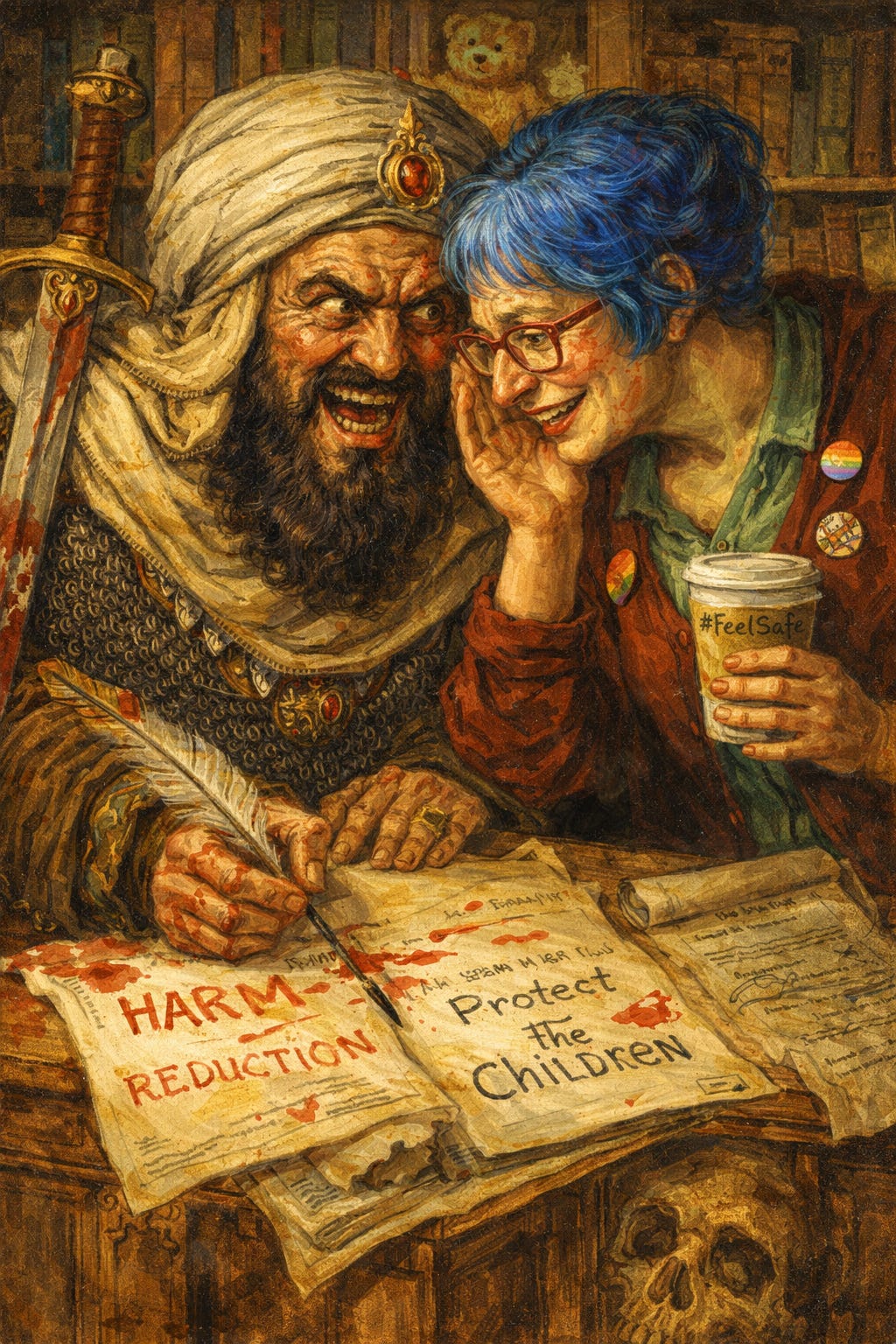
And universities create the leaders of tomorrow; they take once radical positions and normalize them; they are the leading edge of cultural change.
Cultures, like container ships, do not turn on command. They drift. They respond slowly to pressure, incentives, and cowardice dressed up as prudence. The change arrives quietly—through guidelines, sensitivities, equity frameworks, and risk assessments. The moral rudder snaps off without a sound. Everyone insists nothing is happening, even as the current carries them somewhere unmistakable.
We are a post-literate society, particularly among the young—distracted, numbed, and saturated with trivial consumption. Attention is scarce; seriousness is unfashionable.
This paper does not predict the future. Prophecy is for priests and bureaucrats. It does something more modest and more dangerous: it follows numbers, incentives, and stated strategies to their likely destinations. Arithmetic has no ideology. Demography does not care about intentions. Institutions respond to pressure, whether or not they understand its source.
“The most effective way to change people’s minds is not to argue with them, but to arrange the world so that they arrive at the conclusion themselves.”
This is often attributed to John Maynard Keynes (and paraphrased endlessly by marketers, propagandists, and political strategists ever since)
Civilizational change, like a successful sales pitch, works best when the customer believes the idea was his all along. Sudden revolutions provoke resistance. Gradual accommodations feel like progress. The product succeeds not when it is imposed, but when it is internalized—when the buyer thanks you for the privilege.
This is not a novel insight. It is the logic of advertising, political persuasion, and institutional reform. And it is precisely why language—framing, moral vocabulary, reputational pressure—matters more than force in late-stage liberal democracies.
The Muslim Brotherhood understands this. It has repeatedly said so in its own documents. Words, legitimacy, patience, and moral leverage are more effective than violence - violence would fail as it isolates Muslims and turns popular opinion against them.
What tools do they use?
Language - The Uniqueness of “Islamophobia” as a Concept
Islamophobia occupies a peculiar and unprecedented position in Western discourse. There is no parallel framework in law or policy that treats criticism of Christianity as “Christianophobia,” criticism of Hinduism as “Hinduphobia,” or criticism of Judaism as, in itself, antisemitism. Jewish thinkers, in particular, have long insisted on a sharp distinction between hostility toward Jews as people and criticism of Jewish belief, law, or politics.
In those traditions, belief systems remain open to scrutiny, while discrimination against people remains prohibited.
By contrast, Islamophobia—as increasingly defined in policy documents, advocacy campaigns, and institutional codes—collapses three distinct categories into one moral offence: hostility toward Muslims as people, criticism of Islam as a religion or ideology, and opposition to Islamist political movements. This collapse is not incidental. It has been criticized by liberal Muslims, secularists, Jewish organizations, and civil liberties advocates.
Pathologizing Dissent
Islamophobia functions less as a descriptor of prejudice than as a discursive weapon. By framing disagreement as a “phobia,” it pathologizes dissent, delegitimizes argument without answering it, and shifts debate from the realm of ideas into the realm of moral violation. One does not rebut a phobia; one diagnoses it. The result is not persuasion but exclusion.
This is why criticism of Islamic doctrine—on apostasy, blasphemy, women’s rights, or jihad—is increasingly treated not as a contestable argument but as actionable harm. No other major religion enjoys a comparable insulation from scrutiny in secular democracies. That asymmetry is not accidental; it is functional.
The Muslim Brotherhood: Non-Violence as Method, Not Morality
There is broad agreement among serious scholars that the Muslim Brotherhood does not call for violence in Western countries where it operates as a minority movement. It openly rejects violence in these societies, not because it has renounced it in principle, but because it judges it to be ineffective.
The disagreement is not about whether the Brotherhood avoids violence in the West. It is about why. Its restraint is not ethical; it is tactical.
The Brotherhood’s own writings—most notably the 1991 Explanatory Memorandum—describe Western societies as places where bombs would fail, and patience would work. Violence would harden resistance and provoke suppression. Law, culture, demography, and institutions, by contrast, offer access and durability. The goal is not martyrdom, but entrenchment.
Accordingly, the methods are laid out with striking clarity: demographic growth, participation in civic and political institutions, influence over education, legal activism, and alliances with progressive movements. These are not interpretations imposed by critics. They are the Brotherhood’s own stated tools, described plainly and repeatedly in its public documents.
In this framework, non-violence is not a moral triumph. It is a strategic choice—embraced where power is absent, unnecessary where power is secure. The loyalty is not to peace, but to results.
Lawfare and the Language of Human Rights
There is also growing evidence that Islamist-aligned advocacy networks have adopted human-rights language as a tactical vehicle. Three features recur.
First, ideology is reframed as identity. Islam is presented not merely as a belief system but as a racialized category, allowing criticism of ideas to be recast as discrimination against people. This move has been criticized by Jewish organizations, secular Muslim reformers, and civil liberties groups because it dilutes the meaning of racism and expands it beyond coherence.
Second, this logic extends into new categories, most notably “anti-Palestinian racism.” Palestine is not a race; Palestinian identity is national, political, and ideological. Yet criticism of Palestinian nationalism, Hamas, or maximalist political claims is increasingly framed as racial hatred. Analysts in The Times of Israel and Commentary have noted that this framing insulates Hamas-adjacent narratives from scrutiny and transforms political disagreement into moral transgression.
Third, these concepts are operationalized through lawfare. Human rights complaints, workplace investigations, university codes, and hate-speech statutes with deliberately vague thresholds become the enforcement mechanisms. Conviction is unnecessary. The process itself becomes a punishment: investigation, reputational damage, financial strain, professional risk.
And lawfare—especially when laundered through Human Rights offices—is the weapon that makes it bloodless, deniable, and devastatingly effective.
Is There Evidence of Brotherhood-Linked Influence on our society?
Precision matters. The Muslim Brotherhood rarely appears openly in Western advocacy campaigns. Its influence is diffuse, exercised through affiliated NGOs, sympathetic academics, community organizations, and issue-based coalitions.
Israeli and European think tanks have documented overlaps between Brotherhood-inspired networks and campaigns promoting expansive definitions of Islamophobia, consistent opposition to distinguishing Islam from Muslims, and efforts to criminalize “offensive” speech.
This does not establish a centralized conspiracy. It does establish ideological alignment and strategic convergence—sufficient to shape institutions that are already risk-averse and morally uncertain. The Muslim Brotherhood is less an organization than a movement.
Conclusion: Clarity or Drift
Can we articulate our post-Enlightenment values in positive terms? Equality before the law. Freedom of conscience. The right to criticise ideas, religions, and ideologies without fear of legal reprisal. The supremacy of civil law over clerical authority.
Or will we continue to define ourselves almost entirely through guilt, self-denunciation, and ritualised self-contempt?
It is not discriminatory to acknowledge that Western societies have enemies. China and Russia make no secret of their desire to weaken and destabilise the liberal democratic order. Islamist movements—particularly the Muslim Brotherhood—have said, just as openly, that they seek to replace it, not by bombs in the street, but by patience, lawfare, cultural pressure, demographic leverage, and institutional capture.
The West’s mistake is not tolerance. It is confusion.
We have persuaded ourselves that identifying hostile ideologies is inherently immoral, that drawing lines is bigotry, and that every conflict is merely a misunderstanding awaiting better language.
We assume—against all historical evidence—that belief systems do not matter, that religious doctrines dissolve on contact with consumer culture, and that no one really means what their scriptures say.
This is a fantasy.
The Muslim Brotherhood has been explicit for decades about its intentions. Its strategy is clever, adaptive, and non-violent precisely because non-violence works better in societies crippled by moral hesitation.
As Winston Churchill warned, though, feeding the crocodile does not make it vegetarian.
None of this requires panic, persecution, or collective suspicion. It requires clarity. The ability to distinguish between people and ideas. Between discrimination and disagreement. Between reform and replacement.
What can responsibly be concluded is this: Islamist movements—especially the Muslim Brotherhood—have openly endorsed non-violent, legal, cultural, and institutional methods as the most effective means of transforming Western societies.
Concepts such as Islamophobia and anti-Palestinian racism are increasingly used as instruments of lawfare, censorship, and moral intimidation. This process does not depend on violence, illegality, or conspiracy—only time, incentives, and institutional risk aversion.
That conclusion is not conspiratorial. It follows from documents, demographics, incentives, and observed behaviour.
And it returns us to the central question this essay insists upon: whether a civilisation that cannot distinguish criticism from hatred, ideas from people, and accommodation from surrender is capable of defending itself at all.
Change is inevitable.
I will not be around to say “I told you so,” but it is impossible to ignore the direction of travel. We are not marching toward catastrophe; we are drifting toward oblivion, which is far worse. Drift requires no villains of genius, only citizens of indifference.
It is a melancholy thing to contemplate what is being squandered. Centuries of reform. Painful, incremental growth. The slow acquisition of moral clarity. The blood of martyrs who insisted that conscience mattered. The blood of soldiers who fought fascism so that the individual might not be crushed beneath the boot of the collective or the tyrant. Out of all this suffering emerged modern Western liberal democracy—an astonishing and fragile achievement, a rare moral invention in the long and brutal history of our species.
And now we propose to let it be dissolved—not by conquest, not by argument, not even by courage—but by exhaustion.
We permit its slow erasure by theocrats who despise it, whose barbarism is not loud but patient, whose assault is not frontal but insinuating. While they advance with confidence and purpose, we import Trojan horse after Trojan horse of wretched ideas, mistaking tolerance for surrender and pluralism for suicide. We congratulate ourselves on our openness even as we dismantle the very principles that made openness possible.
All the while, we wallow in self-hatred. We recycle tired, thoughtless clichés. We flatter ourselves that standing for nothing—believing in nothing beyond our own erasure—is a form of moral sophistication. We whisper the soothing lie that self-effacement is noble, that it carries no cost, that history will somehow spare us the fate it has imposed on every civilization that confused weakness with virtue.
It will not.
Civilizations do not fall because they are imperfect. They fall because they forget why they exist. And the delusion that one can abandon conviction, dissolve identity, and outsource moral confidence without consequence is not compassion—it is negligence.
What is being risked here is not abstract. It is not theoretical. It is the loss of a pearl of great price: Western liberal democracy itself—hard-won, imperfect, endlessly improvable, and utterly irreplaceable.
And once it is gone, there will be no applause for our good intentions. Only the silence that follows abdication.
If you value this work, consider leaving a tip. It’s cheaper than therapy, less pious than public broadcasting, and the only censorship here is my bad taste. On second thought, it’s bad therapy.
Freedom to Offend is a reader-supported publication. To receive new posts and support my work, consider becoming a free or paid subscriber.
Man, looking at that list at the start, the first thing that popped into my head was, “so, basically, by 2050, NATO will be Hamas.”
Cogent analysis!