


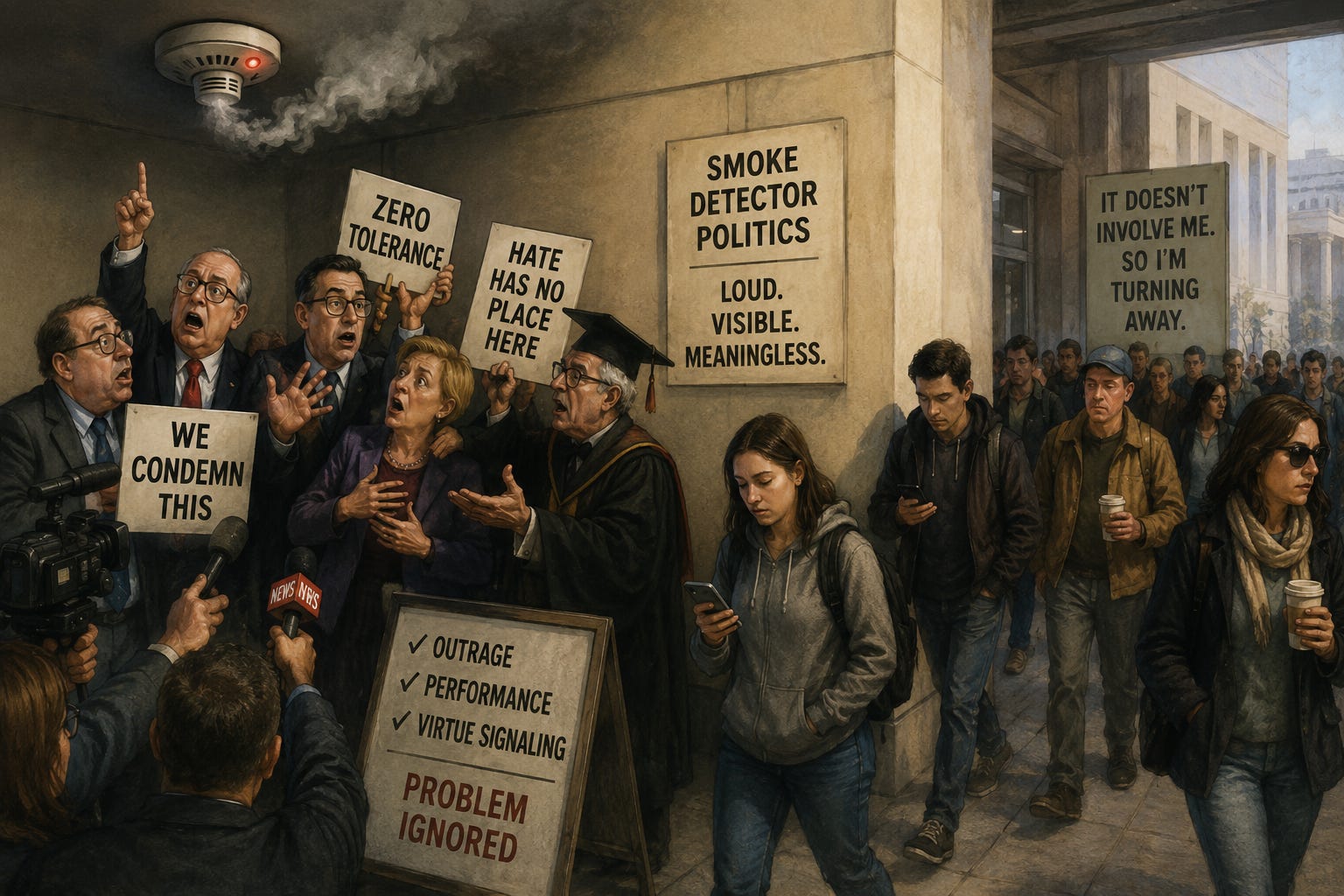
Anti-Semitism increasingly resembles an electrical fire smouldering behind the walls of a building.
Every few weeks, the smoke detector shrieks because something particularly grotesque escapes into public view. A synagogue is vandalized. A Jewish student is threatened. Someone publicly celebrates terrorism with such enthusiasm that even journalists are forced to acknowledge it. Suddenly, the political class springs into action. Grave expressions appear. Statements are issued. “We condemn this unequivocally.”
Then everyone goes home.
No one opens the walls.
No one examines the wiring.
No one asks why the alarm keeps going off.
The smoke is condemned while the fire is left burning.
Observe the contrast. A flotilla of activists sets sail on what increasingly resembles the Grand Voyage of Moral Self-Importance, complete with cameras, hashtags, and the expectation of arriving as moral celebrities. Political voices suddenly discover urgency. Microphones appear from nowhere. Statements materialize instantly. Social media erupts with displays of cultivated conscience.
It has recently been found that Hamas had arranged and funded this PR stunt.
Yet Silenced No More entered public discussion with something rather more substantial than slogans and placards. It was a report concerning sexual and gender-based atrocities surrounding October 7 and hostage captivity, assembled through years of documentation and built upon hundreds of interviews and testimonies, extensive visual analysis, and a broader evidentiary archive.
Imagine almost any other issue arriving with such a volume of testimony and documentation attached.
Imagine the emergency conferences.
Imagine the special sessions.
Imagine the institutional soul-searching.
Instead, much of the reaction felt strangely restrained.
And people notice.
People are not stupid.
Human beings possess an extraordinary instinct for distinguishing between genuine moral conviction and public performance. They know when outrage carries consequences and when outrage is simply theatre.
Because culture rarely communicates its rules through official memoranda.
Culture communicates through incentives.
Through what receives urgency.
Through what receives punishment.
Through what receives silence.
And three institutions increasingly shape those incentives.
First, academia, which often imagines itself to be society’s conscience while too frequently becoming its weather vane, carefully observing ideological winds and mistaking fashion for courage.
Second, political ambition, where moral principles can slowly transform into electoral arithmetic dressed in ethical language. The temptation becomes not “What is true?” or “What is right?” but “Where are the votes?”
And third, the oldest instinct of all:
It does not involve me today.
The ancient question was: “Am I my brother’s keeper?”
Modern society has improved upon it.
“I hope somebody else deals with it.”
That combination—performative politics, institutional incentives, and public indifference—is dangerous precisely because it permits everyone to feel virtuous while requiring almost nothing from anyone.
So let us spare ourselves the ritual astonishment and the carefully rehearsed innocence. Let us dispense with the grave faces, the hashtags, the statements drafted by committee, and the solemn declarations asking how hostility and division could possibly have intensified.
When Canada gets our version of the Bondi Beach massacre, it will just mean more temporary screaming of the smoke alarm.
But again, such electrical fires rarely arrive without warning.
For a long time, there has been only smoke.
The smoke detector shrieks.
Everyone condemns the smoke.
No one repairs the wiring.
And after the cameras leave, after the trending topic dies, after the politicians return to electoral calculations and institutions return to congratulating themselves on their moral seriousness, culture moves another inch down the road.
Not through dramatic declarations. Through tolerated excesses. Through selective outrage. Through small permissions. Through exhaustion. That is how cultures drift. Not with a bang. With a shrug.
Because smoke was never the problem.
The fire was.
"Do as I say, not as I do." -Most "professionals or politicians today" who appease the masses with virtual signalling mumbo jumbo policies, that divide society even more, resulting in people who are afraid, unhealthy, and confused who to trust, except for the boob tube. It is tiresome, watching young citizens marching with keffiyeh wearing hate mobs, and believing they are doing the right thing, because that is what they have been indoctrinated to believe.
This was a brilliant exposé on the world we find ourselves in today, Concise and insightful. That doesn’t make the situation any less dire, but it may encourage your readers to be courageous when they need to be. Bravo!