


Introduction: When Chaos Is Rebranded as Genius
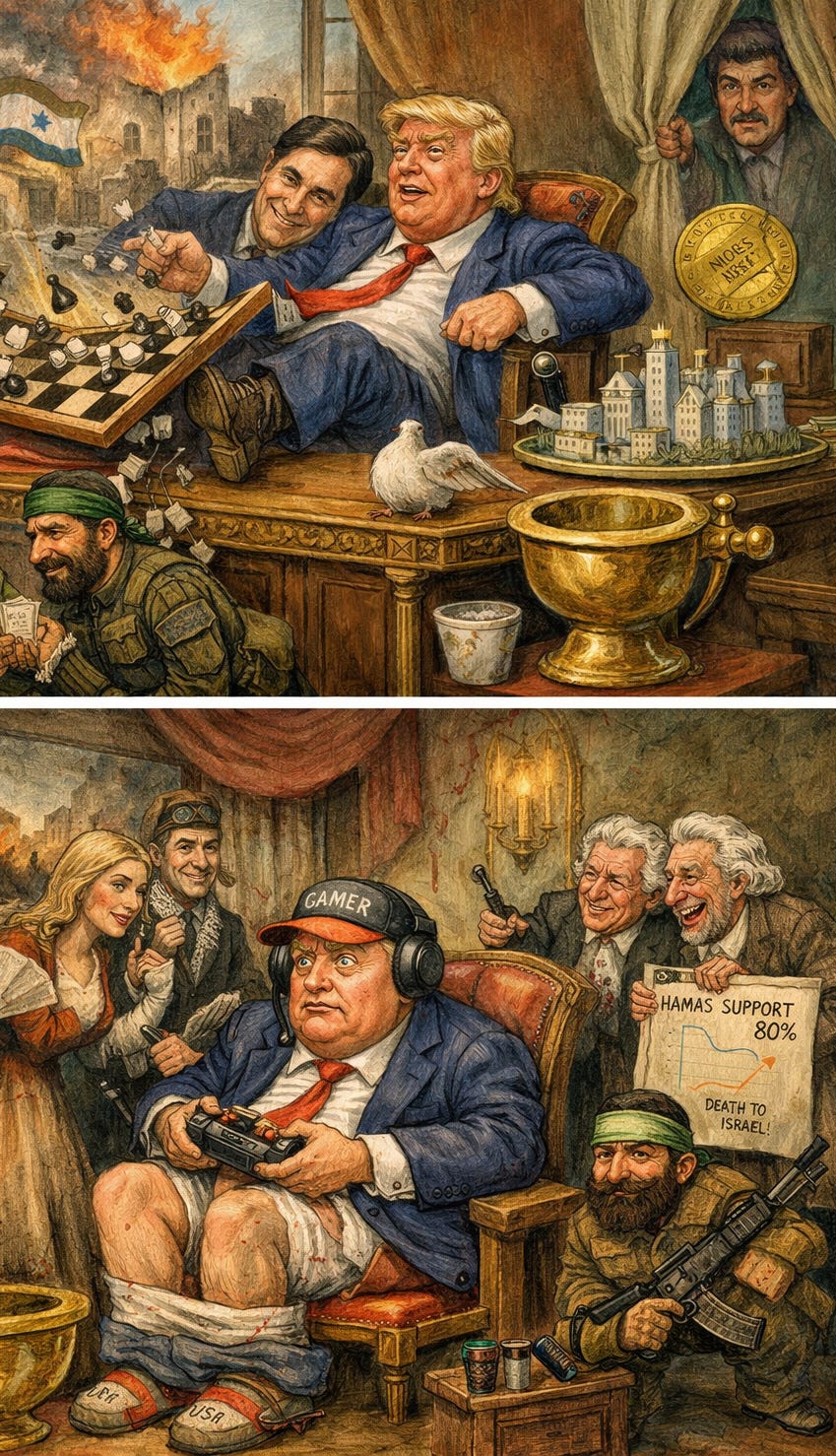
There is a style of politics that confuses disruption with insight, unpredictability with depth, and sheer force of personality with wisdom. Donald Trump has elevated this style into a governing philosophy. He presents chaos as strategy, impulsiveness as boldness, and the refusal to think things through as a kind of higher intelligence.
Anyone who insists on context, history, culture, or constraints is dismissed as “playing checkers,” while Trump, we are told, is playing chess.
But too often, what is described as chess is nothing more than knocking the board over, kicking the other player in the balls, and declaring victory while aides applaud the originality of the move.
This matters nowhere more dangerously than in Gaza.
Trump’s latest “peace vision” for Gaza has all the hallmarks of what might be called magic political surrealism: the belief that desire, spectacle, and willpower can substitute for cultural reality, institutional capacity, and human nature. It is politics as a parlour trick. Say it confidently enough, stage it grandly enough, and reality will eventually get the hint and comply.
It won’t.
The Nobel Prize Problem
Let us dispense with the polite fiction. Trump’s Gaza plan does not read like realpolitik. It reads like a vanity project. It bears the unmistakable scent of a man who believes history owes him a Nobel Peace Prize and is increasingly irritated that Norway hasn’t returned his calls.
This is not trivial psychology. Trump is famously manipulable through flattery. Appeal to his ego, and you can steer him. Appeal to his sense of grievance, and he will move mountains.
This has been a strength at times. It allowed him to punch through bureaucratic paralysis where others stalled endlessly. The Abraham Accords were real. The Iran strikes were decisive. Biden, by comparison, drifted.
But vanity-driven politics is dangerous when it collides with civilizational conflicts. Gaza is not a stalled infrastructure project. It is not a zoning dispute. It is not a misunderstood startup waiting for venture capital and better branding.

Wishing Doesn’t Make It So
Western policymakers persist in a sentimental fantasy: that everyone, everywhere, is basically the same as us. That deep down, all people just want to grill on weekends, send their kids to school, and complain about mortgage rates.
This projection is comforting—and often catastrophically wrong. It’s like gazing at your twenty-foot constrictor, raised from infancy, and assuring yourself that what you see in its eyes is love. It isn’t. It is not a human creature reasoning about affection or restraint. It is an animal living inside coils of muscle, and one day it may crush you for reasons you will never understand. Constriction is not a lapse in judgment; it is in its genes. It is not malice. It is nature.

Gaza is not simply poor. It is culturally and educationally saturated with genocidal ideology. From kindergarten textbooks to children’s television, Jew-hatred is normalised, glorified, and ritualised. It is a massive cult.
Martyrdom is not fringe; it is aspirational.
Support for Hamas violence remains high. That is not an Israeli talking point; it is documented reality.
You cannot rebuild a society while pretending its dominant beliefs are a misunderstanding.
The Hostage Test
Here is a moral litmus test so simple it should silence most Western fantasies.
After October 7, civilians—including teenage girls, elderly women, and infants—were taken hostage. This was universally recognised, even by the morally flexible, as indefensible. So ask the question plainly:
How many Gazans came forward to help release them?
Not rhetorically. Literally.
How many said, “Take the money, I’ll show you where they are”?
How many risked anything at all to oppose this crime?
The answer is not “few.” It is none.
Yes, Hamas would have killed them. That is true. But history is full of people who resisted evil despite lethal risk. Dietrich Bonhoeffer took one for the team. It could have happened.
Gaza produced not one. That is not a policy failure. That is a cultural one.
Magic Surrealism Meets Reality
Trump’s Gaza plan assumes that demolishing the physical landscape will somehow demolish the ideological one. That if you flatten enough buildings and pour enough aid back in, the culture will reset. This is not a strategy. It is magical thinking.
It ignores an uncomfortable but central fact: Gaza is not merely a ruined place; it is a radicalised one. Polling over the past two decades—by Palestinian research centres and international organisations alike—has consistently shown overwhelming rejection of Israel’s right to exist, with majorities endorsing armed “resistance” even in the face of repeated catastrophe.
There is no credible evidence that this has meaningfully changed since October 7. If anything, the war has reinforced existing attitudes. As one astute observer put it, those views were already rock-hard by October 7; what has been learned since is not remorse, but a lesson in impunity—that one can murder civilians, retreat into cover, and still earn applause from the global commentariat. This is not radicalisation through suffering. It is radicalisation-enabled.
This is not incidental. From early childhood, many Gazans are immersed in an educational and cultural environment that glorifies martyrdom, sanctifies Jew-hatred, and treats violence as moral theatre. Documented footage, school materials, children’s programming, and public statements by parents and educators have, for years, celebrated the aspiration that sons will grow up to kill Jews—not metaphorically, but literally.
Toddlers are dressed in mock military uniforms. Children are taught songs about stabbing Jews. Mothers dream of little Mohammed growing up to have a bomb strapped to him, so he can one day turn himself and any Jew nearby into flesh paste.
That’s not normal parenting, that’s not really human.
Games rehearse murder. This is not poverty speaking. It is indoctrination.
That is what cults do.
They close the moral universe, define evil externally, and make death meaningful only insofar as it serves the cause. You cannot rebuild a society like that by laying concrete and hoping for the best.
You cannot pour billions into a territory whose dominant ideology remains genocidal and expect shopping malls to outcompete martyrdom.
Gaza has already received enormous aid—by some estimates, roughly 85 per cent of its economy depends on it. Billions flowed in. What emerged was not civil society, but tunnels; not prosperity, but rockets; not schools oriented toward peace, but institutions that trained children to hate.
They complained about the lack of drinking water and used their water pipes to make missiles.
Hamas leaders became billionaires in Qatar. This was not an accident. It was a choice, sustained by popular legitimacy.
Rebuilding without deprogramming is not reconstruction. It is restocking the shelves before the next fire.
The Venezuela Detour (and Why It Matters)
Look at Venezuela. Even when a regime as repressive and unpopular as Nicolás Maduro’s was effectively removed, and no complaints for that, the aftermath shows the limits of spectacular action when those who used all their whiz-bang military don’t really think about what comes next.
Maduro’s vice-president, Delcy Rodríguez, was sworn in as acting president after his removal, preserving key elements of the old regime and its security apparatus. Within days, journalists and civilians were detained or intimidated by security forces and allied paramilitaries, checkpoints were established, and mobile phones were reportedly searched at random for evidence of opposition to the interim government.
Nobody is mourning Maduro’s downfall so much as cheering the possibility of real change — but the transition has been marked less by the rule of law and more by reactive power plays. Instead of thoughtful planning for a democratic transition, what has emerged so far is an uneasy mix of old power structures and new pressures, with little guarantee that the freedoms Venezuelans hoped for will materialise.
The lesson is not simply that intervention succeeds or fails. It is that not thinking things through — replacing strategy with spectacle — reliably produces more problems than solutions.
The Pants-Crapping Analogy (Because It Fits)
I have an acquaintance with an eleven-year-old son who, when deeply absorbed in computer gaming, will literally crapped his pants rather than pause to go to the toilet.
One of his parents insists this is an “alternative approach to hygiene.” She believes they can “work with him” to eventually transition toward using the toilet. She praises his commitment to the game. Some might even call it innovative.
It isn’t. It’s just crapping your pants.
Calling chaos “strategy,” refusal “genius,” and denial “chess” does not transform the act. It only humiliates the adults pretending not to notice the smell.
Trump’s Gaza plan is political pants-crapping elevated to doctrine. Loud. Confident. Proud. And utterly disconnected from reality.
Conclusion: Chess Requires a Board
This is not an argument for paralysis. It is not an argument for endless seminars or bureaucratic dithering. Action matters. Decisiveness matters. But context matters more. It’s not Trump-bashing. Thank God Kamala Harris isn’t in power; listening to her talk was painful; she seemed like the college idiot who had read one book in his life and would get insanely baked and not have the good sense to stop talking.
But to the real estate developer who thinks that a new development can overcome culture. You cannot ignore cult-like beliefs.
You cannot bulldoze ideology. You cannot flatter a society into abandoning beliefs it has been taught from cradle to grave. And you cannot rebuild Gaza while refusing to say, plainly, that its dominant culture is incompatible with peace.
Magic surrealism is intoxicating. It feels bold. It feels decisive. It feels like genius to those who confuse motion with progress.
But wishing doesn’t make it so.
And crapping your pants is not chess.
Note: LinkedIn, in its infinite solicitude, has informed me that I may not publish a title containing the phrase “crapping your pants.” This, apparently, exceeds the platform’s tolerance for vulgarity. One must draw the line somewhere, and LinkedIn has bravely chosen bowel metaphors.
What is striking—indeed, instructive—is where that line is not drawn.
On the same platform, a former colleague has for years published a voluminous stream of posts attacking Jews as a collective: demeaning them, imputing collective guilt, trafficking in classic antisemitic tropes, and edging—sometimes stumbling—into language that treats Jews as morally suspect or less than fully human. Those posts remain. They circulate. They are algorithmically rewarded. They pass, somehow, as acceptable “political discourse.”
This is not hypocrisy so much as moral illiteracy dressed up as moderation.
LinkedIn is not offended by hatred when it is expressed in the correct dialect. It is not alarmed by incitement when it flatters prevailing orthodoxies. It is merely scandalised by impropriety—by a word that reminds us we are embodied creatures rather than virtuous abstractions.
In other words, it will tolerate dehumanisation so long as it is decorously phrased, footnoted by ideology, and aimed at an approved target. But a mildly vulgar metaphor—one that offends no group and threatens no one—must be scrubbed in the name of “professionalism.”
This is how censorship now works. It no longer protects people; it protects sensibilities. It does not restrain cruelty; it curates tone. It is perfectly content with moral sewage, provided the language is antiseptic.
Christopher Hitchens once observed that what can be asserted without evidence can be dismissed without evidence. One might add a corollary for the digital age: what can be said politely about Jews may be said endlessly, but what can be said impolitely about anything else must be silenced at once.
LinkedIn has made its priorities clear. Antisemitism, if sufficiently well-mannered, is permissible. Crudeness, even when harmless, is not.
That is not moderation. It is etiquette masquerading as ethics—and it tells us far more about the platform than it does about the words it censors.
Great article! Points excellently stated.
Trump's "Board of Peace" was doomed to fail when he invited Qatar and Turkey. It's like a sheep farmer deciding the best way to protect his flock of sheep isn't just with sheepdogs and fencing to keep away the wolves, fox, and coyotes, but instead invite the wolves and foxes to join the sheepdogs and work together towards protecting the sheep. Bring them inside the fence. After all, wouldn't it work so much better and mean less work for the sheepdogs and farmer if he could convince the predators not to be predators by openly welcoming them? Reminds me of the American president played by Jack Nicholson in Mars Attacks, who as the Martians relentllessly attack the humans, says "Why can't we all just...get along!"