


If you believe in the importance of free speech, subscribe to support uncensored, fearless writing—the more people who pay, the more time I can devote to this. Free speech matters. I am a university professor fired because of a free speech issue, so I am not speaking from the bleachers.
Please subscribe to receive at least three pieces /essays per week with open comments. It’s $6 per month, less than USD 4. Everyone says, "Hey, it’s just a cup of coffee," but please choose my coffee when you come to the Substack counter. Cheers.
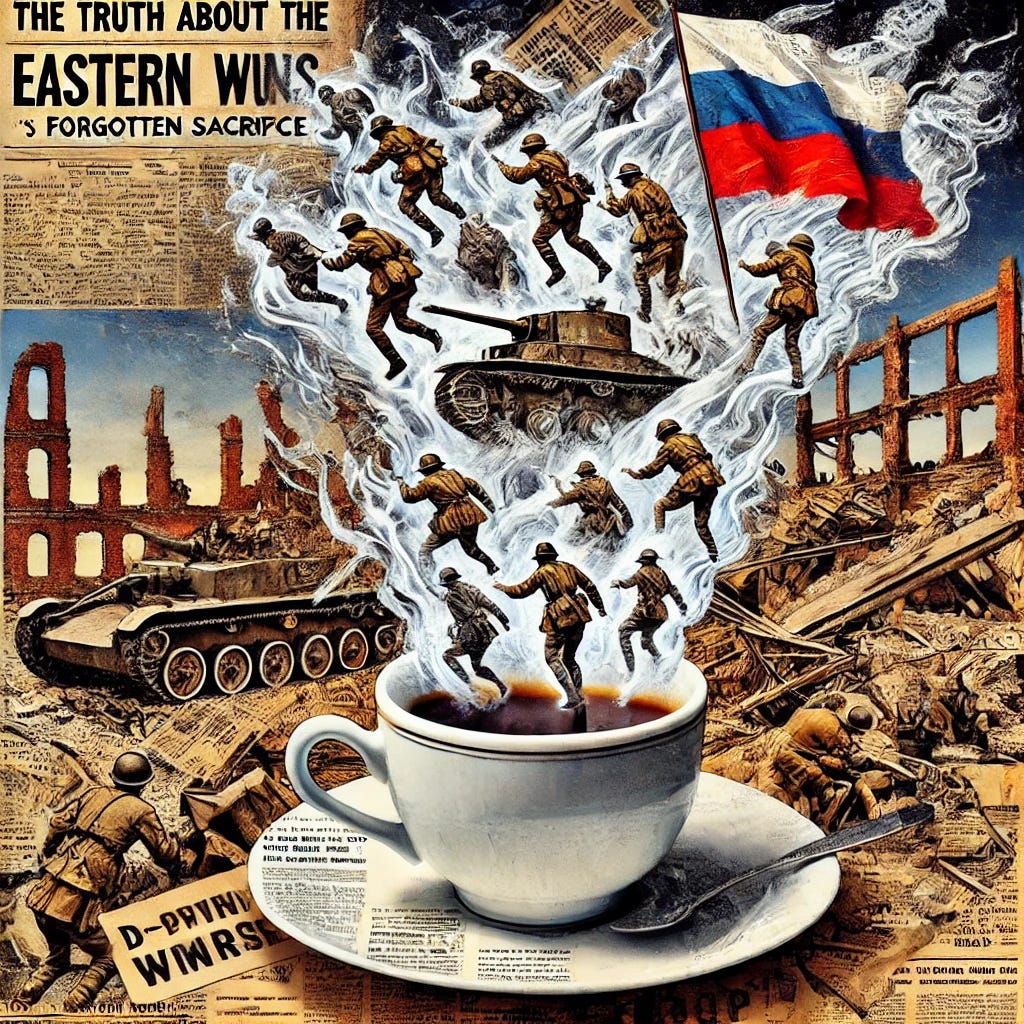
The Second World War is often presented through a Western lens—D-Day, the Battle of the Bulge, the Normandy landings, and the American triumph over fascism. Hollywood, history books, and national narratives have polished this version to such a high sheen that one might think the war was won solely by the United States and its allies.
But this telling is dangerously incomplete.
The real meat grinder of World War II wasn’t in France. It was on the Eastern Front, where the Soviet Union bore the brunt of the Nazi war machine. While American and British forces fought decisive but far smaller battles, the Red Army faced the full force of Hitler’s invasion. By the time of D-Day in 1944, the Soviets had already turned the tide of war at Stalingrad and Kursk, ensuring Nazi Germany’s eventual defeat.
This is not to downplay the heroism of Allied soldiers, but facts are facts:
80% of German military casualties happened on the Eastern Front.
The Soviet Union lost nearly 27 million people, the majority of them civilians.
The largest tank battle in history (Kursk) and the deadliest siege in history (Leningrad) took place in the USSR.
The Soviet Union Paid the Blood Price
The Soviet Union’s war wasn’t just a military struggle but a fight for national survival. When Hitler launched Operation Barbarossa in June 1941, he didn’t just want to conquer Russia; he planned to exterminate its people and turn its land into a “living space” for Germans.
This was total war. Cities were bombed into rubble, millions were starved, and entire regions were wiped out. The numbers are staggering:
The Siege of Leningrad (1941-1944): One of the longest and deadliest sieges in history, where over 1 million civilians starved to death as the Nazis blockaded the city for 872 days.
The Battle of Stalingrad (1942-1943): The deadliest battle in history, with over 2 million casualties. This was the war's turning point, where Hitler’s eastern advance was crushed.
The Battle of Kursk (1943): The largest tank battle ever fought, where the Soviets destroyed the last offensive capabilities of the German Army.
Meanwhile, back in America, factories were booming, cities were untouched, and civilians were never bombed or starved. The contrast could not be starker.
By the time Allied forces landed in Normandy, the Red Army had already pushed the Nazis into retreat. The war’s outcome had been decided—not in the hedgerows of France, but in the brutal snow-covered battlefields of Russia.
How the West Rewrote World War II
So why does the Western narrative diminish the Soviet role? The Cold War.
After the war, it was inconvenient for the United States to acknowledge how much of the heavy lifting the USSR had done. The West preferred to paint itself as the great liberator, the singular force that saved Europe from fascism.
This historical revisionism was deliberate:
D-Day became the war's defining battle, even though it was not nearly as decisive as Stalingrad or Kursk.
Hollywood glorified American heroism while reducing the Eastern Front to a footnote.
The Soviet sacrifice was ignored, and the USSR was soon cast as the next great enemy.
Even today, many Westerners believe that the U.S. “rescued” Europe without realising that the Soviets had already crushed the backbone of the Nazi military long before 1944.
The Consequences of Historical Amnesia
This Western blind spot isn’t just a historical oversight—it has real-world consequences today.
It fuels Russian resentment: Many Russians believe (rightfully) that the West has ignored and disrespected their sacrifices.
It allows NATO to frame Russia as the eternal villain: The narrative that Russia is always the aggressor, never the defender, ignores its history of suffering.
It distorts how we understand World War II: A war truly won in the East is still framed as an American-led victory.
This is not about justifying modern Russian actions, but historical truth matters. The Soviet Union bore the brunt of World War II, and no amount of Western storytelling can erase that fact.
As Winston Churchill once said:
“The truth is incontrovertible. Malice may attack it, ignorance may deride it, but in the end, there it is.”
And the truth is that the Red Army, not the Western Allies, tore the guts out of the Nazi war machine.
What would have happened if Stalin had not initially allied with the Nazis?
Had Stalin resisted the urge to clasp Hitler’s blood‑stained hand in 1939, the war’s opening act would not have been the neat vivisection of Poland but a four‑way donnybrook with no clean front lines and no convenient villains.
The Red Army, freshly decapitated by Stalin’s purges, would have been yanked into the melee at least two years earlier — disorganised, paranoid, and still trying to replace half its competent officers who were rotting in gulags or shallow graves.
In other words: easy pickings.
The consensus among sober historians — those unromanced by the “Uncle Joe the ally” fairy tale — is that Germany would indeed have turned east regardless. Hitler’s obsession with Lebensraum wasn’t exactly a state secret. Without the Molotov‑Ribbentrop buffer, however, the Wehrmacht would have hit Soviet territory faster, and with Soviet forces even less prepared than they were in June 1941. The catastrophic encirclements of Kiev and Smolensk? Picture them worse, sooner, and bloodier.
And for the Western Allies? No, this does not cue a triumphant march to Berlin. Roosevelt and Churchill could barely fund, equip, and stage‑manage the eventual two‑front war we got.
Even if the Nazis and Soviets had annihilated each other early, the vacuum would have birthed chaos rather than “freedom.” Poland and the Baltics would still be trampled; only the flags above the rubble would differ.
The grim truth: the pact’s absence might have accelerated Soviet suffering but scarcely altered Allied strategy. The war would remain what it was — democracy in temporary partnership with dictatorship, pretending the alliance was noble rather than merely necessary.
Appreciate the perspective.
This makes me want to know more about how our ignoring their contribution affected the Russian psyche. Was every Hollywood glorification taken as a personal affront? Did the average Russian know or even care that their sacrifices went unacknowledged in the West? Did they reckon, at some point with Stalin’s purges? This makes me begin to understand that the generational trauma that Russian emigres brought with them was not just the result of surviving brutal Communist dictatorships.