


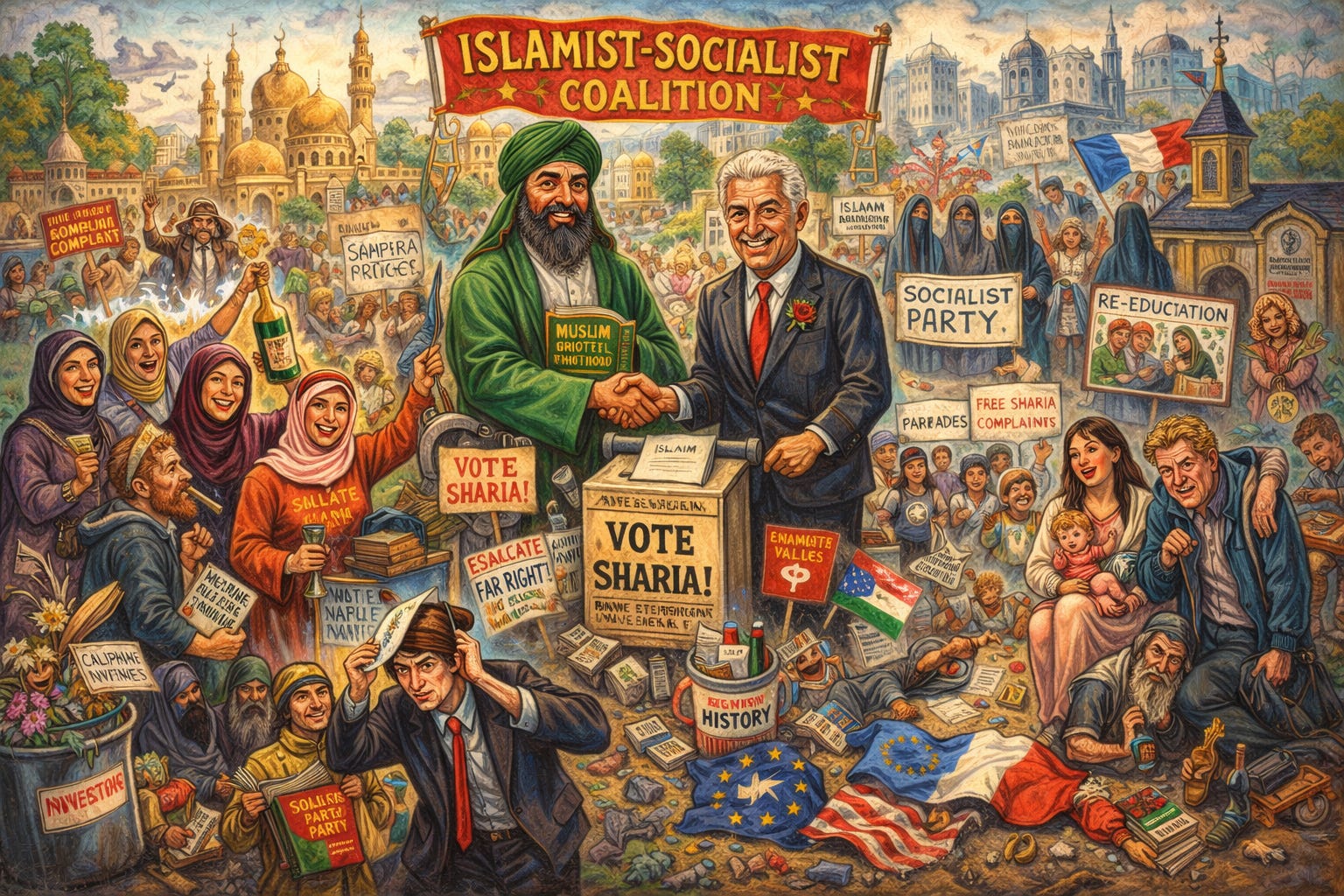
Preface — February 26, 2026
I was repeatedly told that I was imagining things.
That it was paranoia to suggest that Islamist-aligned movements would find common cause with Western leftist parties. It was irresponsible to argue that electoral arithmetic would eventually override ideological discomfort. That talk of alliance-building between segments of the Muslim Brotherhood ecosystem and progressive political machines was conspiratorial.
It was not conspiratorial. It was arithmetic.
I argued that where demographic concentration met proportional systems, where grievance politics met institutional timidity, and where parties hungry for marginal votes met cohesive blocs of motivated voters, alliances would form. Not out of theological agreement. Not out of doctrinal harmony. But out of power.
Votes first. Philosophy later.
Today’s date is February 26, 2026.
Yesterday, in the Gorton and Denton by-election, Green Party leader Zack Polanski centred his campaign not on local infrastructure, not on taxation, not on healthcare, but on Gaza. Leaflets in English and Urdu urged Muslim voters to “punish Labour for Gaza.” Campaign material featured a keffiyeh in front of a mosque. Videos were released in Urdu and Bengali. Labour accused the Greens of deliberately mobilising Muslim voters on a foreign policy grievance; the Greens replied that they were simply communicating in voters’ own languages.
The polls show them effectively tied.
There is nothing illegal in this. Nothing violent. Nothing clandestine. It is entirely lawful. Entirely democratic. Entirely predictable.
A political party identifies a concentrated voting bloc. It speaks in its language. It frames the election around the bloc’s highest emotional priority. It invites electoral punishment of rivals. It competes for power by appealing to identity and grievance.
That is politics. But this is precisely the alignment I described.
When a cohesive minority with strong transnational identity priorities intersects with a left-leaning party seeking marginal gains, incentives converge. The party moderates its rhetoric. It adopts the language. It signals solidarity. It reframes foreign conflicts as domestic moral tests. The bloc delivers votes. The party delivers influence.
This is not an apocalypse. It is coalition mathematics.
The Muslim Brotherhood’s own strategic literature emphasises patience, legitimacy, and institutional engagement. It rejects premature confrontation in minority contexts. It encourages settlement, influence, and alliance. It is explicit about working within legal frameworks and adapting to local conditions.
One does not need secret coordination to observe convergence. Demography supplies leverage. Proportional systems amplify it. Cultural guilt reduces resistance. Administrative law stretches. Universities and media normalise the framing. Political actors respond rationally to incentives.
And so we arrive at the present moment.
A British by-election fought in multiple South Asian languages, structured explicitly around Gaza, with leaflets urging punishment of a major party over its stance on Israel. A left-wing party competing for a concentrated Muslim vote. A mainstream party is accusing it of inflaming tensions. Polls tightening.
No revolution. No coup. No tanks. Just arithmetic.
I did not predict inevitability. I predicted the trajectory.
If trends continued, alliances would form. If blocs became decisive, parties would adjust. If institutional timidity persisted, accommodation would replace resistance.
Look around. This is what accommodation looks like in its early stage: targeted messaging, grievance mobilisation, moral framing, and electoral leverage.
It is still small. It is still local. It is still reversible. But it is not imaginary. And it is not accidental.
The process is not dramatic enough to alarm the inattentive. It rarely is. Civilisational shifts seldom begin with explosions. They begin with leaflets. With translations. With careful signalling. With perfectly lawful appeals to identity.
Power, after all, is won one riding at a time. I was told this would never happen.
It is happening.
And it is happening exactly the way arithmetic suggested it would.
Why Arithmetic, Not Apocalypse, Explains How Civilisations Are Replaced Without a Shot Fired
It’s a lot easier than you think. Though anyone reading this will be dead before 2075, please continue. God knows I’ll be dead by then, and it pains me to say I won’t be able to gloat and say I told you so.
No serious analyst claims to know the future.
History punishes certainty. What can be done, however, is trend analysis—the same method used to forecast pension solvency, climate impacts, urban planning, and public health.
This paper asks a narrow question:
If current demographic trends, migration patterns, institutional incentives, and declared ideological strategies continue without abrupt disruption, what outcomes become more likely by the end of the century?
This is not a claim of inevitability. It is a conditional exercise: if A continues, B becomes plausible. etc.
No violence is assumed. No illegality is required. No secret coordination is alleged. The framework used is explicitly non-violent, open, and documented.
The ideological material referenced—particularly the Muslim Brotherhood’s 1991 Explanatory Memorandum on the General Strategic Goal for the Group in North America and the writings of Hassan al-Banna—describes a gradual, lawful, institutional transformation of society from within. The language is explicit about patience, legality, and adaptation to local conditions.
The analysis below does not add intent or exaggeration. It simply aligns demography with declared strategy.
Methodology: Arithmetic and Institutions
The analysis rests on four inputs:
Demographics
Differential fertility rates
Net migration flows
Age structure and generational replacement
Urban concentration
Political Systems
Proportional representation
Coalition governments
Judicialized rights regimes
Administrative law elasticity
Cultural Incentives
Anti-discrimination norms
Reputational sanctions
Institutional risk aversion
Asymmetry of moral confidence
Declared Strategy
Non-violent, long-term, institutional change
Emphasis on education, law, culture, and legitimacy
Rejection of abrupt confrontation in minority contexts
No acceleration is assumed. No collapse is assumed. This is linear continuation, not catastrophe modelling.
Demographic Baseline
Using Pew Research, UN population projections, and national statistics:
Muslim populations in much of Western Europe grow faster than host populations due to:
Younger median age
Higher fertility (even as rates decline)
Continued migration from higher-fertility regions
Political influence does not require majority status.
15–25% cohesive populations in proportional systems often exert decisive leverage.
Urban concentration amplifies influence.
The Brotherhood’s Framework
The ultimate objective, stated plainly in their writings, is Islamic governance—a caliphate governed by Islamic law, with sharia as the supreme legal authority. In Western societies, this objective is pursued not through force but through settlement (tamkeen), influence, and legitimacy.
The geographic scope is explicitly global. The documents do not differentiate Cairo from Paris, Toronto, London, or New York in principle—only in method.
At this point, two empirical observations matter.
First, survey research across Western countries consistently finds that a significant minority of Muslims—often ranging between roughly 18 and 40 percent, depending on country and question wording—express support for sharia as a governing legal framework or for religious law taking precedence over secular law. These respondents are overwhelmingly non-violent; violence is not the mechanism under discussion.
Second, social science research on political and cultural change shows that majority support is not required to alter norms, institutions, or policy direction.
Across multiple domains, studies of minority influence, agenda-setting, and norm cascades indicate that cohesive and motivated groups representing as little as 15–25 percent of a population can exert disproportionate influence, particularly when the broader majority is passive, fragmented, or reluctant to articulate its own values.
Political systems with proportional representation, coalition governments, and judicialized rights regimes further amplify this effect.
Taken together, these findings explain why the Brotherhood’s strategy does not depend on numerical dominance. It depends on organisation, persistence, institutional engagement, and the absence of confident resistance—not on majority conversion.
Hypothetical 10-Stage Scenario: Gradual Islamization of the West Through Democratic Means
This response presents a speculative, fictional five-stage progression over approximately 50 years (from 2025 to 2075), drawing on historical and theoretical research to imagine a non-violent, democratically consented process of societal Islamization in Western countries (focusing on Europe, Canada, Australia, the UK and the US).
It assumes that demographic shifts, cultural dynamics, and political strategies occur without coercion, violence, or illegal activities, which aligns with the query’s parameters. The scenario is inspired by:
Muslim Brotherhood’s “The Project” (1982 document): A strategic outline for establishing Islamic presence through infiltration, alliances, and cultural influence, emphasising deception, institution-building, and avoiding confrontation until strong enough.
Michel Houellebecq’s Submission (2015 novel): A satirical, dystopian depiction of France’s “democratic capitulation” to Islamism. In the story, a Muslim Brotherhood-inspired party wins the 2022 election via alliances with socialists to block the far-right, leading to gradual reforms like legalising polygamy, removing women from the workforce, and Islamizing education under foreign funding.
Themes include Western apathy, intellectual fatigue, self-doubt, and the allure of patriarchal stability amid decadence—no invasion, just electoral pragmatism and personal incentives for conversion (e.g., career benefits for academics). The tone is fatalistic, highlighting how self-hatred and neo-colonial guilt erode resistance.
Demographic Projections: Based on Pew Research, Europe’s Muslim population could reach 14% by 2050 in high-migration scenarios (e.g., Sweden 30.6%, Germany 19.7%), growing from natural increase and migration. In the US, Muslims may rise from 1.1% (2020) to 2.1% by 2050, but are concentrated in urban areas for political influence.
Theoretical Frameworks:
Antonio Gramsci’s Cultural Hegemony: Applied to Islamism (e.g., by the Muslim Brotherhood), this involves a “march through institutions” to shift cultural norms gradually, creating a new hegemony by co-opting education, media, and civil society. Islamists build counter-hegemonic blocs, using ideology to dominate without force.
Sayyid Qutb’s Influence on MB: Qutb’s view of Western societies as “jahiliyyah” (pre-Islamic ignorance) inspires a vanguard approach to re-Islamize through ideological purity, but adapted gradually for integration.
Tariq Ramadan’s Integration Views: As al-Banna’s grandson, Ramadan advocates “Western Muslims” fully integrating by contributing Islamic ethics (e.g., justice, community) to society, redefining integration as mutual enrichment rather than assimilation.
Radical Tactics: Drawing from studies on extremism, groups use guilt (e.g., neo-colonial remorse), misinformation (via social media propaganda), censorship (labeling dissent as hate speech), fear (of social ostracism or “Islamophobia” accusations), and fostering a “silent majority” through social pressure that suppresses opposition. These exploit Western self-hatred (oikophobia), self-doubt, and guilt over imperialism, leading to cultural relativism and capitulation.
This is a synthesised, hypothetical narrative—not advocacy or prediction—framed as a dystopian thought experiment akin to Houellebecq’s satire. Each stage builds on the prior, leveraging demographics for voting blocs, theories for strategy, and tactics for influence. You will recognise many of the initiatives already active in our society today.
Compressed Five-Stage Timeline (2025–2075)
Stage 1: Normalisation Through Accommodation (2025–2035)
The initial phase centres on visibility and accommodation framed as tolerance. Public prayer increasingly disrupts civic norms—calls to prayer override noise bylaws, and demonstrations block streets, airplane aisles, sidewalks, and shopping malls—all under the banner of religious freedom.
Municipal authorities decline to enforce to avoid accusations of discrimination. Mosque construction, cultural centres, and charities expand rapidly, framed as integration hubs in line with the Muslim Brotherhood's gradualism (“The Project”).
Social media narratives portray Islam as a victim of Western imperialism, exploiting neo-colonial guilt and moral fatigue. Although historical and present slavery was saturated through Arab and Indigenous societies, the conventional norm is that it has strictly been a North Atlantic phenomenon; this type of historical revisionism will be used extensively to misrepresent the march of Mohammed, the Ottoman Empire, etc.
Early censorship emerges informally: critics are labelled “Islamophobic,” triggering professional and social consequences. Elites apologise for historical sins, fostering elite paralysis and a silent majority unwilling to object. You get a Tiktok friendly/Mandami-style Islamic movement crafted by world-class public relations firms slowly transforming a barbaric, theocratic reality (think Taliban) into a modern, progressive, socially aware and painfully misunderstood woke movement.
Demographic marker: Europe reaches ~8–10% Muslim, with dense urban concentrations.
Stage 2: Institutional Capture and Alliance Building (2035–2045)
Entryism accelerates into civil society: unions, NGOs, academia, media, and advocacy groups. Islamist-aligned movements position themselves as anti-capitalist, anti-imperialist, and aligned with progressive causes. Strategic alliances form with left-wing parties, activist networks, and—particularly in Canada—Indigenous groups, leveraging existing frameworks of historical grievance and moral indebtedness.
Universities and colleges, increasingly reliant on Gulf-state funding, adopt curricula emphasising Western moral failure while framing theocratic norms as cultural diversity. Opposition is increasingly framed as hate speech. Moderates self-censor to avoid reputational and career damage.
Demographic marker: Europe ~12–14%; U.S.
~2%; Canada ~5–6%.
Stage 3: Cultural and Educational Reorientation (2045–2055)
Education becomes the primary vector of Gramscian hegemony. Curricula reframe history through guilt-centric narratives: colonialism, Crusades, and Western “decadence” dominate instruction, while Islamic governance is presented sympathetically. Privately funded religious schools expand, normalising gender segregation, polygamy, and parallel legal norms under the language of choice and pluralism.
Speech restrictions formalise under expanded diversity and anti-disinformation laws. Educators and administrators comply to avoid accusations of bigotry. Western intellectuals, exhausted by relativism, rationalise capitulation as inclusivity.
Demographic marker: Europe ~15–18%, enabling control of key municipal governments.
Stage 4: Media, Legal, and Political Consolidation (2055–2065)
Narrative dominance solidifies. Islamist-aligned actors gain disproportionate influence in journalism, tech moderation, and regulatory bodies. “Equity” frameworks demand policy concessions framed as moral repair for Western sins. Deplatforming and legal harassment suppress dissent; the media self-regulates to avoid prosecution.
Electoral breakthroughs follow: Muslim-led parties form coalitions with socialists and centrists to block right-wing opposition. Policy shifts begin modestly—halal standards, prayer accommodations, family-law opt-ins—while critics are portrayed as extremists.
Demographic marker: Europe ~20–22%; decisive swing-bloc power.
Stage 5: Systemic Lock-In and Cultural Hegemony (2065–2075)
Economic leverage and legal normalisation complete the transition. Islamic finance expands through state partnerships and foreign capital, tied to Sharia-compliant reforms. Referenda and court rulings entrench parallel legal systems under democratic legitimacy. Cultural norms shift irreversibly via education, media, and administrative enforcement.
Western liberalism is reframed as oppressive, incoherent, and morally exhausted. Resistance becomes socially impossible rather than legally forbidden. As in Submission, elites adapt and comply—not through force, but through status preservation and relief from moral uncertainty.
Demographic marker: Europe ~25–30%; Islam becomes the dominant cultural reference point regardless of formal majorities.
Summary
This compressed dystopian speculation outlines a non-violent, democratic, and incremental transformation over ~50 years, driven by demographic momentum, institutional capture, guilt-based moral leverage, and elite capitulation. Power accrues not through conquest but through accommodation → alliance → capture → consolidation → lock-in, with democratic consent manufactured amid fear, reputational coercion, and Western self-doubt.
Part III deals with the countries most likely to fall and wraps up. Remember, demographics are destiny. Tomorrow.
If you value this work, consider leaving a tip. It’s cheaper than therapy, less pious than public broadcasting, and the only censorship here is my bad taste. On second thought, it’s bad therapy.
Freedom to Offend is a reader-supported publication. To receive new posts and support my work, consider becoming a free or paid subscriber.
Good stuff, but I’d say the UK is well into stage four already, with Brussels in stage five. Hell, Minnesota is in stage four.