


Imagine the bureaucratic conscience at sea.
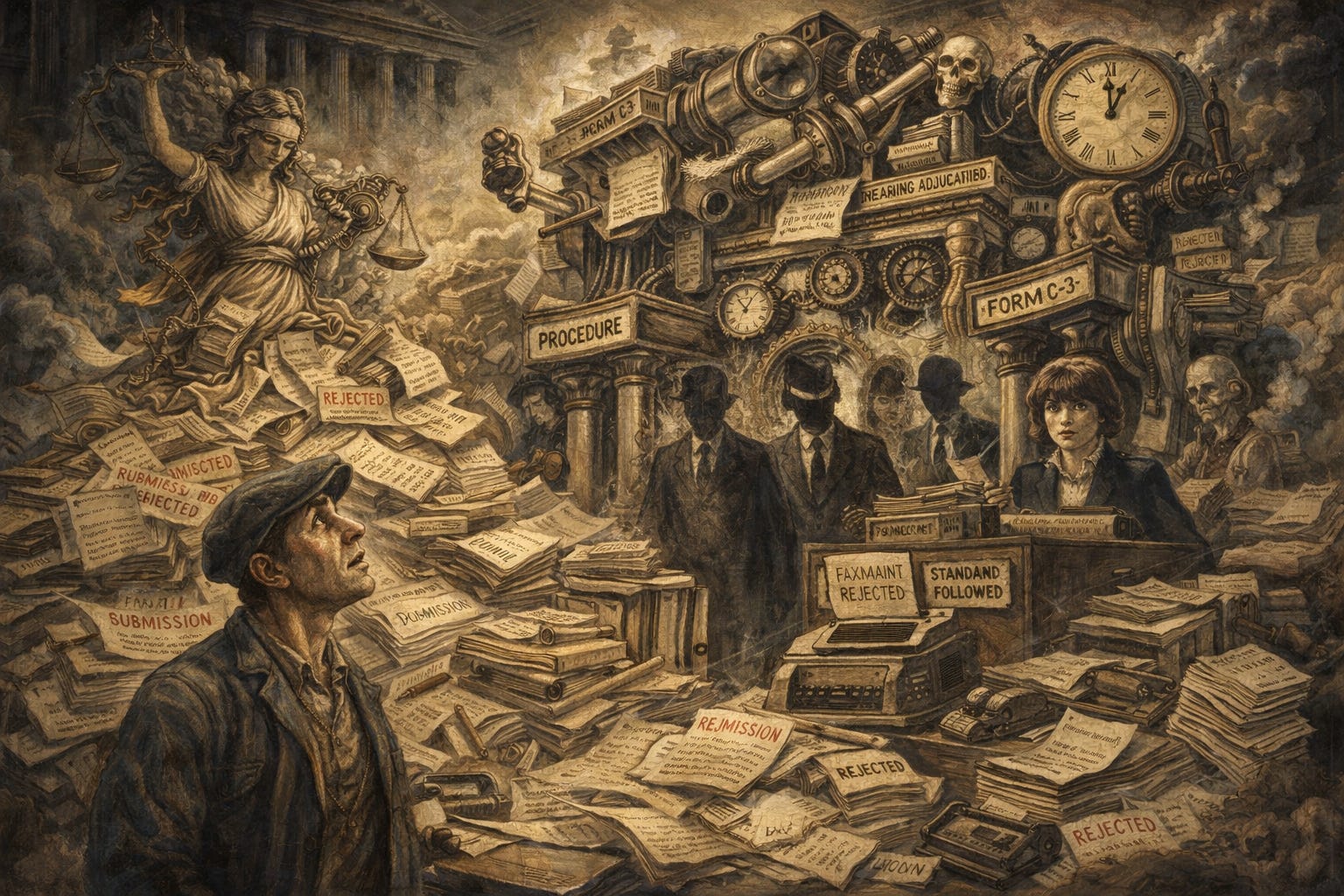
A labour-board member, a union executive, a lawyer, a human-rights manager, a mid-ranking government functionary—pick your specimen—stands on the deck of a large cruise ship, comfortably docked, clipboard in mind if not in hand. Nearby is a small group of vacationing farmers and tradespeople.
Starboard, a section of the deck, has been cordoned off for painting. Tape. Signs. Authority has spoken.
Then someone falls overboard. And someone falls while attempting to save the first.
There is no ambiguity about what has happened. There is shouting. There are arms flailing in the water. There is panic, the real kind, not the laminated variety. And there is, plainly visible, a life ring—hanging just inside the taped-off area.
One of the bureaucrats notices this immediately. He also notices something else: the sign. Access prohibited. Painting in progress.
Procedure, after all, exists for a reason.
He recalls the protocol. In the event of an irregularity, one must notify the appropriate lower-level officer, who then escalates the matter to the next level, who then consults the relevant authority empowered to authorise deviation from standard operating boundaries. The person with that authority, he knows, is three layers up the chain. It could take hours. There will be forms.
He hesitates. Not out of malice. Out of professionalism.
While he deliberates, two civilians—say, a plumber and a farmer—do not have such an internal conference. They duck under the tape, seize the ring, and throw it. They pull one person back toward the ladder. Another slips beneath the surface. They try, but they are too late.
One is saved. One is not.
On the deck, people are crying. Someone is kneeling. There is shock, grief, and the unbearable finality of a preventable death. The bureaucrat observes all this with the grave expression of a man who has just witnessed an unfortunate outcome.

A woman approaches him. She is shaking. She looks at him not with anger at first, but with disbelief—the look reserved for those who seem human but are behaving like furniture.
“Why didn’t you help?” she asks.
The bureaucrat does not bristle. He does not shout. He does not deny the tragedy. He explains.
“Well,” he says calmly, “I did what I was supposed to do. I filed Form 24B with the purser.”
He pauses, as if this should settle the matter.
“It’s very sad,” he adds, “but it wasn’t my responsibility.”
And with that, he adjusts his jacket, reassured by the knowledge that no rules were broken, and walks off toward the dining room—where dinner is being served on schedule, the paperwork is in order, and the system, mercifully, remains intact. He has no guilt; his conscience was offered up to the Moloch-like furnace of the bureaucracy years ago.
This is how conscience is finally offloaded—not onto ideology, not even onto indifference, but onto procedure. Responsibility is dissolved into process. Judgment is delegated upward until it evaporates. And morality is reduced to the comforting knowledge that one followed the rules while someone else drowned.
This is not a malfunction of bureaucracy. It is its moral ideal.
Every legal system requires procedure. Without rules, deadlines, evidentiary standards, and jurisdictional limits, law collapses into arbitrariness. But procedure is not the purpose of law; it is its instrument.
When procedure ceases to be a means and becomes an end—when it is invoked not to serve justice but to excuse its absence—the law does not merely malfunction. It transforms into something else entirely.
Across Canada, Western Europe, and much of the modern administrative state, justice has been quietly displaced by compliance. Institutions no longer ask whether an outcome is right or wrong. They ask whether the correct sequence of steps was followed. If the answer is yes, the inquiry ends. What happened to the individual becomes secondary, then irrelevant, and finally invisible.
Nowhere is this more visible, or more corrosive, than in modern labour law and the regulatory bodies that orbit it.
The Labour Law Exception: When Representation Becomes Compulsion
Modern labour law rests on an extraordinary premise: that a union, once certified, is granted exclusive and compulsory authority over a worker’s legal representation. The worker does not choose this representative. The worker cannot dismiss it. The worker cannot replace it. The worker cannot opt out of funding it. The union is granted full carriage rights, full ownership of the grievance, and full discretion over whether the worker’s case lives or dies.
This arrangement is justified on an assumption—rarely stated aloud but absolutely foundational—that the union will act in good faith.
That assumption is not merely optimistic. It is legally indispensable. Without it, the entire architecture collapses.
In no other area of law is such a relationship tolerated. If an individual hires a lawyer who refuses to act, undermines the client, or openly aligns with the opposing party, the relationship ends immediately. The lawyer is fired. Sanctions may follow. No court would accept that this constituted representation.
But in labour law, the impossible is normalised. A union may refuse to advance a grievance, refuse to meet, refuse to communicate, and even explicitly align itself with management—and still be deemed to have fulfilled its duty of representation
The worker’s only recourse is not a court, but a labour board. The boards themselves are anxious about this comparison and strenuously resist it. They are not courts, they insist—hence the linguistic laundering. Judges become adjudicators. Trials become hearings. Justice becomes a remedy. Each substitution is presented as a gesture of neutrality, though the power exercised is no less final for being euphemistically described.
Language, in this setting, is not clarification. It is camouflage.
One may dismiss a poor lawyer with relative ease. One may even replace a bad doctor. But to challenge a union through the labour board is to enter a procedural labyrinth designed by people who already know the outcome. Forms proliferate—C-3, E22B, schedules, mandates—while communication is artificially throttled. Email is discouraged or forbidden. One must use registered mail, or the fax machine, that archaeological artefact the labour board curiously believes remains ubiquitous.
This is not an accident. The board knows exactly who is appearing before it.
It knows that the complainant is almost always unrepresented. It knows that a duty of fair representation complaint pits a lone worker against a union with lawyers, staff, offices, and institutional fluency. It knows the power imbalance is overwhelming. And it knows that complexity itself is a weapon.
Indeed, the system appears designed to ensure that most such complaints never mature. Intimidation by procedure replaces dismissal by argument. Delay substitutes for judgment. Confusion becomes policy. The aim is not to hear grievances, but to exhaust those who bring them in the hope that they will never bring them.
Meanwhile, the unions are perfectly at home. They have counsel paid for, ironically, with the dues of the member they are now attacking. They have clerks. They have fax machines, which suddenly work flawlessly. The worker, by contrast—the mythical everyman of labour rhetoric, perhaps English as a third language, perhaps never university-educated, content to work hard and mind his business—has no realistic chance.
This is not a flaw in the system. It is the system.
One can almost hear the internal monologue: if we make the process sufficiently unwieldy, sufficiently opaque, and sufficiently humiliating, most people will simply give up. And for those who persist, we retain the trump cards: the elastic, self-referential standards of “arbitrary,” “discriminatory,” and “bad faith,” carefully balanced by the forgiving doctrine of “allowable incompetence.” They are standards so malleable they can justify any outcome, and so convoluted they cannot be meaningfully appealed.
Do not worry, the implication runs. The labour board has this under control.
What emerges is not an adversarial process but a closed ecosystem: well-paid union executives, procedural gatekeepers, and adjudicators who mistake insulation from review for wisdom. It is a cynical alliance, sustained by jargon and ritual, in which power reassures itself that it is benevolent because it has renamed itself neutral.
And this, we are told, is justice.
The Category Error at the Heart of Duty of Fair Representation
Labour boards assess union conduct using three familiar terms: arbitrary, discriminatory, or bad faith. The Labour Board structurally has no concern with justice, truth, or judicial fairness.
The language sounds judicial: arbitrary, discriminatory, bad faith.
It has the ring of solemn principle. It is not.
These words are elastic. They are subjective. And in practice, they are nearly unfalsifiable.
“Bad faith” is not merely an error. It is not incompetence. It is not negligence. It speaks to psychological intention — to conscious dishonesty, to deliberate malice.
Unless a union official openly confesses that he acted to sabotage a member, proving bad faith becomes nearly impossible. You must peer into motive. You must establish a state of mind. The evidentiary bar is stratospheric.
“Arbitrary” sounds straightforward — until you discover that almost any decision can be framed as falling within a “range of reasonableness.” A union can ignore evidence, withdraw a grievance, refuse to call witnesses, or fail to investigate thoroughly — and unless that conduct is so irrational that it borders on absurdity, it will not meet the legal threshold.
At the Labour Board, “discriminatory” does not simply mean unjust. Nor is it confined strictly to Human Rights Code categories. It refers to unequal or prejudicial treatment based on improper considerations — such as hostility, favouritism, or personal animus. But here is the difficulty: a union may mishandle a member badly, negligently, even disastrously, and still avoid liability if that mishandling cannot be tied to arbitrary decision-making, differential treatment, or bad faith motive. Profound unfairness alone is not enough.
And then comes the most astonishing feature: the labour board will openly state that unions are not held to professional standards of competence. They are not expected to perform with the skills of lawyers. They are granted latitude. They are allowed to be imperfect, even seriously imperfect.
One can read decisions in which the board acknowledges that the outcome may be deeply unjust — that the member may have been poorly represented, that the case may have been mishandled — and yet still declines to intervene because the conduct does not cross the narrow threshold of “arbitrary, discriminatory, or bad faith.”
In other words, injustice is not enough.
The standard is not whether the representation was competent. It is whether it was malicious or irrational to an extreme degree. And unless you can prove that, the door closes.
There is no appeal beyond that point. The labour board’s jurisdiction is final.
This is not melodrama. It is a structural reality.
When an adjudicative body explicitly states that union representatives are not expected to meet professional standards of competence, it narrows accountability by design. The purpose may be to preserve union autonomy. The effect, however, is that members have little recourse when representation is grossly inadequate but not provably malicious.
The language—arbitrary, discriminatory, bad-faith—sounds protective. In practice, it functions as insulation.
Do you think union executives would act with such outrageous contempt for fairness and truth if they were not assured that the Labour Board had their back?
That is not an accusation of conspiracy. It is an observation about incentives and thresholds.
If the bar is set high enough, almost no case will clear it. And when almost no case clears it, the structure begins to protect itself.
Here lies the category error at the heart of the system: refusal to represent is treated as a form of representation.
This is not merely illogical; it is ontological nonsense. Representation is an act. Refusal is the absence of an act. To claim that refusing to act can still constitute adequate representation is to drain language of meaning.
Yet labour boards routinely entertain this fiction. They do so because the alternative would require acknowledging that the system permits institutional abandonment of individuals with no meaningful remedy. That acknowledgement would force reform. Reform would disrupt power.
So the fiction is maintained.
But you cannot have two ultimate purposes - justice or power? Of course, it is the second, but even so, they will not admit it. Spare us.
Procedure as Moral Escape Hatch
When confronted with obvious injustice, oversight bodies retreat to procedure. They say the grievance was assessed. They say meetings were held. They say discretion was exercised. They say the threshold for bad faith was not met.
They do not say the worker was treated justly. They do not say the outcome was fair. They say the process occurred.
This same logic governs much of administrative and regulatory law, including occupational health and safety regimes that purport to protect workers.0=
I have seen this up close. One encounters the same moral vacuum when dealing with “inspectors” at Occupational Health and Safety—people who appear distinctly uneasy with words like truth, fairness, honesty, or justice, as if these belonged to a deprecated moral dialect no longer spoken in the building. What remains is not ethics but procedure, not judgment but compliance.
The same holds for that wretched, Kafkaesque contrivance known as the Ombudsperson. Like all well-trained bureaucrats who have successfully outsourced their consciences, they respond to anguish not with cruelty exactly, but with some colder and more efficient: a Stepford-wife serenity. There is no anger, no malice—only the placid recitation of ritual phrases.
“We followed our process.”
This sentence is delivered as a benediction, as if it absolves all consequences. Harm is acknowledged only insofar as it can be reclassified as irrelevant. Responsibility dissolves into workflow. You are instructed to go away, to file Form 12B, after which you will receive another letter—polite, inert, and perfectly formatted—explaining once again that nothing will be done.
It is bureaucracy at its most perfected: suffering met with templates, injustice answered with routing instructions, and moral urgency reduced to an administrative inconvenience. No one is at fault because no one is permitted to think.
The system does not deny your pain; it simply refuses to recognise it as actionable.
And this, apparently, is what passes for accountability when conscience has been replaced by a checklist.
Consider what happens when a harassment complaint is filed, and the complainant retains decisive influence over the process, or when the assessment of that complaint is conducted by someone subordinate to, aligned with, or dependent upon one of the parties. To any ordinary person, the conflict is immediate and obvious. The law has recognised it for centuries.
The principle is ancient and unequivocal: nemo judex in causa sua. No one may be a judge in his own case.
This maxim holds because justice collapses when the accuser or the accused becomes the investigator, arbiter, and enforcer. It is not a technicality. It is a moral boundary. Cross it, and the proceeding ceases to be adjudication. It becomes ritualised power.
Yet modern administrative systems increasingly tolerate, and even normalise, this violation. When the conflict is raised, the response is not alarm but reassurance: this is how the procedure works; this satisfies policy; this meets the standard.
The injustice is not denied. It is reclassified as irrelevant.
What matters is not whether the process was independent in any meaningful sense, but whether the prescribed steps were followed. The system congratulates itself for procedural compliance while abandoning the very moral foundation that makes law legitimate.

The God-Administrator Problem
Administrative law increasingly concentrates power in the hands of a single decision-maker. An adjudicator/arbitrator reviews paper records, applies a reasonableness standard, and issues a decision that is functionally unreviewable.
This is not judicial authority. It is administrative sovereignty.
If the decision is wrong, the remedy is judicial review—an option that exists in theory and is denied in practice. Costs routinely exceed $100,000. Timelines stretch for years. Courts defer heavily to administrative expertise. Most people cannot afford to try.
A right that cannot be exercised is not a right. It is a decoration.
Thus, the administrator becomes, for all practical purposes, a god. Their reasoning need not be persuasive; it need only be defensible. Their conclusions need not be just; they need only be plausible. They answer to no jury, no electorate, and rarely to a court.
Why This Is Not the Rule of Law
The rule of law does not mean that procedures are followed. It means that power is constrained by moral standards that can be recognised, articulated, and challenged.
A system in which an individual can have everything at stake—livelihood, reputation, future—and yet have no idea whether manifest injustice will even be acknowledged is not a system governed by law. It is governed by discretion.
This is why people intuitively distinguish between criminal law and administrative law. In criminal court, overwhelming evidence produces predictable outcomes. Facts constrain power. In bureaucratic law, even the strongest case produces uncertainty—not because facts are unclear, but because meaning itself is negotiable.
That uncertainty is not neutral. It favours the powerful.
What Can Civil Society Not Surrender?
A civilisation cannot survive if it accepts that injustice is tolerable so long as it is processed correctly. In England, Grenfell Tower1 proves this beyond argument. Seventy-two people died—burned alive, suffocated, trapped in their own homes—and afterwards the state told the survivors that the procedures had been followed. Certifications were in order. Inspections were signed off.
Jurisdictions were respected. And so, miraculously, nobody was responsible. When you are pulling the body of your mother, your child, or your spouse out of a charred building, this is not an administrative error that can be bureaucratized away. It is a catastrophic moral failure. Yet the final insult to the dead was not the fire itself, but the verdict that followed: no culpability, no guilt, no accountability.
“Shit happens,” though never phrased with such indelicate precision, is the maxim of most oversight bodies in Canada. I have seen it and experienced it.
This is where administrative law leads when it replaces moral judgment with procedural compliance. It is designed not to deliver justice, but to protect itself—just as law societies protect lawyers, labour boards protect union executives, occupational health and safety protects institutions, and ombudsmen manage liability rather than truth.
When we allow administrative law to substitute for right and wrong, for judicial process, for real culpability, we are not modernising justice. We are surrendering it.
And if we continue to do so, there will be more Grenfell Towers—more dead, more excuses, more procedures impeccably followed while bodies are lowered into the ground. There will be more people like me, a career destroyed because I offended an Islamist who wants all of Western society to fall to a reiteration of the mad march of Mohammed in the seventh century.
But even this deference to “procedure” is fraudulent. They followed a few steps—at most—while ignoring the majority, secure in the knowledge that no one would hold them to account. Who would? They seemed to have never read the collective agreement or the Human Rights Code. The words simply bounce off them, as if written in a foreign language.
My union intervenor announced, without embarrassment and apparently without irony, that she supported management. Then, like a pet proudly presenting the wreckage of something it has just destroyed, she added: “I have never read the collective agreement.”
This from a person whose title is “Grievance Officer.”
At that point, one is left with a limited range of responses. You can cry. You can laugh. Or you can nod mutely and say “thank you,” only to be told that this is simply how the union works.
It is not incompetence masquerading as professionalism. It is institutional nihilism, delivered with a smile.
That is not justice. It is a procedure as an alibi.

A tragedy in England in which the outer sheathing on an apartment caught fire, 72 died, but it was nobody’s fault, apparently. The dead were silent, and the living wept - but the administrators blamed the “collective.”