


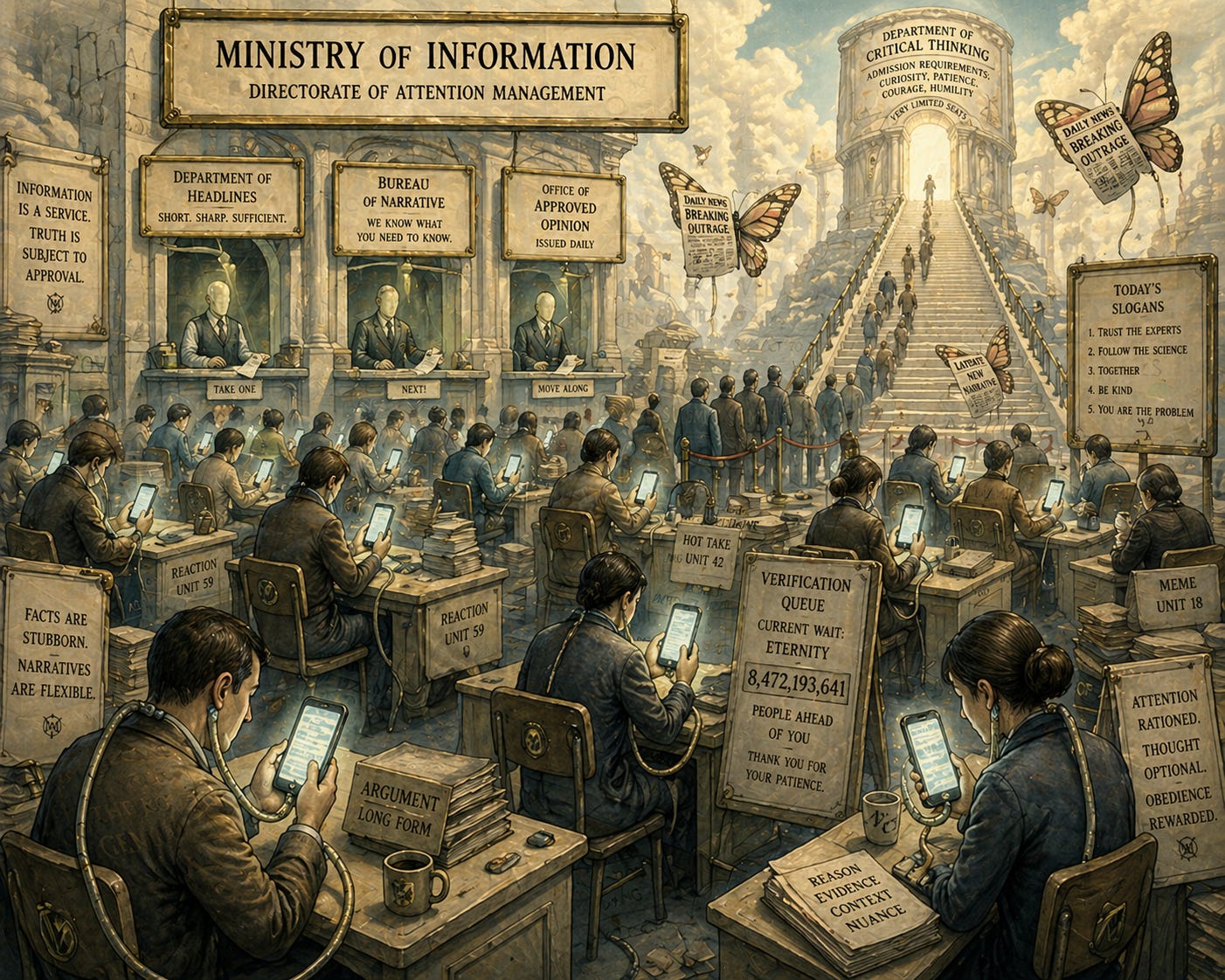
There is a certain intellectual laziness in the now-familiar lament that “print is dying,” as though the decline of ink on paper were the central cultural drama of our time. It is not. Paper is merely a delivery mechanism. If anything, the technological conditions for serious reading have never been more favourable. High-resolution screens, instantaneous distribution, and—most tellingly—the explosion of audio have removed nearly every practical barrier to engaging with long-form thought.
A citizen today can read an essay on a phone sharper than any broadsheet, or listen to an entire book while walking, commuting, or lying in bed. When I was young, audiobooks existed in a primitive form—cassettes, boxed and clumsy. Today, entire libraries travel in one’s pocket. If access were the problem, we would be living through a reading renaissance.
We are not.
The “death of print” thesis is therefore a comforting distraction. Digital did not destroy reading; it made reading easier. Audio did not compete with books; it expanded them. If the appetite for sustained argument still existed, it would have flourished. Instead, we find ourselves in a paradox of abundance and intellectual scarcity.
The problem is not technological. It is cultural: the quiet surrender of attention, judgment, and the will to verify.
What has declined is not merely the newspaper, but the habit of mind newspapers—at their best—once cultivated. And even the oft-repeated obituary for the newspaper is misunderstood. We are told newspapers died because the market killed them: classifieds migrated online, advertising splintered, and profitability eroded. There is truth in that, but it is only half the story.
The counterpoint is obvious. Digital media also gave newspapers something previous generations could scarcely imagine: potentially infinite scale. Distribution costs collapsed. Reach became global. A publication once confined to one city block could now circulate everywhere at once. If newspapers were simply victims of market forces, that technological revolution ought also to have offered a renaissance.
It did not.
Which suggests the “death of the newspaper,” like the “death of print,” is not primarily a market phenomenon but a cultural one.
The deeper collapse is not economic but civilizational.
The real casualty is the editorial tradition: the long-form, structured, morally serious attempt to persuade. Accuracy, so often invoked as journalism’s supreme virtue, is necessary but trivial. A stock ticker is accurate. A weather report is accurate. But neither teaches a citizen how to think.
The editorial once did.
That assumption—that the reader could follow an argument—now feels almost antique.
There was a time when even a partisan reader expected more than slogans. One might disagree, even violently, with a column, but one was required to engage with it. Arguments had structure. Conclusions followed premises. Readers were invited, however imperfectly, into the discipline of reasoning.
Today, that structure has collapsed.
The modern informational diet is not composed of arguments but of fragments: headlines, clips, reactions, denunciations. One does not read; one scrolls. One does not argue; one signals. The goal is no longer persuasion, but affirmation.
And one sees just how far this has gone with a simple question. Walk down any street and ask: Who is your favourite Canadian editorial writer? Most people will not even understand the question. Press them, and they will likely name a podcaster—perhaps someone like Joe Rogan—because in the modern imagination, ideas have been collapsed into personality, tone, and conversational immediacy.
Thirty years ago, this would have been unthinkable.
Back then, even if one did not read editorials, one knew they existed—and that they mattered. Today, the editorial writer has not merely lost influence; they have lost recognition.
The result is not simply a decline in knowledge, but a collapse in intellectual habit.
I see this directly in my own classroom. In a class of fifty business students, I am fortunate if one or two read a daily newspaper. These are not disengaged individuals. They are ambitious, capable and often sharp in practical terms. And yet they move through their education with almost no exposure to structured argument about the very systems they intend to enter.
The decline goes further.
I wrote a 280-page textbook for my course. Not a doorstop, not an indulgence—simply a clear, structured attempt to lay out ideas properly. It even had a lot of pictures and charts, plenty of white space to lower reading anxiety.
The reaction was not indifferent. It was an offence. One student told me he intended to file a complaint with the department head over being required to read. At university.
That moment was clarifying.
This is not about ability. It is about conditioning.
The modern mind, fed a constant stream of short, stimulating, easily digestible content, has been retrained to resist sustained effort. We are surrounded by intellectual candy—immediate, pleasurable, and nutritionally empty. And like all such diets, it produces a kind of malnourishment that is not immediately visible, but deeply consequential.
This collapse of habit extends well beyond students.
I encountered it in a more revealing form with a tenure-track professor at the University of Guelph. He was presented with my work detailing how his affiliated university had treated me—its tolerance for defamation, its failure to intervene and its broader institutional conduct. The material was documented, structured and evidence-based.
His response?
“It just doesn’t ring true.”
Not, “the evidence is flawed.” Not, “the claim is unsupported.” Simply: it doesn’t feel right.
But this was an academic. A professional reader.
And even there, the instinct was not to verify, but to react.
When people criticize my work, I ask one simple question: Did you read the article? It is astonishingly effective. The conversation usually expires on contact. I have yet to meet someone who answers yes and then actually engages.
That is the shift.
I am scarcely fit to call myself a proper academic, but I am at least willing to read.
And sadly, I have met too many lawyers, professors, union leaders, and other heavily credentialed people who seem to regard reading more than 300 words as an unreasonable burden—if not a form of abuse.
The problem is not misinformation. It is not disinformation. Those have always existed. The problem is the disappearance of the instinct to test claims against evidence.
A citizen who asks, “Is this true?” is engaging in reasoning. A citizen who asks, “Does this feel right?” is not.
Journalism has not resisted this drift. There has been a quiet migration from inquiry to advocacy. One reads the editorial pages of The Globe and Mail, The Toronto Star, or The New York Times, and encounters arguments that are often strikingly weak—assertion in place of logic, posture in place of reasoning.
And into this environment step the politicians—no longer required to persuade, only to brand.
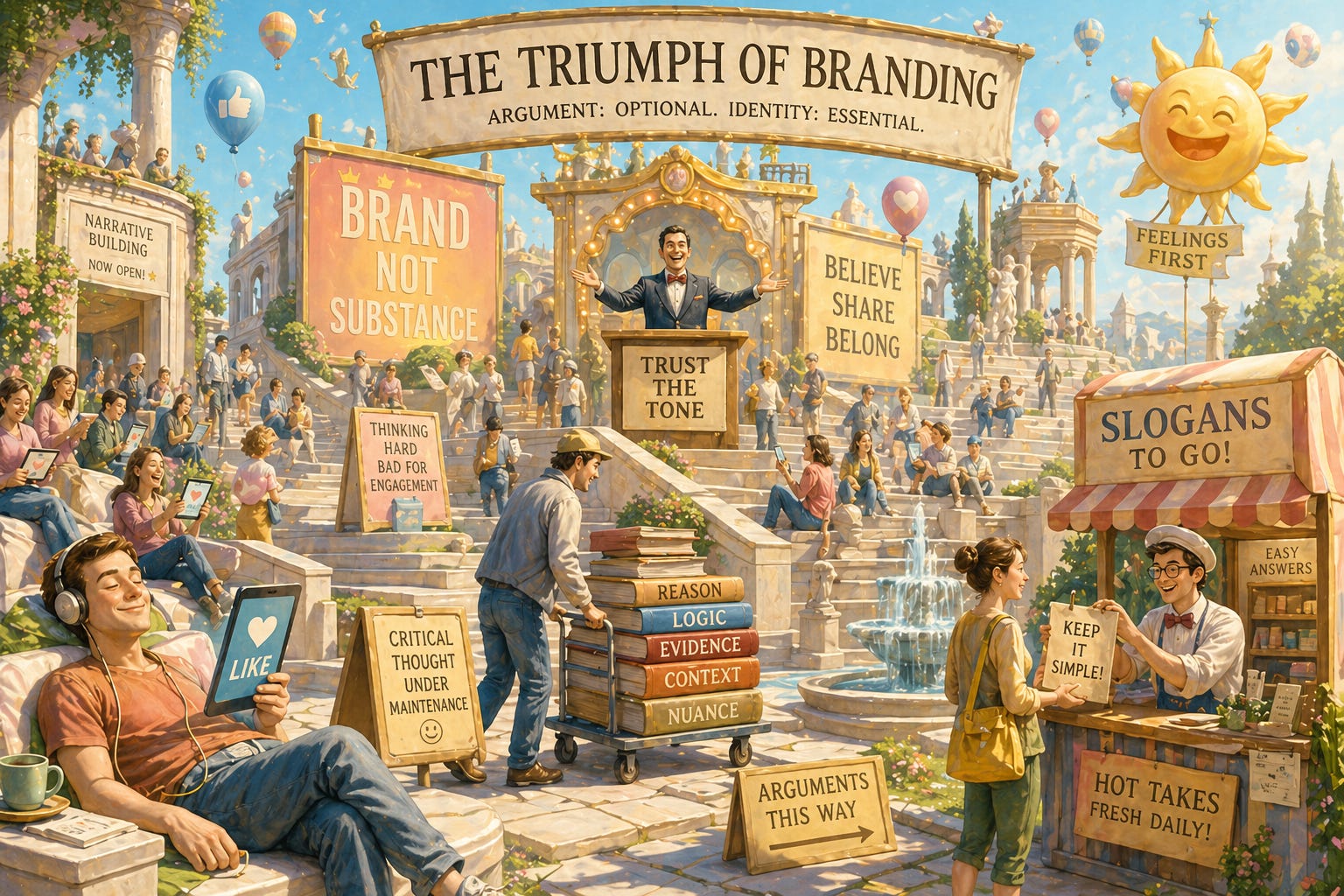
Here, one begins to see the deeper problem. The modern political contest is not between ideas, but between brands—and some brands are simply better than others.
The liberal brand is, in purely rhetorical terms, a masterpiece. It calls itself “progressive”—a word that contains within it the promise of improvement, of movement, of moral advancement. It signals action. It says: " We will do something. It is forward-leaning, assertive, optimistic in tone, even when vague in substance.
The conservative brand, by contrast, is almost comically disadvantaged. It is associated with restraint, caution and the instinct to pause. As William F. Buckley Jr. once put it, conservatism is the act of standing athwart history and yelling, “Stop.” It is, in essence, an appeal to reflection rather than action. This is not good branding.
One side promises movement. The other advises hesitation. One offers the emotional satisfaction of doing; the other insists on the discipline of thinking. In a culture that has lost patience for thought, the outcome is not difficult to predict.
Policy becomes secondary. Language does the work.
Consider the New Democratic Party proposing government-run grocery stores. The economic realities—low margins, efficiency constraints, historical precedent—are beside the point. It sounds like action. It sounds like fairness. And so it resonates.
Or consider Mark Carney and the idea of a sovereign wealth fund financed through borrowing. The phrase itself is the argument. “Sovereign.” “Wealth.” It carries a kind of borrowed authority.
Strip away the language, and the logic becomes rather simpler.
It is the economic equivalent of a child saying, “I would like to start a savings account, but I do not wish to use my own money.” May I borrow the savings?
Any parent would recognize the problem instantly.
Did you hear Carney hinting about Canada joining the EU? It’s an idea divorced from reality, stupid on many levels, but about 50% of Canadians are both elbows and thumbs up on it.
But in a culture that no longer interrogates ideas, the packaging suffices.
This is not a generational issue. Boomers, like everyone else, operate within the same environment—responding to the same cues, the same branding, the same emotional shorthand.
And this has consequences.
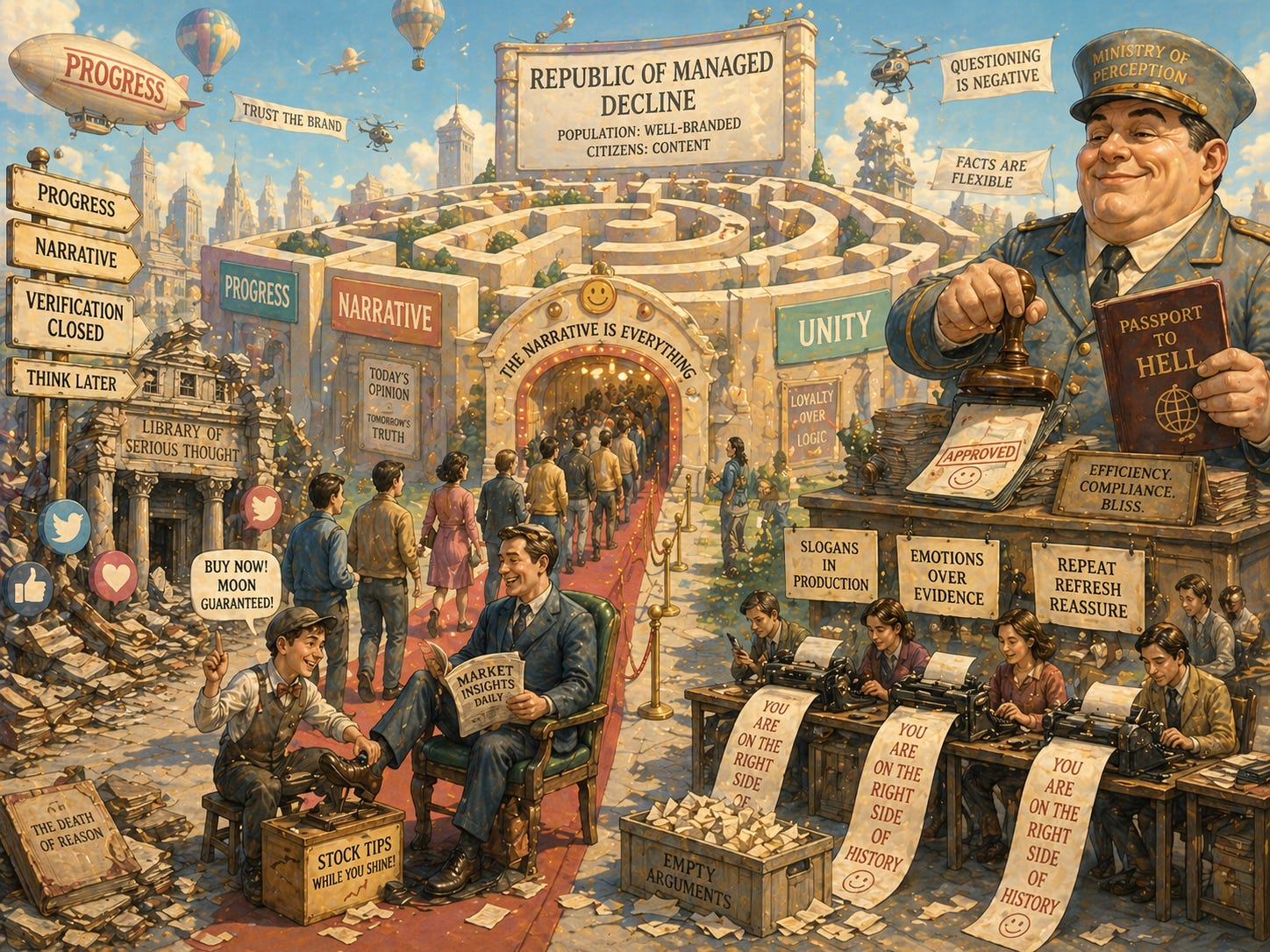
A democracy depends on citizens capable of engaging with arguments that cannot be reduced to slogans. It requires attention. It requires patience. It requires the willingness to think before reacting.
But the demagogue thrives when those habits disappear.
He does not need a 2,500-word argument. Twenty-five words will suffice.
What remains is identity.
Politics becomes a competition between brands. One does not evaluate policy; one selects a side. The process begins to resemble, in a way that should give us pause, the logic of dating applications: profiles presented, judgments made, commitments formed—without ever encountering the full person.
This is not how serious decisions are meant to be made.
The cumulative effect is a quiet erosion of critical thinking. Attention shrinks. Reading disappears. And increasingly, people do not even recognize what they have lost.
Reading is not merely about information. It is about discipline. It is how the mind learns to follow arguments, detect inconsistencies and question assumptions. It is one of the foundations of self-government.
When that foundation weakens, the consequences are inevitable.
A society that does not read seriously will not think seriously. A society that does not think seriously will not govern itself wisely.
The tools for serious thought have never been more abundant.
What is missing is the desire to use them.
And in that absence—not in the death of print, not in the rise of digital, but in the quiet abandonment of critical thinking—the real crisis of modern democracy resides.
Note: If you’ve made it to the end, congratulations—you are now part of a demographic too small to poll.
If you found value in this article and wish to support my ongoing work, please consider leaving a tip. Your support helps me continue producing uncensored content on critical issues. Or you can sign up for a paid subscription, it’s $8.35 per month, you can cancel anytime, and it spares you from the curse of paywalls.
Great piece. Thank you. This is exactly what is happening in public and private schools today- actual critical thinking skills have been replaced by slogans and activism. We are training a generation of kids to be reactive, performative and narcissistic; not deep thinkers who come to understand the world through logic, humility and experience.
I was sitting on my steps waiting for an Uber and looking around. It struck me that every individual walking on the sidewalk and across the street , had their eyes downcast , glued to their i-phone. What a creepy scene it was.