


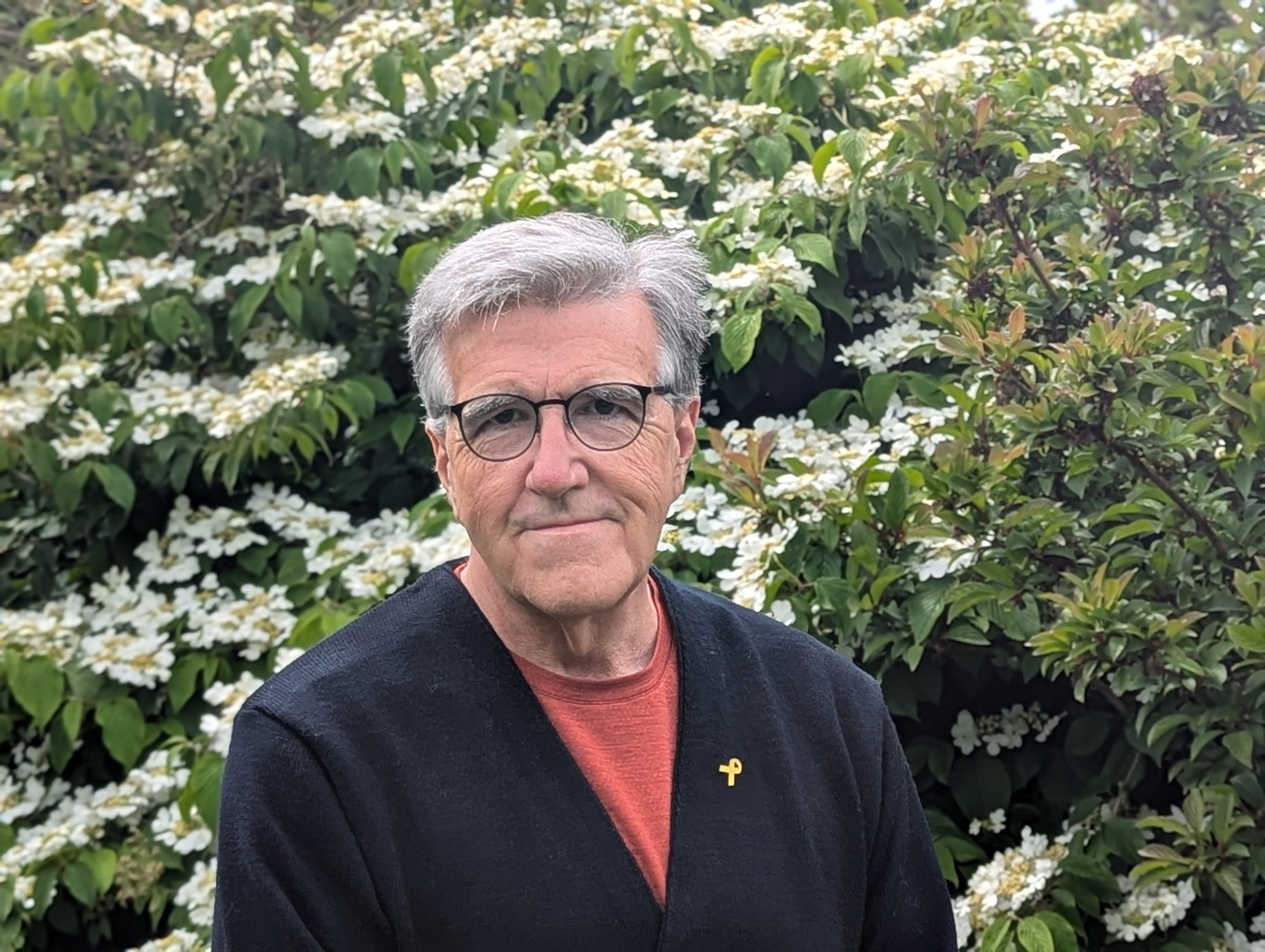
Pat Johnson is a Vancouver-based journalist and commentator whose work sits at the intersection of progressive politics and unwavering support for Israel and the Jewish people. A gay, agnostic, non-Jewish writer, he has spent more than three decades chronicling Jewish life and confronting antisemitism, primarily through his long association with Vancouver’s Jewish Independent and, more recently, his widely read Substack, “Beaten With a Shtick.”
Publishing sharp, thousand-word essays every few days, Johnson has become one of Canada’s most prolific online voices, taking fellow non-Jews – especially on the left – to task for antisemitism, anti-Zionism and what he sees as widespread hypocrisy in progressive spaces. His pieces, often caustic in tone, but grounded in a deep familiarity with Jewish history and contemporary Israel, dissect fashionable narratives about “settler colonialism,” “genocide”, and related slogans that dominate anti-Israel discourse.
Beyond opinion writing, Johnson’s career has included reporting, editing and communications work across mainstream and alternative media, as well as senior roles in Jewish community organisations. Through his organising work and his essays alike, he has fashioned a distinct niche: a progressive Canadian outsider who insists that standing with Jews is a moral test his own camp is failing.
What personally motivates you to write so passionately about antisemitism and support for Israel, especially as someone who isn’t Jewish?
Caffeine and outrage. Beyond this, my background in progressive activism, including gay rights and anti-racism have guided my life and career.
About 30 years ago, I stumbled into the Jewish community by becoming a freelance writer for Vancouver’s Jewish newspaper (the Jewish Western Bulletin, now the Jewish Independent, founded 1930). I’ve been hanging around the Jewish community ever since.
When the Second Intifada began 25 years ago, I saw the communities I was engaged with slowly diverge. The moral atrocity perpetrated by the global left was not so much that they chose to side with Palestinians against Israelis. The incalculable moral error was the choice to side with violence, religious extremism, misogyny, homophobia, xenophobia and almost everything else progressive people claim to oppose – even when peaceful negotiations were in progress, negotiations that would have led to two states living in peace side by side if the Palestinians had been willing.
The decision by activists, as well as foreign ministers, the United Nations, commentators and much of the world to stand with Palestinians and the intifada and against Israelis and civilised dialogue was the moment much of the world went completely off the rails.
They not only betrayed the Israelis. They betrayed our own values. And, most incongruously of all, they betray Palestinians. Negotiation, compromise and coexistence are the only things that will ever “free Palestine.” So those who self-righteously chant “Free Palestine” and who shed crocodile tears about dead Palestinians are the very ones who are standing in the way of a free Palestine. They are ensuring that more Palestinians die. If we want to actually free Palestine and if we want to stop Palestinians from dying, we need to demand that Palestinians abandon their commitment to eradicating Israel and accept, finally, a Palestinian state, astride Israelis, not on their graves.
How did your early experiences in Vancouver and later at McGill University shape your views on Judaism, Israel, and minority activism?
My father was a cop, and CKNW news radio was on in the house all day long. At the top and bottom of the hour, there was no talking during the (endlessly repetitive) newscasts. My family is not terribly political or activist, but my father was obsessed with crime reporting, and my mother was deeply engaged in volunteerism. She never said no to any request to canvass for the March of Dimes, join a phone tree, or cook for a Scouts banquet. This morphed in me, I guess, into a hybrid form of political activism that began with my volunteering for my first political campaign at age 14 and then throwing myself into anti-apartheid, anti-war, pro-feminist, antiracist, and other progressive forms of activism.
After I came out, I threw myself into LGBTQ+ (or, as we less inclusively called it then, “gay and lesbian”) activism and journalism.
I have been a Zionist since a first-year survey course of Middle East history at McGill, when it became clear to me that the root of this conflict is one people seeking to live in peaceful coexistence with their neighbours, and those neighbours responding on a spectrum from frigid peace to repeated attempted genocide.
If we do not recognise the root of this conflict, we will never see a resolution. We can keep blaming Israel, but 77 years of doing that have not freed Palestine, has it? What we are doing is not working.
People who actually want a free Palestine need to change their strategy. The question is, is freeing Palestine what they are really after?
Jordan, Lebanon, Syria, and Iraq were all essentially cut from whole cloth in roughly the same era that Israel was created. No one challenges the right to exist of those countries, even though a few of them are utterly failed states, while Israel is the very model of post-war decolonisation and statecraft.
What’s the difference? Israel is a Jewish state. That’s the problem. That is the root of this conflict.
We either acknowledge the root cause of anti-Zionism – antisemitism – and confront that cause, or we resign ourselves to more dead Palestinians and Israelis. Because as long as we refuse to confront the root of the problem, it will only continue.
Your Substack essays challenge both antisemites and some of your former progressive allies. What do you see as the main sources of hypocrisy or duplicity within the progressive movement regarding Jewish or Israeli issues?
In every other instance, on every other topic, approaching every other person, progressives prioritise dialogue and compromise, acceptance and cross-cultural understanding. With Israel and Jews, they adopt a fanatical – and false – binary. They exemplify intolerance, obstinacy, and a refusal to negotiate.
It is not so much that they have chosen Palestine over Israel – that is a symptom of a larger ideological problem. They have chosen violence, terror and endless war (they call it “resistance”) over peace, a negotiated coexistence and intercultural harmony.
Instead of chanting “From the river to the sea” and encouraging endless conflict and more death and destruction, here’s an idea. How about using your words? How about “resisting” at a negotiating table where you might actually get something you claim to want? Or is what you want not a free Palestine? Is what you want actually more violence? These are the questions we need to be asking.
You’ve compared the Palestinian keffiyeh worn by student activists to “the new blackface.” Can you elaborate on this controversial analogy?
I said earlier that we treat Jews and the Jewish state differently from how we treat every other people and state in the world. There’s a word for that.
We live in an era highly sensitive to cultural appropriation. We have even heard some particularly fanatical voices accuse Israel of culturally appropriating Palestinian foods – as if they invented hummus and falafel.
Now, imagine the cognitive dissonance that it should raise – but absolutely doesn’t – that we have thousands, if not millions, of privileged, white suburban activists dressing up like Arabs in keffiyehs, and not a single voice seems to find anything odd about this.
Can you imagine activists seeking to advance reconciliation with First Nations by wearing Halloween costumes of Indian chiefs? Or people who are horrified by Donald Trump’s politicisation of ICE protesting in sombreros and ponchos?
Allies of the Black Lives Matter movement would not dream, obviously, of engaging in the equivalent of cultural appropriation there.
But the question is, how is cultural appropriation acceptable when it comes to Palestinians, when we wouldn’t dream of behaving this way with any other group? I have theories – and I’ve written about them – but it comes down to the fact that this particular issue involves Jews and therefore somehow drags activists into a recidivism that erases all contemporary standards of behaviour.
The biggest problem here is that the movement is determined to use any means necessary – except the one that would work: Negotiations, coexistence and an agreement to live in peace.
They subscribe to any means necessary, and if that means behaving in culturally inappropriate ways that you would never exhibit in any other circumstance, defiling the historical memory of the Jewish people by accusing them of perpetrating a holocaust, or culturally appropriating. Palestinian symbolism – nothing will stand in the way of a cause that they have fanatically, irrationally, and existentially adopted as their One True Faith.
I mean, cultural appropriation is a progressive sin, but once you have signed on to the idea that baby-killing, beheading and rape are legitimate “resistance,” a little 21st-century blackface doesn’t really look so terrible. So while I think it is atrocious, it is only a symptom of a much broader abandonment of moral principles.
What do you think would lead to more productive dialogue on the Israeli-Palestinian conflict?
Any productive dialogue must recognise that compromise is the key to ending this conflict.
Anti-Zionists love to hold up figures like MKs Bezalel Smotrich and Itamar Ben-Gvir as proof of Israeli intolerance and refusal to compromise. But the history of Israel has been one of endless compromises. And, Smotrich and Ben-Gvir notwithstanding, if there was the slightest hint that Palestinians were ready to compromise and coexist, Israelis would race to the negotiating table for a two-state solution.
It is easy to find examples of Israeli intolerance. But even today, these represent a minority viewpoint. Moreover, they are a reaction to Arab and Palestinian intolerance. The early Zionists always expected and hoped to live in peace with their neighbours. Their neighbours had, put mildly, different ideas.
Every time someone chants “From the river to the sea,” “Globalise the intifada”, or really any statement that demonises Israel, they are pushing away both peace and Palestinian self-determination.
The definition of a compromise is that both sides win some and lose some. That is the only way this conflict will end. If, like the global Palestinian movement today, your objective is total victory for your side and total defeat for the Zionists, you are not advancing what you claim. You are ensuring more Palestinians and Israelis die.
We cannot be either pro-Palestinian or pro-Israel.
We can only be both.
To be pro-Palestinian, we must be pro-Israel. Because a negotiated settlement – not militarily vanquishing the enemy – is the only hope for lasting peace. Until we see a tectonic change in Palestinian, Arab and Muslim thought, we will continue to see more conflict. And as long as Western activists keep egging on this intolerant, violent, one-sided, fanatical approach to Israel, they are not freeing Palestine. They are perpetuating oppression and more death.
Can you tell us more about Upstanders Canada—the organisation you founded—and the importance of non-Jewish allies confronting antisemitism?
Upstanders Canada is separate from my Substack, obviously. My Substack is my personal opinion.
Upstanders Canada mobilises non-Jewish Canadians to stand with Jewish people and Israel. We have tangible, accessible entry points that make it easy to be an ally.
We launched Ally Action Hub, a one-stop shop for people who want to become more educated about the issues and find ways to be allies to Jewish people.
We have other projects in development that will continue to make serious inroads against this problem, empowering and mobilising Canadians to take a stand and make Canada a better, more inclusive society.
Upstanders launched a guide to help people understand antisemitism. Can you talk about that?
In 2024, even before we received charitable status from the Canada Revenue Agency, we released a toolkit called Be An Upstander. There are a lot of toolkits against antisemitism, but ours is different because we focus less on the most overt forms of antisemitism – obvious tiki torch-carrying, screaming Jew-hating forms – and more on the subtle forms of discrimination, prejudice, tropes, biases, and assumptions about Jews that most people do not even know we carry – but which we inherit by mere dint of being a part of Western civilization. It is easy to identify and call out blatant, neo-Nazi or overtly racist antisemitism. It is far more difficult to recognise – even in ourselves – the nuanced and complex network of ideas about Jews that influence our everyday thinking, including our response to the news we see coming out of Israel and Palestine.
That is what this toolkit focuses on. It also offers extremely tangible steps to have a positive impact on the problem.
As part of our current initiatives, we are turning that toolkit into a curriculum that will empower individual Canadians to lead dialogues on these topics in their friend groups, workplaces, congregations, union locals, or wherever.
Your writing has appeared in the Jewish Independent for decades. You also co-wrote a memoir for a BC government minister targeted by anti-Israel activists. At what stage did you feel comfortable enough and knowledgeable enough to write about Jewish issues?
Am I equipped to write on these subjects? I don’t know. As an ally, it is a constant struggle not to speak over or for the people you ostensibly are supporting. This is a lesson that “pro-Palestinians” have sure as hell not learned. It’s a line I have to walk. My career, though, has been maybe the longest undergraduate education in Jewish studies ever undertaken. I have had the opportunity to meet, hear and interview hundreds of the top Israeli and Jewish thinkers and doers who have made their way to Canada’s West Coast over the past 30 years. As someone who has been a freelance writer for most of my career, feeling “comfortable enough” to write about something is a privilege you don’t always get.
What advice would you give to other non-Jewish allies who feel compelled to speak up for Jews or Israel, especially when faced with opposition from their own communities?
Either you are going to do what is right, or you are not. Sometimes it’s hard, but let’s be serious. It’s not that hard. I’m not hiding Jews in my attic. I’m not in an Iranian prison. People say mean things to me on social media. I think I can handle it. And also, we need to take our own advice to toddlers: If you’re afraid, go ahead and be afraid. Then do it anyway. Courage is a muscle. Use it. It gets stronger.
I agree with Mr. Johnson and his analysis of the confusing and immoral antisemitism that has been become so common-place today. I too, am non-Jewish, but was raised in a home that respected Jewish history and their contribution to the world. Throughout my lived life that admiration and empathy for the Jewish people has only grown. However my views, and those of Pat Johnson, diverge based upon one observation that he made in this article. “In every other instance, on every other topic, approaching every other person, progressives prioritise dialogue and compromise, acceptance and cross-cultural understanding.” In my experience, the Left’s take on the Israel/Palestinian issue is quite consistent with their illogical interpretation of many other social and economic issues of the day and dialogue and compromise are not in their DNA.