



Universities like to present themselves as places governed by rules: human rights codes, collective agreements, grievance procedures, and solemn declarations of fairness, due process, and academic freedom.
On paper, the structure appears formidable. In reality, those rules mean very little if there is no practical way to enforce them.
A right that cannot be exercised is not a right. As the old legal maxim reminds us, ubi jus ibi remedium—where there is a right, there must also be a remedy. A law that can be appealed only by those wealthy enough to endure the cost and strain of litigation is not justice in practice. It is merely justice on paper.
It is a decoration.
And decoration, I discovered, is precisely what many institutional rules become when the institution itself decides it wants you gone.
Once that decision is made, the elaborate framework of procedures—collective agreements, human-rights protections, grievance mechanisms—can quietly become stage scenery. They remain visible, but they cease to function.
In my previous essay, I described how one small Canadian university went to war against a professor (me) it had decided it no longer wanted, because that professor had the audacity to say that he stood with Israel.
Although I last wrote in the third person (it looks less pathetic), this one I am back to good old-fashioned first person.
I explained how outrage was cultivated, amplified, and eventually used as evidence against the person it targeted.
But another element of the story deserves its own explanation, because it reveals something even more troubling about how these systems actually function. If the first part concerned the creation of the mob, this part concerns the bureaucratic machinery that quietly ratified it.
At the center of the story remains a question that still astonishes me: the extraordinary confidence of my accuser and ex-colleague, Dr. Wael Ramadan.
Before any of this began, I had never met him. I had never spoken to him. I had never corresponded with him. I had never even heard his name. There was no academic rivalry, no simmering dispute, no personal animus running beneath the surface.
I was minding my own business, teaching my courses and living my life.
The first time I became aware of Dr. Ramadan was when I saw his name in the National Post. Journalist John Ivison had written about controversial anti-Jewish comments appearing on Dr. Ramadan’s social media. Students had reportedly contacted Ivison, expressing concern about the tone and content of Ramadan’s posts and his classroom behaviour. That was how I learned he existed. The post is public; I have no inside information.
Nor did I have any relationship with the university’s senior leadership. I had never met the vice-provost, Melanie Spence-Ariemma. I had no dealings with her whatsoever before these events unfolded. I discovered, though, that she had a 15-year professional relationship with Ramadan; he had her personal number, but of course, this prior relationship was never declared.
But this was not a personal feud. It began with strangers. Which makes what followed all the more remarkable.
Dr. Ramadan is not an unsophisticated man. He is a Fulbright scholar, an accomplished academic, and by all accounts an intelligent professor. One cannot plausibly argue that he did not understand the consequences of his conduct.
In fact, his conduct suggests precisely the opposite.
He behaved like someone who knew exactly how the system worked—and knew that it would not turn against him. He was, for unknown reasons, untouchable.
Normally, when someone finds themselves already under controversy for inflammatory public posts, the instinct is to become cautious. To lower the temperature. To step back.
But Dr. Ramadan did the opposite. He escalated.
The volume of his postings was astonishing—at times, reaching dozens a day. Nor did he hesitate to discuss the situation with students. One reported that he openly bragged that he would get me fired. This was said in the presence of two witnesses. That is not subtle conduct.
A professor telling students he intends to have another professor dismissed is essentially announcing a campaign.
And that campaign did not remain confined to campus.
Dr. Ramadan reached out to activist organizations and encouraged them to mobilize their networks. I possess the posts from those organizations. They were not obscure messages drifting quietly through the internet. Several of them generated enormous engagement—well over five hundred likes in one case.
For perspective, I have never had a social media post in my life receive anything close to that level of attention. If I receive ten or fifteen likes, it is considered a good result. I’m rather content to be a nobody.
These posts were explicit. They included the university’s contact information, implicit instructions telling readers to write in and demand that I be fired.
Even if only 1% of those who saw posts initiated by Ramadan and by faculty and student supporters attacking me actually wrote to the university, the result would be obvious: a flood of thousands of complaints demanding my termination.
What makes this extraordinary is that the university knew exactly how this campaign was being generated. A faculty member—who happened to have a relationship with senior administration—was openly encouraging students and outside organizations to pressure the university to terminate another professor.
To my knowledge, the university took no meaningful steps to stop it.
A student, in the presence of his parents, told me that another staff member—who had previously contacted me at home via LinkedIn proposing what she described as an “independent mediation,” which another student interpreted as a “comply or face consequences” type of message—had made defamatory sexual allegations about me that were then circulated on campus. Despite this, no formal complaint was ever brought forward through proper channels, and no action was taken.
Instead, these unverified claims were permitted to circulate freely, and the climate they helped create was later cited as evidence that I had “poisoned the work environment.” The University of Guelph has acknowledged that it did not investigate the allegations at the time. Humber College, for its part, indicated—nearly two years later—that it had conducted an investigation and determined that the defamatory statements circulated by staff and faculty were unfounded, by which point the reputational damage had already been done.
There was no public correction, no retraction, and, to my knowledge, no effort to trace or address the source of those claims. The damage, in practical terms, was irreversible.
The logic is difficult to follow. The atmosphere described as “toxic” was not created by me, but arose from unverified allegations and internal communications against me - all of which I did not control. Those claims circulated among staff and faculty and went uninvestigated at the time.
And yet, it is that same atmosphere—formed independently of my actions—that was ultimately attributed to me. The conclusion, in effect, is that I “poisoned the workspace,” despite the conditions cited being generated by processes and actors within the institution itself.
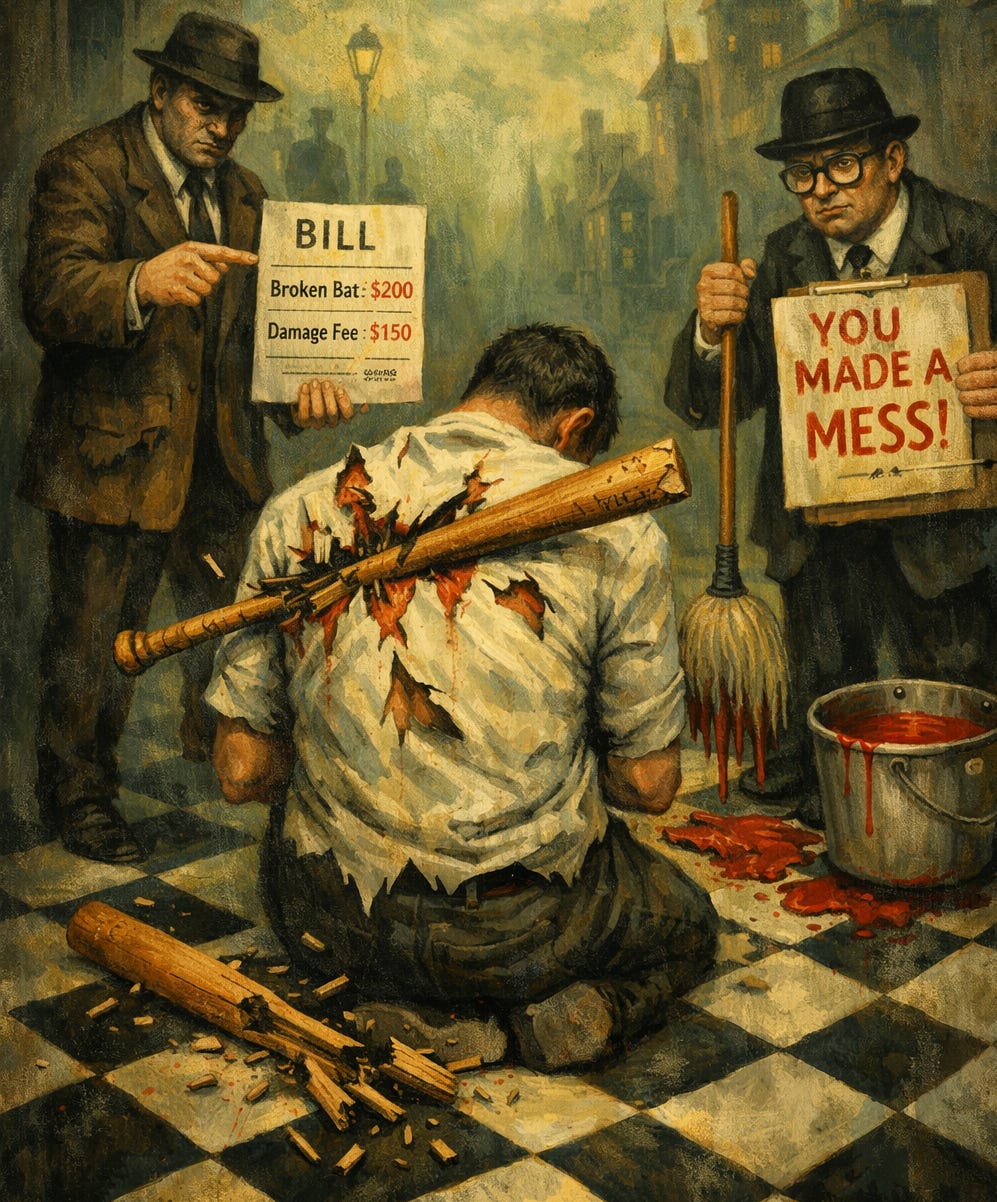
The closest analogy I can offer is this: someone beats you with a baseball bat until the bat splinters across your back. Then they hand you the bill for breaking the bat and accuse you of creating a bloody mess.
When tens of thousands of people are seeing you publicly described as a Nazi or a radical Israeli extremist (an extremist position at GH is not wanting Jews to be murdered, I understand), when that narrative spreads through activist networks, the consequences are not merely professional. They can become physical.
I began receiving threats. I had to install more security equipment at my home. Many students know where I live. I even live next door to a graduate of the university. When a campaign of demonization is allowed to spiral outward unchecked, of course, your family becomes concerned for their safety.
I am not comparing my situation to the horrific violence that has occurred elsewhere—synagogues attacked, restaurants shot at, people targeted simply because of who they are. I hope that doesn’t happen to me, but for a pro-Jewish/Israel supporter in Toronto these days, one should not jump to any conclusion that one is safe in one's home.
For violent anti-Semitic tragedies of this kind do not materialize from nowhere. They are cultivated. They begin with the steady drumbeat of demonization—language repeated, amplified, and circulated to tens of thousands until eventually some unstable or zealous listener concludes that harming the designated villain would be an act of justice.
Dr. Ramadan’s conduct belongs squarely within that poisonous tradition. His relentless attacks on Jews—posted day after day across social media—do not merely degrade discourse. They help create an atmosphere in which Jewish students, and Jews generally in Toronto, are made less safe. Anyone curious can judge for themselves by clicking the link at the end of the essay.
What I have included represents perhaps one percent of his output.
What should disturb any reasonable observer is not merely the existence of such rhetoric but the institutional indulgence surrounding it.
Humber’s Human Rights office—and the external investigator, Gita Anand, brought in to rubber-stamp a conclusion that management had clearly reached in advance—showed no interest in examining it. An office whose title suggests concern for students' welfare displayed none.
In doing so, it risked not merely the fashionable academic abstraction of “emotional safety,” but something far more concrete: the physical safety of the very students it claims to protect. Whether this blindness reflects ideological sympathy or simple obedience to administrative authority is impossible to say. The result, however, is the same.
History provides a warning that ought to be obvious. In France, the schoolteacher Samuel Paty became the subject of escalating outrage after rumours and accusations spread unchecked. As with me, students and faculty lied, distorted facts, and parents became involved. The temperature rose, hysteria was cultivated, and eventually a radicalized young man decided that violence was a legitimate response.
The teacher Paty was murdered. His head was cut off.
No one claims that every campaign of demonization ends in violence. But every such tragedy begins the same way: with reckless words, institutional cowardice, and the quiet indulgence of those who ought to know better.
And when institutions excuse the incitement while punishing those who object to it, they are not merely failing in their duty. They are participating in the creation of the very danger they later pretend to deplore.
Universities should understand that dynamic better than anyone.
Yet in this case, the university allowed the campaign to flourish. I have no evidence that administrators actively collaborated in creating it. But they certainly knew about it, and they allowed it to continue.
Whether I was fired or not, I would not be physically safe returning to work at Guelph-Humber; it only takes one; they could follow me home, assault me, my family or my pets; on campus, it would be so easy.
But in my case, what was created was an extremely effective mob, to this point, thankfully non-violent.
Dr. Ramadan delivered precisely what he promised his students.
I was dismissed—swept away under an avalanche of defamation and vitriol, and socially quarantined from the first hour.
But the story becomes even more extraordinary when one examines the conduct of Humber’s Human Rights Department.
One might assume that a department bearing the title “Human Rights” would at least be familiar with the basic principles of human-rights law.
One of those principles is standing.
In a human rights complaint, the complainant must be someone who has personally experienced discrimination based on a protected ground. Without standing, there is no complaint.
In my case, the Complainant, the Vice Provost, clearly lacked standing to file her human rights complaint. That was clear. But again, so she and her supporters in the Humber Human Rights Department break the rules, who cares, what can I do? Write an indignant email?
This is Canadian university justice.
No standing was claimed. None existed. The complaint did not allege that the complainant had personally suffered discrimination. The human-rights complaint simply became a mechanism for pursuing me.
Yet Humber’s Human Rights Department allowed it to proceed anyway. The boss ordered it, and they do what they are told, human rights code be damned.
Standing is not an obscure legal technicality. It is the foundation of the entire process. Yet in this case, it appeared to be ignored completely.
Even my other faculty union, CUPE, raised concerns about how the process had been constructed. I was told that CUPE representatives believed the complaint form had been taken from the internet and adapted for this complaint.
If that is correct, the university was essentially improvising its human rights procedures as it went along. It weaponized their human rights department.
The contrast becomes even more striking when one examines what happened when complaints were filed in the opposite direction.
Two Jewish students filed human rights complaints regarding Dr. Ramadan’s social media activity. I filed one as well. These complaints were supported by extensive documentation—hundreds, arguably thousands, of publicly available posts. (Posts)
This was not a marginal case.
Under the university’s own policies on harassment and discrimination, the material should have raised alarm bells. Much of it strayed into the territory of outright hate propaganda—serious enough that Peel Regional Police launched an investigation into Dr. Ramadan over a number of his public posts.
Yet those complaints were dismissed - both by the police and by the human rights department, though at least the police admitted the posts were vile and crossed the line from anti-semitism to hate propaganda.
Indeed, the investigator hired by the Human Rights department went so far as to suggest that my citing Ramadan’s long catalogue of antisemitic posts constituted reprisal against him!
This would be comic if it were not so consequential. One of the grounds eventually cited for my dismissal was precisely this supposed “reprisal.”
The reasoning was almost beautiful in its absurdity: the act of documenting antisemitism was itself treated as misconduct.
Such reasoning requires a particular type of academic mind—one in which the PhD functions less as evidence of intellectual discipline than as ornamental paper concealing a broken conscience.
Only in such an environment could a hired investigator seriously maintain that the validity of a human rights complaint depends not on its content but on the complainant’s subjective intention, something the investigator can only guess at from the vibes they gather.
The irony is exquisite. The Human Rights Tribunal of Ontario states quite plainly that terminating someone because they have filed a human rights complaint constitutes reprisal and is unlawful.
But when the institutions themselves decide otherwise, the law begins to resemble theatre more than law. A rule without enforcement and an appeal mechanism beyond practical reach is not justice. It is a decoration.
What this episode ultimately reveals is a deeper structural problem.
Canada has an impressive architecture of rules on paper: human rights codes, collective agreements, grievance procedures, and institutional policies that promise fairness and accountability.
But rules only matter if they can be enforced.
When those rules are broken—when collective agreements are ignored, when human-rights procedures are selectively applied—the real question becomes whether there is any practical path to challenge the violation.
In theory, such a path exists. In practice, it is extraordinarily difficult.
Legal processes are slow, complex, and expensive. The institutions involved are publicly funded organizations with substantial legal resources. The individuals challenging them must often bear the burden themselves.
Most people simply walk away.
That is the quiet reality behind many institutional injustices.
When the union declines to enforce the agreement, and the internal human rights office declines to apply its own standards, the protections written into those documents begin to resemble decorative language rather than enforceable rules.
They exist on paper. But paper alone does not enforce itself. And once enforcement disappears, the rest becomes theatre.
And finally, a word for those who will say that by writing this, I am merely stirring the pot—that I should calm down, move on, and stop publicly advocating for myself. They say I am harming my mental health. On the last point, they may be right, but...
Consider what happened on the very first day.
On day one, I was suspended, gagged, and aggressively threatened—without charges.
On day one, I was told by staff that senior administration had already informed others that, whatever judicial theatre might follow, I would be fired regardless.
On day one, my union declared that I had committed a hate crime. Once your own union pronounces you guilty of a hate crime, the rest of the script writes itself. In that narrative, a hate criminal obviously deserves to be fired.
On day one, staff and faculty were walking around telling anyone who would listen that I had assaulted a student, had been arrested, and had been taken away by police. A completely fabricated and extraordinarily damaging story. When I tried to stop it, I was threatened with arrest by police, friends of public safety.
On day one, I was also told that I had apparently been committing violent crimes for years—five years, according to the rumours circulating through the institution. Exactly what crimes these were was never made clear. Apparently, I had been running a parallel career robbing banks or brawling beneath the plant wall.
I have even posted the message from the staff member attempting to convince a student that these things had happened.
When your first day looks like that, a rational person has two choices.
They can walk away and surrender.
Or they can fight back with the only tool they have.
For me, that tool is the court of public opinion and the simple presentation of the truth.
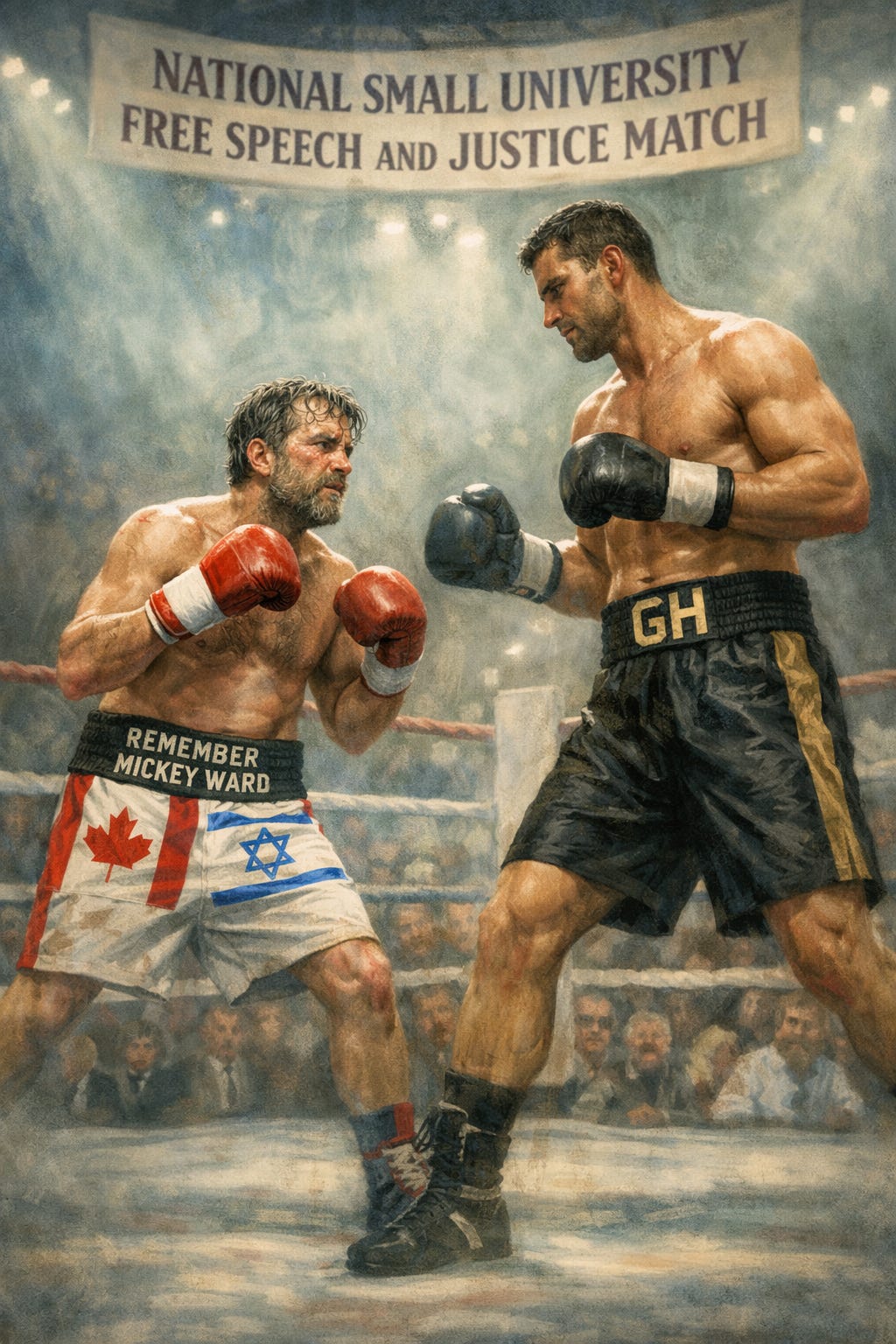
Earlier, I wrote a post titled “Remember Mickey Ward.”
Mickey Ward was the famous Irish-American fighter who fought a legendary trilogy against the far more naturally talented boxer Arturo Gatti. In one of those fights, Ward went into the later rounds bloodied, exhausted, and outmatched. Nobody expected him to survive.
But through sheer heart, grit, and stubborn determination—Irish determination of the old sort (the original Irish, not the modern anti-Semitic variety)—he fought back and won. I have an Irish passport. My family came from Kerrykeel to Alberta in 1904.
So I said it before. And I will say it again. Remember Mickey Ward.
I am not finished yet.
Link to Ramadan posts. Ramadan Posts
Thank you for your support. Feel free to share or delete.
If you found value in this article and wish to support my ongoing work, please consider leaving a tip. Your support helps me continue producing uncensored content on critical issues
Thank you for your courage. Those who speak the Truth are often the most hated. Excellent boxing image!
Even Kafka would have a hard time surpassing this. Canada the nation and western academia the institution have abandoned intellectual rigor and the pursuit of knowledge and truth. You sir, were an obstacle in their way in pursuit of their new cultural revolution in the mold of Chairman Mao.