


If you’ve made it this far without being fired, cancelled, or publicly flogged for saying something true, congratulations — you’re ahead of me. I write because I can’t not; because silence feels like complicity, and complicity feels like rot. If this piece leaves you nodding, snarling, or muttering, “Well, he’s not wrong,” then you’re precisely the reader I’m writing for.
You’ll get three essays a week — unapologetically long, occasionally bleak, often funny, always honest. It’s six bucks a month — less than one coffee in Carney’s Canada, or two if you buy the cheap stuff. Everyone says that, of course: “It’s just a cup of coffee.” Fine. But if you’re only going to buy one cup this month, make it mine. It’s $6 a month, and you can cancel anytime.
👉 Subscribe to Freedom To Offend. It keeps the ink defiant and the lights on.
Ontario’s Colleges: The Hypocrisy Factories
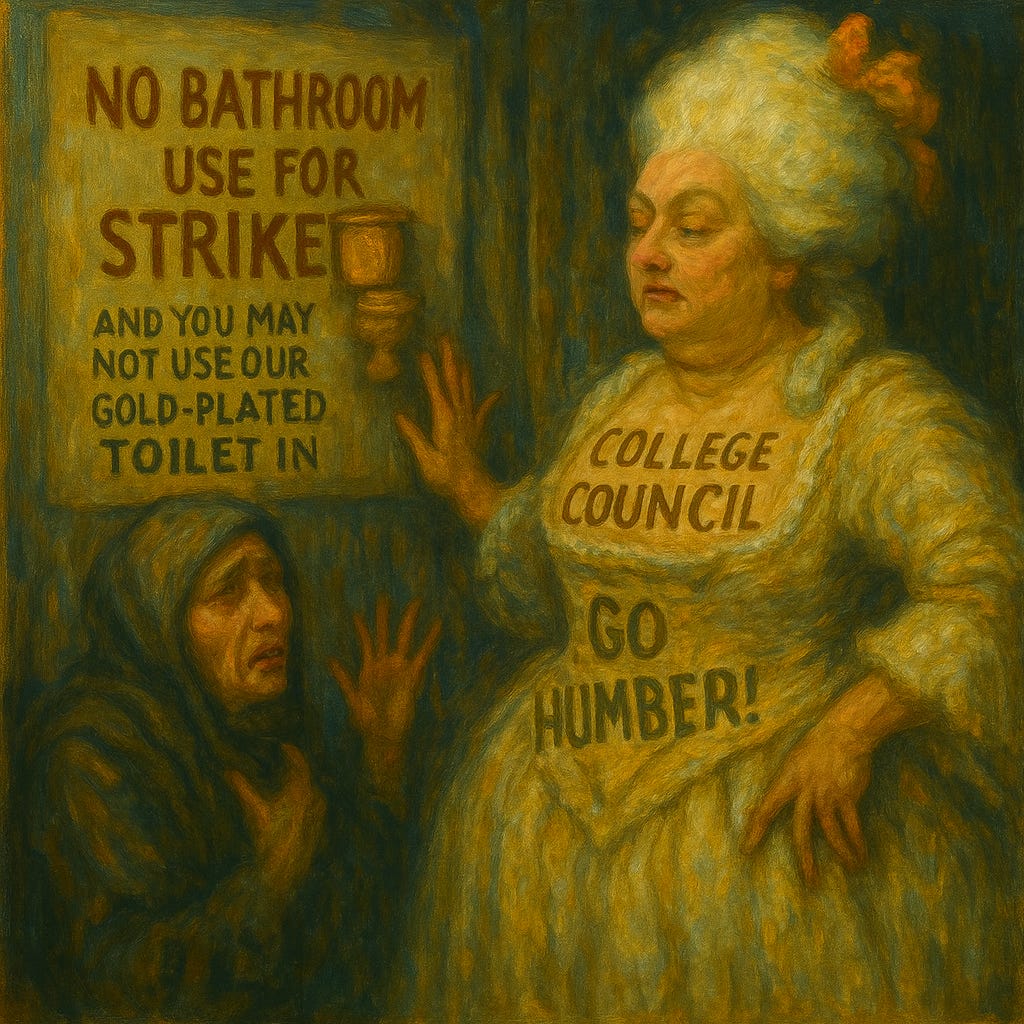
If hypocrisy could be converted into heat, Ontario’s colleges could power the province through winter without burning a lump of coal. The so-called “labour disruption” now playing out across campuses is not a contract dispute — it’s a moral X-ray, a vivid exposure of where the rot lives and how deep it runs. These are not educational institutions anymore; they are hypocrisy factories staffed by overpaid mediocrities and sustained by the moral exhaustion of those beneath them.
Colleges exist for one reason: to enlighten, not enrich; to serve, not inflate. Yet the College Employer Council — a name so pompous even Orwell might have laughed — has flatly refused to bargain. Not delayed, not quibbled over clauses, but simply refused. For more than a week, its negotiators have stayed home while support staff try to survive on $450 a week in strike pay. For part-timers, the silence has lasted nineteen months. This is not austerity; it’s contempt with a spreadsheet.
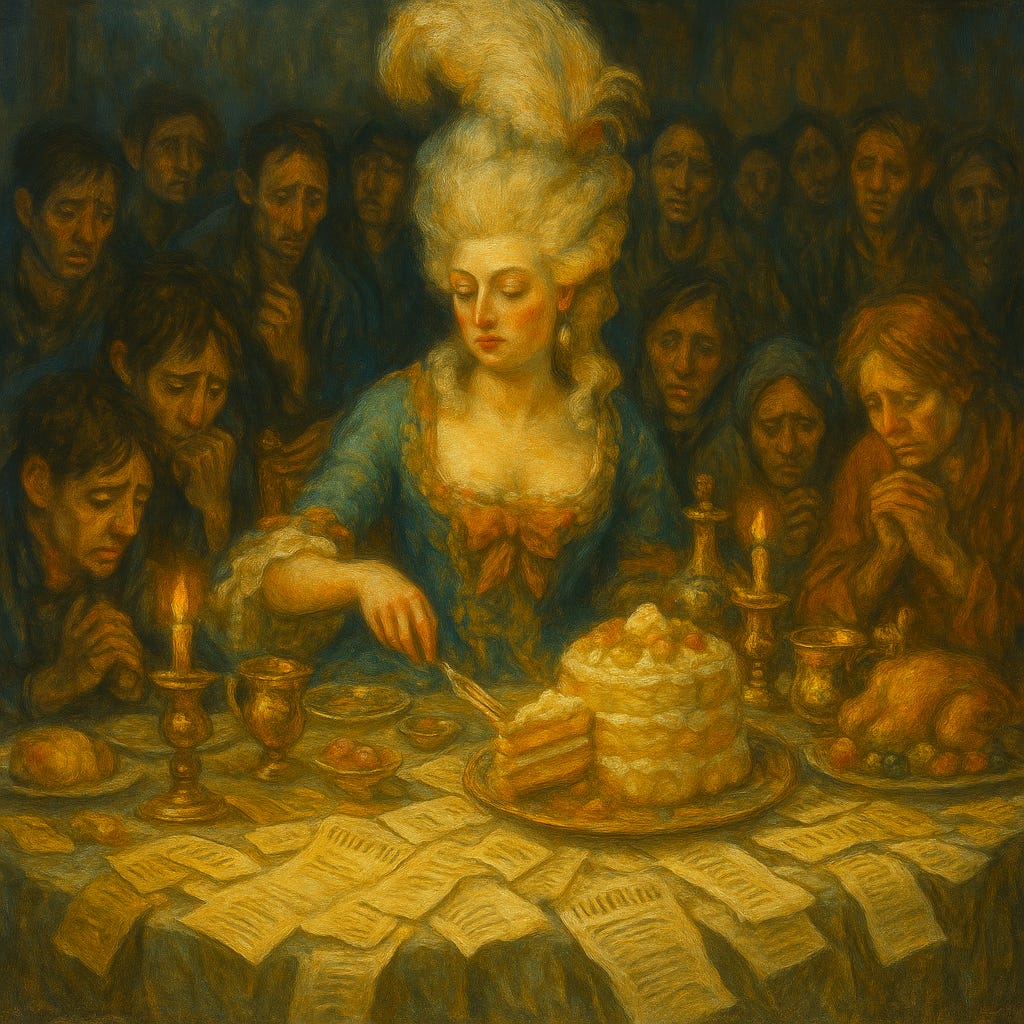
And contempt, it seems, has a powdered face and a royal wig. The attitude of Ontario’s senior college executives toward their staff and students has become a 21st-century echo of Marie Antoinette’s apocryphal sneer — “Let them eat cake.” The meaning, for the less historically inclined, was never about pastry. It was aristocratic shorthand for, “If the peasants cannot afford bread, that’s their fault — I’m too busy attending to my pleasures.” Today, the gilded Versailles is a boardroom, and the powdered courtiers are vice presidents with LinkedIn pages.
The workers’ demands are modest — a four-percent raise, perhaps three if pressed. With inflation at 2.4 percent, they’re asking for a rounding error above subsistence. The colleges call it “unsustainable.” Unsustainable? Tell that to Ann Marie Vaughan, president of Humber, who pocketed $497,880 last year — an 11.7-percent raise over her $445,838 the year before. Tell it to John Tibbits of Conestoga, whose pay rocketed from $494,716 to $636,106 — a staggering 28.6 percent jump. Tell it to Gervan Fearon at George Brown ($412,579, +8%) and David Agnew at Seneca ($459,778, +3%). Their combined raises in one year exceed $230,000 — more than the annual wages of half a dozen front-line staff. This is not leadership; it’s self-dealing by candlelight.
And failure it is — grotesque, measurable, and total. These are the same administrators who bet everything on international-student revenue, turned colleges into tuition mills, and lost. When Ottawa finally capped visas, enrolments collapsed. Conestoga alone is said to have lost up to 20,000 students. Their response? Not reform, not remorse — layoffs. The staff who held the place together are being purged to pay for management’s bad bets and glass-walled “innovation hubs.”
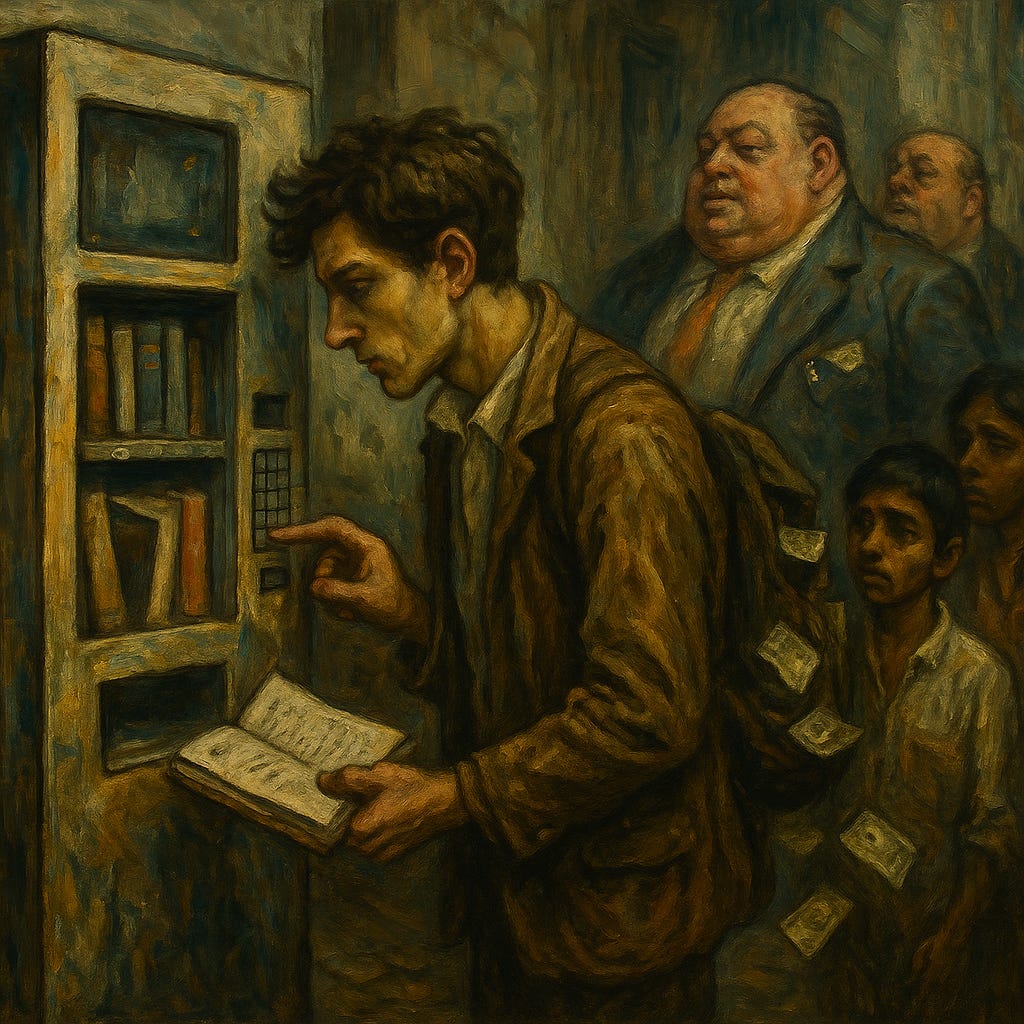
At Conestoga and elsewhere, they have even begun firing librarians. The human mind, apparently, is an inefficiency. They boast of replacing libraries with “automated resource kiosks” — vending machines for books. “How many librarians could we have kept if we weren’t paying these senior managers who’ve done nothing but screw up and now make us pay for their mistakes? What are they doing? Replacing librarians with vending machines. So when a student needs help on a research paper, they’re going to go talk to a vending machine.” One imagines the scene: Press A for Shakespeare. Press B for existential despair. Press C to print your tuition receipt. This is what happens when the managerial imagination replaces the academic one — a death of curiosity disguised as progress.
Meanwhile, students are paying full tuition for half an education. With staff on strike, colleges have defaulted to panic-mode online classes — the pedagogical equivalent of instant noodles. Every serious study confirms what every student already knows: emergency online learning is garbage. Brookings found comprehension collapses. Columbia’s Community College Research Centre found that failure and withdrawal rates skyrocket. Statistics Canada found that post-pandemic students report weaker motivation, lower engagement, and poorer learning. If students wanted online degrees, they would have gone to Athabasca and paid a fraction of the cost. They didn’t. They enrolled in real classrooms with real teachers and real libraries — before the libraries were fired and replaced by hardware.
“I think they’re trying to break the union,” said TM, a mid-level manager on strike. “I spend $2,300 a month on rent and barely make enough to get by. Strike pay doesn’t come close. I’m anxious all the time. These executives making half a million a year don’t seem to care about students or us.”
RM, in admissions, described the spite: “At Humber, they wouldn’t even let us have a port-a-potty on the picket line — made us walk to the hospital. Then they ruled we couldn’t step on the grass. They’re savage. Mean-spirited. Their refusal to bargain doesn’t just hurt us — it hurts the students, too. It’s so petty and cruel. Some people have health conditions that make it hard for them to walk to the hospital. Some people need to be close to a washroom. I’m not sure what’s going on with these executives — or Anne-Marie Vaughan. She does realise she has to work with these people again, right?”
And then Marley D. put it more bluntly still: “I am having to spend $20 a day on parking and lunch, we don’t have a fridge, and it’s stressing me out. I can’t cross the picket line, and I am struggling — I’m living on my credit card now. If I don’t come in, I don’t get strike pay, and I can’t do without. We aren’t the bad guys here, and the colleges are trying to demonise us. We stop the cars coming in — it’s standard during a strike. This entire mess, and all the layoffs that came before, are the fault of our senior executives’ failures, and they are making us regular folk pick up the tab for their screw-ups.”
Petty tyranny is still tyranny, even when it’s delivered in HR-approved language. The staff show more moral stamina on a picket line than their presidents have shown in ten years of boardrooms.
GL, a Conestoga staff member who declined to specify their department, was even more surgical: “They put professors in an impossible situation. They import a bunch of nice, well-meaning students whose families have sacrificed enormously for them to come — usually from India — and they aren’t wealthy, and they come here. Education is just a pathway to immigration status, and everybody knows it, but the students keep quiet about it. They make the profs keep quiet about it, and the institution just perpetuates the lie that they really care about learning. When it came to international students, they cared about one thing — money. They wanted 30 or 40 per cent salary increases and indulged in older vanity projects, which were hurting the students who really wanted to learn. Sure, they may get really high grades, but who cares about grades if you don’t learn anything? These colleges sacrificed their brains, opting for short-term revenue increases over learning. The executives were playing with house money, and now that their bet isn’t paying out, they’re making the staff pay the cost.”

It is the most honest post-mortem Ontario higher education has produced — a system that sacrificed its brains for its balance sheets, and its conscience for its comfort.
GL wasn’t done. “I just look at the massive pay increases that Conestoga’s senior executives — especially the president, Tibbits — took, and it’s disgusting. They fully went all in on this international-student gold rush, treating the students as ATMs. They come here, their families sacrifice enormously to send them, and they barely have enough to get by. They can’t find work. They live in basements for $600 a month, sharing a room with someone else. They barely have enough to eat, and they’re simply not ready for post-secondary studies at a Canadian level. I don’t know if some of them cheated on the IELTS or whatever, but they’re not at the level, and it brings down the entire class.
Tibbits just went crazy on this. He sacrificed the learning. Sure, he raised the grades of his domestic students, but who cares if you don’t learn anything? He made this enormous bet, and now that he lost, he’s not giving back the enormous pay increases or the vanity projects he chased down. What’s he doing? Laying people off. He was playing with house money. Tails, I win; heads, you lose. And that’s the way all the senior executives are. They’re not particularly competent — they really screwed up — and now they’re acting like they’ve gone from drunken sailors to penny-pinching misers, except the only area they’re not willing to cut costs is their massive over-inflated salaries.”
You can almost hear Hitchens laughing from the grave: incompetent when drunk on success, cruel when sobered by consequence.
The hypocrisy is relentless. The same executives who call a 4% raise “unsustainable” quietly award themselves a 20% raise. They claim “fiscal responsibility” while draining every reservoir of trust. They fail upward and call it leadership. They let workers line up at food banks and then attend conferences on “mental health awareness.” They are chauffeured to work while their staff can’t afford gas, and they are photographed beside “student success” banners while treating their employees as disposable. It’s almost art — betrayal rendered as branding.
For years, Ontario’s colleges have been addicted to a narcotic more potent than ideology: international tuition. Domestic tuition is capped, and provincial funding flatlined years ago. So they imported hope and billed it as education. Tens of thousands of students — mostly from India — came on promises of opportunity and world-class learning. What they got were overcrowded classes, landlords charging $700 for a mattress, and administrators who saw them not as students, but as a renewable resource of desperation. They were sold the illusion of meritocracy and delivered a financial Ponzi scheme. The students know it, the professors know it, and even the administrators know it — but everyone pretends. It’s the polite conspiracy of Canadian bureaucracy: nobody names the lie because everyone’s paycheque depends on it.
And through it all, our academic aristocrats sit atop their marble staircases of entitlement, sipping their taxpayer-funded lattes, and say — not in words, but in policy — “Let them eat cake.”
One might say the Ontario college system has not merely lost its soul — it has pawned it. It preaches “student success” while commodifying students, brags about “equity” while practising exploitation, and hides its avarice behind PowerPoint slides about “innovation.” These presidents will lay off librarians, slash staff, and automate learning before forgoing their next raise. They’ll close programs while commissioning another glossy “strategy report.” These are not educators; they are brand managers in tweed.
This is not a labour dispute — it’s a struggle for moral ownership of education. The staff still believe in teaching. The executives believe in optics. The picket lines, despite their hardships, are now the only places in Ontario still teaching truth. As TM said, “They’re trying to break the union.” As RM said, “They’re savage.” As GL said, “They sacrificed their brains.” As Marley D. said, “We aren’t the bad guys here.” That’s the holy trinity of bureaucratic failure — cruelty, cowardice, and stupidity — wrapped in a sustainability report.
If hypocrisy were a credential, the presidents of Ontario’s colleges would all graduate with distinction. They have presided over the slow euthanasia of higher education and had the gall to give themselves a raise for it. It is not the strike that has disrupted learning; it is the administrators. The students deserve the education they paid for. The workers deserve the dignity they’ve earned. And the executives deserve the one experience money has never yet bought: shame.
Until that day, the picket lines remain the only classrooms in Ontario still teaching truth.
Paul Finlayson writes on the decline of Canadian institutions, the moral anaemia of modern bureaucracy, and the cost of cowardice in public life — and was always a champion of student learning until recently, when the University of Guelph and Humber College fired his ass because free speech isn’t allowed at the U of Guelph-Humber, and calling Hamas Nazis to a stranger in Pakistan is now a firing offence.
If you found value in this article and wish to support my ongoing work, please consider leaving a tip.
It is likely true that some teachers might be afraid to speak against what they perceive as moral rot, worried about paying the rent and feeding their partner and three kids. I recall one high school teacher saying to me, "I used to teach with the door open because fresh air helps the kids to stay alert, but nowadays it is always closed because I'm concerned about people eaves dropping and taking what I say out of context."
Others, however, likely the younger teachers, suffer no such concerns because they are products of our universities, of OISE, of boards of education policies, of their federations.
Back in the day, we were taught to avoid politics, sex and religion, and not to introduce our own beliefs, in the spirit that it is unfair to take advantage of a captured audience without the accumulation of life experiences that you as a teacher have. However, sometimes when such topics arose, and I had generated a good class discussion, a student would ask me what I thought. Only then would I offer my opinion and reasoning, emphasizing that it was just one person's thoughts. I think the students could see the fairness in that and never complained.
But today, it seems, beginning with the curriculum about global warming and on to anti Jewish, pro Palestinian activism, to LGBQT2 and withholding student information from their very own parents, believing that they are morally justified in doing so, these are our teachers. And they seem to fully believe that, rather than teaching students truth and critical thinking, it is their right to indoctrinate students and teach narrative.