


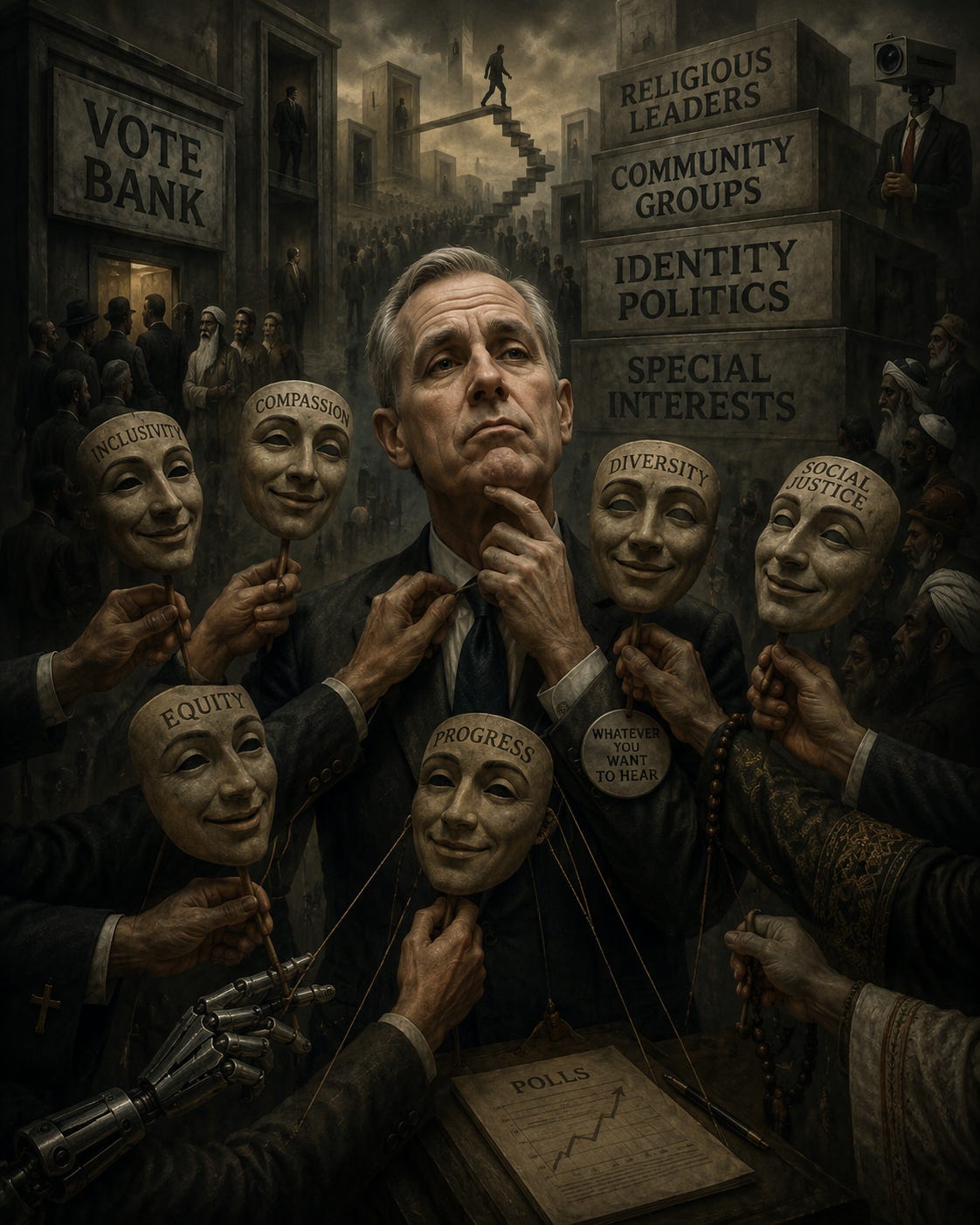
Mark Carney recently declared that “Muslim values are Canadian values,” one more carefully focus-grouped slogan from a political class that increasingly mistakes applause lines for analysis.
Mr. Carney’s talent is not conviction. It is calibration. It is the art of telling people what they want to hear in the moment. He is very good at it.
He is the human equivalent of adaptive camouflage.
Bankers hear prudence. Activists hear compassion. Business leaders hear industrial policy. Internationalists hear global harmony. Muslim audiences hear that their values are Canada’s values. Every room receives its own customized reflection.
One must admire the technique.
The difficulty is that slogans are not arguments. But it seems that there is little appetite for argument.
And a civilization that loses the ability to distinguish between welcoming people and examining ideas eventually loses the ability to defend itself at all.
Before proceeding, an obvious clarification is necessary.
Muslims are not a race.
They are nearly two billion individuals spread across dozens of nations, languages, ethnicities, cultures, and political systems. Many are secular. Many are moderate. Millions are loyal citizens of liberal democracies. Millions contribute enormously to Western societies.
This essay is therefore not about Muslims as people.
It is about ideas.
More specifically, it is about whether orthodox Islamic doctrine and liberal democratic values are, in fact, interchangeable.
To ask that question is no more bigoted than observing that medieval Catholicism conflicted with Enlightenment liberalism, Soviet communism conflicted with free markets, or censorship conflicted with free speech.
Ideas must remain open to scrutiny.
Indeed, a civilization that loses the ability to examine belief systems - both its own and others - critically ceases, in any meaningful sense, to be a civilization at all.
Christopher Hitchens understood this perfectly.
“The person who is certain,” he wrote, “and who claims divine warrant for his certainty, belongs now to the infancy of our species.”
That observation cuts directly to the issue.
The central tension between orthodox Islam and liberal democracy is not ethnic.
It is philosophical.
Liberal democracy rests upon several assumptions that were neither inevitable nor historically universal:
that individuals possess freedom of conscience;
that religion may be criticized;
that law emerges from democratic consent rather than divine decree;
that women are equal before the law;
that citizens may leave a religion without punishment;
and that private life is not principally governed by clerics or sacred law.
These assumptions were painfully constructed through centuries of conflict, reform, and resistance to religious authority. They are trees planted in the Western soil of sweat, blood, suffering and toil. They are not gas station flowers that can be easily moved.
Orthodox Islam emerged from a very different civilizational architecture.
Islam was not merely a devotional faith.
From its inception, it was also a legal, political, and governing framework.
The Quran and Hadith shaped not only prayer and ritual but also law, commerce, warfare, governance, family structure, and public morality. Muhammad was not simply a religious teacher. He was also a statesman, military leader, lawgiver, and empire-builder.
This distinction matters.
Within roughly a century of Muhammad’s death in 632 AD, Muslim armies had conquered territories stretching from the Iberian Peninsula to Central Asia. Syria, Egypt, North Africa, Persia, Mesopotamia, and vast portions of the Byzantine and Sassanian worlds fell under Islamic rule.
This was not merely a religion spreading through private conversion, philosophical persuasion, or quiet missionary work.
It was one of the most successful military and political expansions in human history.
Entire civilizations were conquered. Ancient states were displaced. New legal, political, and religious institutions were imposed across territories spanning thousands of miles and tens of millions of people.
Nor was conquest an embarrassing footnote later attached to an otherwise spiritual movement.
It was part of the founding story itself.
The early Islamic community did not merely survive. It ruled. It governed. It taxed. It legislated. It fought. It expanded.
The distinction is important because imperial expansion is not some colonial distortion later grafted onto Islam by ambitious rulers. It appears in the tradition’s formative history, sacred narratives, and jurisprudential development. Political authority and religious authority emerged together.
That does not mean every Muslim today seeks conquest any more than every Christian wishes to revive the Crusades.
The issue is not the intentions of individual believers. The issue is what is embedded within the tradition itself.
And embedded within Islam’s formative centuries is the memory of extraordinary military success, political expansion, and civilizational confidence.
The same observation applies to slavery.
Modern Western discussions often speak as though slavery were uniquely European or Atlantic in character. It was not.
From the Umayyads and Abbasids to the Ottomans, slave systems were woven into the economic and political structures of much of the Islamic world for over a millennium. Millions of Africans were transported through the trans-Saharan, Red Sea, and Indian Ocean slave trades. Millions more were taken from Eastern Europe, the Caucasus, the Balkans, and the Mediterranean. Some of the largest and longest-lasting slave systems in human history existed under Muslim rule.
It is simply part of the historical record.
The point is not that Muslims are uniquely imperial or uniquely guilty. The Romans built empires. The Mongols built empires. The Chinese built empires. Europeans built empires.
The point is that Islam emerged not simply as a private faith but as a governing civilization whose formative centuries fused religious authority, political authority, military power, law, and expansion.
That historical reality continues to shape debates about sovereignty, law, governance, and identity in ways that modern Western elites often seem reluctant even to acknowledge.
This was not merely a religion spreading through private conversion.
It was a civilization expanding through governance, taxation, law, military conquest, and political authority.
Nor was this expansion treated as an unfortunate deviation from the faith’s original purpose.
It became part of the tradition’s sacred history.
The issue is not whether every Muslim seeks political domination.
Clearly, they do not.
The issue is whether political expansion, civilizational conquest, and the fusion of religious and temporal authority are present within Islam’s foundational texts, traditions, and historical memory.
The answer is plainly yes.
The crucial distinction is between what is embedded in a tradition and how individual believers choose to interpret it.
Many Muslims interpret Islam primarily as a personal faith emphasizing charity, family, devotion, and spirituality.
But the existence of moderate interpretations does not erase the contents of the underlying texts or the historical reality of the civilization that emerged from them.
The question is therefore not whether individual Muslims can be loyal citizens of liberal democracies.
Millions plainly are.
The question is whether a tradition whose formative centuries fused law, governance, military expansion, and divine authority will always sit comfortably beside a liberal order built upon secular sovereignty, freedom of conscience, and democratic law.
That is not a question of prejudice.
It is a question of history.
History, however, is not the only source of evidence.
One need not speculate about how orthodox Islamic concepts of law, governance, and religious authority are understood today. We possess polling data from across the Muslim world measuring precisely these attitudes.
And the results are difficult to reconcile with the comforting political fiction of Mark Carney that all value systems are simply different roads leading to the same liberal destination. His statement is not honest; it is based on a quest for electoral gain.
The landmark 2013 Pew Research Center survey, encompassing more than 38,000 interviews across 39 countries, found overwhelming support in many Muslim-majority societies for Sharia as official law.
Support reached 99% in Afghanistan, 91% in Iraq, 89% in the Palestinian territories, 84% in Pakistan, and 74% in Egypt.
Western commentators often retreat into a comforting ambiguity here. They suggest that Sharia simply means personal spirituality, ethical guidance, or a general commitment to religious values.
Pew’s own findings dismantle that interpretation.
Among Muslims who supported Sharia, majorities in several countries also supported stoning for adultery, amputations for theft, and the death penalty for apostasy.
In Egypt, 86% of Sharia supporters favoured death for leaving Islam.
In Jordan, the figure was 82%.
In Pakistan, 76%.
In Afghanistan, 79%.
Pause for a moment.
A society that supports execution for changing one’s religion is not operating from the same philosophical assumptions as a liberal democracy.
Whatever else one wishes to say about Muslim communities—and one may say many positive things—this is not freedom of conscience.
Nor does the divergence end there.
The Pew data found overwhelming moral opposition to homosexuality across much of the Muslim world. Large majorities endorsed traditional patriarchal structures in which wives were expected to obey husbands. These are not random cultural curiosities. They emerge from longstanding theological and jurisprudential traditions.
This is precisely the sort of civilizational tension Samuel Huntington described in The Clash of Civilizations.
Huntington argued that the post-Cold War world would not primarily fracture along economic or ideological lines but along cultural and religious ones. He warned that Western elites falsely assumed all civilizations were converging toward secular liberal democracy.
His critics often treated such observations as moral crimes rather than arguments to be debated.
Reality has been less cooperative.
The deeper problem is that modern Western elites increasingly behave as though all value systems are interchangeable.
Diversity is marketed as cuisine, music, colourful festivals, and the occasional heritage month.
Actual diversity is considerably more demanding.
It includes profoundly different assumptions about law, authority, religion, sexuality, speech, family structure, and the relationship between the individual and the state.
Some of those assumptions coexist peacefully.
Others collide directly.
A civilization built upon satire, dissent, and freedom of inquiry collides with a tradition that regards criticism of religion as blasphemy.
A civilization built upon secular constitutional law collides with a tradition that regards divine law as superior to democratic legislation.
A civilization built upon freedom of conscience collides with one in which apostasy remains, at least in theory, a punishable offence.
These tensions may be managed.
They cannot be wished away.
What is striking, however, is not merely what we know.
It is what we refuse to ask.
The Pew data tells us a great deal about attitudes across the Muslim world. Yet Canada has shown remarkably little curiosity about equivalent questions at home.
The Macdonald-Laurier Institute’s study What Do Muslim Canadians Want? found a far more complex picture than either critics or defenders of multiculturalism usually admit. Canadian Muslims were hardly a monolith. Many expressed a strong attachment to Canada and its institutions. Yet significant divisions remained regarding identity, religion, integration, and the role of Islamic values in public life.
In other words, the evidence pointed neither toward alarmist fantasies nor toward the fairy tale that every inherited belief system dissolves automatically into progressive liberalism somewhere over Pearson Airport.
Some immigrants liberalize.
Some become more consciously orthodox.
Some integrate rapidly.
Others retain strong attachments to the political and religious assumptions of their countries of origin.
This should surprise no one.
Identity is not erased by customs clearance.
Yet there remains a remarkable reluctance among Canadian institutions to examine these questions directly.
One suspects there may be a reason.
Modern elites increasingly prefer ambiguity to uncomfortable clarity.
Better not to ask the question than risk discovering an inconvenient answer.
Christopher Hitchens despised this kind of intellectual cowardice.
He argued that ideas deserve no immunity from scrutiny merely because they are sincerely held.
“Human decency,” he observed, “is not derived from religion. It precedes it.”
That insight matters enormously.
Because the issue is not whether Muslims can live peacefully in Canada.
Millions already do.
The issue is whether orthodox political Islam—understood as a governing legal and moral system—is fully compatible with the liberal democratic values Canada claims to uphold.
On that question, honesty matters more than applause lines.
Which brings us back to Mr. Carney.
His declaration that “Muslim values are Canadian values” was not a serious civilizational argument.
It was a slogan.
A politically useful incantation designed to signal inclusion, avoid controversy, and harvest goodwill.
Mr. Carney increasingly resembles a man whose principal political philosophy is market segmentation.
Muslim audiences are told that Muslim values are Canadian values.
Quebec nationalists hear a different melody.
Environmental activists hear another.
Western Canadians receive an Edmonton Oilers jersey and carefully calibrated prairie symbolism.
Economic frustrations accumulated over a decade of Liberal governance are redirected toward Donald Trump and American hostility.
Every audience receives its own flattering reflection.
One must almost admire the technique.
But slogans cannot permanently abolish reality.
The values embedded in orthodox Islamic jurisprudence and those underlying secular liberal democracy are, in important respects, profoundly different.
That does not make Muslims bad people.
It does not make coexistence impossible.
It does not diminish the contributions of millions of Muslim citizens to Western societies.
But it does mean that serious societies must distinguish between tolerance toward individuals and the claim that all belief systems are morally, philosophically, and politically interchangeable.
A confident civilization can welcome newcomers while defending its own foundations.
A civilization that cannot draw that distinction eventually loses not merely its clarity, but its courage.
And no amount of carefully marketed applause lines can change that.
If you found value in this article and wish to support my ongoing work, please consider leaving a tip. Your support helps me continue producing uncensored content on critical issues.
The rapey headchopping demographic is vote-rich, which, when you get right down to it is the only thing the LPC cares about. Oh sure, grifting, astroturfing and nepotism are also Liberal “values”, but creating little client voting blocs they can buy off has always been their main thing. That’s exactly why their initial reaction to the 10/07 atrocities was to (1) increase funding to UNRWA, and (2) send Foreign Affairs Barbie Melanie Joly to the West Bank to take selfies with her BFF Mahmoud Abbas.
“But there is no major Canadian polling asking directly whether Canadian Muslims support apostasy laws, blasphemy restrictions, or the implementation of Sharia in any formal legal sense.”
But there is some, although it’s a limited sample and also dated to pre-woke times. A poll was conducted in 2011 by political scientists Christian Leuprecht and Conrad Winn for the Macdonald-Laurier Institute, using a telephone survey of 455 Muslims in Ottawa along with focus groups across Canada. The study examined Canadian Muslims’ attitudes toward democracy, Canada, Sharia law, the Caliphate, terrorism, and foreign policy, with the authors attempting to test competing theories about Muslim integration into liberal democracies.
On the issue of Sharia law, respondents were presented with several options regarding the role of Islamic law in Ontario. The largest group, 47%, supported allowing Muslims to voluntarily choose Sharia courts for divorce and family-law matters. Another 22% opposed any role for Sharia law in Ontario. More strikingly, 8% supported requiring Muslims to be governed by Sharia courts in family matters, while 7% supported requiring Muslims to be governed by Sharia law in all matters, not merely family disputes. Combined, 15% supported some form of mandatory Sharia jurisdiction, while 55% supported either voluntary or mandatory use of Sharia in at least some circumstances. A further 17% were unsure or declined to answer.
The survey also asked about the concept of a Caliphate, defined as a unified Islamic political authority. When asked whether “it would be best if all Muslim countries were united under a Caliphate,” 32% agreed, 35% disagreed, and 33% were unsure or declined to answer. Among those expressing an opinion, support and opposition were therefore almost evenly divided. Support was particularly strong among more religious respondents and among those who regularly attended mosque or Islamic study groups.
The authors emphasized that views varied significantly by religiosity and ethnic background. Opposition to any role for Sharia law was substantially higher among less observant Muslims and among respondents of Iranian origin, while support for Sharia-based legal arrangements and for the idea of a Caliphate tended to increase with religious observance.